Bright Data wins on pool size and procurement.
Decodo wins on sub-1 TB economics and onboarding.
Oxylabs wins on enterprise certifications and advanced filters.
IPRoyal wins on sub-10 GB PAYG with no minimum.
Webshare wins on static-residential product lines — see the Webshare review.
SOAX wins on multi-geo Tier 1 + Tier 3 egress.
NetNut not on the list — its pricing page is seized by the FBI as of capture.
The seven residential proxy providers worth evaluating in 2026, ranked by economics and pool size: Bright Data (400M+ across product lines), Oxylabs (175M+), Decodo (115M+), IPRoyal (64M+), Webshare (30M+), and SOAX (geo-tiered pricing).
The “residential proxy by workload” question — which vendor fits which engineering task — is the one our readers actually ask once they have ruled out the obvious single-recommendation listicles. Vendor pages list themselves, naturally; third-party roundups reuse vendor numbers and rarely measure anything new.
It complements our Bright Data alternatives article, which is the inverse question (when you are already on Bright Data and considering a switch). If you have not yet picked a primary vendor, the workload decision tree below is the short answer.
How we evaluated these seven
We pulled the official pricing pages for all seven providers through Firecrawl on the same day. The numbers on every comparison table below come from those pages. Where a vendor does not publish a number, we say “contact sales” — we do not invent a figure.
We did not run our own real-world scraping benchmarks against these pools. Vendor-published success-rate and uptime numbers in this article come from Proxyway’s annual proxy research, which runs a custom Python script against a global CDN target with 500 requests per endpoint.
The same methodology is used across most third-party proxy reviews. Those numbers are useful for comparison across vendors but are not a guarantee of performance on a specific target. Treat any vendor-published success rate as a directional figure, not a guarantee for your workload.
The “Cheapest published tier” column uses the deepest publicly listed price on each vendor’s pricing page, including any active promo (RESIGB50 for Bright Data, the 50% OFF banner for Webshare, the SOAX Enterprise Monthly tier). Past those published tiers, every vendor reserves its best per-GB pricing for private enterprise quotes.
The seven providers at a glance
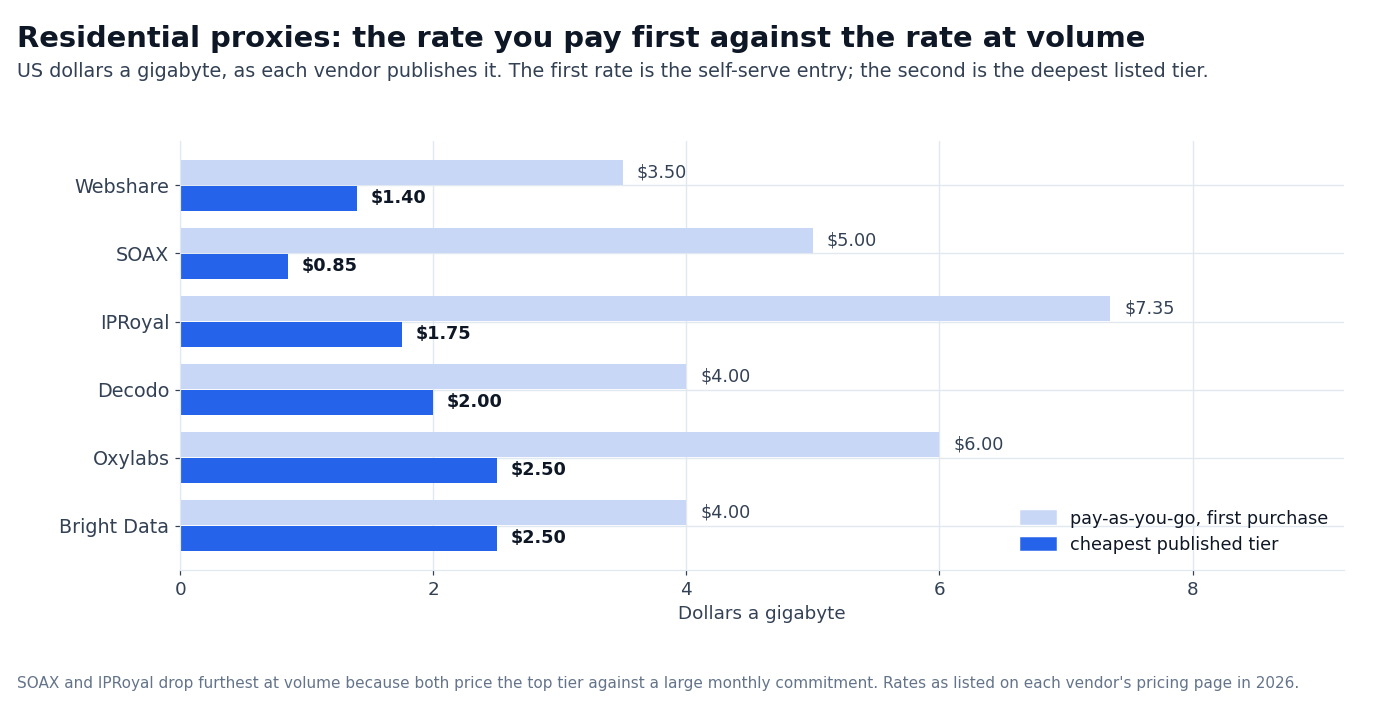
| Rank | Provider | Residential PAYG | Cheapest published tier | Pool | Targeting | Free trial |
|---|---|---|---|---|---|---|
| 1 | Bright Data | $4.00/GB | $2.50/GB (Business, 800 GB) | 400M+ across product lines | Country → city → ASN | On request, then paid |
| 2 | Oxylabs | $6.00/GB (Starter, 5 GB) | $2.50/GB (Corporate, 1 TB) | 175M+ | Country → city → ZIP, ASN, Platform/OS | On request via sales |
| 3 | Decodo (Smartproxy) | $4.00/GB | $2.00/GB (Enterprise, 1 TB) | 115M+ | Country → ZIP, ASN | 3-day / 100 MB |
| 4 | IPRoyal | $7.35/GB (1 GB PAYG) | $1.75/GB (Custom, 10 TB Subscription) | 64M+ | Country → city | None; PAYG from $7.35 |
| 5 | SOAX | $5.00/GB Tier 1 (Sandbox) | $0.85/GB Tier 1 (Enterprise Monthly) | n/a published | Country → city → ISP, ASN + ZIP (Scale+) | Free Sandbox (no credits) |
| 6 | Webshare | $3.50/GB (1 GB, 50% off) | $1.40/GB (3,000 GB, 80% off) | 30M+ | Country, city, state, ZIP, ASN | None published |
| 7 | Honorable: NetNut | n/a — site seized | n/a | n/a | n/a | n/a |
Three observations from the table before going deeper.
On price at scale, Decodo is the cheapest published residential number at $2.00/GB on the 1 TB Enterprise tier. SOAX at $0.85/GB Tier 1 on Enterprise Monthly ($3,000/month commitment) goes lower, but at a much higher monthly commitment. Webshare’s promo table runs to 80% off at 3,000 GB, which is where its $1.40/GB floor comes from.
On pool size, Bright Data’s 400M+ across product lines is the deepest pool in the category, and Oxylabs at 175M+ is the deepest published single-product residential pool. Decodo’s 115M+ is enough for most sub-100K-requests-per-day workloads; for workloads that need fresh IPs at a higher rate, the larger pools win.
On free trial, only Decodo and Webshare offer a self-serve test. Decodo’s trial is 3 days / 100 MB, no credit card. Webshare’s residential page publishes no free tier. Everyone else is sales-gated or PAYG-only.
Bright Data — the deepest pool, the broadest product catalog
Bright Data‘s published residential proxy pricing starts at $8.00/GB ($4.00/GB with the RESIGB50 promo code active at capture) on Pay As You Go. The Starter tier is $7.00/GB ($3.50/GB with promo) on the 141 GB tier at $499/month. Growth is $6.00/GB ($3.00/GB with promo) on the 332 GB tier at $999/month.
Business is $5.00/GB ($2.50/GB with promo) on the 798 GB tier at $1,999/month. The published pool is 400M+ across product lines (residential, ISP, datacenter, mobile); residential alone is roughly half that.
The case for Bright Data is the pool, the procurement story, and the multi-product catalog. SOC 2 Type II, ISO 27001, Big Four audit customers, named account manager, custom MSA, 99.99% uptime SLA on Enterprise — these are the procurement artifacts that enterprise teams ask for.
Web Unlocker (managed anti-bot bypass), Scraping Browser (managed headless browser), SERP API, Web Scraper API, and the proxy network itself are all in one contract. If you need managed anti-bot plus multi-product, Bright Data is the lowest-friction choice.
The case against is the price. Bright Data’s published PAYG ($4.00/GB after the promo) is equal to Decodo’s PAYG, but at the deepest published tier Bright Data sits at $2.50/GB versus Decodo’s $2.00/GB. For sub-1 TB residential workloads, the published gap is $0.50/GB.
The procurement overhead is also real — Bright Data’s trial requires a sales conversation, while Decodo’s is opt-in at signup.
Bright Data’s published residential pricing on the official page reflects an active promo (RESIGB50 for residential, APIS25 for Web Scraper API). The non-promo list price is roughly 2x the promo price. The promo is listed on the pricing page itself, so we treat it as published pricing, but it can change. Verify the promo is still active before quoting.
Oxylabs — the enterprise-procurement-grade alternative
Oxylabs is the only alternative in the category that clears Bright Data’s enterprise procurement bar. Published certifications on the product page cover ISO/IEC 27001:2022, ISO 50001, ISO 14001, NIST 800-53, and ANSI/TIA 942-B. Products are insured by Lloyd’s under a Technology E&O and Cyber policy.
The “Most Scalable Provider 2026” badge from Proxyway and the G2 Summer 2026 Leader badge in Proxy Networks both came out this year.
The published residential pricing starts at $6.00/GB on the 5 GB Starter tier. It drops to $5.00/GB on the 20 GB Basic tier (the most popular published tier) and to $4.00/GB on the 125 GB Advanced tier. The Corporate 1 TB plan sits at $2.50/GB. The published pool is 175M+ residential IPs across 195+ countries.
Top-tier country counts are published on the location-proxy page: USA 10,353,360, China 5,280,618, Germany 3,537,899, UK 3,502,538, Canada 1,970,743, Japan 1,496,392, Australia 1,113,048.
The case for Oxylabs is the advanced filters that are not standard on competitors’ residential products: IPv4/IPv6 selection and Platform/OS targeting (Windows, macOS, Android, iOS, Linux). These require a quick KYC verification.
If your workload depends on matching the IP version or the platform to your target site, Oxylabs is the most documented choice. The avg response time published on the product page is 0.41s; success rate 99.95%.
The case against is price. At every published tier above 100 GB, Oxylabs is $1.50–$2.00/GB more expensive than Decodo. If you do not need the advanced filters, the procurement artifacts, or the published top-of-page location counts, you are paying for capabilities you are not using.
The free trial is via “Book a demo” / sales contact and is offered only once per client.
Decodo (formerly Smartproxy) — the sub-1 TB residential default
Decodo is Smartproxy under a 2025–2026 rebrand. The company, the residential pool, the pricing ladder, and the dashboard account are unchanged. Only the wordmark, the dashboard URL, and the marketing copy changed.
Published residential pricing runs from $3.75/GB on the 3 GB plan to $3.50/GB on 10 GB, $3.25/GB on 25 GB (POPULAR), $3.00/GB on 50 GB, $2.75/GB on 100 GB. Enterprise plans start at $2.50/GB on the 250 GB tier and bottom out at $2.00/GB on the 1 TB Enterprise tier.
Pay As You Go is a flat $4.00/GB through a Wallet top-up rather than a recurring subscription. Every paid plan includes the same 115M+ residential IP pool and free advanced targeting down to continent, country, state, city, ZIP code, and ASN.
The 3-day / 100 MB trial is opt-in at signup, no enterprise sales call required. The trial is enough for a 1,000-page pilot on a real target. The 99.92% success rate, 99.99% uptime, and sub-0.5s average response time are Proxyway figures using the same methodology as Bright Data and Oxylabs.
The case for Decodo is the published price ladder plus the onboarding. At $2.00/GB on 1 TB versus Bright Data’s $2.50/GB on Business, Decodo is $0.50/GB cheaper at scale. At sub-100 GB, the PAYG is equal at $4.00/GB, and the decision moves to onboarding — Decodo’s trial is self-serve, Bright Data’s is sales-gated.
The case against is the smaller pool and the narrower product catalog. If you need fresh IPs at a higher rate than 115M+ can supply, Bright Data or Oxylabs wins. If you need Web Unlocker (managed anti-bot), Bright Data wins. If you need SOC 2 Type II + Big Four audit customers, Bright Data is the lower-friction procurement story.
For the full rebrand context, the pool specifics, and the setup workflow, see our Smartproxy review. For the inverse “should I switch from Bright Data to Decodo” question, see our Bright Data alternatives article.
IPRoyal — the lowest-friction PAYG for sub-10 GB projects
IPRoyal‘s differentiator is the no-monthly-commitment PAYG floor. PAYG starts at $7.35/GB for 1 GB, $6.25/GB for 2 GB, $5.51/GB for 10 GB (the most popular PAYG tier). The Subscription ladder is $7.00/GB for 1 GB, $5.95/GB for 2 GB, $5.25/GB for 10 GB.
At 10 TB volume the price drops to $1.75/GB on Subscription and $1.84/GB on PAYG. The pool is 64M+ residential IPs across 195+ countries with city-level targeting.
The feature set includes sticky sessions up to 7 days — longer than Decodo’s 30 minutes or Oxylabs’ 24 hours. Useful for long-running checkout-flow scrapes. Instant IP change via dashboard or API is also included.
Auto-rotate intervals of 1/10/30 minutes are configurable, and unlimited concurrent sessions are available on every plan. Never-expiring traffic on PAYG means you can top up and use the bandwidth months later if your workload is intermittent.
The case for IPRoyal is the PAYG floor. At 1 GB you can test the pool for $7.35 with no commitment and no credit card top-up required. For very small workloads (a single engineer’s first scraping project, a one-off price intelligence run, a small-volume ad verification job), IPRoyal removes the friction of an enterprise sales call.
The case against is the $5.25–$5.51/GB list price at the most popular 10 GB tier. Decodo is $3.25/GB at 25 GB; Oxylabs is $5.00/GB at 20 GB; IPRoyal is $5.25/GB at 10 GB. IPRoyal only wins on price at the 10 TB+ custom tier.
Payment methods include Visa, Mastercard, PayPal, Discover, Amex, Alipay, and Crypto (Bitcoin, Ethereum, Litecoin, USDT).
SOAX — the multi-geo Tier 1 + Tier 3 specialist
SOAX rebuilt its pricing in 2026 around a five-tier structure with per-GB rates that vary by geo tier. Tier 1 (US, EU) is the highest rate; Tier 3 (e.g. Philippines) is the lowest. The rate per GB depends on the egress IP’s country, not on the customer’s location or the destination’s location.
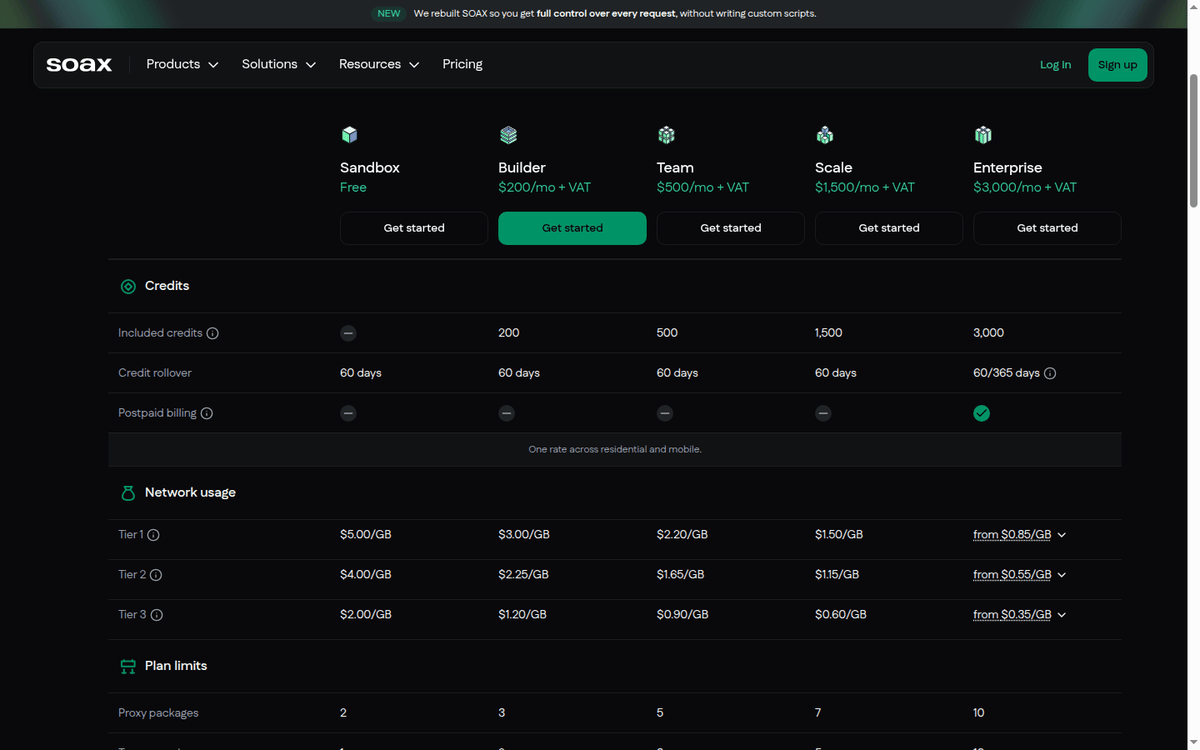
The published plans: Sandbox (free, no subscription fee, no credits — top-up at Sandbox rates to test). Builder is $200/month, 500 credits, with Tier 1 at $3.00/GB. Team is $500/month, 1,500 credits, with Tier 1 at $2.20/GB. Scale is $1,500/month, 3,000 credits, with Tier 1 at $1.50/GB, ASN + ZIP targeting, and Premium SLA.
Enterprise is $3,000/month, with Tier 1 from $0.85/GB, Premium SLA, dedicated IP pools, and 24/7 + CSM.
The case for SOAX is the geo-tier model. If your workload spans expensive geos (US, EU) and cheaper geos (India, Philippines) in the same billing period, SOAX’s separate-per-tier accounting gives you the cheaper rate on the cheaper traffic automatically.
The same 100 GB US-only workload costs more on SOAX than on Decodo. A mixed workload (50 GB US + 50 GB India) costs less on SOAX.
The case against is the credit rollover (60 days on monthly plans; 12 months on annual Enterprise Annual) and the lack of a free trial with credits. Sandbox has no included credits, only a no-fee subscription you top up. For sub-10 GB workloads, the credit model is more friction than PAYG from Decodo or IPRoyal.
SOAX’s Enterprise Monthly is the rare published-pricing proxy vendor that locks the lowest rate from the first GB rather than sliding them through volume bands.
The published rate at signing is the rate you pay. This is genuinely unusual among proxy vendors and worth verifying directly with SOAX sales if you are running a multi-year forecast.
Webshare — the static-residential specialist
Webshare has been a datacenter-proxy vendor longer than it has been a residential vendor, and that history shows in the pricing page. The residential page publishes its rate card outright: a per-GB table running from a 1 GB pack up to 3,000 GB, every bucket discounted against a $7.00/GB list rate.
The published numbers on that card: 1 GB at $3.50/GB, then $2.00/GB at 250 GB, $1.50/GB at 1 TB, and $1.40/GB at 3,000 GB — discounts from 50% at the entry to 80% at the top. The published pool for the rotating product is 30M+ residential IPs across 195+ countries, and the uptime figure on the page is 99.97%.
The case for Webshare is the price floor: $1.40/GB at the top of the table undercuts Decodo’s $2.00/GB 1 TB tier, and the 1 GB entry pack is the smallest self-serve start in this group. That suits a first month on a small target list. The case against is the shape of the discount ladder — the headline rate only lands at a 3,000 GB commitment, so a small buyer pays $3.50/GB, not $1.40.
Free tier: Webshare has historically offered a free datacenter plan with limited bandwidth. The free tier is not on the residential rotating product as captured.
NetNut — not currently accessible in the US
NetNut appears on every residential-proxy shortlist we reviewed. The netnut.io/pricing page returned a “Seized by the Federal Bureau of Investigation” notice when captured, with no live pricing.
Industry press in late 2024 reported the Israeli parent company was facing a federal seizure; the situation was unresolved in our capture and the site is not accessible to US customers in 2026. We do not recommend NetNut until the company confirms a stable operating status.
How the four clusters fit a workload decision
The seven providers split into four clusters by workload fit. A short decision tree.
Cluster 1 — Default for sub-1 TB residential. Decodo at $2.00/GB on 1 TB Enterprise and $4.00/GB PAYG. The 3-day / 100 MB trial is enough for a real pilot. Most engineering teams that say “we need a residential proxy, what should we use” end up here.
Cluster 2 — Enterprise procurement + advanced filters. Bright Data for procurement and multi-product surface; Oxylabs for ISO 27001:2022 + Platform/OS filters + advanced country counts. If your team fills out vendor risk assessment questionnaires and needs named-account procurement, this is the cluster.
Cluster 3 — Low-volume and budget. IPRoyal PAYG from $7.35/GB with no monthly minimum and 7-day sticky sessions. Webshare for static residential. SOAX if your workload is sub-10 GB and you want to test the pool via Sandbox (but be aware Sandbox has no credits, you top up).
Cluster 4 — Mixed Tier 1 + Tier 3 geo egress. SOAX. The geo-tier model is genuinely different from every other vendor’s flat per-GB pricing.
If your workload is “scrape a moderately defended site at sub-100K requests per day,” you are in Cluster 1. If your workload is “run multi-region ad verification at scale across 50+ countries,” you are in Cluster 4. If your workload is “build a vendor risk assessment for a SOC 2 audit,” you are in Cluster 2.
What success-rate and uptime numbers actually measure
The success-rate, uptime, and response-time numbers we cite in this article come from Proxyway’s annual proxy research. Proxyway runs a custom Python script against a global CDN target with 500 requests per endpoint. Rotating sessions are sent from the same country’s VPN as the endpoint.
Results are measured by HTTP 200 response counts and total time divided by 500.
The methodology is published on Proxyway’s site and is broadly comparable to what other vendors publish as “success rate.” The same methodology produces comparable numbers across Bright Data, Oxylabs, Decodo, IPRoyal, SOAX, and Webshare — which is why the published figures cluster within a percentage point.
Three things to keep in mind when reading those numbers.
First, the target is a global CDN, not a specific defended site. Your actual success rate on a Cloudflare-fronted target or a PerimeterX-protected e-commerce site drops, and the relative ranking may change.
Second, the methodology measures rotating residential, not sticky residential. If your workload runs long sticky sessions (login-walled scraping, checkout flows), the relevant number is your sticky session hit rate, which is closer to 90–95% on most vendors.
Third, the vendor-published figures are quarterly snapshots, not real-time. If a vendor’s pool quality has degraded in the last month, the published number will lag.
The success rate you see in production depends on which target you scrape and which session length you use. Treat any vendor-published success rate as a directional figure rather than a guarantee for your workload.
FAQ
Which residential proxy fits a sub-1 TB default workload?
Decodo (formerly Smartproxy) at $2.00/GB on the 1 TB Enterprise tier with a 3-day self-serve trial is the default for most engineering teams. Bright Data wins on the deepest pool (400M+ across product lines) and enterprise procurement. Oxylabs wins on advanced filters (Platform/OS, IPv4/IPv6) and ISO 27001:2022 certification.
How much do residential proxies cost per GB in 2026?
Published residential pricing ranges from $0.85/GB (SOAX Enterprise Monthly, $3,000/month) to $7.35/GB (IPRoyal PAYG 1 GB). The most common published tier across vendors is $4.00–$5.00/GB. Past 1 TB on any vendor, pricing goes to private enterprise quotes.
Which provider has the largest residential IP pool?
Bright Data publishes 400M+ across product lines (residential, ISP, datacenter, mobile combined). Oxylabs publishes 175M+ residential alone, the largest single-product residential pool among the alternatives. Decodo publishes 115M+, IPRoyal 64M+, Webshare 30M+.
Do any of these providers offer a free trial?
Decodo offers a 3-day / 100 MB free trial with no credit card. Oxylabs offers a free trial on request via the “Book a demo” sales contact. SOAX exposes a free Sandbox plan with no credits (you buy top-up credits at Sandbox rates). Webshare’s residential page publishes no free tier.
Is NetNut still a viable option?
NetNut’s pricing page returns a “Seized by the Federal Bureau of Investigation” notice as of capture. Until the company confirms it is operating normally, NetNut stays off our recommendation list.
Which provider is best for small workloads?
IPRoyal. The PAYG floor of $7.35/GB on 1 GB with no monthly commitment and 7-day sticky sessions makes it the lowest-friction starting point for sub-10 GB workloads.
Which provider is best for enterprise compliance?
Bright Data and Oxylabs are the two that clear the standard procurement bar. Bright Data publishes SOC 2 Type II, ISO 27001, Big Four audit customers. Oxylabs publishes ISO/IEC 27001:2022, ISO 50001, ISO 14001, NIST 800-53, ANSI/TIA 942-B, and Lloyd’s-insured.
Decodo publishes PCI DSS, GDPR, and ISO 27001:2022 but does not publish SOC 2 Type II.
Which provider has the best published success rate?
Bright Data, Oxylabs, and Decodo all publish 99.92%–99.95% success rates from Proxyway’s annual research using the same methodology. The differences are within rounding error — treat them as comparable.
Sources
Bright Data proxy network pricing Oxylabs residential proxy product page Decodo (Smartproxy) residential pricing IPRoyal residential pricing SOAX pricing Webshare residential proxy
How we put this together: every per-gigabyte rate, pool figure, targeting option and trial term in the comparison table comes from the vendors’ own pricing pages, read through Firecrawl on the same day and quoted as displayed; Proxyway’s annual proxy research is the reference behind the success-rate framing.
We have not bought bandwidth from any of these vendors, run a crawl through their pools or measured a success rate on our own targets, so the workload fits are argued from the published numbers rather than from a test of our own.
Figures that depend on a real workload, a real target or a real integration are flagged where they appear in the text rather than being estimated.
Disclosure: this article contains affiliate links. If you buy through them we may earn a commission at no extra cost to you. Commission never changes our scoring or the order of a ranking.