The official page answers the first two buyer questions before you talk to anyone: how large the pool is, and what the company can put on file.
Pool: 175M+ residential IPs across 195+ countries, billed monthly, with ASN, ZIP and coordinate filters on top of city and country targeting.
Paper trail: ISO/IEC 27001:2022, SOC 2 Type 2 and Lloyd’s insurance — the deepest published compliance file in our coverage of the category.
The friction sits at the front door: some advanced filters need KYC, and the trial runs through a demo call rather than a sign-up form.
What no page publishes is the part your pilot decides: success rate on a Cloudflare-fronted site and sticky-session hit rate across a 24-hour window.
Oxylabs is the residential proxy provider most teams compare themselves against in 2026, and it is the vendor with the deepest published compliance file in our web scraping and data coverage.
Oxylabs in 2026 is what it has been for the last several years of Proxyway awards: a residential proxy vendor with the largest published pool in the category and the strongest targeting granularity. The published pricing is competitive at scale but premium at small volumes, and the published compliance file is the widest in the category.
The case for the vendor in 2026 is the pool size and the targeting. At 175M+ IPs and ASN/ZIP/coordinate targeting on the product page, the platform wins on workloads where granular geo-fencing matters. The published certifications (ISO/IEC 27001:2022, SOC 2 Type 2, Lloyd’s insurance) win enterprise procurement.
The case against is the per-GB price premium at low volumes and the sales-gated trial flow.
If your workload is enterprise procurement with a published audit trail or geo-fencing at the ASN/ZIP/coordinate level, this is the strongest published option in the category. If you are a single-engineer scraping team looking for the cheapest per-GB rate, compare with Bright Data, Decodo, or IPRoyal before you commit.
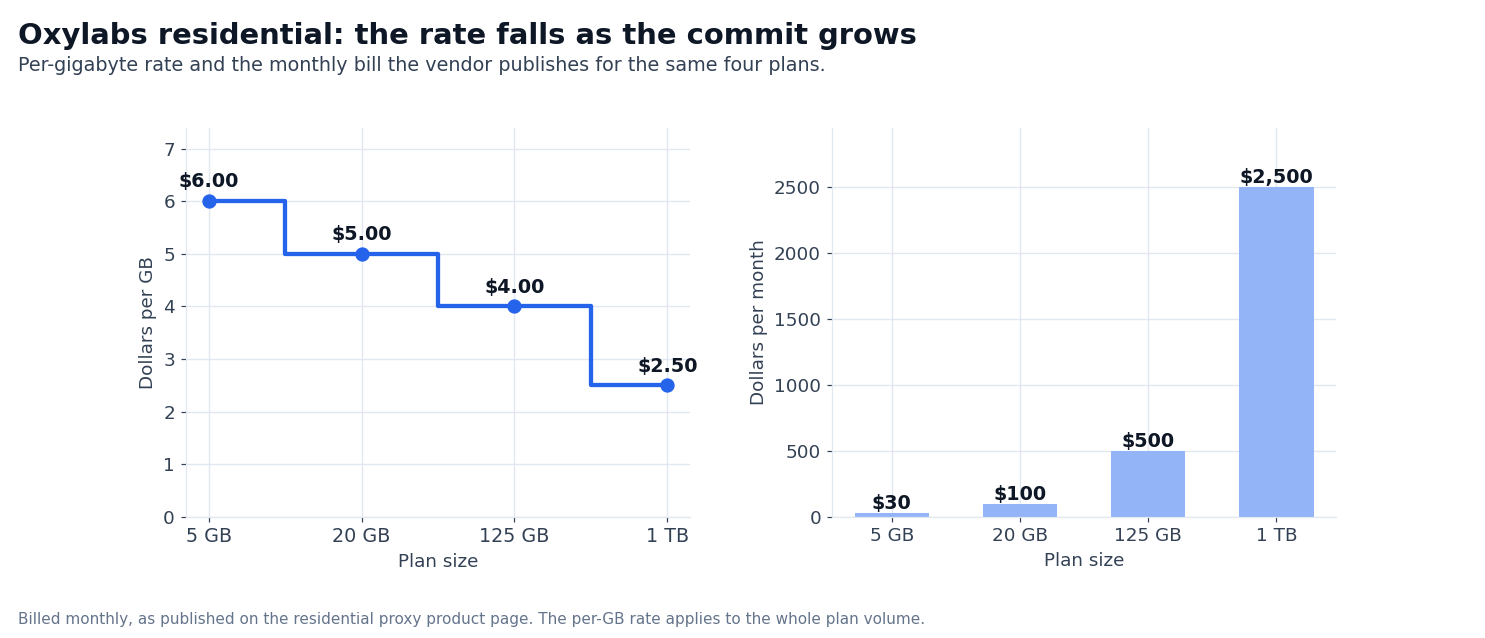
The product page publishes a 175M+ IP pool across 195+ countries, with IPv4 and IPv6 selection and advanced filters at the ASN, ZIP and coordinate level. The pricing ladder runs from $6.00/GB on the 5 GB Starter to $2.50/GB on the 1 TB Corporate tier.
The bottom-of-the-ladder $2.50/GB rate is the headline number. The deeper story is the compliance posture, the targeting granularity, and the few published catches — KYC for some advanced filters, sales-gated trials, ISO/IEC 27001:2022 audit cert.
What the pricing actually costs on real workloads, where the published metrics come from, and what a buyer gets for the premium Oxylabs charges versus Bright Data or Decodo are the questions this review answers. Every number on the price ladder and the feature list comes from oxylabs.io/products/residential-proxy-pool.
The parts that depend on a real workload stay with your own pilot: success rate on a Cloudflare-fronted site, sticky-session hit rate across a 24-hour window. That is the same convention we use in our best residential proxies roundup.
The price per gigabyte, tier by tier
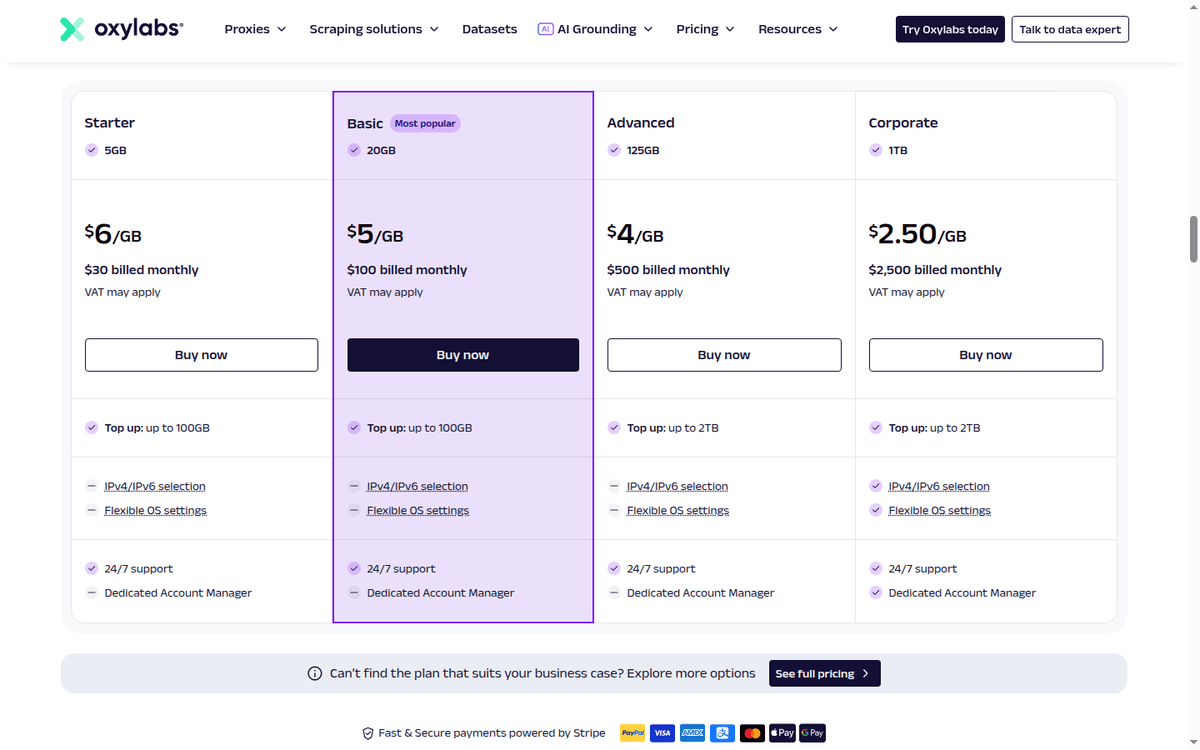
The residential proxy product page publishes four named tiers with a fifth for custom deals. The bottom of the published ladder is $2.50/GB at the 1 TB Corporate tier, and the top is $6.00/GB at the 5 GB Starter.
There is no Pay As You Go column on the public residential page — every plan is a recurring subscription billed monthly in advance. For PAYG, the dashboard exposes a separate top-up flow once you sign up.
| Plan | Bandwidth | Per GB | Monthly total | Notes |
|---|---|---|---|---|
| Starter | 5 GB | $6.00 | $30 | Entry tier; minimum commit |
| Basic (POPULAR) | 20 GB | $5.00 | $100 | Most common entry point |
| Advanced | 125 GB | $4.00 | $500 | Mid-volume default |
| Corporate | 1,000 GB | $2.50 | $2,500 | Cheapest published rate |
| Custom | Volume-based | Quote | Quote | Enterprise contract |
The Starter at $30/month is the floor; below 5 GB, the pricing math stops being published on the residential page. Customers evaluating smaller pilots end up talking to sales for a trial.
Sales-gated trials are not unusual at this end of the category: Bright Data also exposes its lowest residential pricing through a sales conversation. It is still worth flagging that the published ladder assumes a 5 GB commitment.
Two published catches that are easy to miss on the product page:
- Some advanced filters (ASN, ZIP, coordinates) require KYC. The published documentation is light on what KYC means in practice (corporate docs vs ID), but the filter gating is real.
- The free trial is via “Book a demo” / sales contact, not a self-serve signup. Trials are available once per client, which means a single proxy team in a multi-team company cannot easily run parallel trials against the same Oxylabs account.
The pricing math on real workloads depends on three things that are not on the published product page. The first is the country tier: US, EU and similar Tier-1 geos cost more than lower-cost markets. The second is the protocol: HTTP/3 is supported but does not change the per-GB math.
The third is the subscription term, where annual commits are not advertised on the product page but the sales team will negotiate them.
For a clean comparison with Bright Data and Decodo, use the published Basic ($5.00/GB on 20 GB) and Corporate ($2.50/GB on 1 TB) rates as the apples-to-apples baseline.
Pool, locations, and what the 175M+ figure actually measures
The published residential pool is 175M+ IPs across 195+ countries:
- Bright Data publishes “400M+ monthly ethical residential IPs” on its own residential page
- Decodo (formerly Smartproxy) publishes “115M+ real-user IPs”
- IPRoyal publishes “64M+”
Those numbers are marketing figures rather than audited counts, and no vendor explains how it counts a usable IP. That makes the comparison directional. What is verifiable is the 195+ country coverage and the filter list on the Oxylabs product page.
Targeting granularity is where the published differentiation is clearest. The product page lists:
- country
- region
- city
- state
- ZIP
- ASN
- coordinate-level targeting — finer than most competitors
ASN targeting matters for CDN-fronted sites that geo-route by ASN rather than by IP.
Coordinate targeting matters for “I need IPs within 50 km of this specific lat/long” workloads:
- local SEO
- last-mile delivery scraping
- address validation
ZIP targeting matters for US-only workloads where state-level granularity is too coarse.
The advanced filters are the clearest published difference between this vendor and a cheaper one. ASN, ZIP and coordinate targeting come with a KYC step and a higher per-GB rate, and no cheaper published plan in the category lists them. A workload that never touches them has only the per-GB premium left to argue about.
The product page groups location coverage by country rather than publishing a per-country IP count, so what the vendor states is 195+ countries with country, state, city, ZIP, ASN and coordinate filters on top.
If a per-country IP count is what your procurement questionnaire needs, ask for it in writing: the product page does not carry one, and we are not going to invent one here.
Performance, session types, and what gets measured
The published performance claims are 0.41s average response time and 99.95% success rate. Both sit on the product page, and both trace back to Proxyway’s annual research and the G2 profile rather than to a benchmark Oxylabs ran itself.
Proxyway runs its annual benchmark against a global CDN target with 500 requests per endpoint, measuring HTTP 200 response counts and total time. The 99.95% figure is the same Proxyway figure that appears on the Oxylabs G2 profile.
Session types are rotating (per request) and sticky up to 24 hours. The sticky window is shorter than IPRoyal’s published 7 days.
Decodo’s residential page describes sticky sessions as running from “minutes to days”, and Oxylabs publishes 24 hours, so compare the exact session length your workload needs rather than the marketing label.
For multi-day session persistence, IPRoyal’s 7-day sticky window is the published outlier.
| Metric | Published | Source | Comparable across providers? |
|---|---|---|---|
| Pool size | 175M+ residential IPs | Oxylabs official page | Marketing figure; not audited |
| Locations | 195+ countries | Oxylabs official page | Marketing figure |
| Targeting granularity | ASN, ZIP, coordinates | Oxylabs official page | Best in published category |
| Sticky session length | Up to 24 hours | Oxylabs official page | Comparable to Bright Data |
| Avg response time | 0.41s | Proxyway annual research | Yes — same methodology |
| Success rate | 99.95% | G2 / Proxyway | Directional; workload-specific |
| KYC for advanced filters | Yes | Oxylabs official docs | Provider-specific |
| Insurance | Technology E&O + Cyber (Lloyd’s) | Oxylabs official page | Provider-specific |
Your success rate on a real workload depends on the target and the session type. The published 99.95% is a directional figure across the Proxyway benchmark suite rather than a guarantee for a specific Cloudflare, Akamai or DataDome target. Treat it as a starting point and verify it on your own pilot.
Compliance, security, and the published audit trail
The compliance list on the product page is where the premium is easiest to defend:
- ISO/IEC 27001:2022 and GDPR are published on the product page
- the Trust Center adds SOC 2 Type 2
- Technology E&O plus Cyber insurance through Lloyd’s are named alongside them
The published audit trail is the most extensive in the residential proxy category, which is why Oxylabs tends to win enterprise procurement evaluations where the security questionnaire is the gate.
Compliance posture is the strongest single argument for Oxylabs over cheaper competitors. If your buyer is enterprise procurement with a SOC 2 / ISO 27001 requirement, Oxylabs’s published certifications are the cleanest fit.
If your buyer is a single-engineer scraping team, the published certifications are irrelevant and the per-GB price premium is harder to justify.
The published awards list is also longer than most:
- Proxyway Most Scalable Provider 2026
- G2 Summer 2026 Leader (Proxy Networks)
- G2 Summer 2026 Momentum Leader
The 2026 award cycle is consistent with prior years, which suggests the published performance claims are not a one-off marketing spike.
Who Oxylabs fits in 2026
Three personas fit cleanly into the published offer, and three should compare with cheaper options.
Best fit: enterprise procurement teams that need a published audit trail and ISO/IEC 27001:2022 on the contract. The compliance posture and the Lloyd’s-backed insurance are the published differentiators that win enterprise security questionnaires.
Best fit: workloads that need ASN, ZIP, or coordinate-level targeting. The published advanced filters list is broader than any competitor in the residential category. If your target is CDN-fronted by ASN or you need geo-fencing inside a single city, the vendor is the published default.
Best fit: high-volume residential scraping above 125 GB a month, where the per-GB price compression matters most. The $4.00/GB Advanced tier and the $2.50/GB Corporate tier compete head-to-head with the enterprise rates our Bright Data review walks through in detail. Below 125 GB/month, the per-GB price premium is harder to justify.
Worth shopping elsewhere: single-engineer scraping teams that just need IP rotation and do not care about advanced filters – the same buyers our best residential proxies roundup is written for. The Decodo $4.00/GB PAYG and the IPRoyal $5.25/GB on 10 GB are cheaper at small volumes.
Worth shopping elsewhere: workloads that need multi-day sticky sessions. IPRoyal publishes 7-day sticky sessions; Oxylabs caps its own at 24 hours. If your workload holds session state for more than a day, the published window is the constraint.
Worth shopping elsewhere: customers who need a self-serve trial. Trials are sales-gated. Bright Data, Decodo, IPRoyal, and SOAX all offer self-serve free trials.
On pool size, Oxylabs publishes 175M+ and Bright Data publishes 400M+ monthly on its residential page:
On product catalog, Bright Data is wider:
- Web Unlocker
- mobile
- ISP
- datacenter
On compliance posture, Oxylabs publishes more certifications.
Frequently asked questions about Oxylabs
Is Oxylabs a real proxy provider?
Yes. Oxylabs is a Lithuania-rooted proxy vendor with a published pool of 175M+ residential IPs across 195+ countries. The product page carries ISO/IEC 27001:2022 and GDPR, and the Trust Center adds SOC 2 Type 2. The pricing is published on the residential proxy product page.
How much does Oxylabs residential proxy cost?
From $6.00/GB on the 5 GB Starter plan to $2.50/GB on the 1 TB Corporate plan. The most common entry point is the Basic plan at $5.00/GB on 20 GB ($100/month). Below 5 GB/month, the published pricing is sales-gated.
Does Oxylabs offer a free trial?
Free trials are available via “Book a demo” / sales contact. Trials are not self-serve at signup. Trials are available once per client; multi-team pilots against the same Oxylabs account require coordination through sales.
What is the IP pool size?
175M+ residential IPs across 195+ countries, which is the figure on the product page. The page groups coverage by country and does not publish a per-country IP count, so ask for one if your procurement process scores on it.
What targeting granularity is supported?
- Country
- region
- city
- state
- ZIP code
- ASN
- coordinate-level targeting
Some advanced filters require KYC. The ASN, ZIP, and coordinate filters are the published differentiation versus Bright Data and Decodo.
How does Oxylabs compare to Bright Data?
On per-GB price the two ladders are close but not identical: Oxylabs charges $2.50/GB on the 1 TB monthly plan. Bright Data’s pay-as-you-go residential rate is $4.00/GB and its $2.50/GB rate applies to a 798 GB plan billed at $1,999 a month.
What is the sticky session length?
Up to 24 hours. Comparable to Bright Data’s published range; shorter than IPRoyal’s 7-day window. For multi-day session persistence, IPRoyal is the only published residential provider that supports it.
Does Oxylabs support HTTP/3?
Yes. The product page lists HTTP(S), HTTP/3, and SOCKS5 protocol support. HTTP/3 does not change the per-GB math.
What is the success rate?
99.95%, the figure on the product page, which comes from Proxyway’s annual research and the G2 profile. The number is directional across the Proxyway benchmark suite, not a guarantee for any specific target. Verify on your own pilot.
What payment methods are accepted?
Credit card and bank wire (sales-gated) for the published monthly subscriptions. Invoice billing is available on the Corporate and Custom tiers.
Source pages we read
Oxylabs residential proxy pool pricing Oxylabs G2 profile Proxyway Oxylabs review
How we put this together: the per-gigabyte rates, the plan sizes, the pool and targeting figures and the compliance list come from oxylabs.io/products/residential-proxy-pool, read in September 2026. We have not run a paid Oxylabs subscription.
Disclosure: this article contains affiliate links. If you buy through them we may earn a commission at no extra cost to you. Commission never changes our scoring or the order of a ranking.