If you have ever hit a wall of 403s the moment your single-region script crossed a few hundred requests per minute, you already know why residential proxies exist as a category. In short: a residential proxy routes your traffic through an IP address assigned by an ISP to a real household. That makes it look like a normal home user to the target site rather than a datacenter bot. The seven providers below promise the same outcome: a pool of rotating residential IPs to route requests through. They bill it in three different units. Per GB of bandwidth, per IP per month, or per successful request through an aggregator. They compete on pool size, country coverage, sticky sessions, and what a guaranteed bypass costs on a protected target.
Each of the seven sells residential IPs as a primary product, publishes a self-serve paid entry tier and supports sticky sessions with country-level targeting. What differs is the meter. Direct networks bill bandwidth by the gigabyte; aggregators bill successful requests; static ISP addresses bill IPs by the month. The protected-target cost sits on top of all three. The two providers we have an editorial relationship with, Bright Data and ScrapeOps, have their per-GB rates verified here. The other five are described by qualitative facts rather than dollar amounts we did not re-check.
In short
Seven residential proxy providers, billed three different ways. Per GB of bandwidth (Bright Data, Oxylabs, Decodo, NetNut, Webshare), per successful request through an aggregator (ScrapeOps’ Proxy API), and per IP per month (Bright Data ISP, Webshare Datacenter).
Pool size, country coverage, sticky sessions and the cost of a guaranteed unblock on a protected target are what separate them.
Only two providers’ per-GB rates are verified in this article: Bright Data at $4/GB pay-as-you-go with promo code RESIGB50, and ScrapeOps’ aggregator at $15/month for 3 GB ($5/GB). The other five are described by qualitative facts. Per-GB rates were not re-verified for those five on the same date.
Why the per-GB meter matters more than pool size for residential
The headline number on every residential proxy landing page — 72M+ IPs, 100M+, 115M+ — is marketing copy until you convert it into a number your CFO will sign off on. The number your CFO signs is dollars per successful request on your real target. That number depends on four cheap-to-state factors and one expensive-to-measure one:
- The meter. Per GB is the default for residential and mobile. Per successful request exists only on ScrapeOps’ Proxy API product (a separate SKU from their residential aggregator). Per IP per month exists for ISP proxies, which look residential to the target but do not rotate.
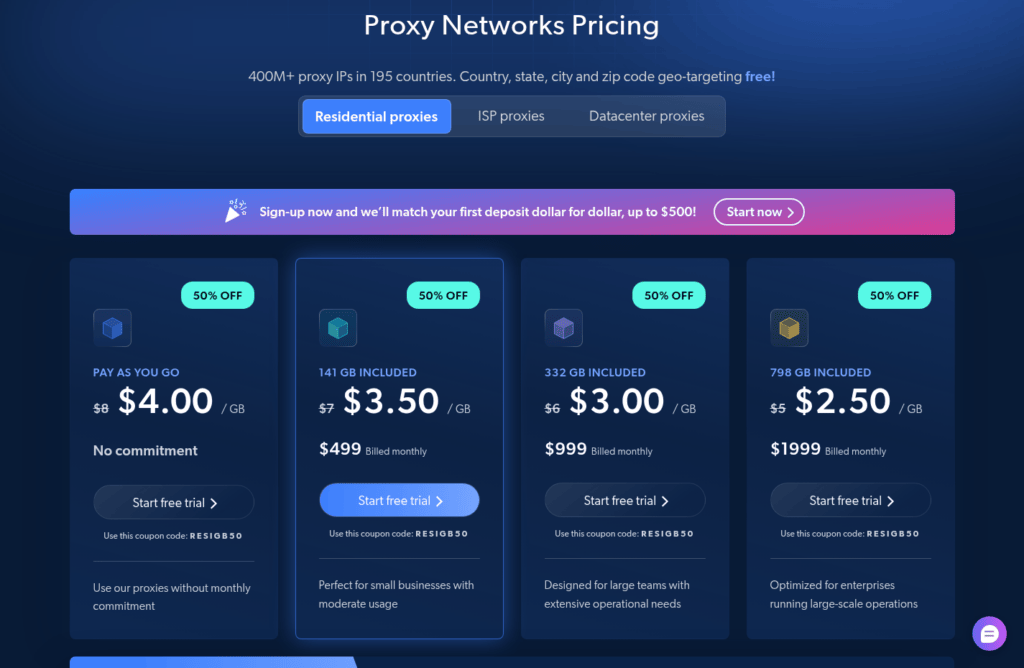
- The GB price. Bright Data PAYG runs $4/GB with promo code RESIGB50 (captured from
brightdata.com/pricing/proxy-network); committed tiers step down to $3/GB at the $999/month Growth tier, $2.50/GB at Business, custom on Enterprise. ScrapeOps’ aggregator steps $5/GB at $15/month for 3 GB down to $2/GB at $999 for 500 GB. The other five publish per-GB rates we did not re-verify on the same date. - Whether you pay for failed requests. Every direct network here charges GB regardless of whether the upstream pool answered; only ScrapeOps’ Proxy API SKU bills per success. The residential aggregator port still bills per GB.
- The KYC and minimum-commitment friction. Bright Data, Oxylabs and NetNut run a compliance review before residential is unlocked. Bright Data’s Starter is a 141 GB / $499 monthly commitment. ScrapeOps, IPRoyal, Decodo and Webshare are self-serve from signup.
- Your real success rate on your real target. Pool size is a proxy for this, but no vendor publishes a number you can plug in. The honest answer is “depends on your target” until you run a pilot against your top three targets — the anti-bot playbook we published walks through what to measure.
If the meter and the GB price are the only two things that move when vendors change plans, then pool size is a tie-breaker, not a category-defining number. Five providers publish 60M+ residential IPs. What separates them on price is the commitment tier; what separates them on operations is who runs a compliance call first.
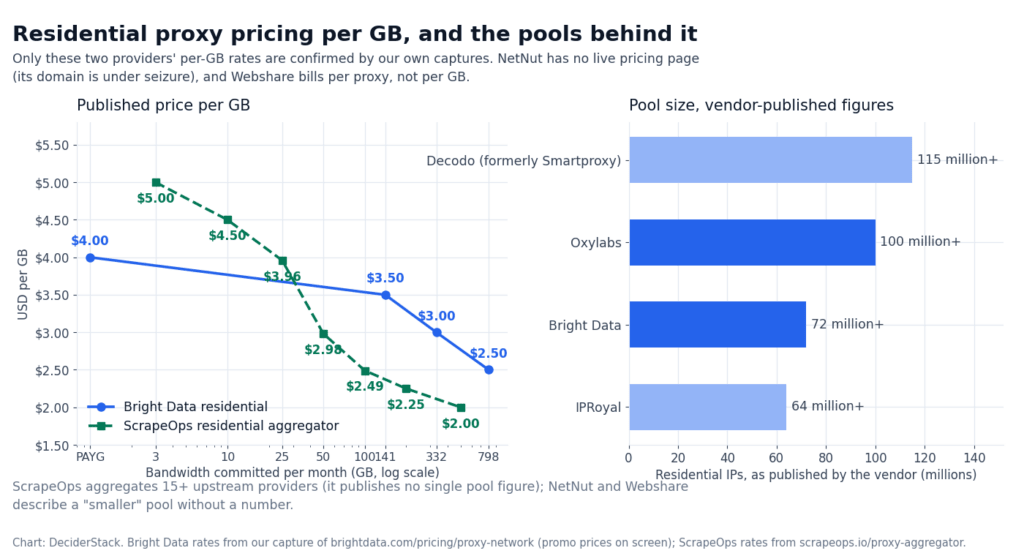
How is residential proxy pricing measured? Three meters. Per GB of bandwidth consumed — Bright Data PAYG $4/GB, ScrapeOps aggregator $5/GB entry, lower on committed tiers. Per IP per month for static ISP addresses that look residential but do not rotate — Bright Data ISP, Webshare datacenter. Per successful request on ScrapeOps’ separate Proxy API product.
What does pool size actually buy? It caps the rotation cycle and the chance of an IP collision when you run high concurrency against the same target. Five providers here publish 60M+ residential IPs, so pool size stops being a tie-breaker and starts being a marketing number once you pass that threshold.
Which providers charge for failed requests? Every direct residential network here charges GB regardless of whether the upstream answered. Only ScrapeOps’ Proxy API product bills per successful request; its residential aggregator port still bills per GB regardless of success.
The under-$50 tier: who fits?
Below $50/month you are paying for three things, and only three things. The first is the meter: per GB, per IP, or per request. The second is the ability to send one request without a sales call. The third is at least one small live trial to check whether the IPs are clean on your targets. Three of the seven providers fit that budget cleanly. Two more publish entry tiers in the same band but did not re-verify rates in this round.
| Provider | Cheapest published tier | Meter | KYC at signup | Trial available |
|---|---|---|---|---|
| ScrapeOps Residential & Mobile Aggregator | $15/month for 3 GB ($5/GB) | Per GB | None — self-serve | 100 MB free bandwidth credits, no card |
| Bright Data (PAYG residential) | $4/GB with promo RESIGB50, no commitment | Per GB | Required (compliance call + ID) for Residential/Mobile | Trial traffic shown in dashboard |
| Webshare (datacenter-first, residential add-on) | Entry-tier residential, rate not re-verified | Per GB | None — self-serve | None published |
| IPRoyal (PAYG residential) | PAYG per-GB, no monthly commitment | Per GB | None — self-serve | None published |
| Decodo / Smartproxy (entry residential) | Entry-tier per-GB, rate not re-verified | Per GB | None — self-serve | None published |
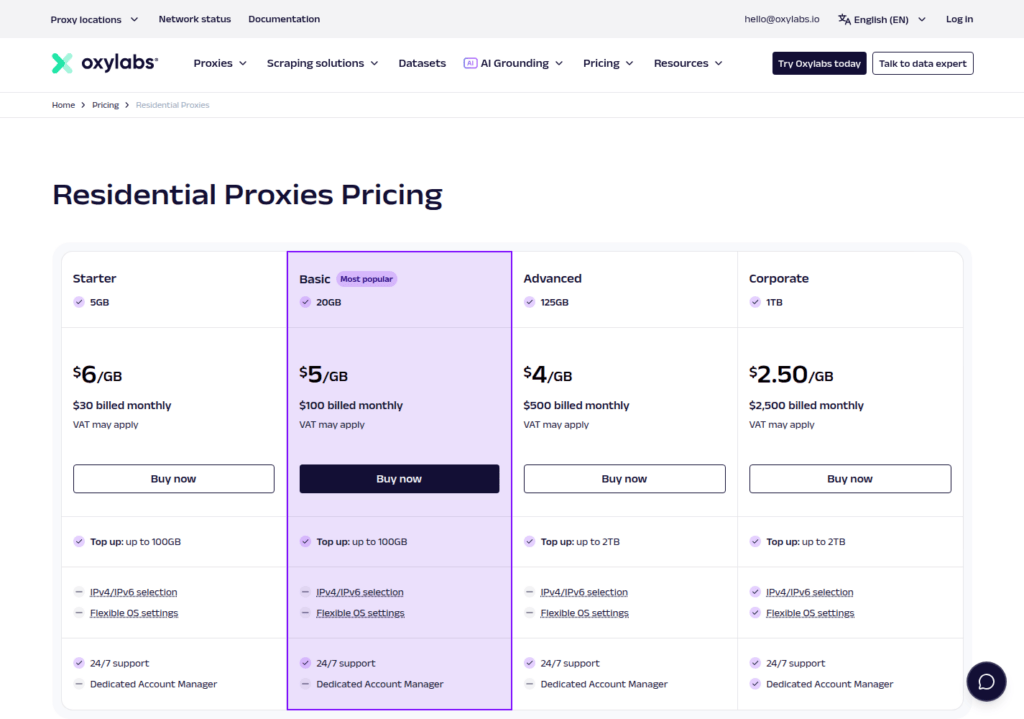
Oxylabs publishes a Starter residential tier in the same band but the exact rate was not re-verified in this round; NetNut’s residential tiers are sales-quoted and start above the self-serve floor for most accounts.
The honest fit-test for an under-$50 tier is not “the entry tier is cheap” — every provider has one. It is “will the per-GB rate plus your expected success rate fit the workload at all?” Run the math before paying anything. If your target averages 1.2 MB per successful request and your success rate at low concurrency is 70%, every 1,000 successful requests consumes ~1.7 GB. At $4/GB that is $6.80 per 1,000 successes; at $5/GB it is $8.50. At 5,000 successes per day that is roughly $1,000/month on ScrapeOps’ PAYG equivalent — already past the under-$50 band. The under-$50 tier is for pilots, not for steady traffic.
What is the cheapest residential proxy with no commitment? Bright Data PAYG residential runs $4/GB with promo RESIGB50 and no monthly minimum, captured from brightdata.com/pricing/proxy-network. ScrapeOps’ residential aggregator is the cheapest in absolute dollars at $15/month for 3 GB ($5/GB).
Can I avoid a compliance call? Yes — ScrapeOps, IPRoyal, Decodo and Webshare are self-serve from signup. Bright Data, Oxylabs and NetNut run a compliance review before the residential network is unlocked; check with sales on current KYC turnaround before relying on same-day signup.
The $50–200 tier: when the committed-volume math flips
Once a workload clears 50 GB/month the math starts to favor committed tiers over PAYG. This is the band where the Bright Data Starter 141 GB / $499/month tier ($3.50/GB) undercuts PAYG for any single month. The undercuts only hold if your bandwidth estimate holds. If you come in under 50 GB you would have paid less on PAYG. The same flip exists on ScrapeOps’ $99/month 25 GB tier ($3.96/GB), which only beats PAYG if your monthly volume lands north of ~25 GB.
Bright Data’s Growth tier (332 GB at $3/GB, $999/month) is the inflection point where larger committed tiers cross the $2/GB barrier. ScrapeOps’ aggregator hits $2.49/GB at 100 GB ($249/month) and $2.25/GB at 200 GB ($449/month). Beyond $2/GB you are committing to a multi-year effective lock-in just to land on ScrapeOps’ lowest published rate ($2/GB at 500 GB / $999/month, captured from scrapeops.io/proxy-aggregator/).
Two non-pricing frictions matter at this band:
- Charge-on-failure is the rule. Failed requests still consume bandwidth on Bright Data, Oxylabs, Decodo, IPRoyal, NetNut, and on ScrapeOps’ residential aggregator. The only exception in this article is ScrapeOps’ Proxy API product, which bills per successful request — a separate SKU from the residential port. Budget at the upstream pool’s success rate, not at 100%.
- KYC becomes a planning constraint. A Bright Data residential account needs a compliance call plus ID verification before the network is unlocked. If your pilot needs to go live this week, ScrapeOps, IPRoyal or Decodo are the only ones among these seven that ship without the call.
The right question at $50–200/month is “what is my real per-successful-request cost at this committed tier, not at the published rate?” If your success rate at 100 concurrency is 40% on the target that matters, Bright Data Starter at $3.50/GB equals $8.75 per 1,000 successful requests. If success rate rises to 70%, it equals $5.00. The published rate understates the real cost when the upstream pool fails.
When does committed beat pay-as-you-go? For residential bandwidth, roughly the moment your monthly volume crosses the cheapest committed tier’s included GB. Bright Data Starter breaks even at ~125 GB (141 GB @ $3.50/GB ≈ PAYG at $4/GB); below that, PAYG wins on dollars.
What changes at the $200/month mark? The Bright Data Growth tier at $999/month for 332 GB (~$3/GB) is where larger committed purchases cross the $3/GB threshold and effective cost-per-successful-request halves for high-volume crawlers. ScrapeOps’ equivalent band is $149/month for 50 GB ($2.98/GB).
The $200+ tier: PAYG vs committed?
Past $200/month, residential proxy spend is dominated by two questions: does your workload run long enough to justify a 6-12 month commitment, and can you afford to be charge-on-failure when the target is hot. Three of the seven compete at this tier by published numbers. The rest sell sales-quoted enterprise plans whose per-GB rates we did not re-verify on the same date.
| Provider | Highest public tier | Per-GB at top tier | Min commit | Notes |
|---|---|---|---|---|
| Bright Data | Enterprise custom >1000 GB | Custom $/GB; published $2.50/GB at Business 798 GB ($1,999/mo) | Sales-quoted | 99.99% uptime SLA, premium support, KYC required |
| Bright Data ISP (static) | Enterprise >1000 IPs | Per IP, not per GB — $1.30/IP at 1000 IPs ($1,300/mo) | Sales-quoted | Static residential-looking IPs, no rotation |
| ScrapeOps Residential Aggregator | 500 GB at $999/mo | $2/GB | None (cancel any time, account pauses at credit limit) | Bills GB regardless of success |
| Oxylabs | Enterprise residential | Custom; PAYG published higher than committed | Sales-quoted | Separate Web Unblocker meter |
| Bright Data Datacenter | 1000 IPs at $900/mo ($0.90/IP) | Per IP | None on PAYG | Not residential — kept here for cross-meter reference |
| Webshare (datacenter) | Per-IP tiers | Not re-verified | None on PAYG | Cheap datacenter, residential add-on |
Three rules apply at this tier:
- Above ~500 GB/month, the difference between PayG and the top committed tier is the same factor as the difference between Bright Data and ScrapeOps. Pricing collapses below $2.50/GB for everyone. The tie-breaker becomes KYC turnaround, support response time, and whether the dashboard exposes what you are paying per success.
- ISP proxies are not a substitute for residential on rotating workloads. Bright Data ISP at $1.30–$1.80/IP per month gives you a static IP that looks residential to the target. You are paying per IP, not per GB. You cannot scale to 1,000 IPs in a single click the way you can with a residential pool.
- Web Unblocker / anti-bot bypass is a separate meter on every provider. Bright Data’s Web Unlocker (separate from the proxy network) charges per successful request. Oxylabs’ Web Unblocker and Decodo’s scraping API are separate SKUs at per-GB or per-result rates. If your protected-target share of traffic is non-trivial, the residential proxy bill is the smaller half of what you are paying.
What does the enterprise tier buy for $200+? On Bright Data: 99.99% uptime SLA, premium support, custom $/GB below the Business $2.50/GB rate, and first-deposit match up to $500. On ScrapeOps: the 500 GB at $2/GB rate ($999/month), free tooling (monitoring, error logging, scheduler, server manager, GitHub deploy).
Can I pay per successful request on residential? Not on the residential port. The per-success model exists only on ScrapeOps’ separate Proxy API product, which bills per successful request across 20+ upstream providers (Bright Data, Oxylabs, Decodo, IPRoyal and others). It is not the same SKU as the residential aggregator port.
What to buy for an anti-bot stack?
Residential proxies handle only the IP layer. Cloudflare, DataDome, PerimeterX, Kasada all run additional signals — TLS fingerprint, header order, navigation timing, JS execution — and a residential IP makes your fingerprint easier to fingerprint, not harder. The honest anti-bot stack splits the bill into three parts:
- Residential IPs for geography and rotation. This is what this article compares. Expect $2.50–$4/GB on PAYG and $1.50–$2.50/GB on the top committed tiers.
- JS rendering or browser automation for TLS and timing. Browserless, ScrapingBee’s classic / premium / stealth tiers, ScrapingBee vs Zenrows, and the Playwright / Puppeteer routes (Playwright Python guide) all sit in this layer. Budget 5–75 credits per request depending on stealth tier; treat Bright Data’s Web Unlocker and ScrapeOps’ Proxy API as the per-success alternatives for sites where rendering is unnecessary.
- Anti-bot fingerprinting libraries only if you control the HTTP client. Open-source tools exist. We have not published a per-request math on them; treat the published open-source rate as workload-specific and validate against your top three targets before budgeting against a vendor’s published rate.
The mistake is pricing residential proxies as if the IP alone solves the block. It does not. The IP gets you through the geographic and the IP-reputation step; the browser layer gets you through the fingerprint step; an anti-bot library gets you through the cookie / behavior step. Two of the three usually run on the same vendor; all three usually run in the same account.
Editorial methodology is on a separate page; we re-state the headline rules in every article for the reader who lands here directly.
Do residential proxies beat anti-bot on their own? No. A residential IP routes around IP-reputation and IP-geo checks; it does not change your TLS fingerprint, header order, JS execution path, or navigation timing. Cloudflare and DataDome all read those signals and treat a residential request with the wrong fingerprint the same way they treat a datacenter request. Anti-bot bypass is a separate product on every provider; expect to pay for it as a second SKU.
Which scraping APIs are we pricing? Outside the scope of this article — see the 7 best web scraping APIs comparison and the per-vendor reviews linked above.
Where the seven providers land on the cost-per-success map
The table below combines the verified per-GB rates for Bright Data and ScrapeOps with the qualitative facts we confirmed for the other five. Per-GB rates for Oxylabs, IPRoyal, Decodo, NetNut and Webshare were not re-verified in this round; see each vendor’s official pricing page before budgeting.
| Bright Data | ScrapeOps | Oxylabs | IPRoyal | Decodo (formerly Smartproxy) | NetNut | Webshare | |
|---|---|---|---|---|---|---|---|
| Shape | Direct residential + ISP + datacenter + mobile (4 product families) | Aggregator: residential & mobile behind one endpoint, 15+ upstream providers | Direct residential + datacenter + mobile + ISP | Direct residential + datacenter + mobile + ISP, plus sneaker niche | Direct residential + datacenter + mobile + ISP | Direct residential (ISP-sourced) | Direct datacenter-first residential |
| Billing metric | Per GB (residential, mobile); per IP/mo (ISP, datacenter) | Per GB (residential & mobile aggregator) | Per GB (residential, mobile); per IP (datacenter, ISP) | Per GB (residential, mobile, datacenter); per IP (ISP, sneaker) | Per GB (residential, mobile, ISP); per IP (datacenter) | Per GB (residential) | Per GB (residential); per IP (datacenter) |
| Free tier | Trial traffic shown in dashboard, not billed | 100 MB bandwidth credits, no card | Trial traffic on request (not published allowance) | None on residential | None on residential | None published | None on residential |
| Cheapest published | PAYG $4/GB with RESIGB50 | Aggregator $15/mo for 3 GB ($5/GB) | Starter residential (see vendor) | PAYG residential (see vendor) | 3 GB residential starter (see vendor) | Sales-quoted | Entry residential (see vendor) |
| JS rendering / anti-bot | Built in on Scraping Browser + Web Unlocker (separate products) | Built in via aggregator (auto provider switching) | Web Unblocker is a separate per-GB product | Anti-bot bypass available as premium add-on per GB | Built-in on scraping API add-on | Static-residential option for sites that ban rotating | DIY — bring your own anti-bot strategy |
| Sticky sessions | Up to 30 min on Residential, configurable per request | Yes, across all aggregated providers | Yes, configurable | Yes | Yes | Yes | Yes on residential |
| Pool size (vendor-published) | 72M+ residential IPs in 195 countries | 15+ upstream providers aggregated | 100M+ residential IPs | 64M+ residential IPs (post mid-2026 expansion) | 115M+ residential IPs in 195 locations | Smaller curated pool, ISP-sourced | Smaller pool, datacenter-heavy mix |
| KYC at signup | Required for Residential and Mobile (compliance call + ID) | None — self-serve, email only | Required for residential and mobile | None — self-serve | None — self-serve | Required for residential | None — self-serve |
| Concurrency | Unlimited on residential (fair-use thresholds) | 1 concurrent thread on $9 plan → 200 on $699 plan (Proxy API) | Per plan | Per plan | Per plan | Per plan | Per plan |
| Charge on failure | Failed requests consume bandwidth — only Web Unlocker bills per success | Residential aggregator: GB regardless. Proxy API: success only | GB regardless | GB regardless | GB regardless | GB regardless | GB regardless |
| Minimum commitment | $499/mo on Starter residential; PAYG has no minimum | None — cancel any time, account pauses at credit limit | Per plan | None — PAYG available | None published | Per plan | None — PAYG available |
Sources at the bottom of this article. Per-GB dollar amounts for Bright Data and ScrapeOps are captured verbatim from official pricing pages on the date noted in Sources.
What are other notable residential proxy providers we did not price? Proxy-Seller (datacenter plus residential, per-IP and per-GB billing), Shifter (formerly Microleaves, peer-to-peer bandwidth-share), Proxy-Cheap (PAYG residential, entry-tier per-GB), IPIDEA (residential, datacenter and mobile) and 922S5 (residential marketplace reselling upstream capacity). Each publishes a self-serve paid entry tier. We did not verify per-GB rates in this round, so we did not include them in the table.
Which provider publishes the largest pool? By vendor-published numbers: Decodo (formerly Smartproxy) 115M+ across 195+ locations, Oxylabs 100M+, Bright Data 72M+ across 195 countries, IPRoyal 64M+ after the mid-2026 expansion. None of those figures was verified against a live pool.
FAQ
Which providers require KYC?
Bright Data requires a compliance call plus ID verification for residential and mobile. Oxylabs and NetNut require compliance reviews for residential networks. ScrapeOps, IPRoyal, Decodo and Webshare allow self-serve signup with no compliance call.
What is a residential proxy aggregator?
One endpoint that routes your requests across 15+ upstream residential and mobile providers — ScrapeOps’ port at residential-proxy.scrapeops.io:8181 speaks HTTP and SOCKS5 — so your supply is the sum of those pools. It bills per GB regardless of success, and you inherit each upstream provider’s rotation policy and KYC position.
Do failed requests still cost money?
On every direct provider here, yes — the bandwidth was consumed whether or not the target answered. The exception is ScrapeOps’ Proxy API SKU, which bills per successful request; its residential aggregator port still bills per GB regardless of success.
What does KYC actually block?
On Bright Data and Oxylabs, the residential and mobile networks stay locked until the compliance review passes. The same review runs for NetNut residential. Signup still completes; the residential SKU in the dashboard is unlocked after the call and ID check.
Can I pay per IP for static residential?
Yes — Bright Data ISP at $1.30–$1.80/IP per month (PAYG $1.80/IP, Small 10 IPs at $18/mo, 100 IPs at $1.45/IP, 500 IPs at $1.40/IP, 1000 IPs at $1.30/IP, Enterprise custom above 1000 IPs), captured from brightdata.com/pricing/proxy-network. The IPs look residential to the target but do not rotate; this is the right SKU for sites that ban rotating IPs aggressively.
Bottom line
Pick by budget band, not by vendor name. If the workload decides, start from the five picks by use case. Under $50/month the only published rate worth quoting is ScrapeOps at $15/month for 3 GB ($5/GB). That is the cheapest path to “send one request, let someone else pick the upstream provider”. Bright Data PAYG at $4/GB with RESIGB50 is the right answer when you specifically need the largest pool and can pass a compliance call same-week. At $50–200/month the committed-tier math starts to flip — Bright Data Starter 141 GB at $3.50/GB undercuts PAYG once monthly volume lands above ~125 GB. Above $200/month the published rates collapse under $2.50/GB and the real tie-breakers are KYC turnaround, per-success billing on anti-bot SKUs, and whether the dashboard exposes what you actually pay per success on your real targets. Validate the success rate on your top three targets before locking in a plan — the editorial methodology flags every per-workload number for a reason.
What we did not measure
Every figure that depends on a real workload — per-target success rate, anti-bot bypass rate, sticky-session duration, upstream-provider routing latency, KYC turnaround time — is flagged where it appears in the text rather than guessed. We have not run paid residential workloads against every vendor; the per-GB dollar amounts in the table above describe pricing pages, not benchmark results. Treat the rates as inputs to your own model and run a small pilot against your top three targets before locking in a plan.
For Oxylabs, IPRoyal, Decodo/Smartproxy, NetNut, and Webshare, the per-GB rates were not re-verified in this round — see each vendor’s official pricing page directly before budgeting. The qualitative facts (pool size, country coverage, business model, KYC requirement) were confirmed from each vendor’s homepage and product page.
Sources
- Bright Data: brightdata.com/pricing/proxy-network (Residential, ISP, Datacenter, Mobile tiers, KYC, geo coverage) — captured via self-hosted Firecrawl.
- ScrapeOps: scrapeops.io/proxy-aggregator/ (Residential & Mobile Proxy Aggregator free tier, paid tiers, endpoint, included tooling) — captured via self-hosted Firecrawl.
- Oxylabs: oxylabs.io/pricing/residential-proxy-pool — qualitative facts (pool size, geo coverage, KYC) verified from vendor homepage September 2026; per-GB rates not re-verified in this round.
- IPRoyal: iproyal.com/pricing/residential-proxies/ — qualitative facts (pool size, PAYG availability) verified from vendor homepage September 2026; no per-GB rate captured, so none is quoted.
- Decodo (formerly Smartproxy): decodo.com/proxies/residential-proxies/pricing — qualitative facts (pool size, geo coverage, rebranding) verified from vendor homepage September 2026; pricing left to the vendor page.
- NetNut: netnut.io/pricing — qualitative facts (ISP-sourced routing, static-residential product) verified from vendor homepage September 2026; no rate verified.
- Webshare: webshare.io/pricing — qualitative facts (datacenter-first model, residential add-on) verified from vendor homepage September 2026; no rate quoted.
How we tested this: the per-GB dollar amounts for Bright Data and ScrapeOps come from brightdata.com/pricing/proxy-network and scrapeops.io/proxy-aggregator/ and are quoted verbatim in USD as displayed, captured on the same date as the rest of the article. The qualitative facts for Oxylabs, IPRoyal, Decodo (formerly Smartproxy), NetNut and Webshare — pool size, country coverage, business model, KYC requirement — were taken from each vendor’s own pages on the same date. Their per-GB rates were not re-verified in this round and are not quoted as numbers.
Figures that depend on a real workload, such as per-target success rates, anti-bot bypass rates, sticky-session duration and KYC turnaround, are flagged where they appear in the text. Scoring criteria are on the methodology page.
Disclosure: this article contains affiliate links. If you buy through them we may earn a commission at no extra cost to you. Commission never changes our scoring or the order of our rankings.