If you typed “best residential proxy 2026” into Google, you are not shopping for a listicle — you are shopping for a single answer. “Best” here is conditional on the workload, and the answer that works for an ad-verification team in Sao Paulo quietly burns the budget of a sneaker monitor in Berlin. The piece below picks one provider for each of five common 2026 workloads. It quotes verified pricing where the vendor publishes it, and keeps honest “depends on your target” notes where only a pilot can give you a number. This guide answers “if I had to pick one today, which one”.
Every dollar figure quoted as a number (not as a qualitative description) comes from a vendor’s official pricing page. Figures that depend on a real workload — your success rate on a Cloudflare-class target, your sticky-session duration, the real cost per successful scrape — are flagged where they appear rather than guessed.
This guide answers “best residential proxy 2026” with five workload-specific picks instead of a single vendor name. Read it end-to-end if your workload is novel; if it is one of the five picks above, jump to the matching section and run the 1,000-page pilot before committing. The best residential proxy in 2026 is whichever provider rates your workload cheapest.
If you searched for “best residential proxy 2026” expecting a single vendor name, the answer is that the category does not have one. Five workloads, five providers.
In short
“Best residential proxy in 2026” is not a single answer — it is one provider per workload. The five picks below cover five jobs: general scraping at scale, ISP-static for sticky login walls, sneaker drops, ad-verification across countries, and pay-per-success via an aggregator.
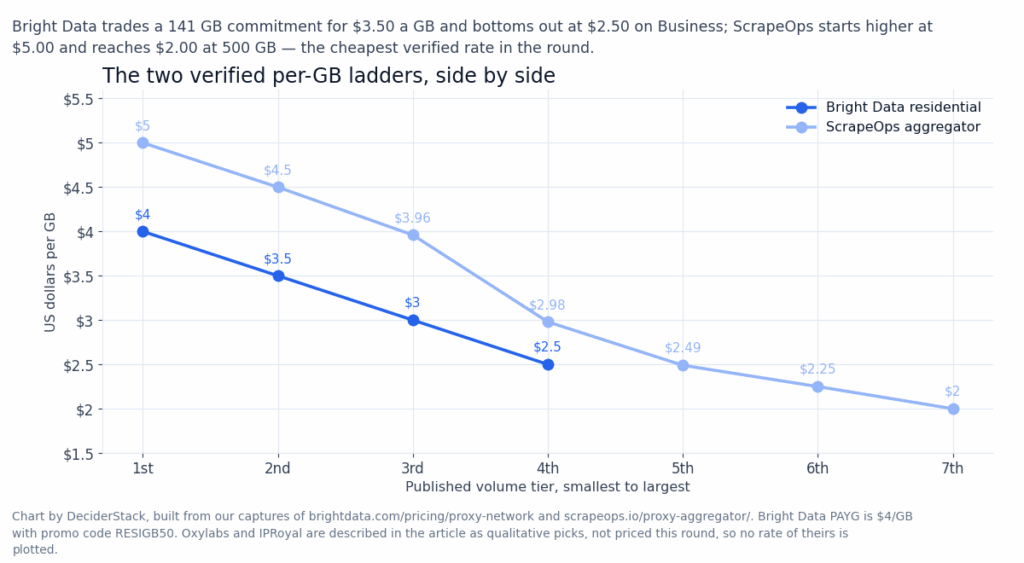
Two providers’ per-GB rates are verified dollar amounts: Bright Data residential at $4/GB PAYG (with promo code RESIGB50) stepping down to $2.50/GB on the $1,999/month Business tier. ScrapeOps residential aggregator at $5/GB on the $15/month entry tier stepping to $2/GB at 500 GB. The other picks are named for their qualitative fit; their per-GB rates were not re-verified this round.
Five residential proxy picks by workload, at a glance
| # | Use case | Provider | Cheapest paid entry | Meter | KYC |
|---|---|---|---|---|---|
| 1 | Scraping at scale across many countries | Bright Data Residential | $4/GB PAYG ($2.50/GB at $1,999/mo Business) | Per GB | Required |
| 2 | Static residential IP for login-walled sessions | Bright Data ISP | $1.80/IP PAYG ($1.30/IP at 1,000 IPs) | Per IP per month | Required |
| 3 | Sneaker / limited-release drops | IPRoyal (sneaker niche) | PAYG residential (see vendor) | Per GB | None |
| 4 | Ad-verification across countries | Oxylabs Residential | Starter tier (see vendor) | Per GB | Required |
| 5 | Pay-per-success scraping (one endpoint, no bandwidth math) | ScrapeOps Proxy API | $9/mo 25,000 credits | Per successful request | None |
Sources: Bright Data pricing and ScrapeOps proxy aggregator (verified September 2026); IPRoyal residential and IPRoyal sneaker proxies (qualitative, not priced this round); Oxylabs residential pool (qualitative, not priced this round).
How we picked these five
Three filters separate a 2026 best pick from the rest of the long tail.
First, the meter matches the workload. A provider that bills per GB is wrong for a workload where you care about successful responses (because failed requests still consume bandwidth). A provider that bills per successful request is wrong for a workload where every request succeeds and bandwidth is the constraint. Per-IP monthly makes sense only when you need a small number of static addresses that do not rotate — typically login-walled targets.
Second, the documented pool size and country coverage match the targeting you need. A 195-country provider is over-built for a workload that scrapes three countries. A 30-country provider is under-built for a workload that needs city-level targeting in Sao Paulo, Lagos, and Mumbai. Pool size matters less than country granularity: a 100M-IP pool that does not actually have Lagos is worth less than a 20M-IP pool that does.
Third, the friction is acceptable. KYC is friction at signup but it is also a signal that the upstream bandwidth has been vetted. A no-KYC provider is faster from signup to first request, but the pool sourcing is often peer-to-peer and the rotation policy is harder to pin down. For ad-verification and brand-protection work, KYC is a feature; for a one-off scrape it is overhead.
These three filters are why five names — not seven, not twelve — appear below. The seven we considered and excluded are listed at the end with the reason.
Pick 1 — Bright Data Residential: scraping at scale across many countries
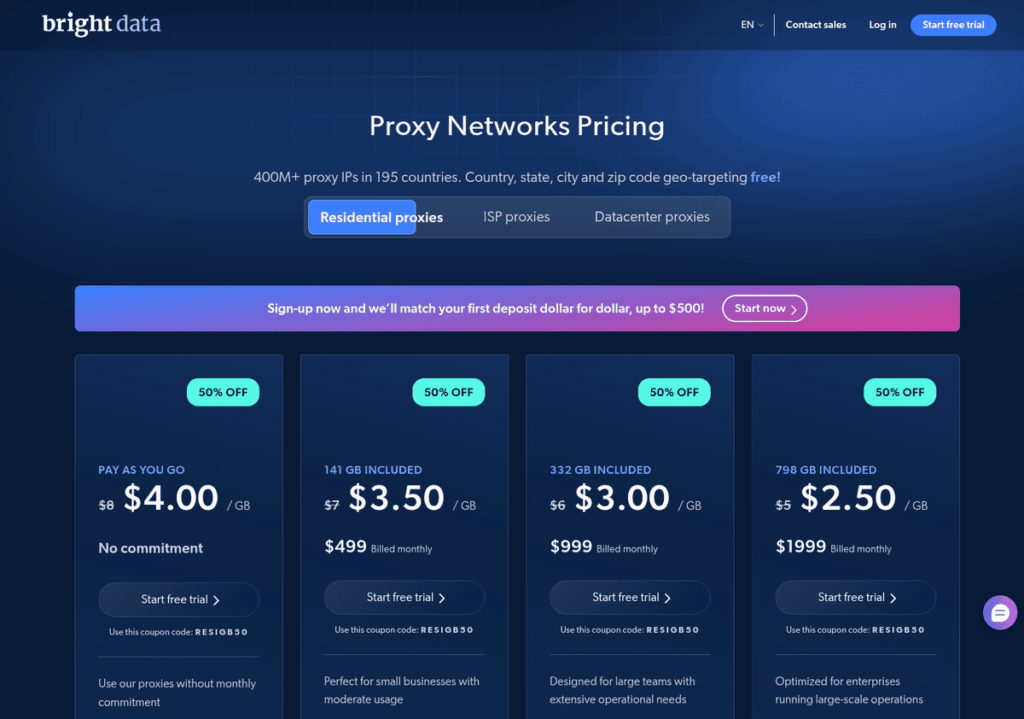
If you scrape at scale and need sticky sessions up to 30 minutes on every product, Bright Data’s residential network is the default. The vendor publishes 400M+ residential IPs across 195 countries with country / state / city / ZIP targeting free on every plan, plus four proxy products on one billing account. Residential (per GB), ISP (per IP, static residential-looking IPs), Datacenter (per IP). Mobile (per GB, carrier-grade 3G/4G/5G). Every API product also has its own 5,000-units-per-month free tier with no credit card.
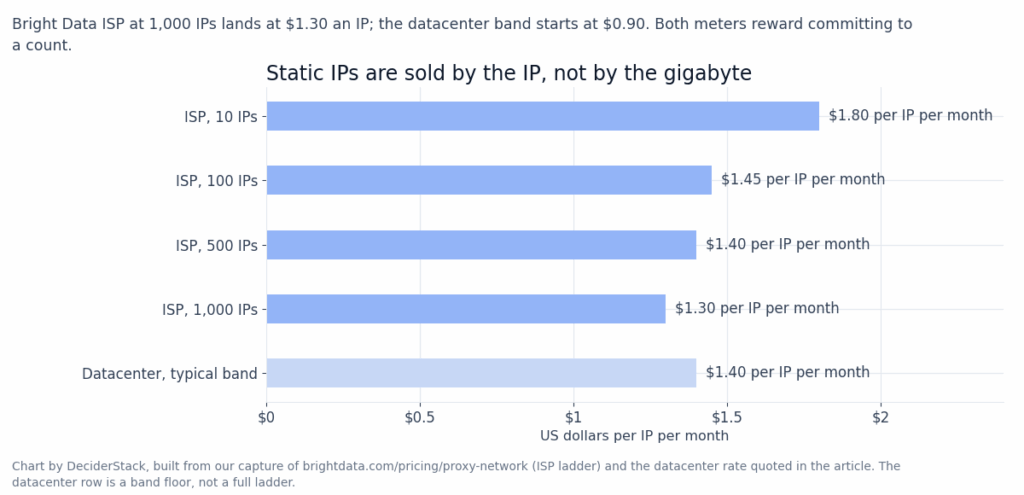
Pricing, captured September 2026 from brightdata.com/pricing/proxy-network: Residential — PAYG $4/GB with promo code RESIGB50 (no commitment, 50% off); Starter 141 GB at $3.50/GB, $499/mo. Growth 332 GB at $3.00/GB, $999/mo; Business 798 GB at $2.50/GB, $1,999/mo; Enterprise over 1,000 GB at custom $/GB, 99.99% uptime SLA. ISP — PAYG $1.80/IP, Small 10 IPs at $18/mo, 100 IPs at $1.45/IP, 500 IPs at $1.40/IP, 1,000 IPs at $1.30/IP.
The trade-off: largest pool in the category by vendor-published count, sticky sessions on every product, geo targeting free on every plan, and a documented first-deposit match up to $500. The friction is KYC — Residential and Mobile networks require a compliance call plus ID verification before the account is fully active. The $499/month minimum on Starter is the entry-tier commitment; PAYG exists but the published rate ($4/GB after promo) is the ceiling, not the floor. Charge-on-failure is the default: failed residential requests still consume bandwidth because the bandwidth cost was already paid to the upstream ISP partner.
Published “successful request” rate and sticky-session duration vary by the upstream IP rotation cycle and by the country you select — confirm both on your targets before sizing a plan.
Pick 2 — Bright Data ISP: static residential IP for login-walled sessions
If your scraper logs into a target and then expects the same IP across the session, rotating residential IPs will get you logged out. That applies to account dashboards, banking portals, anything with a session cookie. The answer is static residential-looking IPs that do not rotate: Bright Data ISP proxies. The IP is hosted on an ISP-assigned range, so it looks like a home user to the target, but it stays put for the duration of your subscription rather than rotating on every request.
Pricing, captured September 2026. PAYG $1.80/IP per month with no commitment. Small 10 IPs at $18/month ($1.80/IP). 100 IPs at $1.45/IP ($145/month). 500 IPs at $1.40/IP ($700/month). 1,000 IPs at $1.30/IP ($1,300/month). Enterprise over 1,000 IPs at custom pricing. The volume tiers matter: at 100 IPs the per-IP rate drops from $1.80 to $1.45, and at 1,000 IPs you are paying $1.30 per IP per month.
The trade-off: static residential-looking IPs without rotation, perfect for sticky sessions and account-bound scraping. The pricing is per IP per month, not per GB, so it does not scale with bandwidth — which is a feature when your workload is bandwidth-heavy on a small number of persistent sessions. KYC still applies. The IP count you buy is the IP count you get; if your workload needs 5,000 IPs spread across 50 countries, the math gets expensive fast and you should be looking at per-GB residential instead.
Many targets re-prompt for authentication after 24 hours regardless of IP stickiness — confirm the actual session duration on your target before sizing the IP count.
Pick 3 — IPRoyal: sneaker and limited-release drops
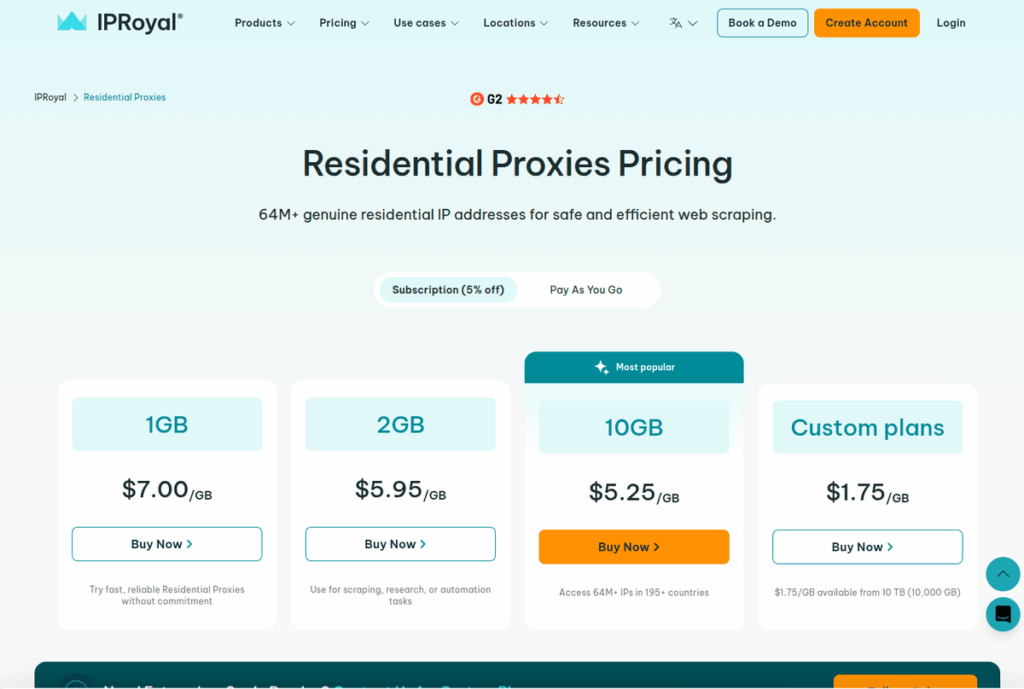
Sneaker monitors and limited-release drops have a different cost profile: the workload is bursty, the targets are aggressively anti-bot, and the provider needs to handle short intense spikes without throttling. IPRoyal publishes a residential and datacenter proxy network with a documented sneaker-proxy product line, PAYG residential at no monthly commitment, and self-serve signup with no KYC.
Pricing — not verified in this round. IPRoyal publishes PAYG residential at a per-GB rate with no monthly commitment, plus subscription tiers that step down per-GB at larger monthly volumes. The sneaker-proxy product is a separate SKU billed per IP with higher rotation control. See iproyal.com/pricing/residential-proxies/ for current rates and iproyal.com/sneaker-proxies/ for the sneaker line.
The trade-off: PAYG-friendly entry with no monthly commitment, a published pool of 64M+ residential IPs after its mid-2026 expansion, and a dedicated sneaker-proxy SKU that targets the exact niche this listicle pick exists for. Less well-known than Bright Data or Oxylabs; documentation is thinner and SLAs are less published. KYC is not required for residential signup, which is a faster path from signup to first request than the KYC-gated competitors.
Sneaker-proxy success rate varies by release calendar — confirm it against your target’s drops before sizing a budget. The provider does not publish per-target numbers.
Pick 4 — Oxylabs Residential: ad-verification across countries
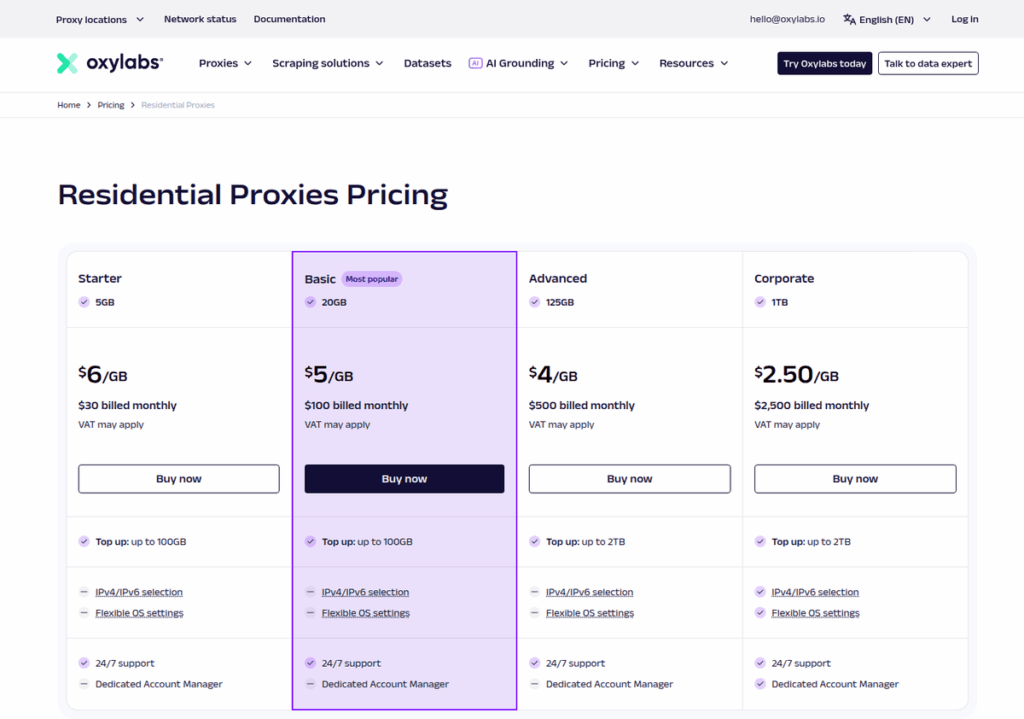
If you run an ad-verification or brand-protection operation that needs to check what ads render in 50+ countries and on dozens of carrier networks, you are not scraping. You are rendering a small number of pages per country per day and confirming what shows up. The workload looks like residential proxy traffic, but the volume is low and the country coverage is the actual constraint. Oxylabs publishes 175M+ residential IPs across 195+ countries, separate Web Unblocker product for protected targets, country / state / city targeting, sticky sessions, and dedicated datacenter and mobile product lines.
Pricing not verified in this round. Oxylabs publishes a Starter residential plan around the $30/month entry tier with rates that step down on larger commitments. Plus a separate Web Unblocker meter billed per GB at higher rates than the residential pool alone. PAYG residential is published at higher per-GB than the committed tiers, with documented 1 GB minimum and 50 GB maximum monthly purchase caps on PAYG. See oxylabs.io/pricing/residential-proxy-pool for current rates.
The trade-off: long-running enterprise vendor with published SLAs, large pool, and the most documented country coverage in the category. KYC is friction at signup. The pricing structure is well-documented but step-tier. You need to size your monthly bandwidth up front to land on the cheaper per-GB rate, which is awkward for ad-verification workloads whose bandwidth varies by campaign calendar.
Pick 5 — ScrapeOps Proxy API: pay-per-success, one endpoint, no bandwidth math
If your workload is request-shaped (you have a list of URLs and want JSON back) and you would rather pay for the response than for the bandwidth. ScrapeOps’ Proxy API Aggregator is the cheapest entry in this list. It routes across 20+ upstream providers — Bright Data, Oxylabs, Decodo, IPRoyal and others — behind one endpoint at proxy.scrapeops.io/v1/, and only successful requests are billed. Failed requests cost you nothing.
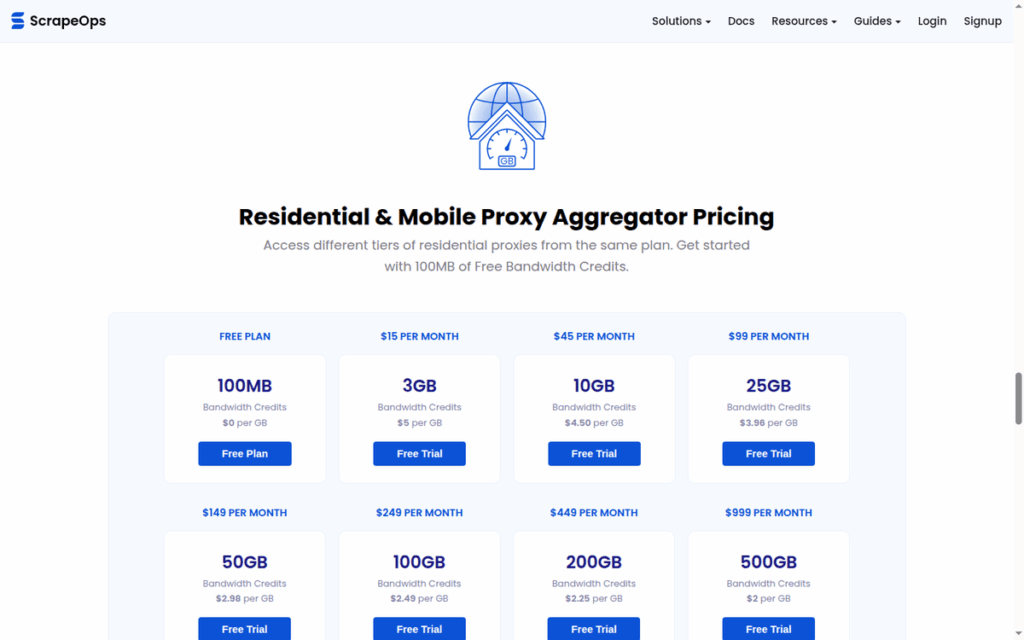
Pricing, captured September 2026 from scrapeops.io/proxy-api-aggregator/: $9/month for 25,000 API credits with one concurrent thread, up to $699/month for 10M credits and 200 concurrent threads. Free tier is 1,000 API credits per month with no card. The endpoint includes JS rendering, sticky sessions, automatic proxy rotation, response validation (ban / captcha detection), and country geotargeting.
The trade-off: lowest entry price on this list at $9/month, the only product here that bills per successful response, and the easiest path to “send one request and let someone else pick the best provider”. The product is an API, not a runtime — you cannot deploy custom scraping code on it. Account pauses at the credit limit unless auto-renew or auto-upgrade is enabled. Pool size is the sum of the 20+ upstream providers, which is a feature (always-fresh supply) and a risk (you inherit each upstream provider’s KYC and rotation policy).
The product bills per successful response, but your effective cost depends on how often the upstream pool returns data — a 70% success rate turns $9/month of credits into $13/month of effective spend. Confirm the actual success rate on your top targets before sizing a plan.
When none of these are the right answer
Three workloads break the framework above, and naming them is more useful than pretending a single pick covers everything.
You are scraping 100,000+ URLs per hour. The first instinct is to buy the largest pool, but at that volume you are paying for rotation speed, not for residentialness. Look at datacenter proxies (Webshare, Bright Data Datacenter at $0.90–$1.40/IP per month) or at ScrapeOps’ residential aggregator port (billed per GB but with a different routing profile). Residential at $4/GB is the wrong meter at that volume; the right answer is datacenter + targeted residential on the protected subset.
You need residential IPs that are legal in your jurisdiction and tied to a real opt-in. Residential peer-to-peer pools are sourced from SDKs bundled with free apps; the IP owner’s consent is implicit at best. For work where the chain of consent matters (regulatory, journalism, certain government uses), the right answer is a vetted ISP-sourced pool (NetNut, Bright Data ISP) where the IP ownership is contractual, not implicit. KYC friction is part of why the pool is vetted.
You need residential IPs for less than 100 MB per month. The entry tiers ($4/GB on Bright Data PAYG, $15/month for 3 GB on ScrapeOps) are built for ongoing workloads. A one-off scrape on a single target is cheaper on ZenRows or ScrapingBee’s API products with a small credit pack. A per-request API lets you size the spend to the request, not to the GB. The best residential proxy in 2026 for a one-off scrape is whichever per-request API rates your single target cheapest, not whichever per-GB network has the lowest entry tier.
Pricing comparison at three workloads
The five picks above are not directly comparable because they bill on different meters. Three workload scenarios put them on the same page.
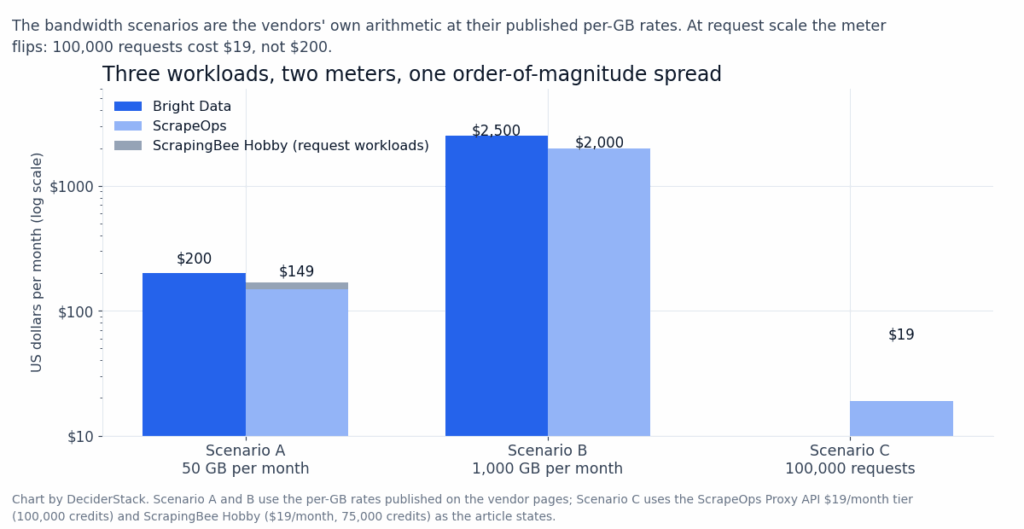
Scenario A — 50 GB of residential bandwidth per month, single country, sticky sessions off. Bright Data PAYG at $4/GB × 50 = $200/month. ScrapeOps aggregator at $2.98/GB × 50 = $149/month on the 50 GB tier ($149/month fee). Oxylabs Starter tier — see vendor site. IPRoyal PAYG — see vendor site. Lowest dollar cost at 50 GB: ScrapeOps aggregator at $149/month.
Scenario B — 1,000 GB of residential bandwidth per month, multiple countries, with sticky sessions of 10 minutes. Bright Data Business at $2.50/GB × 798 GB included + overage = $2,500/month. The $1,999/month tier includes 798 GB; the 202 GB of overage at $2.50/GB adds $505. ScrapeOps 500 GB tier at $2/GB × 1,000 = $2,000/month with 500 GB overage. Oxylabs Enterprise — sales-quoted. Lowest dollar cost at 1,000 GB: ScrapeOps 500 GB tier at $2,000/month, marginally under Bright Data Business.
Scenario C — 100,000 API requests per month, mix of protected and unprotected targets. At one credit per request, 100,000 unprotected requests fit ScrapeOps Proxy API at the $19/month tier (100,000 credits) or ScrapingBee Hobby at $19/month for 75,000 credits (75,000 unprotected). At the combined premium + JS multiplier (25 credits per request), 100,000 unprotected requests cost $19/month of credits on ScrapeOps Proxy API while 4,000 premium+JS requests consume the same 100,000 credits. Bright Data Web Scraper API Scale tier is a separate API product with its own record-based quota; check the pricing page for current record limits. Lowest dollar cost for request-shaped workloads: ScrapeOps Proxy API or ScrapingBee at the $19/month entry tier, depending on the credit mix.
What is actually new in 2026
Four things shifted since the 2025 best-of round, and each one moves at least one pick above.
Promo-code pricing on entry tiers became standard. Bright Data PAYG at $4/GB with RESIGB50, IPRoyal running seasonal promos, and ScrapeOps entry tier at $5/GB on the smallest commitment. Promo codes are no longer the exception. The catch: promo rates are ceiling, not floor. At higher commitments the per-GB drops to $2.50–$3.00 on Bright Data and $2/GB on ScrapeOps at 500 GB.
Pool size consolidation. Decodo’s published 115M+ pool after the Smartproxy rebrand and Oxylabs’ 175M+ have made the mid-tier providers competitive with the historically dominant Bright Data 400M+ pool on raw size. The number is vendor-published; we did not verify it against a live pool.
Pay-per-success APIs crossed the chasm from niche to mainstream. ScrapeOps Proxy API at $9/month and ScrapingBee Hobby at $19/month both ship in 2025–2026 as credible alternatives to per-GB residential for request-shaped workloads. The 25× credit multiplier on combined premium + JS is still the cheapest path to “send one request, get one response” on a Cloudflare-class target.
KYC friction is now a feature, not a bug. Bright Data, Oxylabs and NetNut require KYC for residential and mobile networks. See Bright Data’s legal page and NetNut’s terms. The friction at signup is the visible cost; the less visible benefit is that the upstream bandwidth has been vetted for legal sourcing.
The picks above describe the published pricing and the published positioning; the right answer for your workload is whichever one gives you the cheapest successful scrape, not the cheapest gigabyte. Confirm the actual success rate and sticky-session behavior on your specific targets before locking in a contract.
FAQ: best residential proxy in 2026
What is the best residential proxy in 2026 for first-time buyers?
It depends on the workload. For general scraping at scale across many countries, start with Bright Data Residential at $4/GB PAYG with promo code RESIGB50. For pay-per-success scraping where you do not want to budget by the gigabyte, start with ScrapeOps Proxy API at $9/month for 25,000 credits. For ISP-static IPs for sticky login-walled sessions, start with Bright Data ISP at $1.80/IP PAYG. The “best residential proxy 2026” for a first-time buyer is the one whose meter matches the workload; the picks above map to the five most common jobs.
What is the cheapest residential proxy per GB in 2026?
The verified cheapest residential per-GB rates are ScrapeOps aggregator at $2/GB at the 500 GB tier ($999/month), $2.49/GB at 100 GB ($249/month). Bright Data Business at $2.50/GB on the 798 GB tier ($1,999/month). Lower headline rates on PAYG ($4/GB Bright Data, $5/GB ScrapeOps entry tier) are ceiling, not floor. Both captured September 2026.
Which residential proxy is best for sneaker drops?
IPRoyal is the dedicated pick in this round. It publishes a separate sneaker-proxy SKU, PAYG residential at no monthly commitment, and self-serve signup with no KYC. The alternative is Bright Data residential at $4/GB PAYG if you already have an account and just need the pool.
Which residential proxy needs no KYC?
ScrapeOps (proxy aggregator and residential aggregator), IPRoyal, Decodo (formerly Smartproxy), and Webshare allow self-serve signup — see IPRoyal terms and ScrapeOps pricing. Bright Data requires KYC for residential and mobile; Oxylabs and NetNut require KYC reviews for residential networks.
What is a residential proxy aggregator?
One endpoint that routes requests across 15+ upstream residential and mobile providers — ScrapeOps’ residential aggregator port at residential-proxy.scrapeops.io:8181 speaks HTTP and SOCKS5. Pool size equals the sum of the upstream pools. Bill per GB regardless of success. Inherit each upstream provider’s KYC and rotation policy.
Which provider has the largest residential IP pool in 2026?
By vendor-published numbers. Decodo claims 115M+ residential IPs across 195+ locations, Oxylabs 175M+ across 195+ countries, Bright Data 400M+ across 195 countries, IPRoyal 64M+ after its mid-2026 expansion. We did not verify any of these figures against a live pool.
Do failed requests still cost money on residential proxies?
On every direct provider here, yes — the bandwidth was consumed whether or not the target answered. The exception is ScrapeOps’ Proxy API product, which bills per successful request; ScrapeOps’ residential aggregator port still bills per GB regardless of success.
Is Bright Data still the best residential proxy in 2026?
For scraping at scale across 195 countries with sticky sessions and city-level targeting, yes. The pool size and the SLAs justify the per-GB rate, and the PAYG promo at $4/GB is competitive on small workloads. For one-off scrapes, sneaker drops, or request-shaped APIs, the answer is a different provider. The “best residential proxy 2026” depends on the workload, and Bright Data is the right answer only for the workload it was built for.
Are datacenter proxies cheaper than residential?
Yes — typically $0.90–$1.40 per IP per month on Bright Data Datacenter PAYG, and cheaper on Webshare. Datacenter proxies are not residential IPs, and they are blocked by every major anti-bot vendor within minutes. The right pattern is residential for protected targets and datacenter for unprotected volume.
Verdict: the best residential proxy in 2026 is five answers, not one
There is no single “best residential proxy in 2026” — there is a best per workload. The five picks above are the answer for general scraping at scale across many countries (Bright Data Residential at $4/GB PAYG, $2.50/GB at $1,999/month Business). For sticky login-walled sessions (Bright Data ISP at $1.30–$1.80 per IP per month), for sneaker drops (IPRoyal’s dedicated sneaker SKU), for ad-verification across countries (Oxylabs’ 195-country coverage). For pay-per-success scraping where you do not want to do the bandwidth math (ScrapeOps Proxy API at $9/month for 25,000 credits).
The picks above are the answer to “best residential proxy 2026” for five common workloads.
The seven providers we considered and excluded for this round: Proxy-Seller, Shifter, Proxy-Cheap, IPIDEA, 922S5, and NetNut. Their per-GB rates were not re-verified on September 2026, so they are not priced in the table above.
Run a 1,000-page pilot on your top two picks before committing. The cost on your workload is the only number pricing pages cannot give you. The best residential proxy in 2026 is whichever of these five rates your workload cheapest. The only way to learn that is to spend an hour on the cheapest pick before you sign a contract.
How we put this comparison together: the per-GB dollar amounts for Bright Data Residential and ISP and for ScrapeOps Proxy API and residential aggregator come from brightdata.com/pricing/proxy-network and scrapeops.io/proxy-api-aggregator/ and scrapeops.io/proxy-aggregator/ and are quoted verbatim in USD as displayed, captured September 2026.
Provider picks for IPRoyal (sneaker) and Oxylabs (ad-verification) are based on qualitative positioning — pool size, country coverage, dedicated SKU — taken from each vendor’s homepage and product page.
Their per-GB rates were not re-verified in this round and are not quoted as numbers.
The four 2026 trends section synthesizes vendor pricing pages, product announcements and the published pool-size claims across Decodo, Oxylabs, Bright Data and IPRoyal;
we did not verify any vendor’s pool-size claim against a live pool.
Figures that depend on a real workload are flagged in the text where they appear.
That covers per-target success rate, anti-bot bypass rate, sticky-session duration, KYC turnaround time, and the actual success rate on a protected target.
Scoring criteria are on the methodology page.
Disclosure: this article contains affiliate links. If you buy through them we may earn a commission at no extra cost to you. Commission never changes our scoring or the order of a ranking.