Better Stack is the modular incident-response stack teams reach for when they are tired of stitching together UptimeRobot for monitors, PagerDuty for on-call, Statuspage for status pages, Datadog for logs, and Sentry for error tracking. They want one vendor, one bill, one dashboard for incident response end to end. The pitch is a single stack covering uptime monitoring, on-call scheduling, status pages, incident management, log and trace aggregation, metrics, error tracking, session replay, and web analytics, with modular pricing. The trap is depth: the specialists — Datadog on full-stack observability, PagerDuty on on-call maturity, Sentry on error tracking — are still deeper in their lanes. That is why engineering teams search for Better Stack alternatives — usually when the per-module ceiling shows up in the budget, or when the consolidated stack stops matching the workload.
This guide looks at the five credible Better Stack alternatives that show up most often in the same conversation. Datadog is the broadest observability platform. PagerDuty paired with Atlassian Statuspage and UptimeRobot is the incumbent on-call/status-page stack. Sentry leads on error tracking. Grafana Cloud is the open-source-anchored alternative. SigNoz is the OpenTelemetry-native challenger. Every price below comes from the vendor’s official pricing page. Figures that need a paid account to verify — actual log ingest cost at sustained volume, data residency, compliance, SLA, the on-call cost of your real rotation — are flagged where they appear in the text.
In short
Better Stack in 2026 is a modular incident-response platform: Responder licenses ($29/license/mo on annual) cover on-call, status pages, and unlimited phone/SMS. Telemetry bundles (Nano $25, Micro $100, Mega $210, Tera $420/mo annual) cover logs, traces, and metrics; Sentry-compatible error tracking, session replay, and web events are billed per event. The five credible alternatives split by what they replace. Datadog is the broadest single-vendor observability platform, with APM and infrastructure monitoring in one query layer. PagerDuty + Statuspage + UptimeRobot is the incumbent best-of-breed on-call/status-page stack, still the deepest on-call product in the market. Sentry is the deepest error tracking product, with newer uptime and CRON monitoring bolted on. Grafana Cloud is the open-source-anchored alternative built on Loki, Mimir, Tempo, and Pyroscope. SigNoz is the OpenTelemetry-native challenger built on ClickHouse, with a self-host option and a smaller price tag.
The verdict in short
Better Stack in 2026 is the strongest off-the-shelf option for engineering teams that want to replace four or five separate vendors with a single platform under one bill. The pricing is transparent, the modules are real, the free tier is generous enough to evaluate, and the 60-day money-back window is long enough to validate. The calculus breaks down once your primary need is the deepest APM (Datadog), the deepest on-call maturity (PagerDuty), the deepest error tracking (Sentry), or the open-source anchoring you already use (Grafana Cloud, SigNoz). – Datadog when you need the deepest APM and full-stack observability in the category and can absorb a per-host pricing model and the longer metered tail. – PagerDuty + Atlassian Statuspage + UptimeRobot when on-call maturity, status pages, and uptime are the headline and you accept the integration overhead of three vendors. – Sentry when error tracking is the headline and the feature ceiling matters more than per-event price. Pick when you need release health, source maps, performance monitoring, replay, and profiling. – Grafana Cloud when you want the open-source stack (Loki/Mimir/Tempo/Pyroscope), a real self-host option, and the query language you already know. – SigNoz when OpenTelemetry-native ingestion and a ClickHouse query layer are the priority. Pick when you want to self-host the observability stack, and you do not need native on-call or status pages. Spend the free tiers on each before you commit. The cost you measure on your own workload is the only number pricing pages cannot give you.
Where Better Stack sits in 2026
Better Stack is a modular platform covering the incident-response chain end to end: uptime monitoring, on-call scheduling and alerting, status pages, incident management, log and trace aggregation, metrics, error tracking, session replay, and web analytics. Annual billing is the headline (“Starts at just $34/mo” for Uptime + Telemetry bundle, $29/mo for Responder); monthly is the alternative. The structural claim Better Stack leans on is consolidation. A team paying for PagerDuty (Professional $21/user/month and up) plus Statuspage ($79–$399/month) plus a separate uptime monitor can replace all three with one Responder license per responder, unlimited phone/SMS alerting. Unlimited team members on the dashboard. The published plan ladder (annual billing; monthly is roughly 2.5× the annual tier):
| Plan | Price | What it pays for |
|---|---|---|
| Free | $0 | 10 monitors + heartbeats, 1 status page, 3 GB logs retained for 3 days, 3 GB traces for 3 days, 30 GB metrics, 100,000 exceptions, 5,000 session replays |
| Responder | $29/license/mo annual ($34 monthly) | Incident management + status pages + on-call + unlimited phone/SMS alerts |
| Nano | $25/mo annual ($30 monthly) | 40 GB each of traces, logs, and metrics; 30-day log retention |
| Micro | $100/mo annual ($120 monthly) | 160 GB each of traces, logs, and metrics; 30-day log retention |
| Mega | $210/mo annual ($250 monthly) | 340 GB each of traces, logs, and metrics; 30-day log retention |
| Tera | $420/mo annual ($500 monthly) | 700 GB each of traces, logs, and metrics; 30-day log retention |
| Enterprise | Custom | SAML SSO, audit logs, custom Telemetry data residency, custom VPC, BAA for HIPAA |
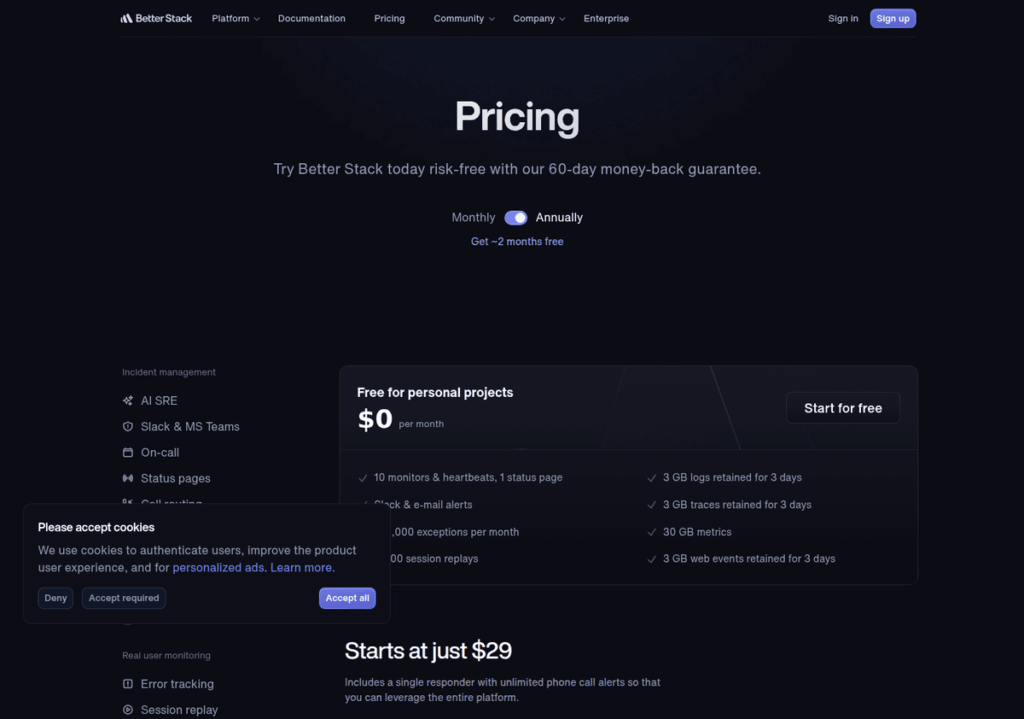
Sources: betterstack.com/pricing. The 60-day money-back guarantee and the modular assembly are real differentiators. The ceiling is depth: the alternatives below still own the per-module frontier.
How the five Better Stack alternatives split
The five alternatives below split by what they replace. Each one solves a specific weakness in Better Stack: APM depth, on-call maturity, error tracking depth, open-source anchoring, or OpenTelemetry-native query layer.
Datadog — full-stack observability platform
Pros: Broadest single-vendor coverage: APM, infrastructure monitoring, distributed tracing, logs, RUM, synthetic monitoring, network monitoring, Cloud SIEM, and Continuous Profiler in one query layer. APM Pro $35/host/mo annual; APM Enterprise $40/host/mo annual. Logs ingest $0.10/GB on-demand with 15-month metric retention on Pro. 1,000+ integrations. Cons: Per-GB ingest cost runs roughly an order of magnitude higher than Better Stack at the same retention tier, before counting per-host and custom-metric charges. Dozens of metered SKUs (Continuous Profiler $19/host, Container Monitoring $0.002/hr/container, Custom Metrics 100/host included) — the bill adds up faster than the headline. APM Enterprise needs its own host license.
PagerDuty + Atlassian Statuspage + UptimeRobot — incumbent best-of-breed on-call stack
Pros: PagerDuty is the deepest on-call product in the market after a decade of incumbency — advanced escalation policies, multi-region failover, dependency-aware alerting, AIOps. PD Reliability Platform Starter at $2,800/platform/yr includes 10 seats, 5,000 Signal Intelligence Events, 5,000 AI actions; larger tiers (Essential, Plus, Ultimate) unlock advanced escalation. Atlassian Statuspage covers the public status page; UptimeRobot covers external monitors from $9/mo on the cheapest paid annual plan (Solo) for 10 monitors at 1-minute checks. Cons: Three vendors, three bills, three dashboards. No native logs/traces/error tracking — you stack Datadog or Sentry on top. PagerDuty’s Reliability Platform moved to a platform-fee model; per-user billing on the legacy Digital Operations plans is the Professional $21/user/month tier.
Sentry — error tracking first, now with uptime and CRON
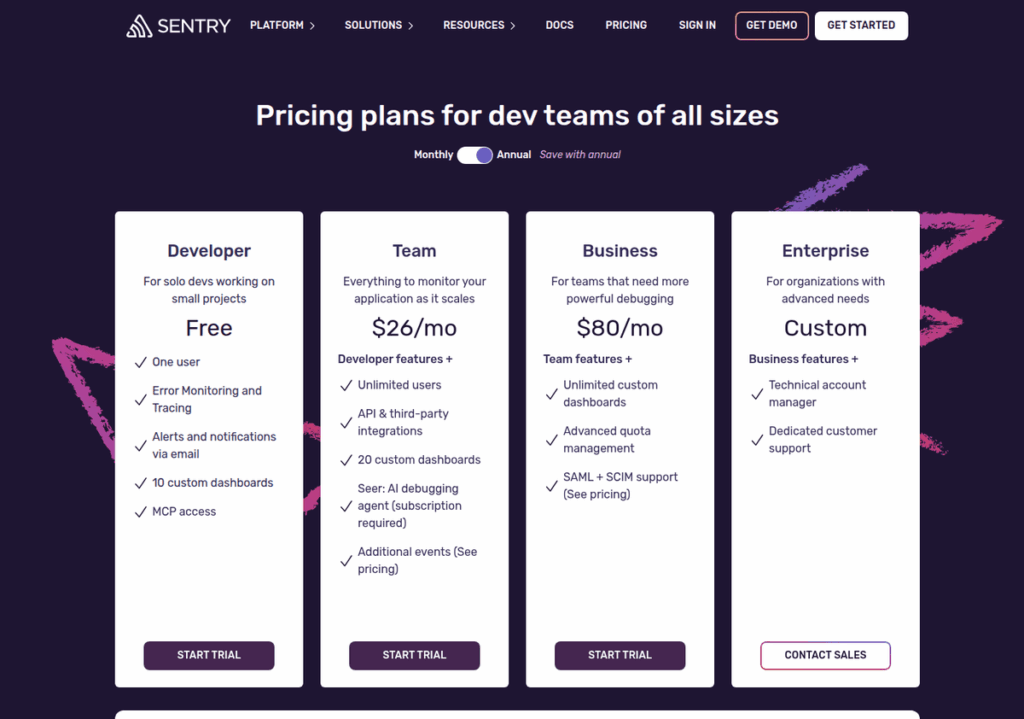
Pros: Deepest error tracking product in the market — source maps, release health, performance monitoring, replay, profiling, AI debugger (Seer), agent tracing. Sentry-compatible SDK means Sentry-instrumented apps drop in. Developer plan free for one user; Team at $26/mo annual includes 50K errors, 5 GB logs, 5 GB metrics, 5M spans, 50 replays, 1 uptime monitor, 1 CRON monitor; Business $80/mo adds SAML/SCIM. Uptime ($1/uptime alert) and CRON ($0.78/monitor) cover the external-monitoring gap. Cons: Better Stack’s “Sentry-compatible at one-sixth of the price” claim rests on a published $0.000075 per exception on annual billing; Sentry’s Team tier is $0.0003625 per error at the 50K–100K volume band. Per-event cost is the trade-off for Sentry’s feature depth. Session Replay at 50/month on Team is too tight for production.
Grafana Cloud — open-source-anchored observability
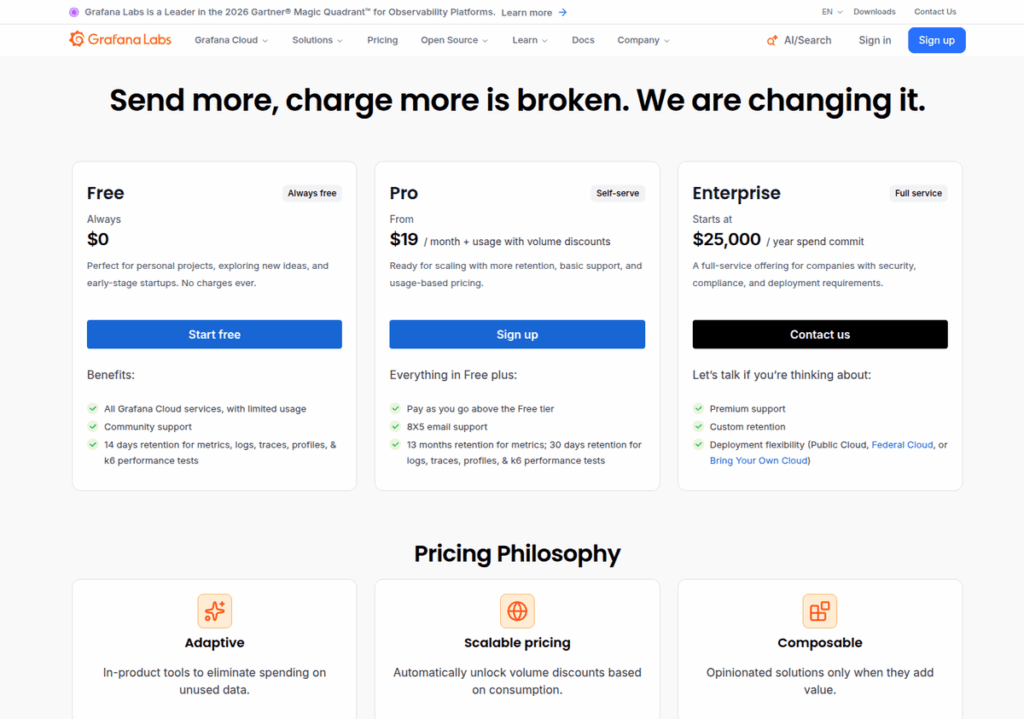
Pros: Built on the open-source stack the industry knows — Loki (logs), Mimir (metrics), Tempo (traces), Pyroscope (profiling), Faro (frontend), k6 (synthetics). Free tier is real: 10K metrics series, 50 GB logs, 50 GB traces, 50 GB profiles, 3 users, 14-day retention. Pro tier usage-based with Adaptive Logs (pay only for what you query); metric pricing on Pro is published at $6.50 per 1,000 active series (Enterprise as low as $3 per 1,000). IRM (Incident Response Management) included; Application and Frontend Observability are managed products with usage-based pricing. Cons: Pro pricing is usage-based and harder to budget than Better Stack’s fixed bundles. Grafana Enterprise starts at $25,000/year — overkill for most teams but the only path to Advanced features and SLA. Self-host option requires operating Loki/Mimir/Tempo yourself.
SigNoz — OpenTelemetry-native challenger
Pros: Built on OpenTelemetry and ClickHouse — the same query layer the largest observability vendors are moving to. Self-host option is a real differentiator for teams that want to keep telemetry on their own infrastructure. Pricing starts lower than Better Stack’s Mid bundle on comparable retention. Native traces, metrics, and logs in one binary. Cons: Smaller ecosystem than Grafana Cloud — fewer integrations, smaller community, no native IRM or on-call. Pricing pages publish less granular detail than Better Stack or Grafana; budget models are easier to build for fixed-bundle competitors. ClickHouse query performance and dashboard parity at sustained 1 TB/day ingest, and whether the alerting layer covers the multi-region failover and escalation policy surface Better Stack and PagerDuty ship, are the figures to validate on a 30-day pilot before committing.
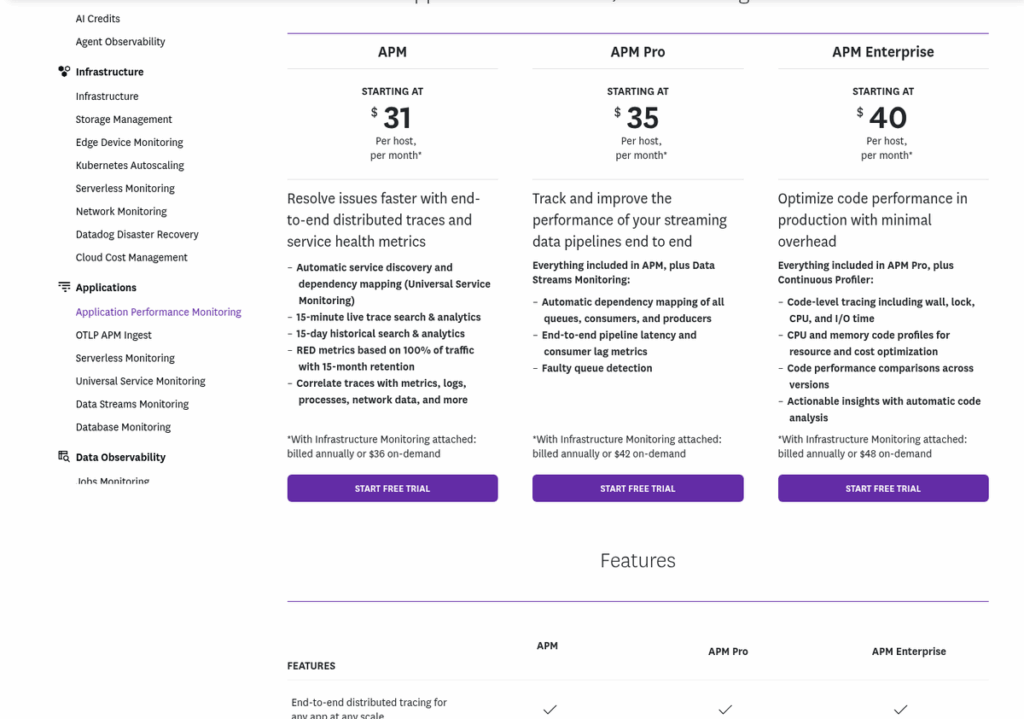
The pattern across all five is the same: the difference is what you pay for. How the modules are licensed. Better Stack pays per responder license + per-bundle + per-event overage. Datadog pays per host + per GB + per custom metric. PagerDuty pays per seat or per platform. Sentry pays per event at declining per-event rates. Grafana Cloud pays per active series + per GB queried. SigNoz pays per GB ingested + per day retention.
Side-by-side comparison
A single table cannot capture every nuance, but it does let you match the right shape of tool to the workload you actually have. Prices are from the official pricing pages, quoted in USD as displayed; promotional codes, custom enterprise SKUs, and dedicated infrastructure pricing are excluded.
| Better Stack | Datadog | PagerDuty + Statuspage + UptimeRobot | Sentry | Grafana Cloud | SigNoz | |
|---|---|---|---|---|---|---|
| Category | Modular incident-response platform | Full-stack observability platform | Incumbent on-call + status page + uptime stack | Error tracking first, with uptime/CRON | Open-source-anchored observability (Loki/Mimir/Tempo/Pyroscope) | OpenTelemetry-native observability on ClickHouse |
| Primary unit | Per responder license + per bundle + per event | Per host + per GB + per custom metric | Per seat (legacy Digital Ops) or per platform (Reliability Platform) | Per error + per GB + per span | Per active series + per GB + per user | Per GB ingested + per day retention |
| Free tier | 10 monitors + 1 status page + 3 GB logs + 100K exceptions | Permanent Free (up to 5 hosts, 1-day metric retention) | Free for a single team (PagerDuty Digital Ops Free) | Developer: 1 user, 5K errors, 5 GB logs, 50 replays | 10K series, 50 GB logs, 50 GB traces, 50 GB profiles, 14-day retention | Self-host free; Cloud free tier with limited retention |
| Cheapest paid | Responder $29/license/mo annual | APM Pro $35/host/mo annual | UptimeRobot Solo from $9/mo annual (10 monitors, 1-min checks) | Team $26/mo annual (50K errors, 5 GB logs) | Pro usage-based; Adaptive Logs pricing | Cloud from ~$49/mo comparable retention |
| Mid-tier | Micro bundle $100/mo annual + Responder $29/license | APM Enterprise $40/host/mo annual + logs usage | PagerDuty Starter $2,800/platform/yr (10 seats) + Statuspage $79/mo + UptimeRobot Scale $65–$77/mo | Business $80/mo annual (SAML/SCIM, 1K metric monitors) | Pro with Application Observability usage; IRM included | Cloud higher bundles or self-host on dedicated hardware |
| High-tier | Tera bundle $420/mo annual + per-event overage | Enterprise: custom pricing, 99.99% SLA | PagerDuty Ultimate: custom; Statuspage Enterprise $399/mo | Enterprise: custom (BAA, dedicated TAM) | Grafana Enterprise from $25,000/year | Enterprise custom |
| Logs billing | $0.10/GB ingest + $0.05/GB/mo retention (annual) | $0.10/GB on-demand + 15-month metric retention included (Pro) | None (use Datadog or Sentry logs on the side) | $0.50/GB additional logs on Team/Business | GB Write $0.10/GB, GB Process $0.40/GB, GB Retain usage-based | Per GB ingested + retention |
| Error tracking | $0.000075/exception (annual); Sentry-compatible SDK | $0.10–$0.38 per error indexed (varies by volume tier) | None | $0.0003625 to $0.0001500 per error (50K–20M+) | None built-in (logs/traces only) | None built-in |
| On-call / IRM | Responder: unlimited phone/SMS, escalation policies, status pages | Not native; integrates with PagerDuty | Native: advanced escalation, multi-region failover, AIOps | Not native; integrates with PagerDuty/Opsgenie | IRM Pro included; on-call schedules, rotations | Not native; integrates with PagerDuty/Opsgenie |
| Uptime monitoring | 10 monitors on Free; $21/50 monitors/mo (annual) | Synthetic Monitoring billed per test (range published per usage) | UptimeRobot Solo from $9/mo annual (10 monitors, 1-min checks) | 1 monitor on Free/Team; $1/uptime alert additional | Synthetic test per minute of run time | Native monitor support |
| Status pages | 1 page on Free; additional public pages at $12/page/mo | Not native | Atlassian Statuspage $79–$399/mo | Not native | IRM includes status page | Not native |
| Data residency | EU by default; US/SG on Enterprise | US/EU; custom on Enterprise | US (PagerDuty); EU (Statuspage EU) | US/EU on Enterprise | US (Grafana Cloud); self-host = your choice | Self-host = your choice; Cloud US/EU |
| Compliance | SOC 2 Type II, ISO 27001, GDPR; HIPAA on Enterprise with BAA | SOC 2 Type II, ISO 27001, HIPAA, FedRAMP | SOC 2 Type II, ISO 27001, HIPAA on Enterprise | SOC 2 Type II, ISO 27001, HIPAA on Enterprise | SOC 2 Type II | SOC 2 on Cloud; self-host = your compliance |
| Self-host option | No | No | No (UptimeRobot self-host discontinued) | No | Yes (Grafana OSS) | Yes (SigNoz OSS) |
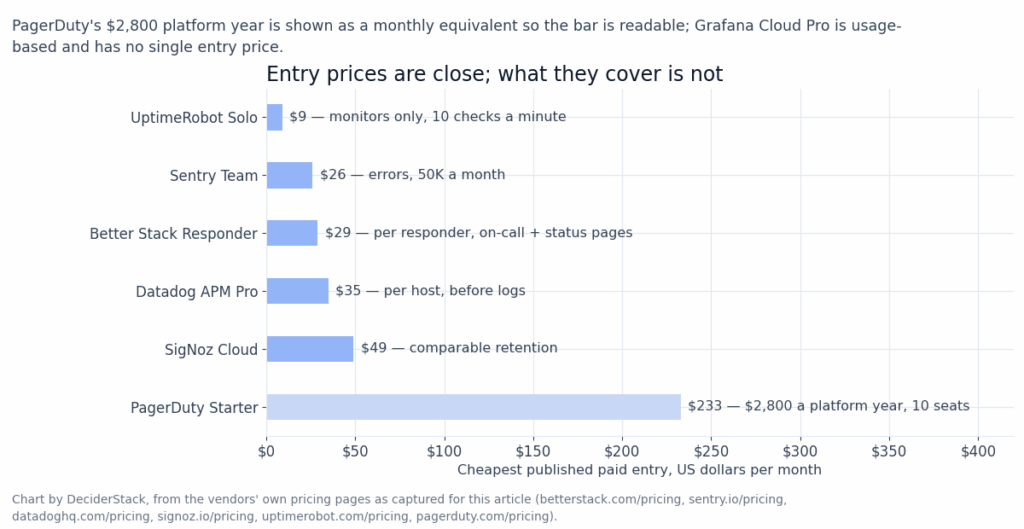
Sources: betterstack.com/pricing; datadoghq.com/pricing; pagerduty.com/pricing; sentry.io/pricing; grafana.com/products/cloud/pricing; signoz.io/pricing; uptimerobot.com/pricing. Compliance: betterstack.com/security; datadoghq.com/security; pagerduty.com/security; sentry.io/security; grafana.com/security; signoz.io/security.
Pricing mechanics that matter more than the headline number
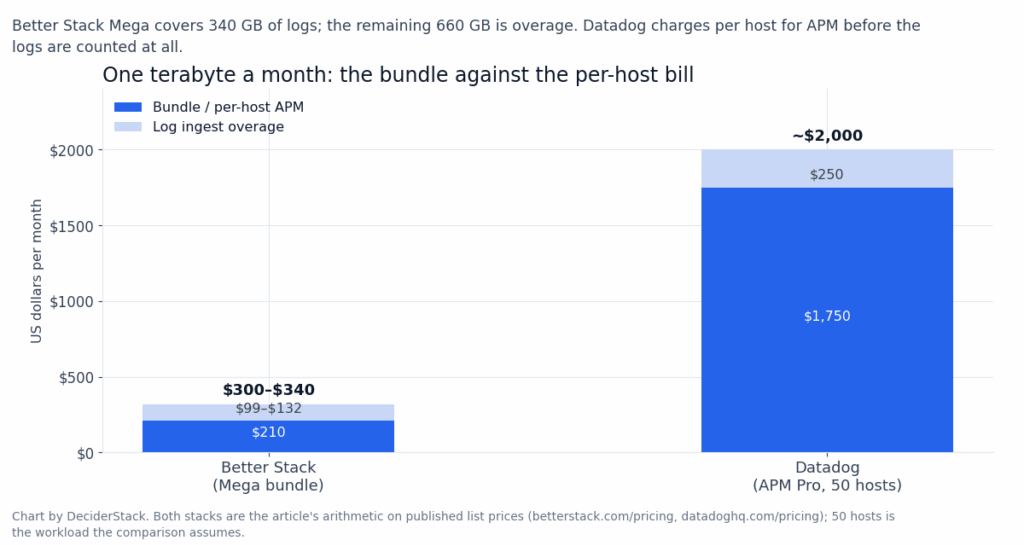
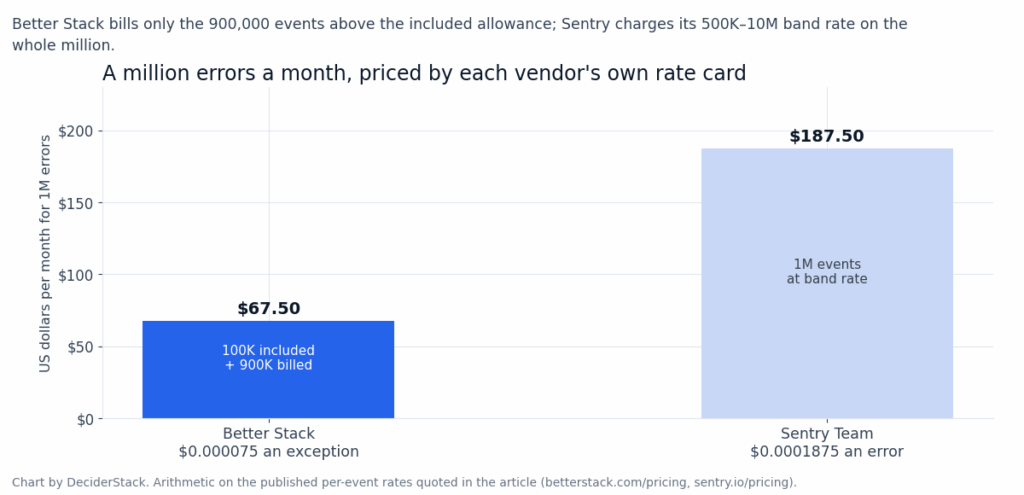
Better Stack vs Datadog on 1 TB/month ingest. Better Stack Mega ($210/mo annual) covers 340 GB each of logs/traces/metrics with 30-day retention. The remaining ~660 GB of logs at $0.10/GB ingest + $0.05/GB/mo retention lands at $99–$132/month in overage. Datadog logs at $0.10/GB on-demand, but APM Pro at $35/host is required for the same surface — at 50 hosts that’s $1,750/month before logs. Total on Datadog runs roughly $2,000/month for the same ingest + APM stack; Better Stack runs around $300–$340/month. The Datadog bill buys a deeper query layer and 15-month metric retention. The Better Stack bill buys consolidation and a known ceiling. Better Stack alternatives for on-call alone. Better Stack Responder at $29/license/mo annual covers incident management, status pages, and unlimited phone/SMS. For 5 responders, that’s $1,740/year or $145/month. PagerDuty Professional (legacy Digital Operations) at $21/user/month for 5 users is $1,260/year or $105/month; the Reliability Platform Starter at $2,800/platform/year includes 10 seats but locks in a platform fee. Add Statuspage ($79/mo Starter) and UptimeRobot Solo (from $9/mo annual for 10 monitors). Total $200–$300/month for the same on-call + status page + uptime surface. With three bills. Better Stack alternatives for error tracking alone. At 1 million errors/month on annual billing, Better Stack’s published rate is $0.000075 per exception. The published rate assumes the included events are used first: 1M events = 100K included + 900K × $0.000075 = $67.50 in overage. If you read the rate as a flat $0.000075 per event with no included allowance, 1M = $75. The published pricing page lists the included allowance, so the all-in figure for 1M errors/month is closer to $67.50 than $75. Sentry Team at the 500K–10M volume band is $0.0001875 per error, so 1M = $187.50. The trade-off is feature depth: Sentry’s release health, source maps, performance monitoring, replay, profiling, and AI debugger are deeper. Better Stack covers the SDK-drop-in case; Sentry covers the feature ceiling. Better Stack alternatives on open-source anchoring. Better Stack Nano ($25/mo annual) covers 40 GB each of logs/traces/metrics with 30-day retention — a real on-ramp. Grafana Cloud Free covers 50 GB each of logs/traces/profiles with 14-day retention for $0 — that’s a wider free tier. Grafana Cloud Pro is usage-based and harder to budget for predictable workloads. Better Stack’s fixed bundle pricing wins on predictability and loses on query flexibility. Better Stack alternatives on OpenTelemetry-native. SigNoz’s appeal is the ClickHouse query layer and the self-host option. Teams that want to keep telemetry on their own infrastructure, or that have a strong OpenTelemetry investment, find SigNoz more natural than Better Stack’s hosted stack. Pricing is competitive on a per-GB basis at low retention; feature breadth is narrower. Run a 1 TB/month pilot on each platform’s free or trial tier before committing. The cost on your workload is the only number pricing pages cannot give you.
Compliance, data residency, and SLA
The on-call and observability layer touches incident data — usually customer PII and production traces. Compliance posture varies more than the pricing. Data residency. Better Stack stores telemetry in EU regions in GDPR-compliant DIN ISO/IEC 27001-certified data centers by default; US/SG on Enterprise. Grafana Cloud US-default with EU; self-host = your choice. Datadog, PagerDuty, and Sentry US-default with EU on Enterprise. SigNoz self-host = your choice; SigNoz Cloud US/EU. Compliance. Better Stack publishes SOC 2 Type II, ISO 27001, GDPR; HIPAA on Enterprise with a signed BAA. Datadog, PagerDuty, Sentry, and Grafana Cloud publish SOC 2 Type II and ISO 27001; HIPAA on Enterprise tiers. SigNoz Cloud publishes SOC 2; HIPAA and BAA on Enterprise. SLA. Datadog publishes a 99.99% SLA on Enterprise APM and Synthetic Monitoring. Better Stack, PagerDuty, Sentry, Grafana Cloud, and SigNoz publish uptime targets in the 99.9%–99.99% range depending on tier. Enforcement is by tier and by contract; confirm the SLA tier and credits on your contract before running production, since credit terms and the trigger tier are negotiated.
When Better Stack is the right pick
Pick Better Stack when you want one vendor for the incident-response chain end to end. Pick when you are running a small to mid-size team (5–50 engineers) and the per-module ceiling is acceptable. Pick when you want the Sentry-compatible error tracking SDK to drop in at one-sixth of Sentry’s per-event cost. Pick when you want EU data residency by default without negotiating Enterprise terms. Pick when you want a 60-day money-back window on the first annual cycle. Pick when you would rather pay a fixed annual bundle than a usage-based bill. Pick when you need a free tier generous enough to evaluate on a real workload.
When the alternatives make more sense
- Datadog when the deepest APM and infrastructure monitoring in the category is the bottleneck. Pick when you run a large fleet (50+ hosts) where per-host pricing beats per-GB pricing. Pick when you need 15-month metric retention out of the box, or a single query layer across APM, RUM, infrastructure, logs, and synthetic monitoring.
- PagerDuty + Statuspage + UptimeRobot when on-call maturity is the headline (multi-region failover, advanced escalation, dependency-aware alerting, AIOps). Pick when you already have separate observability and error tracking tools, and you accept the integration overhead of three vendors.
- Pick when you need release health, source maps, performance monitoring, replay, profiling, and the AI debugger. Pick when you want a free Developer plan for one user.
- Grafana Cloud when you want the open-source stack (Loki/Mimir/Tempo/Pyroscope). Pick when you want to keep the query language you already have (LogQL, PromQL). Pick when you want a real self-host option, or want to consolidate logs and traces without paying for incident management you do not need.
- SigNoz when OpenTelemetry-native ingestion is the priority. Pick when you want a ClickHouse query layer. Pick when you want to self-host the observability stack on your own infrastructure, or want a smaller price tag at comparable retention.
Key parameters at a glance
| Vendor | Cheapest paid | Mid-tier | Free tier | Native unit | Built-in on-call | Self-host | Best fit |
|---|---|---|---|---|---|---|---|
| Better Stack | Responder $29/license/mo annual | Micro bundle $100/mo + Responder | 10 monitors, 1 status page, 3 GB logs | Per responder + per bundle + per event | Yes (Responder) | No | Consolidated incident-response stack |
| Datadog | APM Pro $35/host/mo annual | APM Enterprise $40/host/mo annual | Permanent Free (up to 5 hosts, 1-day metric retention) | Per host + per GB + per metric | Not native (PagerDuty integration) | No | Deepest APM and full-stack observability |
| PagerDuty + Statuspage + UptimeRobot | UptimeRobot Solo from $9/mo annual | PagerDuty Starter $2,800/yr + Statuspage $79/mo + UptimeRobot Scale from $65/mo annual | PagerDuty Free for single team | Per seat or per platform | Yes (PagerDuty) | No | On-call maturity + status page + uptime best-of-breed |
| Sentry | Team $26/mo annual (50K errors) | Business $80/mo annual (SAML/SCIM) | Developer: 1 user, 5K errors | Per error (declining per-event) | Not native | No | Deepest error tracking + monitoring |
| Grafana Cloud | Pro usage-based from $0 + usage | Pro + Application Observability usage | 50 GB logs, 50 GB traces, 50 GB profiles | Per 1,000 active series + per GB | Yes (IRM Pro) | Yes (Grafana OSS) | Open-source-anchored observability |
| SigNoz | Cloud from ~$49/mo | Cloud higher bundles or self-host | Self-host free; Cloud limited free | Per GB ingested + per day retention | Not native | Yes (SigNoz OSS) | OpenTelemetry-native with self-host |
FAQ
What does Better Stack actually replace?
The consolidation pitch covers five tools teams typically run separately: an uptime monitor (UptimeRobot, Pingdom). An on-call/alerting tool (PagerDuty, Opsgenie). A status page (Statuspage, Instatus). A logs/traces/metrics platform (Datadog, Grafana Cloud, Elastic). An error tracker (Sentry, Rollbar).
Responder covers on-call, incident management, and status pages; Telemetry bundles cover logs/traces/metrics. Modules can be adopted independently. Which alternative is cheapest for a small team?
Better Stack Nano ($25/mo annual) plus Responder ($29/license/mo) for two responders lands around $83/month annual — the cheapest published on-ramp. Grafana Cloud Free is $0/month for 50 GB of logs/traces/profiles but no on-call.
SigNoz self-host is $0/month plus operational cost. Sentry Developer is $0/month for one user. Which alternative has the deepest APM?
Datadog. APM Pro $35/host/mo annual, APM Enterprise $40/host/mo annual; the query layer spans APM, infrastructure, distributed tracing, RUM, synthetic monitoring, network monitoring, and continuous profiling.
Which alternative has the deepest on-call product?
PagerDuty. After a decade of incumbency, PagerDuty ships advanced escalation, multi-region failover, dependency-aware alerting, AIOps, and a deep audit-log surface.
Better Stack Responder covers the standard cases; the edge cases still favor PagerDuty. Which alternative has the deepest error tracking?
Sentry. Release health, source maps, performance monitoring, replay, profiling, AI debugger (Seer), agent tracing — Sentry is the deepest product in the category.
Better Stack’s error tracking module is Sentry-compatible at one-sixth of the per-event price. Do any alternatives have a permanent free tier?
Grafana Cloud Free is permanent (50 GB logs/traces/profiles, 10K active series, 14-day retention). Sentry Developer is permanent for one user. Better Stack Free is permanent for personal projects. SigNoz self-host is permanent and free. Datadog publishes a permanent Free plan (up to 5 hosts, 1-day metric retention) in addition to its 14-day trial of paid features.
PagerDuty publishes a Free tier for a single team. Which vendor has the strongest open-source anchoring?
Grafana Cloud (Loki, Mimir, Tempo, Pyroscope — all OSS) and SigNoz (OpenTelemetry + ClickHouse, self-host OSS option).
Datadog and Sentry publish no self-host option. Better Stack and PagerDuty publish no self-host option. Can I keep my Sentry-instrumented apps if I switch to Better Stack?
Yes. Better Stack’s error tracking module ships a Sentry-compatible SDK, so existing Sentry-instrumented apps drop in without re-instrumentation.
The published per-exception price on annual billing is $0.000075 (100,000 exceptions included), roughly one-sixth of Sentry’s per-event rate at the 500K–10M band. What changes at annual billing?
Better Stack: ~17–25% off (Responder $34/mo monthly → $29/mo annual). Datadog: billed annually at the published rate or ~$18/host on-demand for APM Pro. Grafana Cloud: usage-based regardless of term. Sentry: “save with annual” on the calculator. PagerDuty: annual contracts unlock the Reliability Platform tiers.
Verdict
Better Stack in 2026 is the strongest off-the-shelf option for engineering teams that want to replace four or five separate vendors with a single platform under one bill. Spend the free tiers on each before you commit.
How we put this comparison together: plan prices, billing units, free-tier limits, and per-event rates come from official pricing pages — betterstack.com/pricing, datadoghq.com/pricing/, pagerduty.com/pricing/, sentry.io/pricing/, grafana.com/products/cloud/pricing, signoz.io/pricing — captured via self-hosted Firecrawl, quoted in USD as displayed.
We have not run a paid account on any of the six vendors, so figures that depend on real-world ingest cost, on-call escalation behavior, or production volume are flagged where they appear in the text instead of being estimated.
Our scoring criteria are documented on the methodology page.
Disclosure: this article contains affiliate links. If you buy through them we may earn a commission at no extra cost to you. Commission never changes our scoring or the order of a ranking.