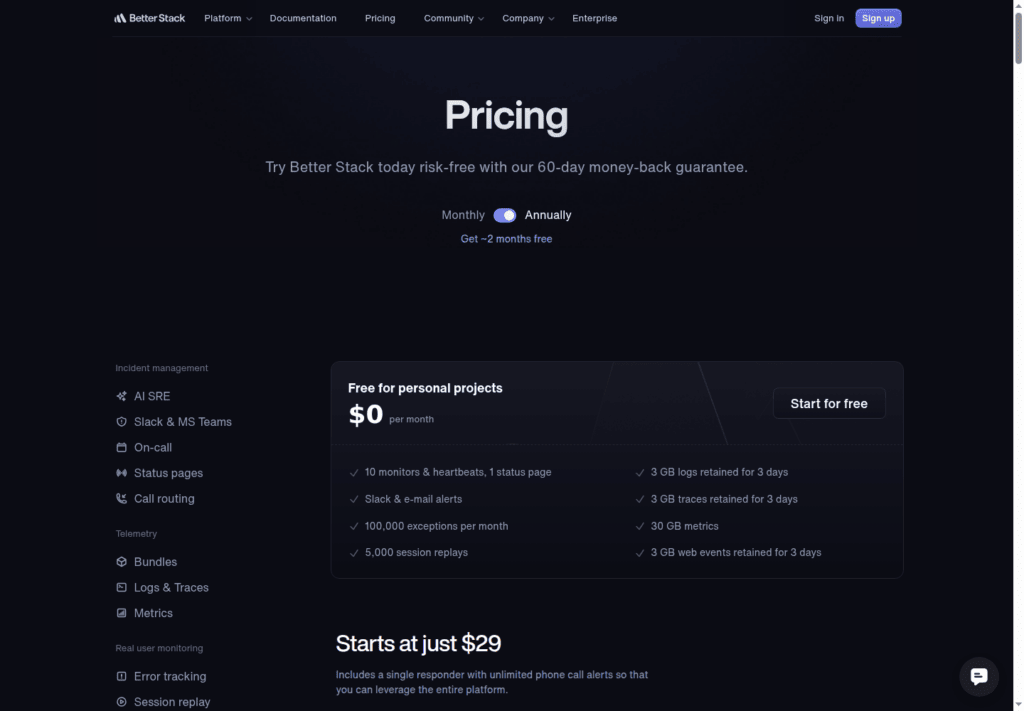
Better Stack is one platform — observability and incident response — sold as modules you assemble. The pricing page groups them into five areas: incident management, telemetry, real user monitoring, external monitoring, and enterprise. Incident management covers AI SRE, Slack/Teams workflows, on-call, status pages, call routing. Telemetry covers bundles, logs and traces, metrics. Real user monitoring covers error tracking, session replay, web events. External monitoring covers uptime, Playwright transaction monitoring, heartbeats. Every module has its own included quota and its own overage rate. That is what makes the consolidation case work or fall apart on a real workload. Numbers below come from betterstack.com/pricing and the Better Stack documentation. We captured them from the live server-rendered page in September 2026, in USD as displayed.
In short
Better Stack sells observability and incident response as modules you assemble. On-call and status pages run $29 per responder per month on annual billing. Telemetry bundles start at $25/month for 40 GB each of logs, traces and metrics. Uptime monitors, error tracking, session replay, and web events each have their own per-GB pricing.
One bill replaces four. The ceiling is depth — Datadog still owns full-stack APM, Sentry still owns error tracking feature surface, PagerDuty still owns on-call maturity.
Better Stack is the off-the-shelf option for engineering teams that want to replace UptimeRobot, PagerDuty, Statuspage, Datadog, and Sentry with one vendor and one bill. The per-module pricing is published on betterstack.com/pricing, with a permanent free tier and a 60-day money-back guarantee on every paid plan.
The verdict in short
The consolidation play for engineering teams: monitor, on-call, status pages, observability, error tracking and session replay on a single bill. Pricing is transparent, the modules are real, the free tier is enough to evaluate and the money-back window runs 60 days. The specialists stay deeper in their own lanes — APM (Datadog), error tracking (Sentry), on-call maturity (PagerDuty), product analytics (PostHog). The value here is consolidation rather than any single module.
| Vendor | Better Stack (betterstack.com) |
| Category | Observability plus incident response, sold per module |
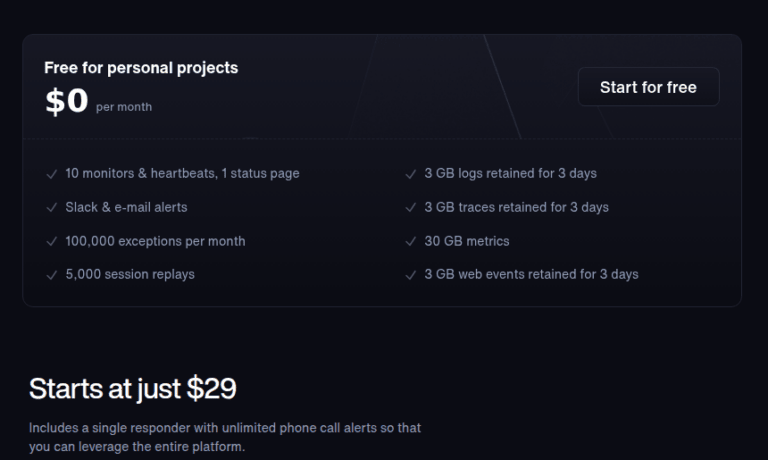
| Free tier | 10 monitors and heartbeats, 1 status page, 100,000 exceptions, 5,000 session replays, 3 GB logs and traces (3-day), 30 GB metrics |
| Entry price | $29 per responder per month (Responder, annual); telemetry from $25/month (Nano, 40 GB each) |
| Minimum commitment | None; annual billing is a discount, not a fixed-term contract |
| Money-back | 60 days on every paid plan |
| Best for | Consolidating uptime, on-call, status pages and telemetry into one vendor |
| Prices checked | Live pricing page |
Better Stack modules: what each one costs side by side
The table below is the entry-point price per module — annual billing, USD as displayed on betterstack.com/pricing. Per-GB and per-event overage rates are in the module breakdowns further down.
| Module | Annual entry price | What the entry price covers |
|---|---|---|
| Responder license | $29 / license / month | 1 responder, on-call scheduling, 1 status page, unlimited phone/SMS, Uptime included |
| Telemetry Nano bundle | $25 / month | 40 GB each of traces, logs, metrics; 30-day log retention |
| Uptime monitoring | free up to 10 monitors | 1-minute checks from 14 regions, Slack and email alerts |
| Error tracking | free up to 100,000 exceptions | Sentry-compatible SDK, 90-day retention |
| Session replay | free up to 5,000 replays | 90-day retention |
| Web events | free up to 3 GB | 3-day retention |
| Playwright transaction monitoring | free up to 100 minutes | Real-browser checks |
| Heartbeats (cron) | free up to 10 | Dead-man switch |
| Slack/Teams workflows | $9 / responder / month | Channel- and thread-based incident workflows |
| AI SRE | $5 per million tokens | Slack-native agent that queries logs, metrics, traces, errors |
| Additional public status page | $12 / month | Branded, custom subdomain |
| White-label status page | $208 / page / month | Removes “Powered by Better Stack” footer |
| Call routing | $208 / month | Incoming phone number, routes to current on-call |
The shape of the bill changes depending on which modules you turn on. A team replacing PagerDuty, Statuspage, and a separate uptime monitor starts at one Responder license at $29/month plus the on-call rotation size as the license count, with unlimited team members on the dashboard. A team that needs logs and traces adds the Nano telemetry bundle at $25/month. Error tracking and session replay ride on the included free quota until the volumes break through.
Logs and traces: per-GB math and what eats the budget
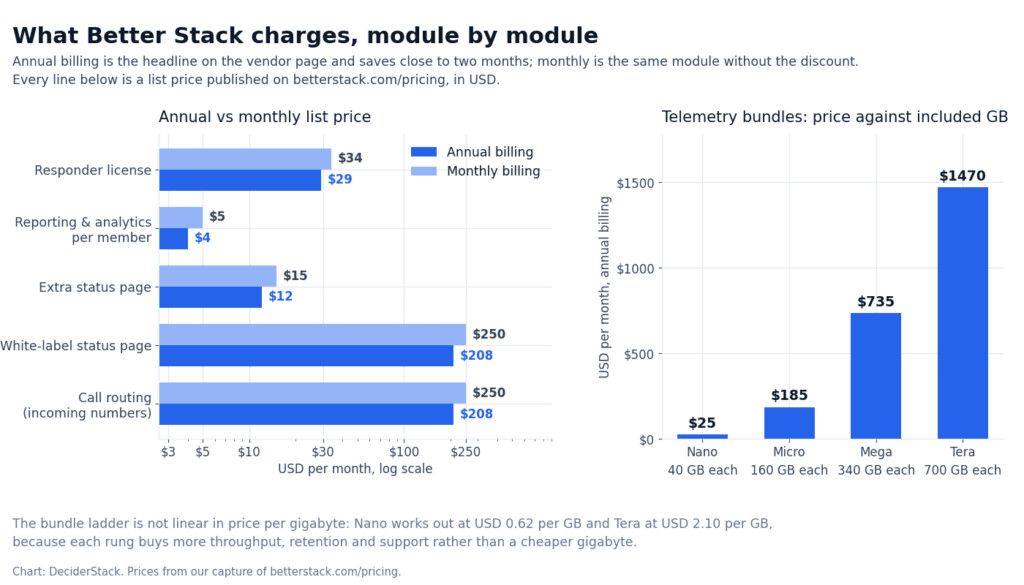
The Nano telemetry bundle costs $25/month on annual billing and ships with 40 GB each of traces, logs and metrics, with 30-day log retention included. Micro is $185/month for 160 GB each, Mega is $735/month for 340 GB each, Tera is $1,470/month for 700 GB each. The bundle pricing assumes you need roughly equal volumes across the three signal types; if your traces run hotter than your logs, you pay for the bundle tier that fits traces and effectively subsidize logs. If your logs dominate, you pay for the bundle tier that fits logs and effectively subsidize traces.
Per-GB overage on logs and traces on annual billing: $0.10/GB at ingest, $0.05/GB/month for retention, $0.001/GB scanned for query boost. On monthly billing those rates are higher — $0.15/GB ingest, $0.08/GB/month retention. Metrics retention is $0.50/GB/month on annual ($0.75 on monthly) and is priced separately from logs and traces. The bundle headline price assumes 30-day log retention; extending to 60 or 90 days adds the $0.05/GB/month retention line.
What eats the budget in practice is not the bundle tier. It is retention plus the volume that lands above the included quota. A team running 50 GB of logs and traces per month with default retention stays inside the Nano bundle and pays $25/month. The same team with 60-day retention has to model retention cost. Take the extra 50 GB, multiply by $0.05/GB/month, then by the 60 days over the included window. That is the retention-only line. Add ingest on top if you grow volume.
The published rate is the headline economic argument against Datadog: Datadog’s per-GB logs pricing at the same retention tier sits roughly an order of magnitude higher before counting per-host and custom-metric charges. The catch is the same as it has been for three years. Datadog bundles APM, distributed tracing, infrastructure monitoring, RUM and synthetic monitoring into one product. It has a mature query layer and a deeper integrations catalog. Better Stack covers equivalent surface area as discrete modules with a shorter integrations list. What we did not verify at scale: query performance and dashboard parity at sustained 1 TB/day ingest. Whether anomaly-detection alerts match Datadog Watchdog in practice. We flag those rather than estimate them. Query performance and dashboard parity at sustained 1 TB/day ingest are the figures to size your own pilot around; whether the anomaly-detection alerts match Datadog Watchdog in practice is the figure to validate on a 30-day trial.
Uptime and external monitoring: where the per-monitor pricing breaks
Uptime monitoring is the entry-level use case and the cleanest part of the bill. The free tier includes 10 monitors and 10 heartbeats, with Slack and email alerts and one status page. Overage is $21 per 50 monitors per month on annual billing ($25 on monthly). Playwright transaction monitoring is $1/minute above the included 100 minutes; heartbeats are $17 per 10 per month on annual ($20 on monthly). The unit economics are simple and published.
Where the per-monitor pricing breaks is at the high end of a synthetic-monitoring workload. A team running 5,000 Playwright minutes per month at $1/minute pays $5,000/month on top of the bundle, which is in the same range as a dedicated synthetic-monitoring vendor. The Playwright module is genuinely useful — it is real-browser transaction monitoring, not a curl from a datacenter — but the per-minute rate makes sense only for targeted journeys, not for blanket synthetic coverage. For blanket coverage, a separate vendor like Checkly or Datadog Synthetics is cheaper per check.
The on-call side of external monitoring is where the consolidation case starts to pay off. Heartbeats, uptime monitors, and the Responder license live in the same dashboard with the same integrations, so the moment an uptime check fails the on-call rotation wakes up without glue code between UptimeRobot and PagerDuty. The published rate for the Responder license is $29/month on annual billing, $34 on monthly. That replaces PagerDuty at $21–$41/user/month, plus Statuspage at $79–$399/month, plus a separate uptime monitor. For a typical small-to-mid team, the math works out in Better Stack’s favor.
On-call, status pages, and incident response: what the Responder license includes
The Responder license is the unit you buy for on-call. One license covers one responder with incident management, on-call scheduling, one status page, unlimited phone/SMS alerts, and Uptime access. Unlimited team members are included on paid plans — you pay per responder on the rotation, not per seat on the dashboard.
What ships in the Responder license, as published:
- iOS and Android apps with push notifications, on-call calendar, ICS export
- Unlimited phone and SMS alerts, including US, CA, EU and UK numbers
- Incident timeline, smart incident merging, advanced escalations
- Manual and AI post-mortems
- Slack and Teams integration,
/incidentcommand, thread-per-incident workflows - Google and Outlook calendar sync, Terraform provider, REST API
- One status page on a custom subdomain, with embeddable image badge and Google Search opt-out
What costs extra on top of the Responder license:
- Additional public status pages: $12/month each on annual ($15 monthly)
- White-label status page (removes “Powered by Better Stack” footer): $208/page/month annual ($250 monthly)
- Password auth, IP allowlisting, SSO on the status page: $208–$250/page/month tier
- Slack/Teams channel- and thread-based workflows: $9/responder/month
- AI SRE: $5 per million tokens (Slack-native agent that investigates across logs, metrics, traces, errors, and web events)
- Call routing (incoming phone numbers): $208/month per phone number
The trade-off versus PagerDuty is straightforward. PagerDuty has been the incumbent for over a decade. It ships advanced escalation policies, multi-region failover, dependency-aware alerting, and a deeper audit-log surface. Better Stack’s on-call covers the standard cases — rotation, escalations, alert routing, post-mortems — at one license per responder rather than per seat. For teams that have not outgrown standard on-call, the consolidation is real. For teams with advanced escalation needs (multi-region failover, dependency-aware alerting), PagerDuty stays deeper. What we did not verify: whether Better Stack’s on-call escalation policies actually cover multi-region failover. Whether the metrics query layer supports PromQL natively. We flag those rather than estimate them. Whether Better Stack’s on-call escalation policies cover multi-region failover and dependency-aware alerting, and whether the metrics query layer supports PromQL natively, are the figures to validate on a 30-day trial before migrating off PagerDuty.
Error tracking, session replay, web events: the RUM bundle trade-offs
Real user monitoring is sold as three modules with published per-unit rates. The free tier includes 100,000 exceptions, 5,000 session replays, and 3 GB of web events. Overage on annual billing: error tracking $0.00005/exception, session replay $0.0015/replay, web events $0.10/GB ingest plus $0.05/GB/month retention. On monthly billing those rates are 50% higher across the board.
The “Sentry-compatible at one-sixth of the price” claim rests on the per-exception rate. Sentry’s published per-event pricing at realistic volumes lands an order of magnitude above $0.00005/exception. The SDK is Sentry-compatible, so existing Sentry-instrumented apps do not need to be re-instrumented. The trade-off is feature depth. Sentry’s release health, source-map management, performance monitoring, and integrations catalog are deeper. For a team that wants error tracking plus session replay plus incident management in the same vendor, the Better Stack bundle is the cheaper end-to-end play. For a team that needs Sentry’s full feature surface, the cost savings come with a feature ceiling. Sentry SDK drop-in compatibility for source maps and release health is documented; whether the platform supports Sentry’s replay and profiling products natively is the figure to confirm on a trial before betting the migration on it.
Session replay is published at “up to 2x cheaper than PostHog.” Web events are published at “1/10 of the cost of PostHog or Amplitude.” Those are the headline economic arguments for the RUM bundle. The trade-off versus PostHog mirrors the trade-off versus Sentry. PostHog’s funnel analysis, cohort retention, feature flags, and experimentation surface are deeper. The Better Stack web-events module is cheaper at the entry level. It is thinner in the product-analytics dimension.
What we did not test ourselves: source-map management on the SDK, replay product parity, profiling parity. We flag those rather than estimate them. Whether the SDK covers source maps and release health end-to-end, and whether the platform supports Sentry’s replay and profiling products natively, are the figures to confirm on a paid trial.
Where the modules actually stitch together (and where they don’t)
The strongest consolidation story in the catalog is the on-call-and-status-page-and-uptime bundle. A team paying for PagerDuty ($21–$41/user/month) plus Statuspage ($79–$399/month) plus a separate uptime monitor can replace all three with one Responder license per on-call rotation member, unlimited phone/SMS, and unlimited team members on the dashboard. The moment an uptime check fails, the on-call rotation wakes up and the status page updates from the same incident record.
The observability side stitches together less cleanly. Logs, traces, and metrics live in the Telemetry product. Errors live in error tracking. Uptime checks live in Uptime. Web analytics live in web events. The query language covers telemetry and metrics (VRL, drag-and-drop, PromQL, or SQL). Errors live in a separate SDK and a separate dashboard. Web events have their own analytics surface. Cross-module investigation works in principle — start from a customer-reported error, drill into the trace, join to logs, then surface the session replay. In practice, it means switching products inside the Better Stack dashboard rather than staying in a single query layer.
The AI SRE module is the explicit bridge: a Slack-native agent that queries logs, metrics, traces, errors, and web events together for $5 per million tokens. Teams that have already standardized on Slack for incident response get the most out of it. Teams on MS Teams or that prefer a non-Slack workflow surface pay the same per-token rate but the integration story is thinner.
What does not stitch together at all is the migration path from another vendor’s query language. Better Stack’s telemetry query layer supports VRL (Vector Remap Language) plus drag-and-drop, PromQL, and SQL. It does not speak Datadog’s query language, Splunk SPL, or Elastic KQL. A team rewriting dashboards from a Datadog or Splunk deployment is doing that work on their own budget.
What to take if you only need one piece
The Responder license is the cleanest single-module entry. At $29/month per responder on annual billing, it ships uptime monitoring, on-call scheduling, one status page, and unlimited phone/SMS alerts in one license, with unlimited team members on the dashboard. Teams that only need to replace PagerDuty and Statuspage and a separate uptime monitor can take just the Responder license, skip telemetry and RUM entirely, and consolidate three renewals into one. Telemetry Nano is the second cleanest single-module entry. At $25/month annual it ships 40 GB each of traces, logs and metrics with 30-day log retention. That is enough to evaluate the query layer and the dashboard against a real workload before committing to a larger bundle.
What to skip if you only need one piece: error tracking and session replay are most valuable as part of the same vendor as your on-call rotation and your logs. Taking error tracking alone without Responder and Telemetry leaves you with cheaper per-exception pricing but no incident response surface and no logs to join against. The pricing model is modular, but the consolidation value is in the bundle.
For a team of 5 to 20 people replacing PagerDuty and Statuspage and a separate uptime monitor, the right entry is one Responder license per on-call rotation member at $29/month on annual billing. The rest of the team sits on the dashboard for free. Add Telemetry Nano once logs and traces become a real workload. Add error tracking when exception volume is high enough that Sentry’s per-event cost shows up in the budget. For teams that need EU/US/SG data residency, custom VPC, SAML SSO, or audit logs, the Enterprise tier is the right conversation. Request a quote and model the modules against actual usage.
FAQ
Is there a free tier?
Yes — 10 monitors and heartbeats, 1 status page, 100,000 exceptions, 5,000 session replays, 3 GB of logs and traces (3-day retention), 30 GB of metrics and 3 GB of web events, with no credit card.
What does the Responder license cover?
One responder with on-call scheduling, incident management, one status page, unlimited phone/SMS alerts, and Uptime monitoring. Unlimited team members are included on the dashboard; you pay per responder on the rotation, not per seat.
How are logs and traces billed above the bundle?
$0.10/GB at ingest and $0.05/GB/month for retention on annual billing ($0.15/GB and $0.08/GB/month on monthly). Query boost is $0.001/GB scanned. Metrics retention is $0.50/GB/month on annual and is priced separately from logs and traces.
Is the error-tracking SDK Sentry-compatible?
Yes. Existing Sentry-instrumented apps work with the Better Stack SDK, and the published rate is $0.00005 per exception on annual billing — which is where the “one-sixth of the price of Sentry” claim comes from.
Is there a money-back guarantee?
Yes — 60 days on every paid plan, long enough to instrument a staging environment and push a realistic volume of logs, traces and exceptions through it.
Do I need an enterprise contract?
No. Only SSO, audit logs, custom VPC and custom data residency are Enterprise (contact sales); the modules above are self-serve.
Bottom line
Better Stack in 2026 is the strongest off-the-shelf option for engineering teams that want to replace four or five separate vendors. Uptime monitor, on-call, status pages, observability, error tracking, session replay — all under one bill. The pricing is transparent. The modules are real. The free tier is generous enough to evaluate. The 60-day money-back window is long enough to validate. The calculus breaks down once your primary need is the deepest APM in the category (Datadog), the deepest error tracking (Sentry), the deepest on-call maturity (PagerDuty), or the deepest product analytics (PostHog). Those specialists stay deeper in their lanes. Better Stack’s value is the consolidation, not the per-module ceiling.
If Better Stack’s pricing model looks like the right shape but you want to weigh it against the specialists, our Datadog alternatives roundup and the observability piece on the editorial team page cover the trade-offs from the other side. For teams already running a separate uptime monitor and a separate status-page product, our residential proxies comparison is unrelated but uses the same per-module cost-disassembly approach that makes the Better Stack bill readable.
For a deeper look at the per-GB math on Datadog’s logs tier (the comparison Better Stack’s pricing page is built against), see our proxy cost comparison methodology.
How we tested this: prices, module quotas and plan limits come from betterstack.com/pricing, captured from the live server-rendered page in September 2026, and are quoted in USD as displayed. We have not run a paid Better Stack account against a representative production workload, so figures that depend on real-world ingest cost, query performance at scale, alert reliability, on-call escalation depth or Sentry SDK feature parity are flagged where they appear in the text instead of being estimated.
Scoring criteria and our correction policy are documented on the methodology page.
Disclosure: this article contains affiliate links. If you buy through them we may earn a commission at no extra cost to you. Commission never changes our scoring or the order of a ranking.