
Most cloud-storage services treat encryption as the paid upgrade. Internxt treats it as the floor. Every plan — including the free tier — ships with end-to-end, post-quantum encryption, open-source clients, and EU jurisdiction baked in; you do not unlock zero-knowledge by paying more, you unlock storage volume. That single decision is why Internxt keeps showing up in privacy-focused best-of lists, and why it keeps getting compared to Proton Drive, Tresorit, and Sync.com.
The math against Dropbox, Google Drive, iCloud, and Proton Drive is the harder question. Prices on internxt.com/pricing are EUR only — there is no currency switcher on the live page. USD figures below are conversions at the ECB reference rate of 1 EUR = 1.1367 USD for September 2026. The page renders prices client-side, so the prices you see in your browser are what the article cites. Anything we could not verify without a paid account — real sync speed, mobile reliability, post-quantum audit scope — is flagged where it appears rather than guessed at.
In short
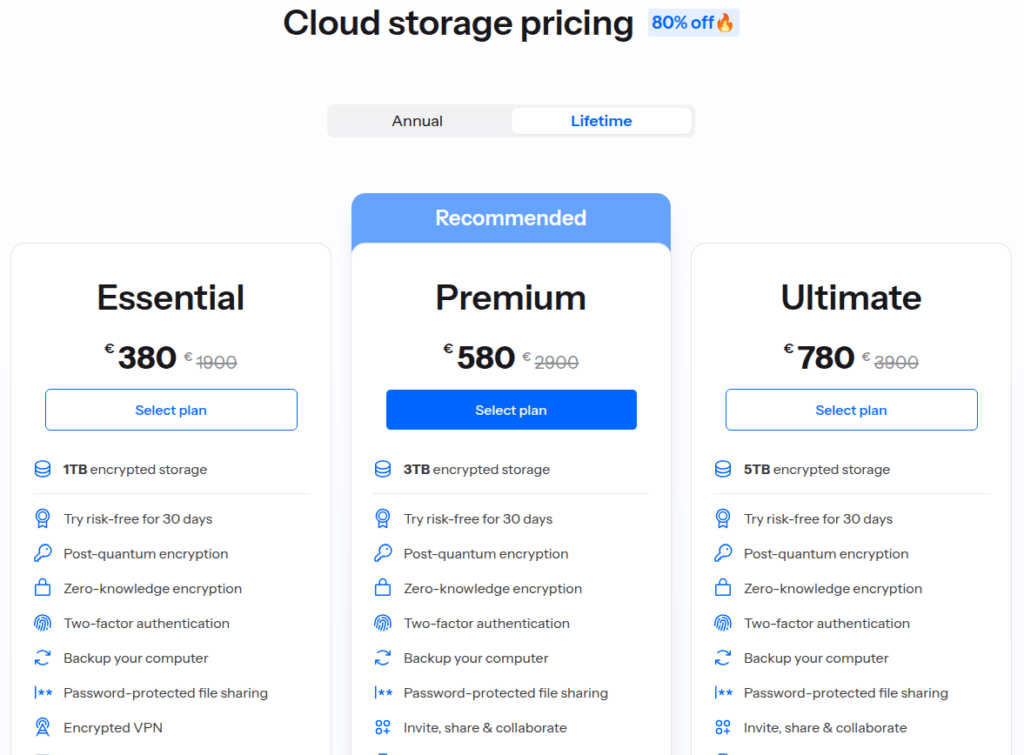
Internxt sells encrypted cloud storage in three sizes — 1 TB, 3 TB and 5 TB — billed either as an annual subscription or as a one-time lifetime plan. The free tier is 1 GB for life, no credit card. Paid annual plans start at €1.99 for the first month and renew at €9.99/month for the 1 TB Essential tier. Lifetime plans are €380, €580, and €780 for the same 1 TB, 3 TB, and 5 TB buckets.
Internxt ships zero-knowledge and post-quantum encryption as the default — every plan, including the 1 GB free tier, is encrypted at the client; the server only sees ciphertext. Storage buckets are 1 TB, 3 TB and 5 TB. Paid annual plans start at €1.99 for the first month and renew at €9.99/month for the 1 TB Essential tier; lifetime plans are €380, €580, €780 one-time for the same buckets. The encryption story is not unique (Proton Drive, Tresorit, Sync.com make similar claims); the storage-volume lead and the lifetime option are. Pricing is EUR-only on the official page; numbers below are converted at the ECB reference rate of 1 EUR = 1.1367 USD for September 2026.
The verdict in short
The pick for buyers who need zero-knowledge encryption shipped as the default rather than as an upgrade. The audit (Securitum, see the security section of internxt.com), the open-source clients on GitHub and the EU jurisdiction add up to a real privacy floor. The lifetime option pays for itself inside two to three years for a buyer who expects to stay.
| Vendor | Internxt (Valencia, Spain — EU jurisdiction) |
| Category | Encrypted cloud storage, zero-knowledge |
| Free tier | 1 GB for life, no credit card |
| Entry price | €1.99 first month, renewing at €9.99/month — about $11.36 (Essential, 1 TB) |
| Lifetime plans | €380 (1 TB), €580 (3 TB), €780 (5 TB), one-time |
| Per-file upload limit | 10 GB (Essential), 50 GB (Premium), 100 GB (Ultimate) |
| Money-back | 30 days on every paid plan |
| Prices checked | Live pricing page |
| Currency | EUR as displayed; USD at the ECB reference rate of 1 EUR = 1.1367 USD |
All three Internxt pricing tables in one glance
The pricing page exposes two billing shapes (annual and lifetime) over the same three storage tiers, with a 1 GB free tier underneath. We lay them out together here so you can pick a row without scrolling.
Free tier
| Storage | Cost | What you get | Limits |
|---|---|---|---|
| 1 GB for life | €0 forever | Encrypted storage and photos backup | Not enough to back up a phone; 1 GB per-file limit implied by plan scope |
The “10 GB free” figure that shows up on older review sites is the per-file upload limit of the Essential 1 TB paid plan, not the free-tier amount. The live page CTA reads “Get 1 GB of encrypted cloud storage for free.” If you see 10 GB free elsewhere, that review is stale.
Annual subscription (recurring)
| Plan | Storage | First month (EUR) | Renewal (EUR/month) | Renewal (USD/month) | Per-file upload limit |
|---|---|---|---|---|---|
| Essential | 1 TB | 1.99 | 9.99 | 11.36 | 10 GB |
| Premium (recommended) | 3 TB | 3.99 | 19.99 | 22.72 | 50 GB |
| Ultimate | 5 TB | 5.99 | 29.99 | 34.09 | 100 GB |
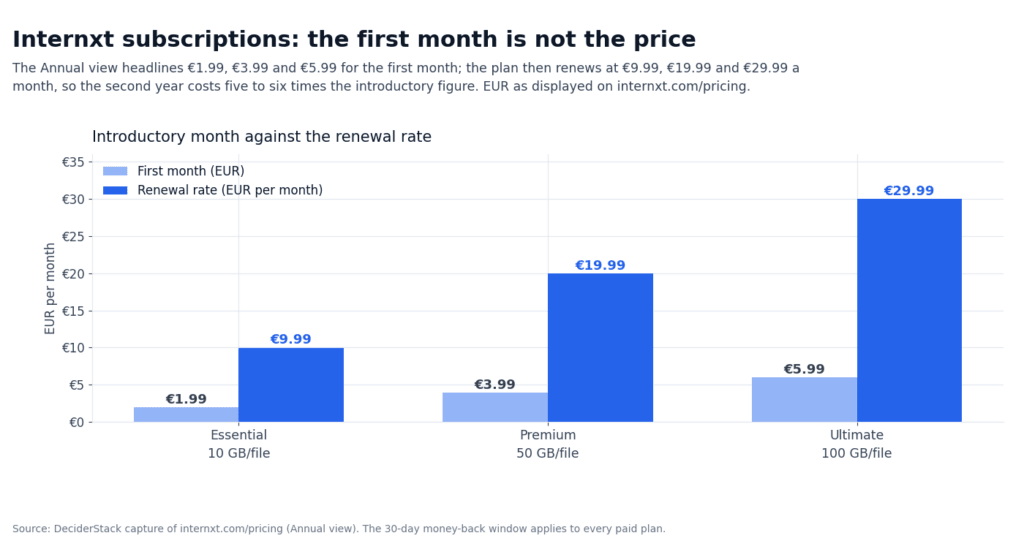
First-month prices are promotional. The renewal column is what your credit card pays from month two onward. Promotional banners during capture showed up to 80% off the headline rates; the figures above are the steady-state cost as printed on the live page.
Lifetime (one-time payment)
| Plan | Storage | One-time (EUR) | One-time (USD) | List price (EUR) | List price (USD) |
|---|---|---|---|---|---|
| Essential | 1 TB | 380 | 431.95 | 1,900 | 2,159.73 |
| Premium | 3 TB | 580 | 659.29 | 2,900 | 3,296.43 |
| Ultimate | 5 TB | 780 | 886.63 | 3,900 | 4,433.13 |
Each lifetime plan ships the same feature list as the annual tier — it is the same product, paid up front instead of monthly. Stacking rule from the official FAQ: lifetime plans can be stacked up to 100 TB total storage across one account. Each stack is a separate purchase. The Internxt FAQ does not publish how stacking interacts with the per-file upload limit, and whether stacked lifetime plans retain the full Ultimate feature set — confirm both with Internxt support before you stack.
The “list price” column is what the vendor shows as a strike-through anchor to make the discount look bigger; the real prices are the one-time column. We kept it because the page renders both, and skipping it would leave the discount math dangling.
How each Internxt tier breaks down
The three paid tiers are not just about storage. Each step up adds Internxt apps to the bundle, raises the per-file upload ceiling, and changes which integrations are available. The integration jumps are easy to overlook
Essential (1 TB) — the price-of-entry tier
Essential is the cheapest path to the full Internxt client surface, but it is the most aggressive on upload limits. The 10 GB per-file ceiling blocks anyone who works with video projects, raw photo libraries, or virtual-machine images on the cheapest plan.
What you get on Essential:
- 1 TB of zero-knowledge storage, with post-quantum-cryptography client-side encryption (the keys never leave your device).
- 10 GB per-file upload limit. Workable for documents, spreadsheets, normal photos, and most software; painful for large videos or backups.
- Bundled privacy stack at the entry tier. Encrypted VPN (via Internxt VPN), antivirus (via Internxt Antivirus), two-factor authentication, and password-protected sharing links.
- Computer backup. The desktop client backs up a chosen folder to the encrypted drive.
- 30-day money-back guarantee. Cancel and refund inside the window without questions.
What Essential does not give you: file versioning, photos backup as a separate flow, Internxt Meet (the bundled encrypted video-calling app), the system-cleaner utility, CLI access, WebDAV and NAS/Rclone support, encrypted Internxt Mail, or premium support. Those features force you up to Premium.
Premium (3 TB) — the “recommended” tier for a reason
Premium is the only tier the vendor itself tags as Most Popular on the live page. The 3 TB ceiling is large enough to hold a personal photo library and a working project archive at the same time. The 50 GB per-file upload limit covers DSLR raw files and most consumer video projects short of 4K feature work.
What Premium adds over Essential:
- 3 TB of storage and 50 GB per-file uploads.
- File versioning — recovery of previous versions of edited files, which Essential does not have.
- Photos backup — automatic upload from the mobile camera roll.
- Meet (encrypted video calls) — bundled inside the same subscription; useful for buyers who would otherwise pay for a separate Zoom or Teams license.
- Cleaner (system utility) — disk-space reclaim tools.
If you are a single user backing up one phone and one laptop, this is the tier the Internxt pricing page is steering you toward. At €3.99 for the first month and €19.99/month after (about $22.72), it lands in the same monthly bracket as a personal Spotify-plus-Netflix subscription, with the entire privacy stack attached.
Ultimate (5 TB) — the power-user and small-team ceiling
Ultimate is the tier Internxt prices for users who push storage hard: photographers, video editors, security researchers, and small teams that want zero-knowledge without standing up their own infrastructure.
What Ultimate adds over Premium:
- 5 TB of storage and 100 GB per-file uploads.
- CLI (command-line interface) access to the drive — useful for cron job backups, scripted uploads, and integration into CI pipelines.
- WebDAV, NAS, and Rclone support — mount the encrypted drive as a file system on supported devices.
- Encrypted Internxt Mail — encrypted email inside the same subscription.
- Premium support — faster response time than the standard tier. The Premium-vs-standard response-time SLA is not published on the public pricing page; ask Internxt support for the contract-level number before you buy on this feature alone.
Ultimate is also the only tier that hits pricing parity with a one-time-payment lifetime license for buyers who think in five-year blocks. €780 once for 5 TB is roughly four years of the annual plan at the renewal rate.
Free (1 GB) — the evaluation surface, not a working drive
The free tier is small on purpose. 1 GB can hold about 250 photos from a modern smartphone, or one or two hundred documents; it cannot back up a phone’s photo library, hold any meaningful video, or replace Dropbox for ongoing work. Its real purpose is to put the client apps on your devices so you can decide whether the upload/download UX is good enough before paying.
What the free tier does and does not include:
- Included: encrypted storage, photos backup on mobile.
- Excluded: every paid-tier app (VPN, antivirus, Meet, Cleaner, Mail), file versioning, CLI, WebDAV.
- No credit card. You cannot accidentally convert the free tier into a paid plan; you upgrade by signing in and choosing a plan.
- No time limit. Free stays free for as long as your account exists.
If you sign up for the 30-day money-back window, pay the €1.99 first-month Essential rate, and only then test the full feature set, you can evaluate Premium and Ultimate features without first paying for them.
The four things that never ship in any Internxt plan
Several features look like they belong in an encrypted-cloud-storage product and are conspicuous by their absence. These are the four we hear about most often.
1. Collaboration and office-suite features. Internxt is a sync drive, not a productivity suite. There is no Docs, Sheets, or Slides product; no live co-editing; no commenting threads inside files. Buyers who live inside Microsoft 365 or Google Workspace will keep those subscriptions regardless and treat Internxt as the encrypted archive layer underneath.
2. US-only data residency. Internxt distributes storage across data centers it does not name publicly, and there is no US-only or EU-only switch on the settings page. Spain is part of the 14-Eyes intelligence-sharing network — a real counter-argument for buyers with strict threat models. For most individual buyers, GDPR is the meaningful protection; for compliance regimes that require US-only data centers, Internxt is not the right vendor.
3. Cheap bulk storage above 5 TB. Lifetime plans stack to 100 TB. The per-TB cost above 20 TB starts to lose to dedicated object storage — Backblaze B2, Wasabi, or even AWS S3 Glacier for cold archives. The break-even depends on whether you need zero-knowledge or just cheap bytes.
4. A contractual SLA with financial credit. Standard plans publish no uptime SLA, no credit table for downtime, no published refunds outside the 30-day window. Enterprise sales is contact-only and not priced on the public page; ask the sales team for an enterprise plan with contractual SLA and what it costs before you commit to a procurement requirement.
Bonus: EUR-only display on the official pricing page. US buyers see prices in EUR. The bank conversion happens at the credit-card processor’s rate, which adds a small FX spread above the ECB reference figure quoted in this article.
What you keep when you go lifetime instead of annual
The lifetime tier looks like the annual tier, paid up front, but two mechanics differ and they are easy to miss.
- Lifetime plans can stack. Up to 100 TB in one account, per the vendor FAQ. Stacking is the only way to get more than 5 TB without giving up zero-knowledge and going to S3.
- No recurring bill means no renewal cliff. The €380 / €580 / €780 numbers are the steady-state cost; there is no renewal rate to trip over. Annual plan buyers pay €9.99 / €19.99 / €29.99 from month two, which is roughly 5× the first-month promo rate.
The breakeven math, in months of renewal-rate payment the lifetime price replaces:
| Tier | Lifetime (EUR) | Annual renewal (EUR/month) | Lifetime pays for itself after |
|---|---|---|---|
| Essential (1 TB) | 380 | 9.99 | 38 months |
| Premium (3 TB) | 580 | 19.99 | 29 months |
| Ultimate (5 TB) | 780 | 29.99 | 26 months |
If you expect to be on Internxt for more than three years, the lifetime tier wins. If you expect to churn inside two years, the annual plan with the 30-day money-back window is the cheaper bet.
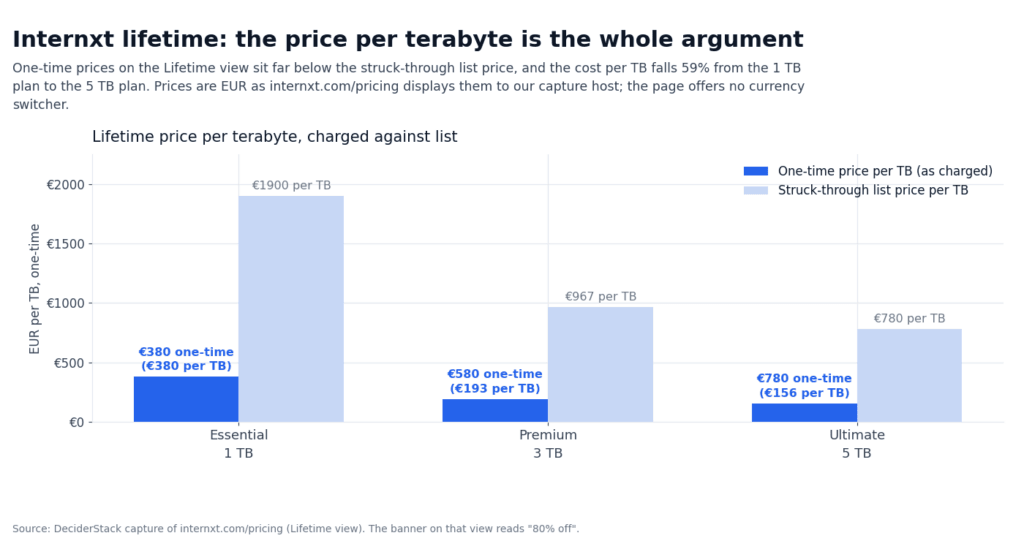
The official FAQ explicitly says lifetime plans “do not auto-renew,” but it also says “pricing for renewals is subject to change.” Read that to mean: you keep your storage at the price you paid; future Internxt billing changes do not retroactively hit your stack.
How Internxt stacks against the privacy-cloud field
Encryption is not a unique story — Proton Drive, Tresorit, and Sync.com make similar claims. Where Internxt differs is on three axes: storage volume per tier, open-source code, and the lifetime option. Proton Drive ships inside Proton Unlimited ($7.99/month on the 24-month plan, listed in our Proton VPN review) with Proton Mail and Proton VPN. The storage ceiling inside that bundle is 500 GB — smaller than Internxt’s 1 TB entry tier. Proton’s higher-storage tier outside the bundle is not surfaced on the public pricing page; check with Proton sales if you need more than 500 GB inside the bundle.
| Provider | Headline encryption | Storage per plan | Open-source clients | Jurisdiction |
|---|---|---|---|---|
| Internxt | End-to-end, post-quantum | 1 TB / 3 TB / 5 TB | Yes | EU (Spain) |
| Proton Drive | End-to-end | Up to 500 GB on Proton Unlimited | Yes | Switzerland |
| Tresorit | End-to-end | Per plan, varies | Partial (apps are not all open source) | EU (Switzerland) |
| Sync.com | End-to-end | Per plan, varies | Partial | Canada |
A broader comparison against Dropbox, Google Drive, and iCloud — none of which ship zero-knowledge by default on free or entry tiers — lives in our encrypted cloud storage roundup.
The 30-day money-back window is the real test
Encryption is what Internxt sells; the day-to-day product is what you live with. The 30-day money-back guarantee is the only signal that crosses both, and it is the right way to evaluate the product.
A useful evaluation sequence, inside the 30-day window:
- Pay the first-month Essential promo (€1.99). You get the full Essential tier; refund anytime inside 30 days.
- Upload a representative file mix. A 4 GB video (to test the 10 GB per-file limit), a 50 MB raw photo (to test photos backup), and a folder tree with hundreds of small files (to test sync reliability on the desktop client).
- Exercise the mobile apps. Install iOS or Android, enable photos backup, check that the encrypted upload pipeline does not stall on cellular.
- Test sharing and password-protected links. Send a link to a second device and confirm the password gate works.
- Time a full-drive restore. Upload until the 1 GB free tier maxes out, then drop the client and re-link, and see how long the restore takes. That number is the closest proxy for how the product will feel under real failure modes.
If any of those steps fails to meet your bar, refund and walk. If they pass, upgrade to Premium (€19.99/month after the promo) for the feature set and let the year run. Outside the 30-day window, the renewal rates above are what you pay.
FAQ
What does Internxt actually encrypt?
Everything uploaded through the official clients. Files are encrypted on the device before they leave it, using keys that Internxt’s servers never see. Server-side metadata is limited to the data needed to authenticate and bill you; your file contents are unreadable on the server side.
Is there a real free plan?
Yes — 1 GB for life, no credit card. It includes encrypted storage and photos backup. Older review sites that quote 10 GB free are repeating stale data; the live page in 2026 reads “Get 1 GB of encrypted cloud storage for free.”
How do Internxt and Proton Drive actually compare?
Internxt ships more storage per tier (1 TB / 3 TB / 5 TB entry points) and offers lifetime plans; Proton Drive inside Proton Unlimited caps at 500 GB. Proton Drive adds Proton Mail and Proton VPN in the same bundle; Internxt includes VPN and antivirus but not full Proton Mail unless you also buy it.
Can Internxt recover my files if I lose my password?
No. The service is zero-knowledge: keys never reach the server, so losing the recovery phrase means losing the data. The same caveat applies to every zero-knowledge provider.
Does Internxt offer a contractual SLA?
Standard plans publish no SLA and no credit table. Enterprise pricing is contact-only and not on the public page; ask sales for the contract-level scope and pricing before you sign a procurement requirement.
Where is the data stored?
Internxt is headquartered in Valencia, Spain, so GDPR applies and US legal requests go through EU process first. Spain is in the 14-Eyes intelligence-sharing network; there is no US-only residency option. The closest comparison sits in our encrypted cloud storage roundup.
Bottom line
Internxt in 2026 is the strongest encrypted-cloud-storage pick for buyers whose headline requirement is zero-knowledge encryption shipped as the default rather than as a paid tier. The encryption is audited (Securitum, see the security section of internxt.com), the clients are open source on GitHub, and EU jurisdiction adds a meaningful privacy floor. The lifetime option is real and pays for itself inside two to three years for any buyer who expects to stay.
The ceiling shows up the moment you need cheap bulk storage above 5 TB, deep collaboration integrations, a contractual SLA, or US-only data residency. For each of those, the right answer is a different product, and the comparison links above walk through them in turn.
The 30-day money-back window is the most useful feature on the page, and it is also the one Internxt does not advertise loudly. Use it: pay €1.99, upload a representative file mix, exercise the mobile apps, and let the renewal decision rest on what the product does with your data, not on what the page promises.
How we tested this: prices and plan details come from internxt.com/pricing, captured in a real browser in September 2026 because the page renders its prices client-side. Internxt lists EUR only, so USD figures in this article are conversions at the European Central Bank reference rate of 1 EUR = 1.1367 USD for September 2026, not vendor quotes.
We have not run a paid Internxt account against a representative workload, so figures that depend on real-world sync speed, mobile reliability, audit scope or enterprise pricing are flagged where they appear in the text instead of being estimated. Scoring criteria are documented on the methodology page.
This article contains affiliate links. If you buy through them, we may earn a commission at no extra cost to you. Commission never changes our scoring or the order of a ranking.