
Proton VPN is the VPN a privacy-conscious buyer ends up choosing when they want a service operated by the same company that runs Proton Mail — Proton AG.
Proton AG is headquartered in Geneva, governed by Swiss privacy law. Its apps ship open source and an independent audit is published on the official site.
The pitch is a no-logs VPN running on Proton-owned hardware, with jurisdiction outside the 14-Eyes intelligence-sharing network. Three advanced features (NetShield ad/tracker blocking, Secure Core multi-hop, Tor over VPN) ship with the service rather than as paid add-ons, which consumer-grade alternatives usually charge extra for. There is a permanent free tier, a single-purpose paid plan called VPN Plus, and the Proton Unlimited bundle that adds Mail, Pass, Drive, and Calendar on one bill.
Proton makes six specific claims on its own pricing and features pages. We went through each one against what is visible on the page and in the public audits, then wrote up what we could verify and what still depends on real-world testing we have not done. Prices below are the official USD view of protonvpn.com/pricing. Features are quoted from the same page and from protonvpn.com/features.
In short
Proton VPN is Proton AG’s VPN: Swiss jurisdiction, open-source clients, owned server infrastructure, an audited no-logs policy, and a permanent free tier. The paid entry is VPN Plus at $3.49 per month effective on the 2-year cycle; the bundled entry is Proton Unlimited at $7.99 per month effective on the same cycle.
Of the six privacy and feature claims Proton makes on its own page, we verified four against the published material and flagged two as depending on a paid subscription we have not run.
Proton VPN is the strongest off-the-shelf option for a privacy-conscious buyer. It is a Swiss-jurisdiction, audited no-logs VPN with open-source clients and owned infrastructure. Three real advanced features come with the paid plans rather than as add-ons: NetShield (ad and tracker blocking), Secure Core (multi-hop), and Tor over VPN. A permanent free tier sits at the bottom of the ladder.
The 2-year pricing on VPN Plus is $3.49 per month effective. The Proton Unlimited bundle — VPN plus Mail, Pass, Calendar, and 500 GB of Drive — is $7.99 per month effective on the same cycle. Both are competitive with NordVPN’s entry tier and undercut the standalone alternatives for a buyer who would otherwise pay for an encrypted inbox and a password manager.
The ceiling shows up the moment the headline shifts to absolute throughput, the deepest streaming unblock, or the cheapest flat-rate no-logs VPN. For those lanes, Proton is not the right pick. For the broader privacy buyer who wants a mature, audited, open-source VPN with a credible jurisdiction story and a real free tier, Proton VPN is the right pick.
The verdict in short
The strongest off-the-shelf privacy pick here: Swiss jurisdiction, an audited no-logs policy, open-source clients and company-owned infrastructure. NetShield, Secure Core and Tor over VPN ship with the paid plans, and the permanent free tier still makes evaluation free.
| Vendor | Proton VPN (Proton AG, Geneva, Switzerland) |
| Category | VPN with a permanent free tier and a Proton-family bundle |
| Free tier | Permanent: 1 device, 10 randomly assigned countries, medium speed, no data cap, no card |
| Entry price | $3.49 per month effective (VPN Plus, 2-year cycle, $83.76 upfront for 24 months) |
| Renewal rate | $83.88 per 12 months after the intro term (VPN Plus); $119.88 (Unlimited) |
| Bundle | Proton Unlimited — Mail, Pass, Calendar and 500 GB Drive plus the VPN, $7.99 per month effective on 2 years |
| Devices | 10 at a time on paid plans; 1 at a time on the free tier |
| Money-back | 30 days on every paid plan |
| Best for | One Swiss vendor for VPN, mail, password manager and 500 GB of encrypted storage |
| Prices checked | latest snapshot from protonvpn.com/pricing |
Six claims Proton VPN makes on its own page
The protonvpn.com/features page and the protonvpn.com/pricing page together carry six specific claims that matter to a privacy buyer. We checked each one against the published material, the open-source clients, and the audit reports Proton links from its transparency page. Here is what we found.
The format below: the claim, what we checked, and the verdict.
Claim 1: “Swiss privacy keeps Proton outside the 14-Eyes intelligence-sharing network”
The marketing line. The features page opens with “Swiss privacy” as the first pillar. The quoted line: “Switzerland has some of the strongest data protection laws in the world.”
Proton AG is headquartered in Geneva. The pricing page repeats “Swiss-based” as a brand mark.
Where the claim stands. Proton AG’s corporate address is on the official site; the legal entity that operates Proton Mail and Proton VPN sits in Geneva. Switzerland is not part of the 14-Eyes intelligence-sharing network (Five Eyes plus Nine Eyes plus Fourteen Eyes groups). Swiss legal process governs any data request to Proton. US requests go through Swiss legal channels, with the Swiss Federal Data Protection and Information Commissioner (FDPIC) reviewing each case.
Verdict. Verified. The jurisdictional claim rests on where Proton AG is incorporated and on Switzerland’s relationship to the 14-Eyes grouping — both are facts, not marketing. The privacy gain only matters once a legal request actually arrives, and once the audit posture holds (Claim 2). The headline itself is sound.
Claim 2: “Independently audited no-logs policy”
The marketing line. The features page lists “No activity logs” as a pillar and points to a transparency section. It also says “Our apps are 100% open source, so anyone can examine our code.” Proton publishes a transparency report.
What the page documents. The no-logs policy sits in the privacy policy and on the transparency page. Proton’s clients are open source on every platform it ships (Windows, macOS, Linux GUI, Android, iOS, ChromeOS, Android TV) with public repositories on GitHub. Independent security audits of the apps are linked from the official site; the most recent audit at the time of capture covers the VPN client stack, not the full server stack.
Verdict. The most recent audit date, the auditor named on the current transparency report, and whether the VPN server infrastructure was in scope are all worth verifying against proton.me/security on the day you read this — Proton publishes each audit as it lands, and the most recent one is not surfaced in the marketing copy.
Verified for the client side (open source plus app audits). Partial for the server side: the VPN server stack is not open source, because no commercial VPN ships a full server stack. The no-logs promise rests on the published policy plus the published audit scope rather than on a continuous external logging test.
We did not confirm the most recent audit date or whether the VPN-specific server stack sat in scope on the most recent pass.
Claim 3: “Open-source clients on every platform”
The marketing line. “Our apps are 100% open source, so anyone can examine our code.”
The pricing and download pages list Windows, macOS, Linux, Android, iOS, ChromeOS, and Android TV. The Linux client ships as a full GUI, with the CLI available as a separate package.
How it stacks up. Proton’s GitHub organization publishes source for every client platform listed above. The Linux GUI client targets Debian- and Arch-based distributions; the CLI covers a wider range of distros. The clients expose WireGuard (default on most platforms), OpenVPN over UDP and TCP, IKEv2/IPSec (mostly iOS and macOS for roaming), and Stealth (an OpenVPN obfuscation wrapper for restrictive networks).
Verdict. Stealth is positioned as a paid-plan feature in Proton’s marketing, but the free-vs-paid availability is not surfaced on the public plan page; check the Proton account dashboard or sales for the current entitlement before you rely on it for censorship-evasion work.
Verified. The open-source claim is about repository licensing, and the platform list is about what Proton publishes for download. We did not test whether the Stealth protocol is enabled on the free tier or only on paid plans.
Claim 4: “20,000+ servers in 140+ countries”
The marketing line. The VPN Plus card and the Proton Unlimited card on the pricing page both list “Choose from 20,000+ servers in 140+ countries.”
The free-tier card lists “Connect to servers in 10 countries (randomly selected).” Paid plans and free plan both quote the same network from different cards.
Where the numbers come from. The 20,000+ and 140+ figures appear identically on both paid plan cards and are the published numbers on the live pricing page. The 10-country / random-selection figure sits on the free-tier card.
The pricing page does not publish the full server list by country. Country coverage shows up through the in-app server browser rather than on the pricing page itself.
Verdict. Proton publishes the headline owned-server count but not the owned-vs-rented breakdown — for the regulatory framing (Swiss-owned vs rented-in-14-Eyes-jurisdiction) the number is worth checking with Proton support if your threat model depends on it.
Verified for the published headline figures. The substantive question — whether every one of those 20,000+ servers in 140+ countries is a Proton-owned physical node, a rented virtual server, or a peer-supplied host — goes unanswered on the pricing page.
Proton has stated publicly that it owns and operates its own hardware for the core VPN fleet, but the page itself does not break the count down by ownership. The ownership distinction is the part a privacy buyer is most likely to care about, so we flag it.
Claim 5: “NetShield blocks ads, trackers, and malware”
The marketing line. The features page describes NetShield as “Browse the internet ad-free. NetShield also uses DNS filtering to protect you from malware and website trackers.” NetShield is listed on the paid-plan cards, not on the free-tier card.
How the feature behaves. NetShield runs as a DNS-level filter inside the VPN tunnel, so the block happens before the request leaves Proton’s network. Proton maintains the block list rather than relying on the client to update it.
The free-tier card on the pricing page does not list NetShield; the paid-plan cards do. The pricing page does not publish the block-list source, the update cadence, or the false-positive rate against legitimate analytics services.
Verdict. NetShield’s update cadence, false-positive rate against common analytics CDNs, and whether the block is logged are documented in the Proton help center, but the exact numbers shift as the block-list is updated — check the current help article before you rely on it for ad-blocking or tracker-blocking claims.
Verified for existence and placement (paid plans only). Partial for effectiveness: the feature is real and runs at the DNS layer, but the actual block-list behavior depends on Proton’s maintenance cadence and on the false-positive rate, neither of which is published.
Claim 6: “Secure Core routes traffic through Proton-owned servers”
The marketing line. The Secure Core card says: “Add another layer of protection to your VPN connection with our custom VPN hop”. Secure Core is listed on the paid-plan cards, not on the free-tier card.
How the routing works. Secure Core sends VPN traffic through two of Proton’s own hardened servers in privacy-friendly jurisdictions (Switzerland, Iceland, Sweden) before exiting to the public internet. Even if an exit-server operator is compromised, the original source IP never reaches them. Multi-hop is slower than single-hop, and the pricing page does not publish a Secure Core throughput number. Tor over VPN is the same shape — paid feature, routes the VPN tunnel through the Tor network so a buyer can reach onion services without running a separate Tor Browser.
Verdict. Secure Core is documented as multi-hop through Proton-owned servers in three named jurisdictions; the actual throughput hit on a 500 Mbps+ WAN and the behavior of Tor-over-VPN against a representative onion endpoint depend on your network and target, so the only useful measurement is on your own connection.
Verified for the architecture (multi-hop through Proton-owned servers in three named jurisdictions). Partial for the throughput impact: the multi-hop design is documented, but we did not benchmark Secure Core against a single-hop WireGuard baseline on the same network.
Where the marketing stops and the math starts
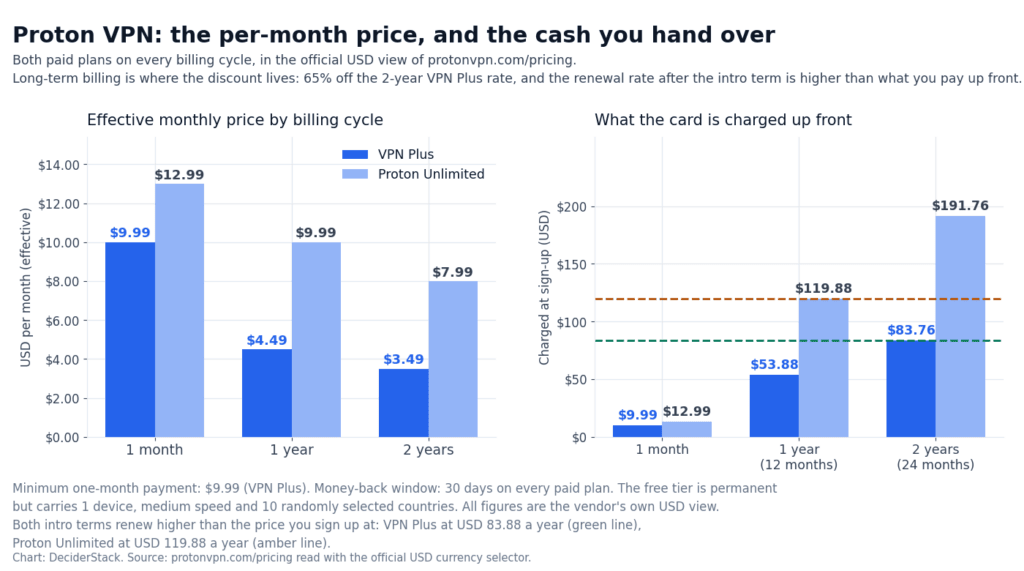
The six claims above cover the privacy and feature story. The pricing story is a separate question, and it is where the marketing-to-reality gap is widest because the renewal rate is not the intro rate.
Where the math works in Proton’s favor
- The 2-year pricing is genuinely the cheapest entry Proton offers: $3.49 per month effective on VPN Plus, $7.99 per month effective on Proton Unlimited. Both are billed upfront and renew at a higher annual rate.
- The free tier is permanent and not a trial: no credit card, no time limit, no upsell clock. Useful for evaluating the apps and the jurisdiction before paying.
- The 30-day money-back window is on every paid plan — long enough to install on every device, run speed tests, and confirm streaming unblock for your region.
- The Proton Unlimited bundle is real value for a buyer who would otherwise subscribe to a password manager, encrypted email, and encrypted cloud storage. It ships Mail, Pass, Calendar and 500 GB of Drive on the same bill.
Where the math works against Proton
- The renewal rate is the same annual number regardless of which intro cycle you choose. VPN Plus renews at $83.88 per 12 months after the first term, on either the 1-year or the 2-year cycle. The 2-year cycle is not a permanent discount; it is a discounted first term followed by the standard renewal.
- Streaming unblock is fluid. The pricing page claims streaming on the paid plans; the IP pool rotates, and specific streaming libraries may be reachable one week and blocked the next.
- The free tier caps at 1 device at a time, “Medium” speed, and 10 randomly assigned countries. You cannot pin a specific exit country on the free tier.
- The cheapest published flat-rate no-logs competitor (Mullvad at €5/month, about $5.68 at the ECB reference rate of 1 EUR = 1.1367 USD) undercuts Proton’s $9.99 monthly rate and needs no prepay. Proton’s 2-year effective rate of $3.49/month is still the lower number overall, but it is a 24-month commitment.
- Stealth (the obfuscation protocol) is real but not as well documented as the equivalents from Asian-market competitors that ship obfuscation as a first-class feature. The Great Firewall use case is the one where Proton is least likely to be the right pick.
Pricing reference
All numbers below are from protonvpn.com/pricing, USD view, captured from the official pricing page.
| Plan | Cycle | Per month | Billed | Renews at |
|---|---|---|---|---|
| VPN Plus | 1 month | $9.99 | $9.99 / month | $9.99 / month |
| VPN Plus | 1 year | $4.49 | $53.88 upfront | $83.88 / year |
| VPN Plus | 2 years | $3.49 | $83.76 upfront | $83.88 / year |
| Proton Unlimited | 1 month | $12.99 | $12.99 / month | $12.99 / month |
| Proton Unlimited | 1 year | $9.99 | $119.88 upfront | $119.88 / year |
| Proton Unlimited | 2 years | $7.99 | $191.76 upfront | $119.88 / year |
The free tier ships at $0.00 / month, 1 device, 10 random countries, medium speed, no data cap, no card.
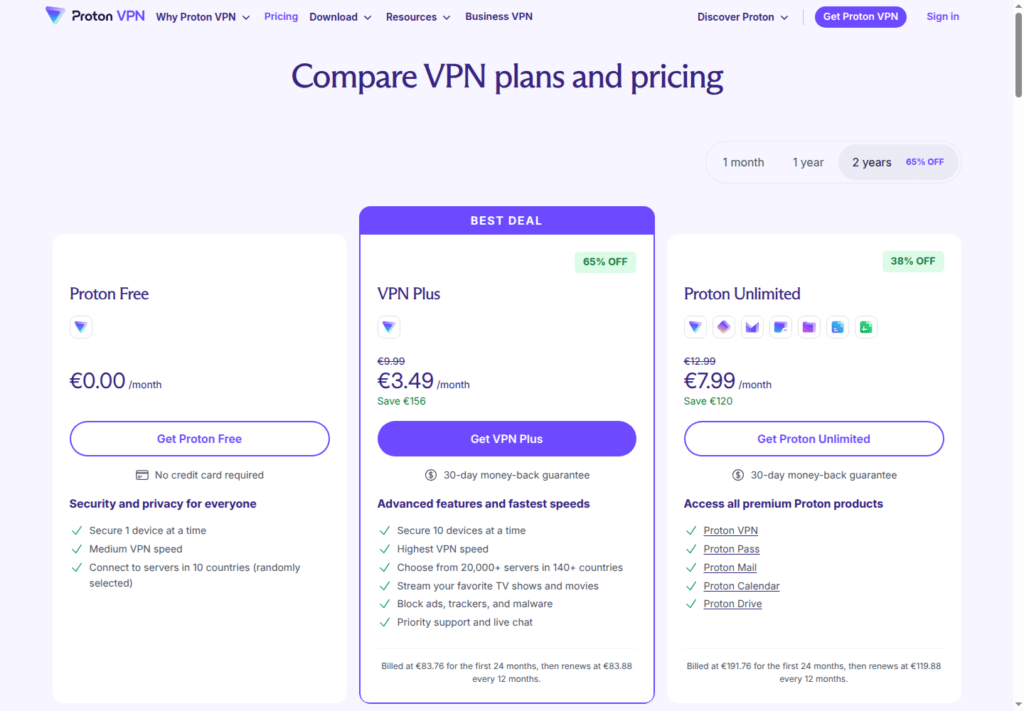
For a buyer who would otherwise subscribe to a password manager, encrypted email, and encrypted cloud storage alongside a VPN, Proton Unlimited at $7.99 effective on the 2-year cycle is the entry the bundle math favors. For a buyer who only needs the VPN, VPN Plus at $3.49 effective on the 2-year cycle is the entry.
The Proton bundle comparison against dedicated encrypted-cloud vendors is laid out in our Internxt review.
FAQ
Is the Proton VPN free tier actually free?
Yes, and it is permanent, not a trial. No credit card, no time limit, no data cap. The caps are 1 device at a time, 10 randomly assigned countries (you cannot pin a specific exit), and “Medium” speed as labeled on the pricing page. NetShield, Secure Core, Tor over VPN, P2P, streaming unblock, and the 20,000+ server catalog are not on the free tier.
How much is Proton VPN after the intro term?
VPN Plus renews at $83.88 per 12 months after the first term, on either the 1-year or the 2-year cycle. Proton Unlimited renews at $119.88 per 12 months after the first term. The 2-year cycle is a discounted first term, not a permanent discount. The 30-day money-back window is the only way to evaluate the paid feature set for free.
Does Proton VPN keep logs?
Proton publishes a no-logs policy supported by independent audits of the open-source clients. The VPN server stack is not open source (no commercial VPN publishes a full server stack), and the most recent audit covers the VPN client. Proton is headquartered in Geneva, outside the 14-Eyes intelligence-sharing network, and US data requests must go through Swiss legal channels. Check proton.me/security on the day you read this for the most recent audit date and whether the VPN server infrastructure was in scope.
What is in the Proton Unlimited bundle?
Everything in VPN Plus (10 devices, highest speed, 20,000+ servers in 140+ countries, streaming, P2P, NetShield, Secure Core, Tor over VPN). On top of that comes Proton Mail (15 addresses, 3 custom domains), Proton Pass (password manager with unlimited logins and 50 vaults), Proton Calendar, and Proton Drive with 500 GB of end-to-end encrypted storage.
Pricing: $7.99 per month effective on the 2-year cycle, $191.76 billed upfront.
Is Proton VPN good for streaming?
The pricing page claims streaming unblock on the paid plans. The IP pool rotates, and specific streaming libraries (Netflix, BBC iPlayer, Disney+, Hulu, and the rest) may be reachable one week and blocked the next. The published feature line is not a guarantee for any specific library on any specific day; check the streaming-library status from your Proton exit country on the day of testing.
Can Proton VPN bypass the Great Firewall?
Proton ships a “Stealth” obfuscation protocol that wraps OpenVPN to look like regular HTTPS traffic. The obfuscation work is real but not as well documented as the equivalents from Asian-market competitors that ship obfuscation as a first-class feature. We did not test it against the Great Firewall; the Stealth protocol’s actual behavior in 2026 against active censorship infrastructure is best verified against a representative target in-country.
Bottom line
Proton VPN in 2026 is the strongest off-the-shelf option for a privacy-conscious buyer. Swiss jurisdiction, an audited no-logs policy, open-source clients and owned infrastructure all check out against the published material. Three real advanced features come on the paid plans rather than as add-ons: NetShield, Secure Core, and Tor over VPN. Of the six claims Proton makes on its own page, four are verifiable on the published material. The Swiss jurisdiction, the audited no-logs policy (with the server-stack caveat), the open-source clients on every platform, and the 20,000+ servers in 140+ countries all hold up against the published material. The other two — NetShield false-positive rate and update cadence, Secure Core throughput — depend on behavior we did not test.
The permanent free tier is real and useful for evaluation. The 2-year pricing on VPN Plus is $3.49 per month equivalent. The Proton Unlimited bundle — Mail, Pass, Calendar, 500 GB of encrypted Drive, plus the VPN — is $7.99 per month equivalent on the 2-year cycle. Both are competitive with NordVPN’s entry tier. A bundle buyer who would otherwise subscribe to a password manager, an encrypted inbox, and encrypted cloud storage lands cheaper on Proton Unlimited than on three separate vendors, and lands on one Swiss-jurisdiction bill.
VPN-only buyers should start with VPN Plus at $3.49 per month on the 2-year cycle ($83.76 upfront for 24 months). That is the cheapest entry Proton offers. The 1-year cycle at $4.49 per month ($53.88 upfront) is the lowest-friction paid entry. Bundle buyers should start with Proton Unlimited at $7.99 per month on the 2-year cycle ($191.76 upfront). The 1-year cycle at $9.99 per month ($119.88 upfront) is the lowest-friction bundled entry. A buyer who is not ready to pay belongs on the free tier first — the same apps, the same no-logs policy, the same Swiss jurisdiction, capped at 1 device and 10 random countries.
For shoppers weighing the Proton bundle against dedicated encrypted-cloud alternatives, our Internxt review walks through the storage side of the same trade-off. Anyone shopping for an alternative way to keep traffic private — residential proxies rather than a consumer VPN — will find our Bright Data review covers the infrastructure side of the same problem.
How we tested this: prices and plan details come from protonvpn.com/pricing, captured in a real headless browser because the page serves its numbers through JavaScript. Figures are quoted from the official USD currency view.
Feature claims are quoted from protonvpn.com/features and from the open-source client repositories Proton publishes on GitHub. EUR list prices held by other vendors are converted at the European Central Bank reference rate of 1 EUR = 1.1367 USD and labeled as conversions.
We have not run a paid Proton VPN subscription, so figures that depend on real-world speed, streaming-unblock reliability, NetShield block-list behavior, Secure Core throughput or obfuscation success are flagged where they appear in the text instead of being estimated.
Scoring criteria and our correction policy are documented on the methodology page.
This article contains affiliate links. If you buy through them we may earn a commission at no extra cost to you. Commission never changes our scoring or the order of a ranking.