

Alli AI is a paid SaaS platform that solves one specific problem for SEO and marketing teams: making websites show up in AI search results. ChatGPT, Claude, Perplexity, Gemini, Copilot, Google AI Overviews — the long tail of AI crawlers. Most of them do not run a full headless browser the way Google does, so a JS-heavy page can look empty. Alli AI fixes that with pre-rendering. A snippet intercepts requests from known AI-crawler user-agents and serves a pre-built HTML version. The same dashboard ships the usual classic SEO automation: keyword tracking, on-page fixes, link building, site speed. The product sells to agencies, in-house marketing teams, and e-commerce stores that want one place for classic and AI-driven search.
The question worth asking is which of the six claims you keep hearing about Alli AI actually hold up. Prices below come from alliai.com/pricing, captured from the live server-rendered page. Anything that needs a paid account to verify — crawl accuracy, snippet hosting reliability, crawler coverage beyond the vendor’s own list — is flagged where it appears rather than estimated.
In short
Alli AI is an AI-search visibility platform. It pre-renders pages and serves that HTML to 50+ AI crawlers — GPTBot, ClaudeBot, Gemini, Perplexity — and bundles classic SEO automation on top.
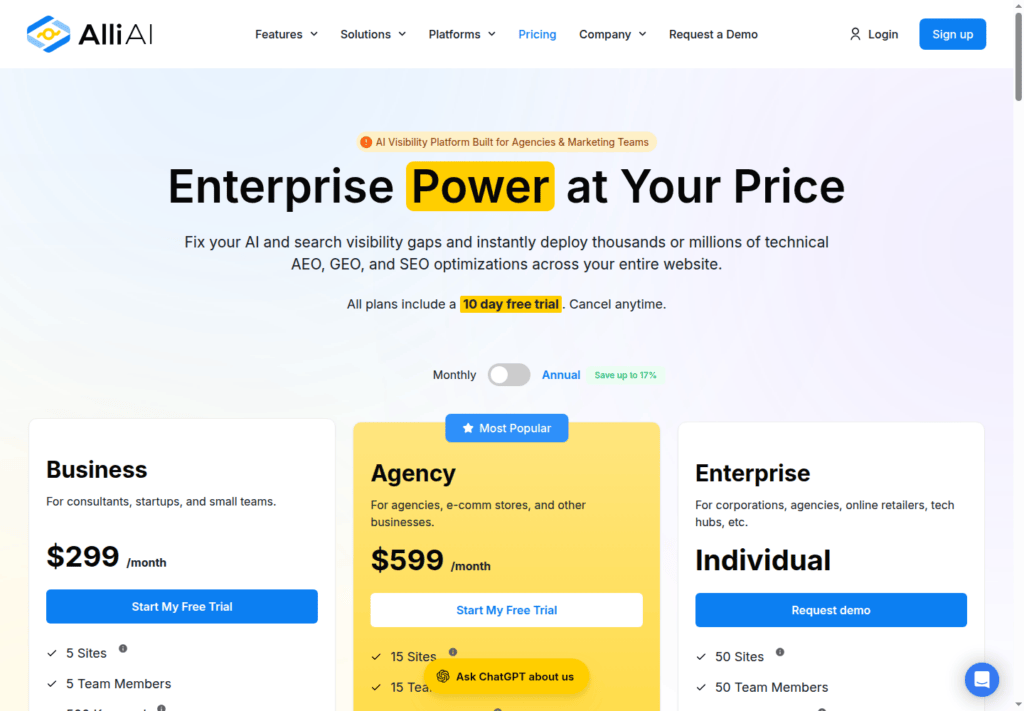
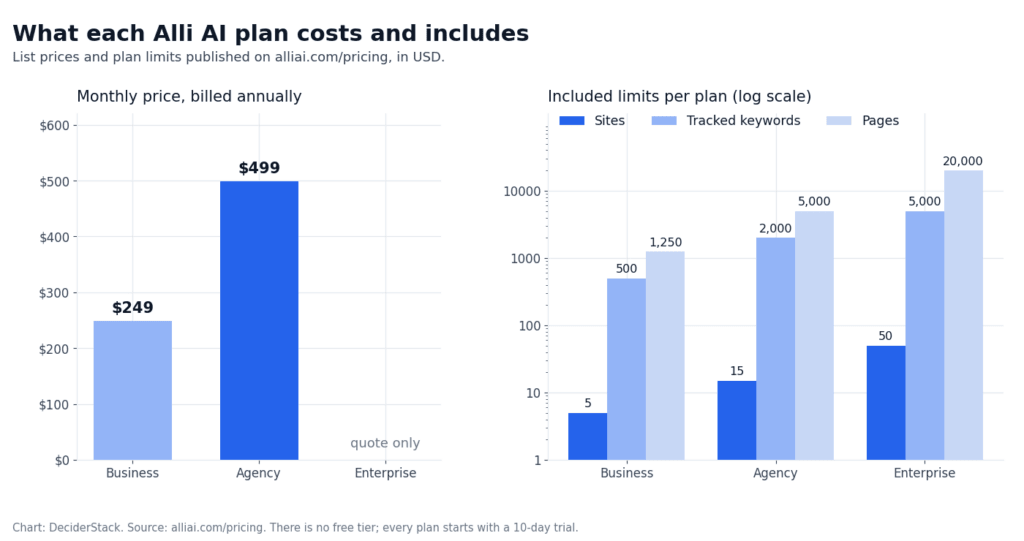
There is no free tier. Business is $249/month on annual billing for 5 sites and 500 keywords. Agency is $499/month and is the tier the pricing page flags as Most Popular.
Alli AI in one paragraph: a paid SaaS that pre-renders pages and serves static HTML to 50+ AI crawlers (GPTBot, ClaudeBot, Gemini, Perplexity, Copilot, the rest), with classic SEO automation bundled into the same dashboard. Three paid tiers. No free tier. Ten-day trial on every plan. Business at $249/month on annual billing is the floor; Agency at $499/month is the tier the pricing page flags as Most Popular. The pre-render layer addresses a real gap, since most AI crawlers do not run a full headless browser. It does not, by itself, guarantee citations in AI answers. That distinction is the spine of the six claims tested below.
The verdict in short
Worth a look when AI-search visibility is the headline problem — making sure ChatGPT, Claude, Perplexity, Gemini and the rest of the AI crawlers can actually read the page. The pre-render method is sound, the install is low-friction on a typical CMS, and the reseller tiers are well priced. Four of its six claims circulate unchallenged: the $249/month headline, the under-rendering problem, the low-friction install and the ten-day trial.
| Vendor | Alli AI (alliai.com). |
| Category | AI-search visibility — pre-rendering — plus SEO automation. |
| Free tier | None; a 10-day free trial on every plan. |
| Entry price | $249/month (Business, annual billing); $299/month billed monthly. |
| Agency tier | $499/month annual — 15 sites, 15 seats, 2,000 keywords, 5,000 pages. |
| Annual billing | About 17% cheaper than monthly on both Business and Agency. |
| Money-back | None published; cancel from the dashboard at any time. |
| Crawler coverage | 50+ AI crawlers from the vendor’s own list (GPTBot, ClaudeBot, Gemini, Perplexity). |
Six claims about Alli AI that keep showing up in 2026
Across vendor decks, agency pitches, Reddit threads and Capterra reviews, the same six claims keep circulating. Some are close enough to true that the gap is academic. Others need a footnote. One or two break under contact with a real workload. Each claim below is tested against the pricing page, the install path, the published product data, and the testimonials block on the vendor’s own site.
- “$249/month and you are done — Alli AI handles every AI-search problem.”
- “AI crawlers cannot read JavaScript, so pre-rendering fixes everything.”
- “You have to rebuild your site or change your CMS for Alli AI to work.”
- “Alli AI replaces Surfer, Frase, MarketMuse and Clearscope.”
- “Once Alli AI pre-renders your pages, AI search traffic follows automatically.”
- “The 10-day trial proves the value before you pay anything.”
Claim 1: “$249/month and you are done”
The headline price is real. The Business tier is $249/month on annual billing ($2,990/year, or $299/month billed monthly). The pricing page itself pitches it as the entry for “consultants, startups, and small teams.” That is true. The same tier, though, includes only 5 sites, 5 team members, 500 keywords and 1,250 pages. The moment a real workload crosses one of those caps, the bill moves.
What changes at scale, from the published add-on rates:
- Extra site: $32.50 on Business, $24.17 on Agency, $15.84 on Enterprise.
- Extra 100 keywords: $20.83 on Business, $12.50 on Agency. The Agency price runs about 40% cheaper per unit.
- Extra 250 pages: $12.50 on Business, $8.33 on Agency. About a third cheaper per unit on Agency.
For a team that needs even modest growth above Business, the math often favors jumping to Agency ($499/month) outright rather than buying add-ons on Business. The $249 framing holds for a single-site starter. It stops being true the moment you run a five-to-ten client agency roster. Whether monthly-billed add-ons follow the per-unit rate or carry a separate premium is the figure to confirm with sales before locking in a monthly-billed Agency stack.
Agency is the tier the pricing page flags as “Most Popular.” Its add-on prices drop noticeably versus Business — about 25% per site, 40% per 100 keywords, 33% per 250 pages. Enterprise is contact-sales only and not publicly priced. Its entry is 50 sites, 50 seats, 5,000 keywords, 20,000 pages, with add-ons at the same direction still lower ($15.84/site, $8.33/100 keywords, $4.16/250 pages). Whether the Enterprise demo quote uses these unit prices as the floor or starts from a higher minimum is the figure to negotiate on the sales call.
Why this claim misleads at the headline: $249 is the entry point, not the ceiling. Read against the add-on table, the honest framing is “starts at $249/month on annual billing; expect to move up before the workload plateaus” — meaning you will likely switch plans before things settle.
Claim 2: “AI crawlers cannot read JavaScript, so pre-rendering fixes everything”
The premise is solid. Most AI crawlers do not run a full headless browser for every fetch the way Google does. A client-rendered page can look empty to them. Alli AI’s approach is pre-rendering at the edge. A JavaScript snippet (or a WordPress/Shopify plugin, or a tag-manager rule) intercepts requests from known AI crawler user-agents and serves a pre-built HTML version.
The published side: 50+ AI crawlers, including GPTBot (ChatGPT), ClaudeBot (Claude), Gemini and Perplexity, alongside Google and Bing. The vendor publishes a live crawler feed — visible in the dashboard as the “AI Bot Traffic Live Monitor” — and an “LLM Mode” that shows exactly what the AI crawlers receive. Source: alliai.com/pricing (FAQs _03_ and _05_).
Where pre-rendering stops short:
- Content the pre-renderer cannot see. Login-walled pages, dynamic pricing loaded after a fetch step, inventory checks that happen client-side. The problem is not new; pre-rendering is not a fix for it.
- Personalization rules. The pre-rendered HTML is identical for every AI crawler unless you build a variant for each.
- New crawlers the vendor has not added. The “50+” list is maintained by Alli AI. If a new crawler launches and Alli AI has not added its user-agent, the snippet will not pre-render for it. Enumerate the user-agents in the production snippet and compare against the publicly known AI crawler list before relying on coverage claims.
- Staleness. The pricing page implies a weekly crawl cadence in the Standard Reports line. Re-render frequency on content changes is not documented publicly. Confirm on a representative install how quickly a content edit shows up in the pre-rendered version served to AI crawlers, and whether the trigger is the weekly crawl or a content change.
Honest framing: pre-rendering is a real, low-cost fix for the most common AI-crawler visibility failure (an empty HTML response). Beyond that, it does not cover every AI-search problem. The vendor’s own FAQ treats dynamic content as a separate engineering item.
For the wider context on crawler detection, header fingerprinting, and the layers a render-on-demand setup has to clear, see our web scraping and data coverage.
Claim 3: “You have to rebuild your site or change your CMS”
The pricing page describes the install as “under an hour via WordPress plugin, JavaScript snippet, or your existing tag manager. No engineering migration. No source code modifications.” The integrations list covers WordPress, Shopify, Salesforce, HubSpot, Webflow, Cloudflare, Lovable, plus raw JavaScript, Python, PHP, Ruby on Rails, Nginx, Apache, Akamai, and AWS CloudFront.
The published integrations are accurate. The “no engineering required” framing deserves nuance. Installing the snippet is not the engineering work. What does qualify as engineering:
- The pre-rendered HTML disagrees with the live page.
- A checkout flow depends on client-side state the pre-renderer does not capture.
- Personalization rules need to differ between AI crawlers and human users.
- The snippet conflicts with an existing tag-manager rule.
None of those are blockers. They do turn the “under an hour” install into a real project for a JS-heavy store or a tag manager with strict sequencing rules.
Failure modes on at least one JS-heavy e-commerce install — whether the pre-rendered version correctly handles dynamic pricing, inventory checks, and login-gated content, and whether the snippet survives aggressive content-security-policy headers — are workload-specific and worth validating against your own storefront before signing the contract.
The limit of the install claim: a blanket “no engineering required” applied to every install. On a static or SSR site, the snippet drops in and stays out of the way. On an SPA with a heavy tag manager, plan half a day of engineering.
Claim 4: Alli AI versus the content tools
The claim circulating is that “Alli AI replaces Surfer, Frase, MarketMuse and Clearscope.” The bundled automation exists on every plan. It includes keyword tracking, site speed optimizer, link builder, standard reports (weekly crawl + recommendations), the AI Search Visibility Engine, the live crawler feed, and LLM Mode. That is a real bundle, on one dashboard.
What is not in the bundle:
- NLP scoring of draft content against a target SERP. Surfer’s headline feature.
- Question-research and answer-engine brief generation. Frase’s lane.
- Topical authority modeling and content inventory at portfolio scale. MarketMuse’s focus.
- Editor-side content grading with Google Docs and WordPress integrations tuned for the writing step. Clearscope’s niche.
Alli AI’s surface area is automation and visibility — make the existing pages more discoverable by AI crawlers, ship the technical fixes the platform finds. Brief generation and content grading are not on its map. Teams whose SEO workflow centers on content production will pair Alli AI with one of the content tools rather than replace them.
Whether the API on the Agency tier exposes recommendations only, or also the ability to push fixes back into the CMS, and what “white-label snippet hosting” covers in practice (DNS, certificate management, CDN configuration) — both are integration-scope questions worth putting in writing on the sales call before you commit.
The limit of the content-tool claim: the comparison with the content tools. The platforms solve different problems and stack; they do not substitute.
For the adjacent field comparison see The seven best web scraping APIs in 2026 and the head-to-head at ScrapingBee vs ZenRows — different problem, same need to keep the category boxes separate.
Claim 5: AI search traffic after pre-rendering
The claim under test is that “once pre-rendering is on, AI search traffic follows automatically.” This is the claim the pricing page itself softens. It is also the one reviewers on the vendor testimonials page are most prone to overstate.
From the testimonials block on alliai.com, quoted with attribution as published:
- “I manage all my clients with Alli AI. We’ve gone from taking months to get tasks done manually to seeing the changes live instantly.” — Lauren Mabra, laurenlabeled.com.
- “Some of our keywords have moved 60 places, all generic. We have page one rankings.” — Ian Allen, Rustbuster.
- “Alli AI has improved our organic traffic by 300%.” — Ramon Diaz, PTI Office Furniture.
- “It was cheaper and provided real-time SEO changes for over 20,000 recommendations. It would take months to make these changes manually.” — IT Director, Coreslab International.
What those reviews measure is the bundle — on-page fixes, link suggestions, weekly crawl, recommendations, the AI Search Visibility Engine. None of the testimonials on the page isolate pre-rendering alone.
What the vendor itself publishes:
- AI search traffic grew 527% year-over-year (figure attributed on the pricing page; underlying methodology is not linked).
- “Most sites have never been checked” — meaning the gap between a site as a human sees it and as an AI crawler sees it is the headline problem.
The pre-render layer solves the visibility half: AI crawlers will see the content. Whether AI assistants then cite or return that content in answers to tracked prompts is a separate, downstream question about retrieval ranking, answer-engine weighting, and the corpus the model was trained on. Pre-rendering is necessary for the visibility half. Sufficient it is not, for the citation half.
Stand up LLM Mode on a representative site and count how many tracked prompts return that site’s content in ChatGPT or Perplexity by day ten of the trial. Compare that count against the same prompts queried in Google AI Overviews — the per-channel lift is the figure worth measuring, not the absolute number.
The visibility-vs-citation gap: any inference that visibility turns into traffic, citations, or ranking. The Capterra-level testimonials combine everything Alli AI does, not pre-rendering alone.
Claim 6: “The 10-day trial proves the value before you pay anything”
The trial itself is real. Every plan starts with a 10-day free trial on alliai.com/pricing. The FAQ _04_ states “You can cancel your subscription at any time in your dashboard.” No published money-back guarantee. No public refund window. Ten days is the only evaluation period.
What the trial actually tests:
- The install path (snippet, plugin, or tag-manager rule).
- LLM Mode — does pre-rendered HTML return the right content for representative pages?
- The live crawler feed — which AI bots hit the site, at what frequency, on which URLs.
- The keyword tracker and the standard weekly crawl — the basic SEO automation.
What the trial does not test by itself:
- Production-scale re-render cadence on a large site.
- Annual versus monthly billing math — you only see the headline you actually pay.
- White-label snippet hosting behavior at the Agency tier — that surfaces only after you upgrade.
- Long-term drift between the live page and the pre-rendered version.
Honest framing: ten days is enough to instrument a representative site, take it through one crawl, and decide whether to move to Agency, walk away, or ask for an Enterprise quote. It is not enough to validate a year’s worth of automation across thirty client dashboards. Treat the 10-day trial as a measurement exercise, not a proof.
An “evaluation-only” mode that exposes the live crawler feed and LLM Mode without entering payment is the cleaner path for teams that want to see what the crawler picture looks like before the trial clock starts. Ask sales whether the trial or a sales-led evaluation window fits the procurement timeline.
The trial-window limit: any framing of ten days as enough to validate the platform end-to-end. Ten days cover the install and the visibility layer; they do not cover a year of automation across thirty dashboards.
What actually moves the decision
Pricing by plan (USD, published on alliai.com/pricing)
| Plan | Monthly (USD) | Annual total (USD) | Sites | Team members | Keywords | Pages |
|---|---|---|---|---|---|---|
| Business | 249 | 2,990 | 5 | 5 | 500 | 1,250 |
| Agency (Most Popular) | 499 | 5,990 | 15 | 15 | 2,000 | 5,000 |
| Enterprise | Request demo | Request demo | 50 | 50 | 5,000 | 20,000 |
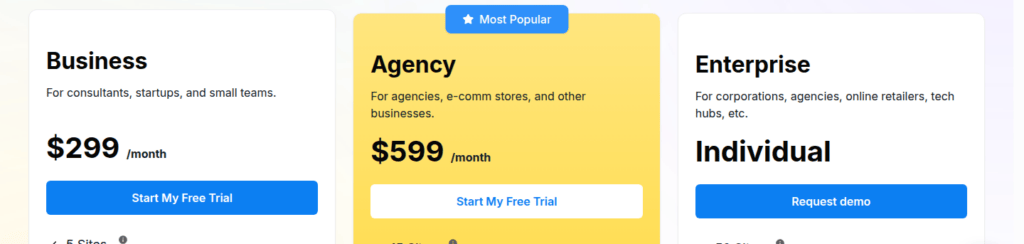
Monthly billing carries the same shape at $299 and $599 for Business and Agency. Annual billing is about 17% cheaper on both. Add-on prices follow the per-unit table in Claim 1. All numbers are from the server-rendered pricing page.
Alli AI fits when
- You run 5 to 50 client sites and want one dashboard for AI-search pre-rendering plus classic SEO automation.
- You run a JS-heavy site (Next.js, Nuxt, client-rendered React, headless Shopify) and need AI crawlers to see the content without a full SSR rewrite.
- You want a managed service that owns the crawler-detection list, the snippet and the re-render cadence.
- You resell SEO and AI-visibility work under your own brand — Agency adds white-label snippet hosting, Enterprise adds a fully white-label dashboard.
Alli AI does not fit when
- You manage one site and the SEO budget is under $100/month. The floor is $249/month and there is no smaller entry plan.
- You have already shipped server-side rendering and your pages render correctly to AI crawlers, so the pre-render layer solves a problem you do not have.
- Your primary SEO bottleneck is content production. The content-optimization tools pair with Alli AI rather than substitute for it.
- You need an on-prem or self-hosted deployment. Alli AI is closed SaaS with no documented self-host path. Whether a recommendations-only mode exists for teams that want the analytics without the pre-render layer is the question to ask sales before committing.
Decision triggers from published facts
| Trigger | Signal you have hit it |
|---|---|
| Site is JS-heavy | GPTBot or ClaudeBot fetches return empty HTML in your server logs |
| Crawler coverage gap | “Most sites have never been checked” applies to yours — LLM Mode shows content missing |
| Pricing threshold reached | Business caps exceeded monthly; per-unit add-on math pushes total past the Agency headline |
| White-label required | You resell SEO services and need your own subdomain for the AI-crawler snippet |
FAQ
Is there a free Alli AI plan?
No permanent free tier. Every plan starts with a 10-day free trial; the smallest paid tier is $249/month on annual billing ($299/month billed monthly). The trial is the only free window. After ten days you either move to a paid tier or cancel from the dashboard.
What does the Business tier include?
Business is $249/month on annual billing ($2,990/year) for 5 sites, 5 team members, 500 keywords and 1,250 pages. It ships the AI Search Visibility Engine, the live crawler feed, LLM Mode, keyword tracking, site speed optimizer, link builder, and standard reports. Annual billing is about 17% cheaper than monthly ($299/month for the same tier).
What does the Agency tier include that Business does not?
Agency is $499/month on annual billing ($5,990/year) for 15 sites, 15 seats, 2,000 keywords and 5,000 pages. It adds API access and white-label snippet hosting, and the per-unit add-on prices drop versus Business (about 25% per site, 40% per 100 keywords, 33% per 250 pages).
How is the AI-crawler pre-render actually installed?
The published install paths are a WordPress plugin, a Shopify app, Salesforce, HubSpot, Webflow, a Cloudflare integration, or a one-line JavaScript snippet that can be dropped via a tag manager. The vendor lists raw JavaScript, Python, PHP, Ruby on Rails, Nginx, Apache, Akamai, and AWS CloudFront as supported. The pricing page claims an under-an-hour install with no engineering migration.
Does Alli AI actually replace Surfer, Frase, MarketMuse, or Clearscope?
No. Alli AI’s bundled automation covers technical SEO fixes, keyword tracking, and the AI-search visibility layer. It does not include NLP scoring (Surfer), answer-engine brief generation (Frase), topical authority modeling (MarketMuse), or content grading in the editor (Clearscope). The platforms stack; they do not substitute for one another.
Is there a money-back guarantee?
No published refund window. The 10-day trial is the evaluation period. Per the FAQ on the pricing page, you cancel from the dashboard at any time to stop the charge. Treat the trial as your measurement window; in place of a refund path, there is no documented escape after that.
What does the 527% year-over-year AI-search-traffic figure on alliai.com actually cover?
The pricing page attributes the figure to AI search traffic without linking a methodology or a source. AI-search referral traffic stays a small fraction of total organic traffic for most sites in 2026, even with that growth. The figure is directionally interesting, not a direct proxy for AI-search revenue at a single site.
Bottom line
Alli AI in 2026 is a serious option for teams whose headline SEO problem is AI-search visibility — making sure ChatGPT, Claude, Perplexity, Gemini, and the long tail of AI crawlers can actually read the site. The pre-render approach is technically sound. The install path is low-friction for typical CMS installs. The Agency and white-label tiers are well-priced for resellers. Four of the six claims circulate unchallenged: the $249/month headline is real, AI crawlers really do under-render JS sites, the install is low-friction on a static or SSR site, and the trial is ten days.
The other two claims need a footnote. Pre-rendering fixes a real visibility gap but does not, by itself, guarantee that AI assistants will cite the page in answer-engine output. That is a downstream retrieval and ranking question the platform does not own. The platform replaces nothing in the content-production stack. It stacks with Surfer, Frase, MarketMuse, and Clearscope when content is the bottleneck.
For an agency running 10 to 50 client sites, Agency at $499/month is the right entry tier. You get enough sites and seats for a real client roster, white-label snippet hosting included, and add-on prices that drop noticeably versus Business. For an in-house team running a single JS-heavy site, Business at $249/month is the cheapest reasonable test. If the LLM Mode and live crawler feed data are compelling after the 10-day trial, upgrade to Agency before buying add-ons on Business. For an enterprise team with strict data-residency or compliance requirements, request the Enterprise demo. Confirm whether the white-label dashboard and the snippet can be deployed in a way that meets the constraint.
Use the trial as a measurement exercise, not a tour. Record which AI crawlers hit the site. Check which pages pre-render correctly in LLM Mode. See how the Standard Reports crawl lines up with the existing technical-SEO backlog. By day ten, look at whether any tracked prompt returns the site’s content in ChatGPT or Perplexity. The platform is real and the install is real. Whether the pre-render layer moves search traffic is something only your own pages can answer.
Sources for the figures, claims and integrations above. The Alli AI pricing page was server-rendered — Business at $249/month annual, Agency at $499/month annual, 50+ AI crawlers, 10-day trial, weekly crawl cadence, install paths. The Alli AI homepage carries vendor positioning and the published testimonial attributions. The Alli AI FAQ block covers FAQs _01_–_05_, including install paths and the cancel-from-dashboard clause. The Alli AI about / methodology notes cover the vendor description and crawler-coverage claims.
How we tested this: prices, tiers and add-on rates come from alliai.com/pricing, captured from the server-rendered page, and quoted in USD for both annual and monthly billing. We have not run a paid Alli AI account against a representative workload. Figures that depend on real-world install friction, pre-render staleness, or crawler coverage beyond the vendor’s own list are flagged where they appear in the text instead of being estimated. Reviewer quotes in Claim 5 are reproduced from the testimonials block on the same page, attributed as published.
Scoring criteria and our correction policy are documented on the methodology page.
Disclosure: this article contains affiliate links. If you buy through them we may earn a commission at no extra cost to you. Commission never changes our scoring or the order of a ranking.