Browse AI is the easiest way to scrape a website without writing code: click through a page in a recorder, point at the data. Browse AI learns the pattern and returns rows on a schedule. The flip side is what you pay for that convenience. Credits reset on a hard cycle (no rollover on the basic plans). Premium sites are flagged and billed a multiplier regardless of how many rows you actually extract. The moment your workload becomes more than “watch 50 pages for changes a few times a day,” the credit math gets tight. That is why teams start shopping for alternatives — usually the first time a cycle ends mid-month, or a Premium site eats 8 credits per run on a one-row dashboard.
This guide compares Browse AI with the alternatives that show up most often in that search: Apify and ZenRows on the API side. ScrapeOps as a unified proxy aggregator. Bright Data for scale. ScrapingBee and Browserless for code-first teams. Every number below comes from the vendor’s official pricing page. Figures that need a paid account to verify — actual anti-bot bypass rates, monitored-job reliability, the credit burn on your real target — are flagged where they appear in the text.
In short
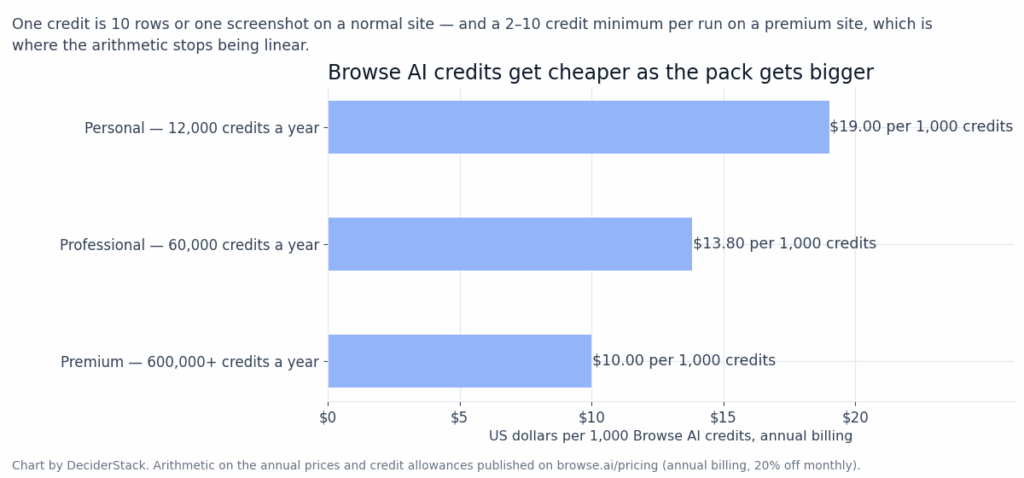
Browse AI is a no-code recorder whose meter is rows: 1 credit = 10 rows or 1 screenshot, with a 2–10 credit per-run premium-site multiplier on top.
The seven credible alternatives split cleanly into three shapes: programmatic scraping platforms (Apify), request-based scraping APIs (ZenRows, ScrapingBee), and proxy and browser services (Bright Data, ScrapeOps, Browserless). Each one bills a different unit, and the right one is the one whose native unit matches your workload.
The verdict in short
Browse AI is the fastest way to point a recorder at a page and walk away with rows. The credit model rewards that simplicity: 1 credit for 10 rows is easy to budget, and a 12,000-credit annual pack at $19/month is a known ceiling. The cost is what happens when a workload stops being row-bound. Long crawls, paginated lists, custom flows with retries, protected sites with rotating residential + CAPTCHA — and the credit unit no longer matches the work.
Where Browse AI sits in 2026
Browse AI is a no-code recorder running in the browser. You train a “robot” by clicking through a site and pointing at the data; the robot returns rows on demand, on a schedule, or as a change-detection monitor. Output is CSV, JSON or a webhook. There is no published custom-code path and no marketplace — Browse AI is the runtime.
The catch is the credit unit. One credit buys 10 rows or 1 screenshot. Sites that need rotating residential proxies plus CAPTCHA solving are flagged Premium and cost a minimum of 2–10 credits per run, regardless of how many rows you extract. A 50-row product page on a Premium site costs 2 credits. A one-row login-walled dashboard also costs 2 credits. That is the right shape for the common case — monitoring a small set of pages. It is the wrong shape for any row-bound workload at scale, where the credit math starts to dwarf the lowest published plan.
The published plan ladder (annually billed; monthly is ~2.5×):
| Plan | Price | Credits | Websites | Users | What it pays for |
|---|---|---|---|---|---|
| Free | $0 | 50 / month | 2 | 3 | ~500 rows/month, full platform |
| Personal | $19/mo ($228/yr) | 12,000 / year | 5 | 3 | ~1,200 rows/year on non-premium sites (≈100 rows/month); premium-site floor (2–10 credits per run) sharply reduces the row yield on this tier |
| Professional | $69/mo annual ($87 monthly) | 60,000 / year | 10 | 10 | ~5,000 rows/month on Premium |
| Premium | $500/mo annual | 600,000+ / year | Custom | Custom | Dedicated AM, managed pipelines |
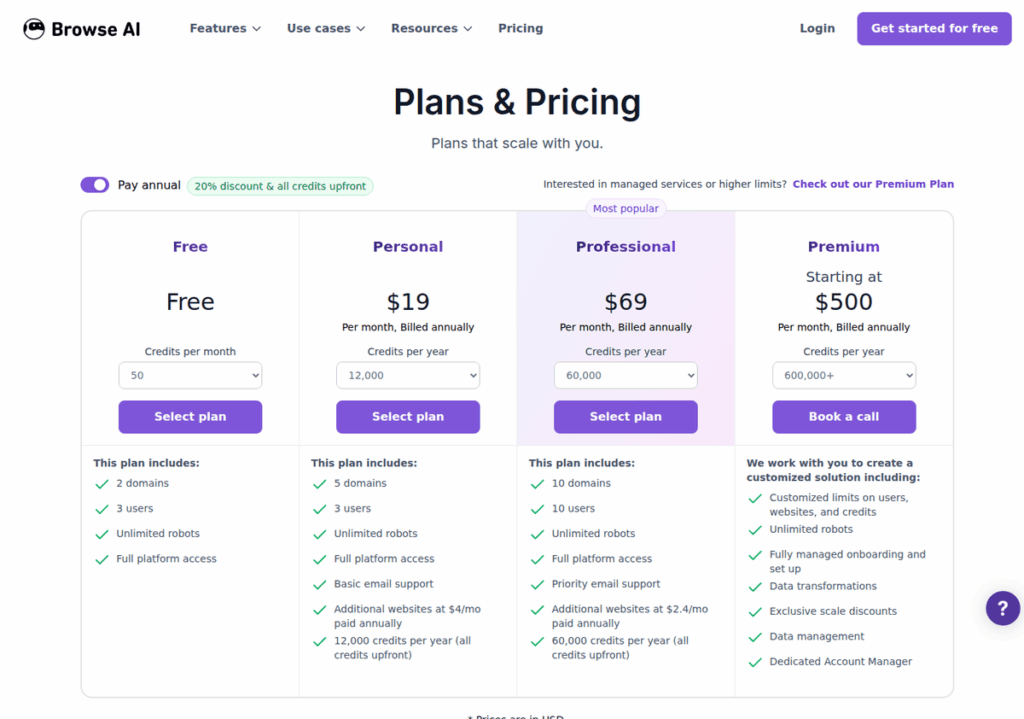
Sources: browse.ai/pricing and help.browse.ai/article/137-premium-sites (captured September 2026). Credits do not roll over except on plan upgrade. The unused balance of the previous plan is added on top of the new plan. The real per-row credit cost against your actual targets depends on the Premium-site multiplier, which varies by domain, and on how many rows the recorder captures per page — confirm on a representative sample before sizing a paid plan.
What the alternatives actually change
The seven alternatives below split into three shapes. Each one solves a specific weakness in Browse AI: per-row pricing, the credit ceiling, scale ceilings, or the lack of a custom-code path.
Browse AI — no-code recorder, row-based credits
Pros: Fastest path from “I need this data” to “the robot is scheduled”; credit budget is a known ceiling; no engineering work to start. Cons: Premium-site multiplier makes monitored jobs expensive; no custom code; credits reset every cycle and don’t roll over.
Apify — programmable scraping platform
Pros: 74,000+ pre-built Actors in the Store (Instagram, Google Maps, Amazon, LinkedIn, real estate, etc., per the current Apify Store title). Custom Actors in Node.js, Python or any Docker-friendly language. Granular proxy control (residential by GB, datacenter by IP, SERP per 1k, Unblocker per 1k). Agents can pay per run via x402/MPP rails. Cons: CU model is harder to budget than a flat credit allowance. Prepaid usage does not roll over. Free tier is $5 of prepaid usage, then services block.
ZenRows — request-based scraping API
Pros: Charges only for successful requests (404 and 410 count as successful). Free plan is permanent, not a trial. Rollover on paid plans. Credit weights stay constant across plans. Built-in JS rendering and Premium proxies at multipliers of 5× and 25×. Cons: Browser Sessions are 25,000 credits per GB + 5 credits per minute — heavy flows get expensive. Response-cap on the Build tier is documented separately on the ZenRows docs page (not re-verified this round). No debit cards, no crypto.
ScrapeOps — proxy aggregator with free tier
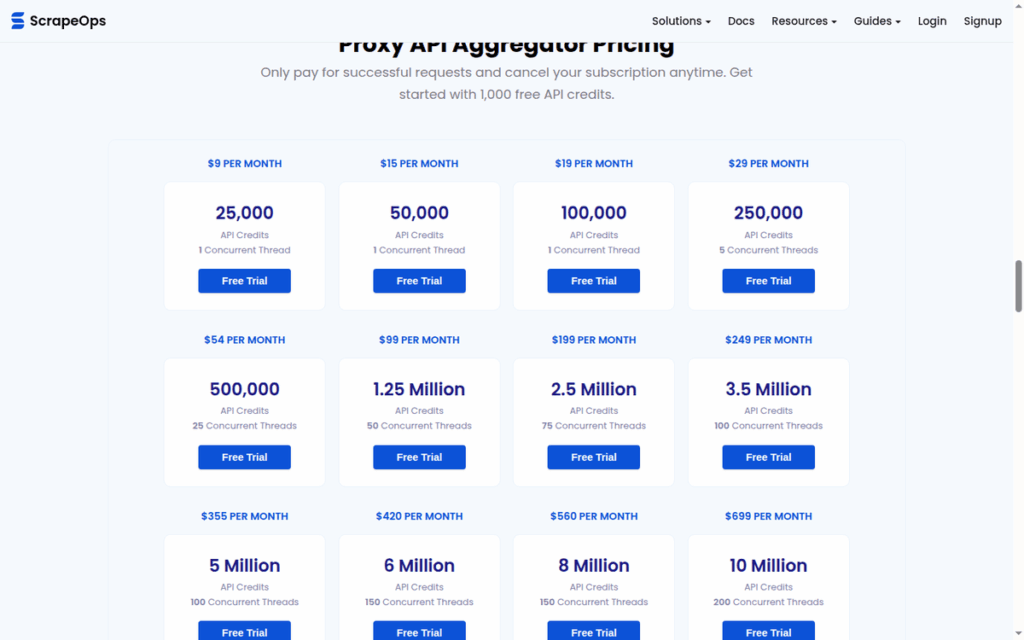
Pros: Free tier is real (1,000 API credits + 100 MB residential). Only successful requests are billed. Aggregates 20+ proxy APIs (ScraperAPI, Zyte, ScrapingBee, ZenRows, Bright Data, Oxylabs, Smartproxy, others) behind one endpoint. Built-in JS rendering, ban and CAPTCHA detection. Account pauses on credit-out by default. Cons: Two products (Proxy API Aggregator by API credits, Residential Aggregator by GB) means two meters to track. Lowest plan ($9/mo) only allows 1 concurrent thread.
Bright Data — multi-product web data platform
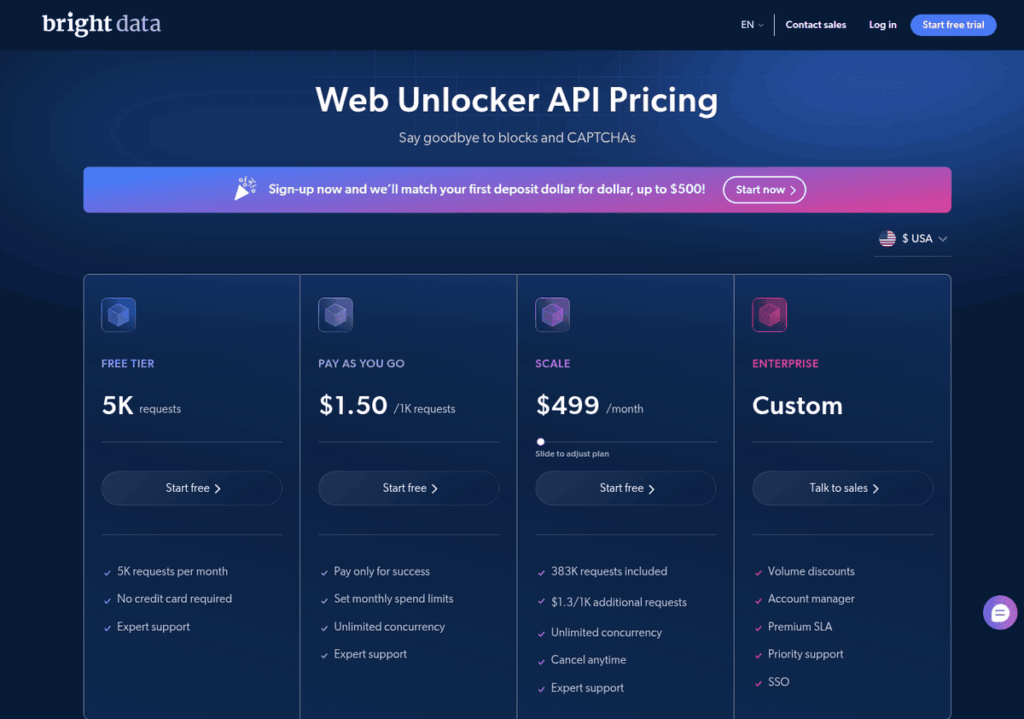
Pros: Six products under one contract (residential/ISP/datacenter proxies, Web Scraper API, Scraping Browser, Web Unlocker, Scraper Studio, SERP API). Generous free tier (5K units/month on every API product). 195 countries with city-level targeting. Strongest anti-bot product (Web Unlocker + Scraping Browser). Cons: Residential plans start at $499/month and require KYC (compliance call + ID verification). Pricing pages list promo codes (RESIGB50, APIS25) that change at checkout. Six products means you have to pick which one points at your workload.
ScrapingBee — credit-based scraping API with auto-mode
Pros: Auto-mode picks the cheapest successful configuration (1/5/10/25/75 credits/req) and caps it with max_cost. 1,000 free credits on signup, no card. Dedicated APIs for Amazon, Google Search, Fast Search, YouTube, ChatGPT, Walmart on Business+. US-state geotargeting on Business+. Cons: Stealth proxy is 75 credits/req — affordable for targeted calls, expensive for bulk scraping on protected sites. Credits do not roll over. No published SLA. 429 instead of auto-upgrade on concurrency overflow.
Browserless — unit-based browser-as-a-service
Pros: Pure hosted browser for Puppeteer / Playwright / Selenium (BrowserQL editor). Cheapest path for code-first teams. Residential + datacenter proxies included (6× cost multiplier for residential). Self-hosted Docker product for on-prem. Cons: Free plan is too tight for production (2 concurrent browsers, 2-min sessions). CAPTCHA solving not included (10 units per successful solve on top). No built-in anti-bot — you bring your own strategy.
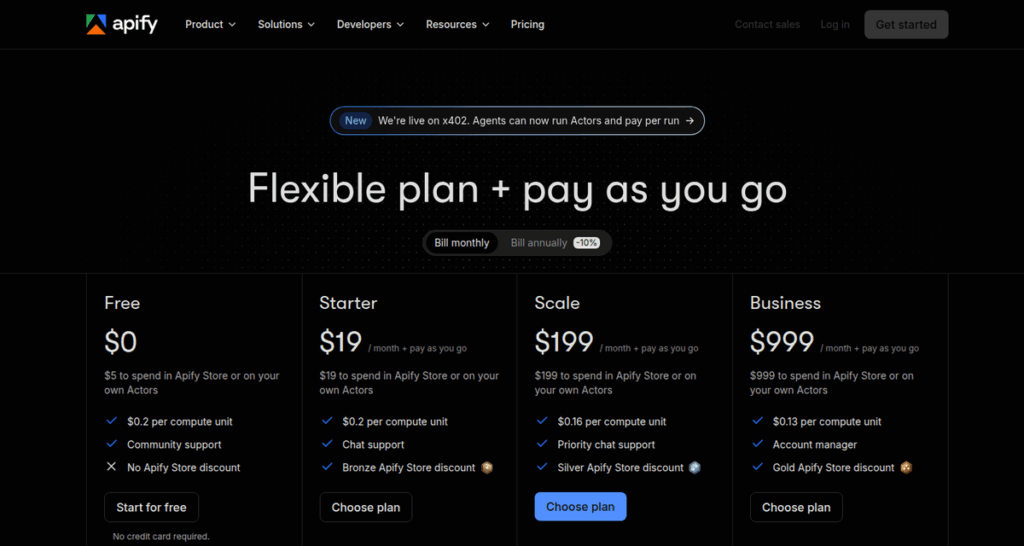
The pattern across all of them is the same: the difference is in what you pay for. Browse AI pays rows. Apify pays compute units and bandwidth. ZenRows pays requests with multipliers. ScrapeOps pays requests or bandwidth. Bright Data pays gigabytes or records depending on the product. ScrapingBee pays credits with auto-mode. Browserless pays units of browser time. The fastest way to pick between them is to express your workload in each one’s native unit and see which one rates it cheapest.
Side-by-side comparison
A single table cannot capture every nuance, but it does let you match the right shape of tool to the workload you actually have. Prices and credits are from the official pricing pages, quoted in USD as displayed; promotional codes and Enterprise SKUs are excluded.
| Browse AI | Apify | ZenRows | ScrapeOps | Bright Data | ScrapingBee | Browserless | |
|---|---|---|---|---|---|---|---|
| Category | No-code recorder | Programmable scraping platform + store | Scraping API (per successful request) | Proxy API Aggregator + Residential Aggregator | Multi-product web data platform | Scraping API (auto-mode credits) | Hosted browser (Puppeteer/Playwright) |
| Billing unit | 1 credit = 10 rows or 1 screenshot; Premium 2–10 cr/run min | 1 CU = 1 GB RAM × 1 hour + $/GB proxies + storage + transfer | 1 credit = 1 successful request; JS 5×, Premium 10×, combined 25× | API aggregator: $/request; residential: $/GB | Web Scraper: $/record; Residential: $/GB; Browser: $/GB; Unlocker: $/1k | 1–75 credits per request (1 classic, 5 JS, 10 premium, 25 premium+JS, 75 stealth+JS) | 1 unit per 30 s per connection; 6 u/MB residential; 2 u/MB DC |
| Free tier | 50 cr/mo, 2 sites, 3 users | $5 prepaid/mo, 16 GB RAM, 5 concurrent | Permanent 5,000 cr/mo, 5 concurrent, no card | 1,000 API + 100 MB residential, no card | 5K records/req per API product, no card | 1,000 credits on signup, no card | 1,000 units/mo, 2 browsers, 2-min max session |
| Cheapest paid | Personal $19/mo annual, 12,000 cr/yr | Starter $19/mo + PAYG, 64 GB RAM, 32 concurrent | Build B1 $19/mo, 45,000 cr/mo, 20 concurrent | Proxy API $9/mo (25K credits); Residential $15/mo (3 GB) | PAYG residential $4/GB; PAYG API $0 + usage | Hobby $19/mo, 75,000 credits, 25 concurrent | Prototyping $25/mo, 20,000 units, 10+5 concurrent |
| Mid-tier | Professional $69/mo annual, 60,000 cr/yr | Scale $199/mo + PAYG, 256 GB RAM, 128 concurrent | Launch L1 $69/mo, 250,000 cr/mo, 50 concurrent | Residential $45/mo (10 GB); API $29/mo (250K credits, 5 concurrent) | Residential Starter $499/mo (141 GB at $3.50/GB) | Startup $99/mo, 1,000,000 credits, 100 concurrent | Starter $140/mo, 180,000 units, 40+10 concurrent |
| High-tier | Premium $500/mo annual, 600,000+ cr/yr | Business $999/mo + PAYG, 512 GB RAM, 256 concurrent | Growth G1 $199/mo, 1,200,000 cr/mo, 100 concurrent | Residential $99/mo (25 GB); API $99/mo (1.25M credits, 50 concurrent) | Residential Growth $999/mo (332 GB); Business $1,999/mo (798 GB) | Business $249/mo, 3M credits, 200 concurrent, Premium proxy | Scale $350/mo, 500,000 units, 100+20 concurrent |
| Custom | Above Premium: sales contact | Enterprise: custom CU rate, SLAs | Enterprise: 400–1,000+ concurrent, premium support | Above $99/mo: sales contact | Enterprise: 99.99% SLA, custom $/GB | Business+ $599/mo, 8M credits, 400 concurrent, dedicated APIs | Enterprise: SSO, SLAs, custom proxy limits |
| JS rendering | Built-in (Chromium recorder) | Per-Actor; headless via Playwright Actor or browser pool | Built-in (5× credit multiplier) | Built-in; JS snippet execution | Built-in (Unlocker / Browser) | Built-in (5–75 credits per request) | Built-in (the product is the browser) |
| Anti-bot | Rotating residential + CAPTCHA; Premium multiplier | Metered (residential $7–8/GB, SERP, Unblocker $1–1.50/1k) | Premium proxies + CAPTCHA at 10–25× | Aggregates 20+ proxy APIs; ban and CAPTCHA detection | Strongest in set: Unlocker + Browser + fingerprinting | Premium 10–25 cr/req; Stealth 75 cr/req | DIY (6 u/MB residential, 10 u/captcha) |
| Concurrency | Not published; limited by platform load | 5 → 32 → 128 → 256 (Free → Business) | 5 → 20 → 50 → 100 → 200 → 400–1,000+ | 1 → 5 → 25 → 50 → 75 → 100 → 150 → 200 | Unlimited on paid API products | 25 → 50 → 100 → 200 → 400 | 2 → 10+5 → 40+10 → 100+20 |
| Credit rules | Reset every cycle; no rollover (except on plan upgrade) | Prepaid usage never rolls over; PAYG thresholds per tier (see Apify billing docs) | Top-ups up to 4/period; unused roll over; rollover on paid | Only successful requests billed; pauses on credit-out | PAYG no commitment; per-product top-ups documented per API | Use-it-or-lose-it; 429 on overflow | Overage at $0.0015–0.0020/unit |
| Annual discount | -20% (Personal $48 → $19, Pro $87 → $69) | -10% | 10 months for 12 (~17% off), full-year up front | n/a | n/a on PAYG APIs | n/a | n/a |
| KYC | None | None | None | None | Required for Residential / Mobile | None | None |
Sources: apify.com/pricing + docs.apify.com/platform/account/billing; docs.zenrows.com/first-steps/pricing; browse.ai/pricing; scrapeops.io/proxy-api-aggregator/ + scrapeops.io/proxy-aggregator/; brightdata.com/pricing/proxy-network + brightdata.com/pricing/web-unlocker; scrapingbee.com/pricing/; browserless.io/pricing/.
The billing-unit trap: rows, requests, units, gigabytes
Browse AI vs ZenRows on the same request. Both charge per successful outcome, but ZenRows’ multiplier model is more granular. A protected page on Browse AI costs 2–10 credits per run minimum (a one-row dashboard costs the same as a 50-row product page, as long as it sits behind a CAPTCHA wall). A protected page on ZenRows costs 25 credits (Premium + JS); a classic page costs 1 credit. The math lands differently depending on how many rows the page actually returns.
Browse AI vs Apify on the same scrape. Browse AI’s $19/month is a fixed annual credit pack; Apify’s $19/month is a prepaid platform-usage allowance that pays for whatever you run. Apify’s per-CU rate starts at $0.20 on Free/Starter, drops to $0.16 on Scale and $0.13 on Business; proxies add $7–8/GB. Long-running scrapes that return a lot of pages for low cost per page are cheaper on Apify; a small set of pages watched on a schedule is cheaper on Browse AI.
ScrapingBee auto-mode vs Browse AI. ScrapingBee auto-mode picks the cheapest successful configuration and caps with max_cost. Premium + JS is 25 credits; Stealth + JS is 75. The max_cost cap gives you a per-request ceiling, which Browse AI does not — Premium-site runs are billed at the vendor’s published floor regardless.
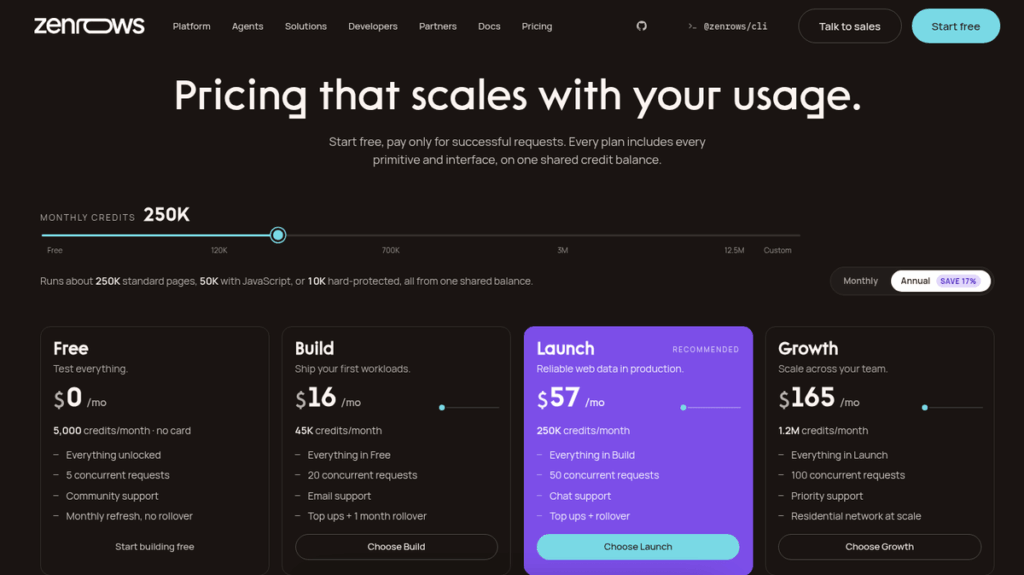
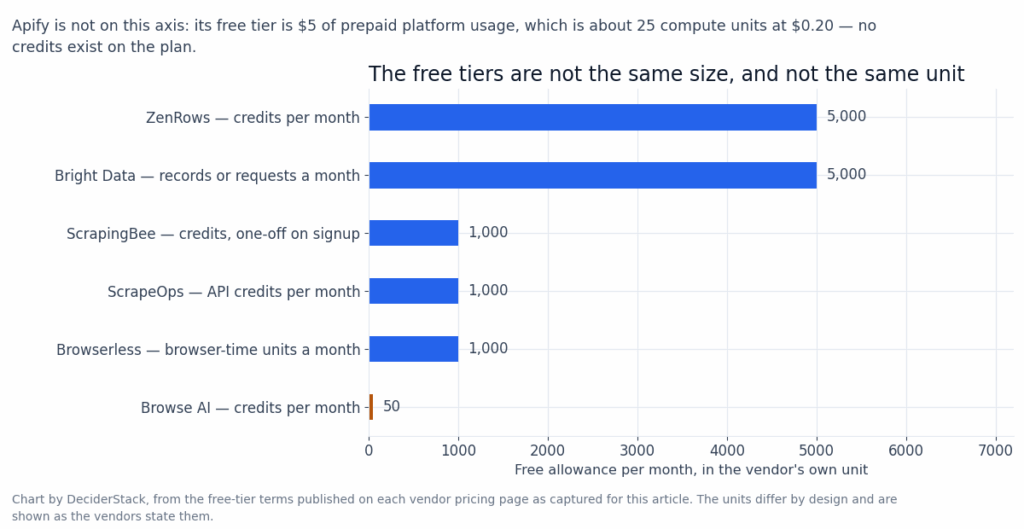
Bright Data free tier vs ScrapeOps free tier vs the rest. Bright Data offers 5,000 records or requests per month on every API product. ScrapeOps offers 1,000 API credits plus 100 MB residential bandwidth. Browse AI, ZenRows, Apify and ScrapingBee all have free tiers, but only ScrapeOps and Bright Data combine API + residential bandwidth in the free allowance.
Browserless units vs everyone else’s credits. One Browserless unit is up to 30 seconds of browser time. A 90-second session is 3 units; residential proxies are 6 units per MB; CAPTCHA solving is 10 units per solve; session reconnects count as new connections. The math is concrete, but you have to budget it for every step in the flow.
Run a 100-page pilot on each platform’s free tier against your real target before committing. The cost on your workload is the only number that pricing pages cannot give you.
Worked example: 1,000 Premium-site pages a day
A scrape of 1,000 Premium-site pages per day, 10 rows per page, is the workload that Browse AI handles worst — Premium sites trigger the 2–10 credit per-run floor regardless of row count.
- Browse AI Premium ($500/mo annual, 600,000 cr/yr): 30,000 runs × 2–10 credits minimum ≈ 60,000–300,000 credits/month; over the Premium annual budget at the upper end.
- Apify Scale ($199/mo + PAYG, $0.16/CU, $7.50/GB residential): a custom Actor scraping 1,000 pages/day at 30s each with 1 GB RAM ≈ 8.3 CU/day at $0.16 + ~10 GB/month residential. Total ≈ $240–$260/month on top of the $199 prepaid allowance.
- ZenRows Growth G1 ($199/mo, 1,200,000 cr/mo, 100 concurrent): without JS/Premium = 900,000 credits/month (within budget); with Premium + JS (25×) = 22,500,000 credits/month — far over.
- ScrapeOps Proxy API Aggregator ($99/mo, 1.25M credits, 50 concurrent): 30,000 credits/day = 900,000 credits/month, under the $99 plan. Anti-bot bundled; residential sidecar billed separately.
- Bright Data PAYG: Residential PAYG ($4/GB) + Web Unlocker PAYG. ~30 GB/month at $4/GB + Unlocker usage ≈ $200–$300/month, no commitment.
- ScrapingBee Startup ($99/mo, 1,000,000 credits, 100 concurrent): covers the same workload at auto-mode pricing.
- Browserless: 30-second sessions × 30,000/month = 900,000 units — over the Scale plan’s 500,000. Plus residential 6 u/MB and CAPTCHA 10 u/solve.
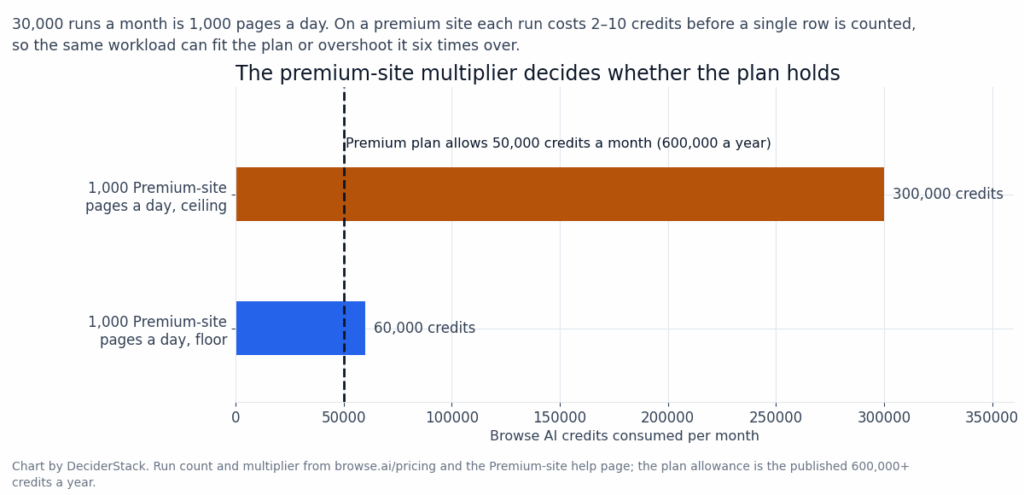
Your real page fetch size and whether the target triggers Premium-site pricing on Browse AI or premium-tier credit costs on the alternatives are workload-specific. The cost structure is real, but per-row math depends on inputs you can only measure against a live target.
Anti-bot and JavaScript rendering
Each platform handles anti-bot and JS rendering differently — and the differences are larger than the price differences.
Built in. Browse AI ships rotating residential proxies and CAPTCHA solving, with Premium sites flagged and billed a minimum of 2–10 credits per run. ScrapeOps bundles 20+ proxy APIs behind one endpoint with ban detection, CAPTCHA detection, sticky sessions and country geotargeting. Bright Data bundles Web Unlocker + Scraping Browser — the strongest anti-bot product in the set, with 99.99% SLA on Enterprise.
Built in, metered. ZenRows uses fixed multipliers — JS 5×, Premium proxies 10×, combined 25×; Browser Sessions are 25,000 credits per GB + 5 per minute. Apify exposes every layer as a separate metered product — residential $7–8/GB, datacenter per IP, SERP per 1k, Unblocker $1–1.50 per 1k — and runs headless Chromium via the Playwright Actor, billed at CU rates. ScrapingBee’s Premium proxy is 10–25 credits per request and Stealth proxy is 75, with built-in CAPTCHA evasion and JS rendering at the same multiplier.
Bring your own. Browserless does not bundle anti-bot. You choose your proxy type via BrowserQL (residential 6 units/MB, datacenter 2 units/MB) and pay 10 units per successful CAPTCHA solve on top of base.
On hard targets (Cloudflare, DataDome, PerimeterX), the order of capability is usually Bright Data > ScrapeOps aggregator > Apify Store (premium Actors) > ScrapingBee Stealth > Browse AI Premium > ZenRows Premium > Browserless DIY. The cost gradient looks similar.
Vendors do not publish “we beat the other” numbers — confirm the actual anti-bot success rate on the targets you care about on a pilot before committing.
Plan ladders, free tiers, and the annual billing cliff
Three things stand out across the ladders:
1. The $19 entry tier spans four vendors. Browse AI Personal, Apify Starter, ZenRows B1 and ScrapingBee Hobby all sit at $19/month — but they buy four different things. Browse AI’s $19 buys 12,000 credits once a year; Apify’s $19 buys $19 of prepaid platform usage every month at $0.20/CU. ZenRows’ B1 buys 45,000 credits per month with rollover; ScrapingBee’s Hobby buys 75,000 credits per month with no rollover. Map your workload to the cheapest native unit. Not the cheapest dollar entry. 2. The jump from mid to high is largest on Browse AI. $69 → $500 monthly is a 7× step that bundles dedicated account management. Fully managed data pipelines and a 10× credit allowance. Bright Data’s $499 → $999 is 2× with 2.4× bandwidth. Apify’s $199 → $999 is 5× with 2× RAM and 2× concurrent runs. 3. Free tiers favor API-first vendors. ScrapeOps (1,000 API + 100 MB residential). Bright Data (5K on every API), ScrapingBee (1,000 on signup), ZenRows (5,000 permanent), Apify ($5 prepaid) and Browse AI (50/month) all let you run a real workload. Browserless’ free tier (1,000 units, 2-min sessions) is too tight for production.
When a no-code recorder beats an API
Pick Browse AI when the data sits on a small set of pages you already know (10–50 detail pages or one product search URL), watched on a schedule. Pick when you need to hand the recorder to a non-technical team member. Pick when you would rather pay a fixed annual credit allowance than a PAYG bill. Pick when you want change-detection monitors with a built-in alert path. Pick when you are running the workload for less than a year and want the 60-day satisfaction guarantee to back the first two annual cycles.
When the alternatives make more sense
- Apify. You want a programmable platform. Pick when the Apify Store covers your target. Pick when you want granular proxy control. Pick when you run long jobs that return a lot of data per dollar.
- ZenRows. Your workload is request-shaped. Pick when you want a permanent free tier and 1-month rollover on paid plans. Pick when fixed multipliers are easier to budget than Premium-site floors.
- ScrapeOps. You want one endpoint that aggregates 20+ proxy APIs. Pick when you want the account to pause on credit-out (no surprise charges). Pick when you are okay with two meters.
- Bright Data. You are scraping at scale across 195 countries with city-level targeting. Pick when you need the strongest anti-bot product (Web Unlocker + Scraping Browser). Pick when you can absorb the $499/month Residential minimum and KYC.
- ScrapingBee. You want auto-mode with a
max_costcap. Pick when you need dedicated vertical APIs on Business+. Pick when you want US-state geotargeting. - Browserless. You already write Puppeteer / Playwright / Selenium code; you want a hosted browser with proxies as an add-on; you want a self-hosted Docker option for on-prem.
Key parameters at a glance (and what they actually decide)
| Vendor | Cheapest paid | Mid-tier | Free tier | Native unit | Built-in anti-bot | Concurrency cap | Best fit |
|---|---|---|---|---|---|---|---|
| Browse AI | $19/mo annual | $69/mo annual | 50 cr/mo, 2 sites | Row + Premium-site multiplier | Yes | Not published | Non-technical teams, monitored jobs |
| Apify | $19/mo + PAYG | $199/mo + PAYG | $5 prepaid | Compute Unit (GB × hour) | Metered | 5 → 256 | Programmable scrapers, custom Actors |
| ZenRows | $19/mo (B1) | $199/mo (G1) | 5,000 cr/mo permanent | Successful request × multiplier | Yes (10–25×) | 5 → 200 | Per-request APIs, JS rendering |
| ScrapeOps | $9/mo API / $15/mo res | $29/mo / $45/mo | 1,000 API + 100 MB | Per request (API) or per GB | Yes (aggregates 20+) | 1 → 200 | Single-vendor proxy aggregation |
| Bright Data | PAYG from $0 | $499/mo Residential | 5K records/req per API | $/GB, $/record, $/1k | Yes (Unlocker + Browser) | Unlimited on paid APIs | Multi-product web data, hardest targets |
| ScrapingBee | $19/mo Hobby | $99/mo Startup | 1,000 credits signup | Credit per request (1–75) | Yes (10–75 cr) | 25 → 400 | Auto-mode with cap, dedicated vertical APIs |
| Browserless | $25/mo Prototyping | $140/mo Starter | 1,000 units/mo | Units of browser time + proxy MB | Bring your own | 2 → 100+20 | Code-first Puppeteer / Playwright |
FAQ
What does a Browse AI credit buy?
One credit = 10 rows extracted from a page, or 1 screenshot. Premium sites cost a minimum of 2–10 credits per run regardless of row count. Credits reset every cycle on Personal, Professional and Premium plans and do not roll over, except on plan upgrade where the unused balance of the previous plan is added on top of the new plan.
Which Browse AI alternative is cheapest for a small workload?
ZenRows’ permanent free tier (5,000 credits/month, no card) and ScrapeOps’ free tier (1,000 API credits + 100 MB residential, no card) both let you scrape for $0. Bright Data’s API products give 5,000 requests/records per month free. ScrapingBee, Apify and Browserless all have free tiers too, but tighter ceilings.
Which alternative is best for code-first teams?
Apify (programmable platform with custom Actors and a marketplace), Browserless (hosted browser for Puppeteer/Playwright/Selenium, with self-hosted Docker), ScrapingBee (credit-based API with auto-mode and max_cost), Bright Data (multi-product platform). ZenRows fits either side — a per-request API any code can call.
Which alternative has the strongest anti-bot?
Bright Data’s Web Unlocker + Scraping Browser bundle, with a 99.99% SLA on Enterprise. ScrapeOps is next strongest because it aggregates 20+ proxy APIs behind one endpoint. Apify and ScrapingBee both expose Premium and Stealth proxy tiers at 25 and 75 credits per request.
Do any of these have a permanent free tier?
ZenRows’ Free plan is permanent (5,000 credits/month, no time limit). Browse AI, Apify, ScrapeOps, Bright Data, ScrapingBee and Browserless publish free tiers that reset monthly or per cycle.
Which vendor offers the largest credit allowance per dollar?
ZenRows Growth G1 ($199/mo, 1,200,000 credits per month per the published ZenRows annual pricing) and Browse AI Premium ($500/mo annual, 600,000+ credits/yr) offer the most credits per dollar among self-serve plans. At different units (per request vs per row + Premium multiplier). Apify Scale at $199/mo is $199 of prepaid platform usage, not a credit allowance.
Can I run my own code on each one?
Apify, yes — Actors are Docker containers running Node.js, Python or any Docker-friendly language. Browserless is the most code-native — Puppeteer / Playwright / Selenium APIs against a hosted browser. ScrapingBee, ZenRows and Bright Data’s Web Scraper API are all HTTP APIs. Browse AI publishes no custom-code path; the recorder is the runtime.
What changes at annual billing?
Browse AI: 20% off (Personal $48 → $19, Professional $87 → $69). Apify: 10% off. ZenRows: 10 months for 12 (~17% off), full-year allowance up front. Bright Data, ScrapingBee, ScrapeOps and Browserless publish monthly-only plans.
Verdict
Browse AI is the fastest way to point a recorder at a page and walk away with rows. The cost is what happens when a workload stops being row-bound.
The six alternatives divide by workflow:
- Apify when you want a programmable platform with an Actor store, granular proxy control, and a bill that scales with memory, time, and bandwidth. Best for workloads that run a lot of pages for low cost per page.
- ZenRows when the workload is request-shaped and you want fixed multipliers (5× JS, 10× Premium, 25× combined) you can budget per call. The only vendor with a permanent free tier and rollover on paid plans.
- ScrapeOps when you want one endpoint aggregating 20+ proxy APIs behind it, with an account that pauses on credit-out instead of running into surprise charges.
- Bright Data when you need to scrape at scale across 195 countries, need the strongest anti-bot product (Web Unlocker + Scraping Browser), and can absorb $499/month Residential minimum plus KYC.
- ScrapingBee when you want auto-mode with
max_cost, dedicated vertical APIs, and US-state geotargeting. - Browserless when you already write Puppeteer / Playwright / Selenium code and want a hosted browser with proxies as an add-on, plus a self-hosted Docker option.
Spend the free credits on each before you commit — our editorial policy explains why unverified figures are marked rather than estimated. The cost you measure on your own workload is the only number pricing pages cannot give you.
How we put this comparison together: plan prices, billing units, free-tier limits, proxy rates, credit costs and concurrency ceilings come from official pricing and documentation pages — apify.com/pricing, docs.apify.com/platform/account/billing, docs.zenrows.com/first-steps/pricing, browse.ai/pricing, help.browse.ai/article/137-premium-sites, scrapeops.io/proxy-api-aggregator/, brightdata.com/pricing/*, scrapingbee.com/pricing/, browserless.io/pricing/ — captured via self-hosted Firecrawl, quoted in USD as displayed.
We have not run a paid account on any of the seven vendors.
Figures that depend on real-world success rates, monitored-job reliability, anti-bot bypass rates, or per-target Premium-site multipliers are flagged where they appear in the text instead of being estimated.
Our scoring criteria and the rule that bars us from linking vendors who prohibit trademark bidding are documented on the methodology page.
Browse AI, Apify and ZenRows prohibit paid advertising on their brands — they appear in this article as plain-text mentions only, without affiliate or partner links.
Disclosure: this article contains affiliate links. If you buy through them we may earn a commission at no extra cost to you. Commission never changes our scoring or the order of a ranking.