If you are shopping for Apify alternatives, you already know what Apify is: the platform where you rent Actors out of a 74,000+ marketplace (the figure in the Apify Store title; the public blog has used smaller numbers historically and the headline on apify.com/store today is the larger one), run your own code in a hosted runtime. Assemble a monthly bill out of compute units, proxy gigabytes, and storage. The reason you are reading this is the part that does not feel obvious — the bill. A custom Actor that runs 30 minutes a day with 1 GB of RAM and a residential proxy, billed at $0.16/CU on Scale plus $7.50/GB residential, lands in the low single-digit dollars per day in pure platform usage before storage and dataset costs. When that happens, the first instinct is to look for a cheaper platform. The smarter move is to figure out which unit your workload is bound by, because the cheapest headline price is rarely the cheapest bill for your workload.
This guide compares Apify with seven Apify alternatives that come up most in search. Browse AI as the no-code recorder opposite, ZenRows and ScrapingBee as per-request APIs, ScrapeOps as a unified aggregator, Bright Data as the multi-product heavyweight. Browserless for code-first teams. Every number comes from the vendor’s official pricing page. Figures that need a paid account to verify — actual anti-bot success rates, real Actor costs on your workload, proxy bypass quality — are flagged where they appear in the text.
In short
Apify is a programmable scraping platform. The bill is built from compute units (1 CU = 1 GB RAM × 1 hour) plus metered proxies, storage, and data transfer — not from rows, requests, or credits.
The seven credible alternatives split into three shapes: no-code recorders (Browse AI), per-request scraping APIs (ZenRows, ScrapingBee, ScrapeOps API), and proxy or browser services (Bright Data, ScrapeOps residential, Browserless). Apify, Browse AI and ZenRows prohibit paid advertising on their trademarks; the four remaining names can carry affiliate links. The right platform is the one whose native unit matches the unit your workload is bound by.
The verdict in short
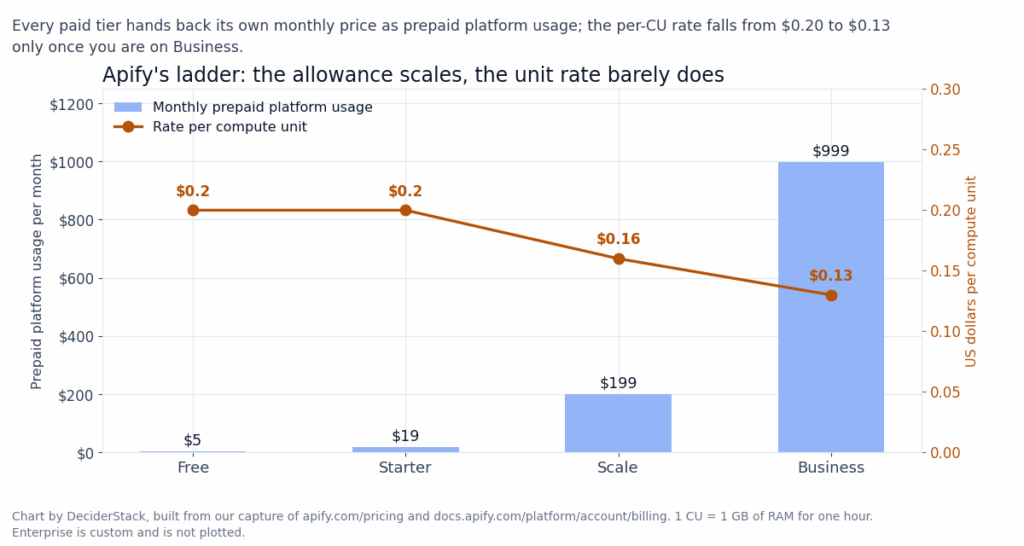
Apify is the right pick when the workload is compute-bound and the bill is dominated by long-running Actors, large RAM, or heavy proxy bandwidth. The CU model rewards scale: per-CU rate drops from $0.20 on Starter to $0.16 on Scale to $0.13 on Business, and residential bandwidth is $7–$8/GB at all tiers. The cost is what happens when the workload is not compute-bound — 50,000 simple requests, a row-bound monitoring job, a hosted-browser flow — and the CU math starts to dwarf alternatives with simpler meters.
How Apify is actually built
Apify is not a scraping API. It is a programmable platform with three layers, and understanding them is the only way to make sense of the bill.
The first layer is the Actor. An Actor is a Docker container running Node.js, Python, or any Docker-friendly language. Apify hosts the runtime; you write the code (or grab one from the Apify Store). The marketplace ships with 74,000+ pre-built Actors (per the current Apify Store page title; older posts on the Apify blog and third-party coverage have quoted smaller figures historically) covering Instagram, Google Maps, Amazon, LinkedIn, real estate listings, and dozens of other targets. Each Actor exposes an input schema (the JSON you POST to the run endpoint) and an output dataset (the rows you retrieve when it finishes).
The second layer is the platform usage. Every run consumes compute units, where 1 CU = 1 GB of RAM × 1 hour, billed at $0.20/CU on Free and Starter, $0.16 on Scale, $0.13 on Business. On top of CU you pay for proxies (residential $7–$8/GB, datacenter per IP, SERP per 1k, Unblocker per 1k), storage in GB-hours, and data transfer. Free and Starter ship with a monthly prepaid allowance — $5 on Free, $19 on Starter — that pays for whatever you run. Beyond the prepaid allowance, overage continues as pay-as-you-go on the same invoice; the exact PAYG threshold per tier is documented in the Apify billing docs.
The third layer is the integration. Actors can be triggered by the Apify Scheduler, by webhook, by the public API, or by agentic payment rails (x402 / MPP) at agi.apify.com. This last path is useful if you are building an agent that calls pay-per-run Actors without an Apify account of its own.
A representative custom Actor scraping 1,000 product pages per day, 30 seconds per page, 1 GB RAM, with residential proxy: about 8.3 CU/day at $0.16 (Scale) = $1.33/day on CU alone. Add 10 GB/month of residential bandwidth at $7.50/GB ≈ $75/month, plus a slice of dataset storage. A $199 Scale plan with $199 of prepaid allowance barely covers that workload, and PAYG overage starts accruing on top.
Sources: apify.com/pricing, docs.apify.com/platform/actors/running/usage-and-resources, docs.apify.com/platform/account/billing.
Apify pricing at a glance
The plan ladder. Annual billing takes 10% off; prepaid allowance equals monthly price on every tier.
| Plan | Prepaid | Per CU | Max Actor RAM | Concurrent runs | Residential | DC IPs included | SERP / 1k | Unblocker / 1k | Store discount |
|---|---|---|---|---|---|---|---|---|---|
| Free | $5/mo | $0.20 | 16 GB | 5 | $8/GB | 5 | $2.50 | $1.50 | None |
| Starter | $19/mo | $0.20 | 64 GB | 32 | $8/GB | 30 | $2.50 | $1.50 | Bronze |
| Scale | $199/mo | $0.16 | 256 GB | 128 | $7.50/GB | 200 | $2.00 | $1.25 | Silver |
| Business | $999/mo | $0.13 | 512 GB | 256 | $7.00/GB | 500 | $1.70 | $1.00 | Gold |
| Enterprise | Custom | Custom | Custom | Custom | Custom | Custom | Custom | Custom | Custom |
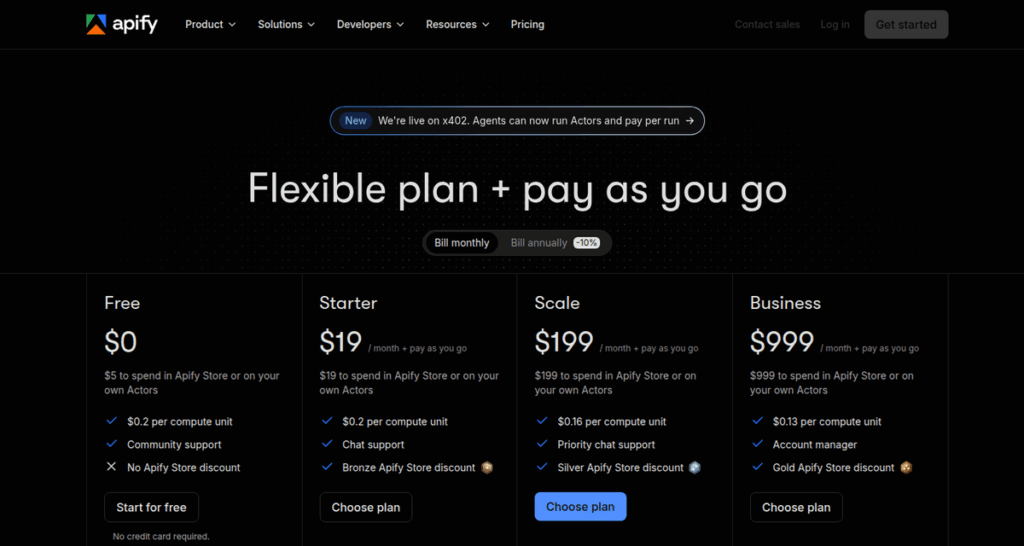
Add-ons include concurrent runs ($5/each), Actor RAM ($1/GB), datacenter proxy (from $0.60/IP), and personal training ($150/hour). Discounts: students get 30% off Starter and Scale, startups get 30% off Scale, and any plan billed annually takes another 10% off.
The math is concrete but indirect. The $19 Starter buys you $19 of prepaid platform usage per month at $0.20/CU — 95 CU before PAYG starts. A long-running Actor eats that allowance in days. The $199 Scale plan drops the per-CU rate to $0.16, raises RAM to 256 GB, and lifts concurrent runs to 128. But it still only buys $199 of prepaid usage, which goes faster than most teams expect once proxy bandwidth is included. Estimate your monthly CU + proxy GB against the published rates; the prepaid allowance covers roughly that much work before PAYG starts.
Sources: apify.com/pricing, docs.apify.com/platform/account/billing.
What Apify alternatives actually change
The seven Apify alternatives below fall into three shapes, each one solving a specific weakness in Apify’s bill: the CU math, the marketplace dependency, the prepaid allowance ceiling. The absence of a per-request API for callers who don’t want to deploy code.
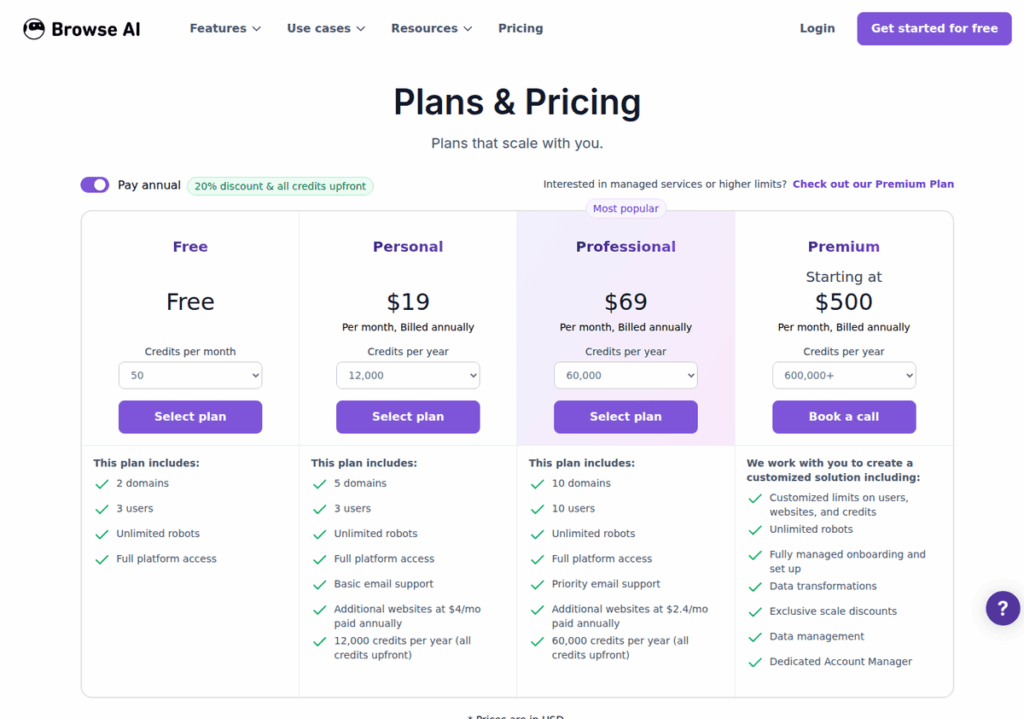
Browse AI — no-code recorder with row-based credits – Pick when: the workload is 10–50 detail pages watched on a schedule. Pick when you would rather hand a robot to a non-technical teammate than maintain an Actor. Pick when change-detection alerts are part of the deliverable. – Skip when: you want custom scraping logic, your workload is row-bound at scale (the Premium-site 2–10 credit per-run floor makes monitored jobs expensive), or you need to run code.
ZenRows — per-request scraping API – Pick when: the workload is request-shaped (you have a list of URLs and want JSON back). Pick when you want a permanent free tier with no card. Pick when multipliers are easier to budget than a CU model. – Skip when: you want to write your own scraper or schedule it on a cron, you need to deploy code; ZenRows is an API, not a runtime.
ScrapeOps — proxy aggregator with two meters – Pick when: you want one endpoint that aggregates 20+ proxy APIs (ScraperAPI, Zyte, ScrapingBee, ZenRows, Bright Data, Oxylabs, Smartproxy) behind a single URL. Pick when you want the account to pause on credit-out by default instead of running into surprise charges. – Skip when: you want a hosted runtime for custom code; ScrapeOps is a routing API plus a residential proxy port, not a platform.
Bright Data — multi-product web data platform – Pick when: you are scraping at scale across 195 countries with city-level targeting. Pick when you need the strongest anti-bot product in this set (Web Unlocker + Scraping Browser). Pick when you can absorb the $499/month Residential minimum and KYC. – Skip when: your workload is small (the platform is built for multi-product consumption), you cannot do KYC, you only need one product and not the rest of the suite.
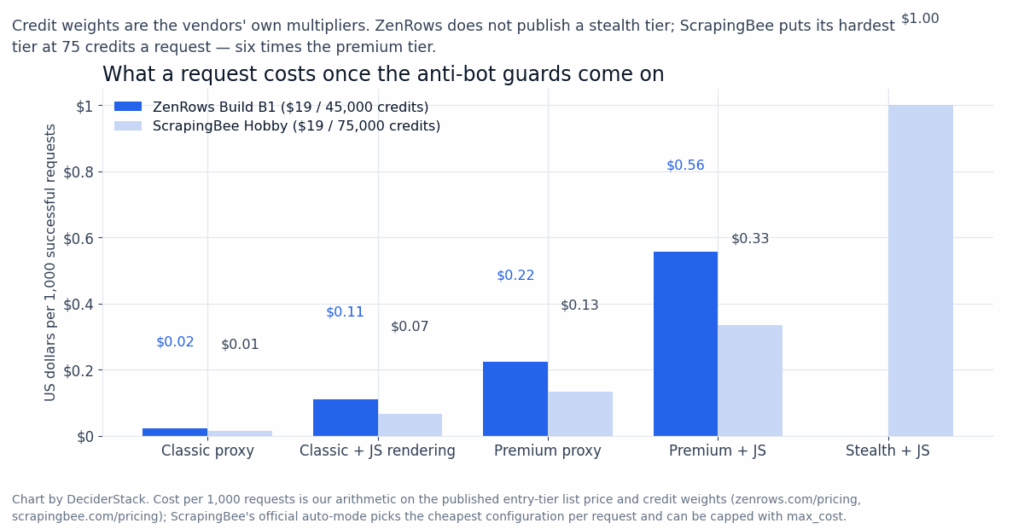
ScrapingBee — credit-based scraping API with auto-mode – Pick when: you want per-request pricing with a max_cost cap (auto-mode picks the cheapest successful config and stops at the ceiling you set). Pick when you need dedicated vertical APIs (Amazon, Google Search, YouTube, ChatGPT, Walmart) on Business+. – Skip when: you want to deploy code (ScrapingBee is an API), you need large-scale scraping on protected sites (Stealth proxy is 75 credits/req — affordable for targeted calls, expensive for bulk scraping).
Browserless — hosted browser for code-first teams – Pick when: you already write Puppeteer, Playwright, or Selenium code and want a hosted browser with proxies as an add-on. Pick when you want a self-hosted Docker option for on-prem. – Skip when: you don’t want to write code, you need anti-bot bundled (Browserless does not include it — you bring your own strategy or pay 6 units/MB for residential).
The pattern across all of them is the same: the difference is in what you pay for. Apify pays compute units and bandwidth. Browse AI pays rows. ZenRows pays requests with fixed multipliers. ScrapeOps pays requests or bandwidth depending on the product. Bright Data pays gigabytes or records depending on which of its six products you point at the workload. ScrapingBee pays credits with auto-mode. Browserless pays units of browser time. The fastest way to pick between them is to express your workload in each one’s native unit and see which one rates it cheapest.
Side-by-side comparison
A single table cannot capture every nuance, but it does let you match the right shape of tool to the workload you actually have. Prices and units are from the official pricing pages, quoted in USD as displayed; promotional codes and Enterprise SKUs are excluded.
| Apify | Browse AI | ZenRows | ScrapeOps | Bright Data | ScrapingBee | Browserless | |
|---|---|---|---|---|---|---|---|
| Category | Programmable scraping platform + Store | No-code recorder | Scraping API (per successful request) | Proxy API Aggregator + Residential Aggregator | Multi-product web data platform | Scraping API (auto-mode credits) | Hosted browser (Puppeteer/Playwright) |
| Billing unit | 1 CU = 1 GB RAM × 1 hour + $/GB proxies + storage + transfer | 1 credit = 10 rows or 1 screenshot; Premium 2–10 cr/run min | 1 credit = 1 successful request; JS 5×, Premium 10×, combined 25× | API aggregator: $/request; residential: $/GB | Web Scraper: $/record; Residential: $/GB; Browser: $/GB; Unlocker: $/1k | 1–75 credits per request (1 classic, 5 JS, 10 premium, 25 premium+JS, 75 stealth+JS) | 1 unit per 30 s per connection; 6 u/MB residential; 2 u/MB DC |
| Free tier | $5 prepaid/mo, 16 GB RAM, 5 concurrent | 50 cr/mo, 2 sites, 3 users | Permanent 5,000 cr/mo, 5 concurrent, no card | 1,000 API + 100 MB residential, no card | 5K records/req per API product, no card | 1,000 credits on signup, no card | 1,000 units/mo, 2 browsers, 2-min max session |
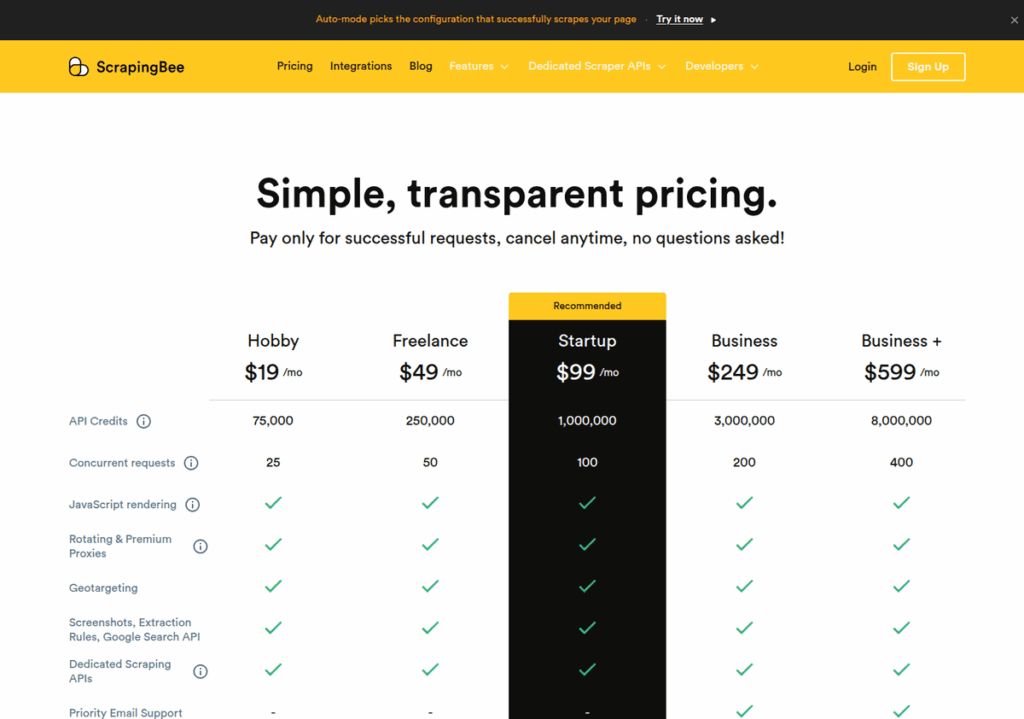
| Cheapest paid | Starter $19/mo + PAYG, 64 GB RAM, 32 concurrent | Personal $19/mo annual, 12,000 cr/yr | Build B1 $19/mo, 45,000 cr/mo, 20 concurrent | Proxy API $9/mo (25K credits); Residential $15/mo (3 GB) | PAYG residential $4/GB; PAYG API $0 + usage | Hobby $19/mo, 75,000 credits, 25 concurrent | Prototyping $25/mo, 20,000 units, 10+5 concurrent |
| Mid-tier | Scale $199/mo + PAYG, 256 GB RAM, 128 concurrent | Professional $69/mo annual, 60,000 cr/yr | Launch L1 $69/mo, 250,000 cr/mo, 50 concurrent | Residential $45/mo (10 GB); API $29/mo (250K credits, 5 concurrent) | Residential Starter $499/mo (141 GB at $3.50/GB) | Startup $99/mo, 1,000,000 credits, 100 concurrent | Starter $140/mo, 180,000 units, 40+10 concurrent |
| High-tier | Business $999/mo + PAYG, 512 GB RAM, 256 concurrent | Premium $500/mo annual, 600,000+ cr/yr | Growth G1 $199/mo, 1,200,000 cr/mo, 100 concurrent | Residential $99/mo (25 GB); API $99/mo (1.25M credits, 50 concurrent) | Residential Growth $999/mo (332 GB); Business $1,999/mo (798 GB) | Business $249/mo, 3M credits, 200 concurrent, Premium proxy | Scale $350/mo, 500,000 units, 100+20 concurrent |
| Custom | Enterprise: custom CU rate, SLAs | Above Premium: sales contact | Enterprise: 400–1,000+ concurrent, premium support | Above $99/mo: sales contact | Enterprise: 99.99% SLA, custom $/GB | Business+ $599/mo, 8M credits, 400 concurrent, dedicated APIs | Enterprise: SSO, SLAs, custom proxy limits |
| JS rendering | Per-Actor; headless via Playwright Actor or browser pool | Built-in (Chromium recorder) | Built-in (5× credit multiplier) | Built-in; JS snippet execution | Built-in (Unlocker / Browser) | Built-in (5–75 credits per request) | Built-in (the product is the browser) |
| Anti-bot | Metered (residential $7–$8/GB, SERP, Unblocker $1–$1.50/1k) | Rotating residential + CAPTCHA; Premium multiplier | Premium proxies + CAPTCHA at 10–25× | Aggregates 20+ proxy APIs; ban and CAPTCHA detection | Strongest in set: Unlocker + Browser + fingerprinting | Premium 10–25 cr/req; Stealth 75 cr/req | DIY (6 u/MB residential, 10 u/captcha) |
| Concurrency | 5 → 32 → 128 → 256 (Free → Business) | Not published; limited by platform load | 5 → 20 → 50 → 100 → 200 → 400–1,000+ | 1 → 5 → 25 → 50 → 75 → 100 → 150 → 200 | Unlimited on paid API products | 25 → 50 → 100 → 200 → 400 | 2 → 10+5 → 40+10 → 100+20 |
| Credit rules | Prepaid usage never rolls over; PAYG thresholds per tier (see Apify billing docs) | Reset every cycle; no rollover (except on plan upgrade) | Top-ups up to 4/period; unused roll over; rollover on paid | Only successful requests billed; pauses on credit-out | PAYG no commitment; per-product top-ups documented per API | Use-it-or-lose-it; 429 on overflow | Overage at $0.0015–0.0020/unit |
| Annual discount | -10% | -20% (Personal $48 → $19, Pro $87 → $69) | 10 months for 12 (~17% off), full-year up front | n/a | n/a on PAYG APIs | n/a | n/a |
| KYC | None | None | None | None | Required for Residential / Mobile | None | None |
Sources: apify.com/pricing + docs.apify.com/platform/account/billing; docs.zenrows.com/first-steps/pricing; browse.ai/pricing; scrapeops.io/proxy-api-aggregator/ + scrapeops.io/proxy-aggregator/; brightdata.com/pricing/proxy-network + brightdata.com/pricing/web-unlocker; scrapingbee.com/pricing/; browserless.io/pricing/ — all captured.
Three cost scenarios: when Apify wins, when it loses
Workloads bind to a unit, and the unit decides which platform rates them cheapest. Three scenarios cover most of what teams actually run.
Scenario A — long-running custom Actor, 100 detail pages scraped 4× a day, residential proxies. Apify’s home turf. The bill is dominated by CU + residential GB, both native to Apify’s pricing. A Scale plan at $199/month with 256 GB Actor RAM and 128 concurrent runs handles this comfortably; residential bandwidth at $7.50/GB is the dominant line item. ZenRows pays Premium + JS = 25 credits per request — at 1,200,000 credits/month it costs more than Apify Scale even before residential bandwidth. Pick: Apify Scale.
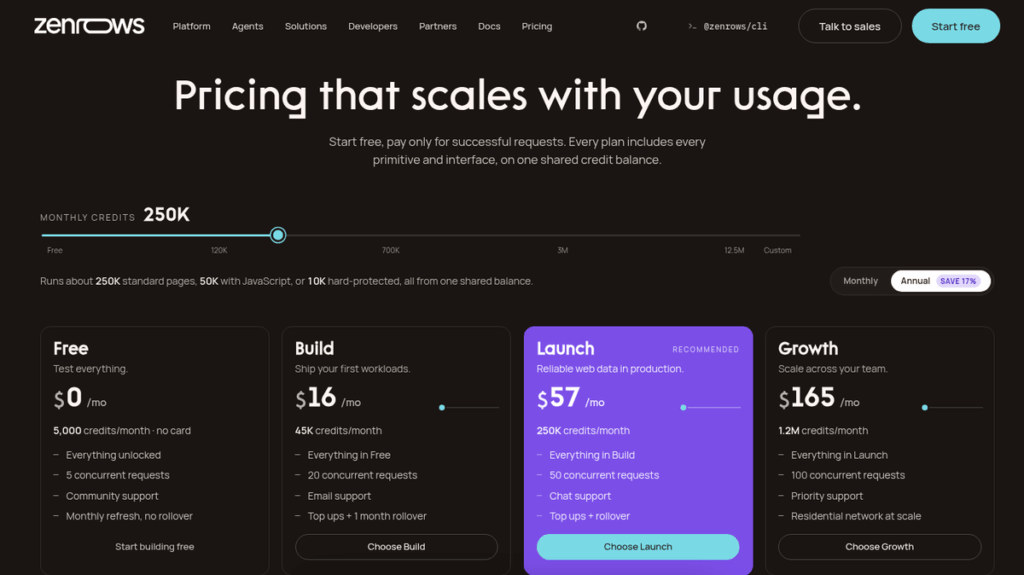
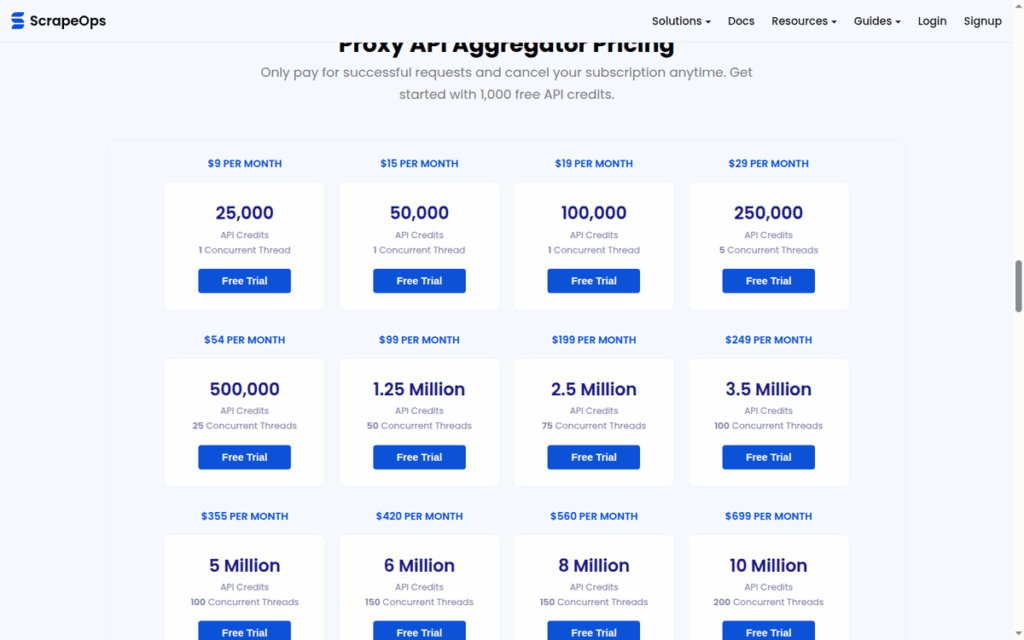
Scenario B — 50,000 simple API calls per day, no rotation needed. Every alternative beats Apify here because the workload is request-shaped, not compute-shaped. Apify Starter ($19 + PAYG) at 128 MB Actor × 5 minutes × 50,000 runs/day would burn hundreds of CU per day; the PAYG overage alone dwarfs any alternative. ZenRows Build B1 ($19/month, 45,000 credits/month) is the entry tier but covers only ~36% of 50,000 × 30 = 1.5M monthly requests. Growth G1 ($199/month, 1,200,000 credits/month) covers ≈80% of that monthly volume at multiplier 1; the remaining ≈20% is either PAYG overage or a higher tier. Scale-tier pricing lives behind a sales quote. ScrapeOps Proxy API Aggregator at $9/month (25,000 credits, 1 concurrent thread) is the cheapest entry. Pick: ZenRows or ScrapeOps.
Scenario C — code-first team that already writes Puppeteer or Playwright. Apify requires packaging your scraper into a Docker Actor; if the codebase is already a Puppeteer project, that is friction. Browserless at $25/month (Prototyping) or $140/month (Starter) drops you into a hosted browser with proxies as an add-on (6 units/MB residential, 2 units/MB datacenter), plus a self-hosted Docker product for on-prem. ScrapingBee Startup at $99/month with 1,000,000 credits and auto-mode + max_cost cap is the alternative if you would rather not maintain the browser logic. Pick: Browserless or ScrapingBee.
Run a 1,000-page pilot on each platform’s free tier against your real target before committing. The cost on your workload is the only number pricing pages cannot give you.
Anti-bot and JavaScript rendering
Each platform handles anti-bot and JS rendering differently — and the differences are larger than the price differences.
Built in. Browse AI ships rotating residential proxies and CAPTCHA solving, with Premium sites flagged and billed a minimum of 2–10 credits per run. ScrapeOps bundles 20+ proxy APIs behind one endpoint with ban detection, CAPTCHA detection, sticky sessions and country geotargeting. Bright Data bundles Web Unlocker + Scraping Browser — the strongest anti-bot product in the set, with 99.99% SLA on Enterprise.
Built in, metered. ZenRows uses fixed multipliers — JS 5×, Premium proxies 10×, combined 25×; Browser Sessions are 25,000 credits/GB + 5 per minute. Apify exposes every layer as a separate metered product — residential $7–$8/GB, datacenter per IP, SERP per 1k, Unblocker $1–$1.50 per 1k — and runs headless Chromium via the Playwright Actor, billed at CU rates. ScrapingBee’s Premium proxy is 10–25 credits per request and Stealth proxy is 75, with built-in CAPTCHA evasion and JS rendering at the same multiplier.
Bring your own. Browserless does not bundle anti-bot. You choose proxy type via BrowserQL (residential 6 units/MB, datacenter 2 units/MB) and pay 10 units per successful CAPTCHA solve on top.
On hard targets (Cloudflare, DataDome, PerimeterX), the order is usually Bright Data > ScrapeOps aggregator > Apify Store (premium Actors) > ScrapingBee Stealth > Browse AI Premium > ZenRows Premium > Browserless DIY. The cost gradient looks similar. Vendors do not publish “we beat the other” numbers; confirm the actual anti-bot success rate on the targets you care about on a pilot before committing.
What you can actually do on each free tier
The free tiers are not equal, and the gap between them predicts which platform you end up paying for.
- ZenRows Free — 5,000 credits/month, permanent, no card, 5 concurrent. The only permanent free tier.
- ScrapeOps Free — 1,000 API credits + 100 MB residential bandwidth, no card. Real workload capability.
- Bright Data Free — 5,000 units/month on every API product (Web Scraper, Scraping Browser, Web Unlocker, SERP, Scraper Studio), no card. The most generous API free tier; no KYC on API products.
- Apify Free — $5 of prepaid platform usage/month, blocked until reset. 16 GB Actor RAM, 5 concurrent. Tight, enough to test an Actor.
- ScrapingBee — 1,000 credits on signup, no card. One-off trial, not a monthly free tier.
- Browserless Free — 1,000 units/month, 2 max concurrent browsers, 2-min max session. Tight for production.
- Browse AI Free — 50 credits/month, 2 websites, 3 users. Enough for a small monitoring job (~500 rows/month).
When Apify is the right pick
Pick Apify when the workload is bound by compute (long-running Actors, large memory, heavy I/O), the Apify Store has an Actor for your target. You want granular proxy control (residential $7–$8/GB, SERP per 1k, Unblocker per 1k), you need to deploy custom code in Node.js, Python. Any Docker-friendly language, you want agentic pay-per-run via x402 / MPP rails, or you can absorb Scale pricing ($199/month + PAYG) for the per-unit savings on a high-volume workload.
When each alternative makes more sense
- Browse AI when the workload is a small set of pages watched on a schedule and the recorder can be handed to a non-technical teammate.
- ZenRows when the workload is request-shaped and you want fixed multipliers (5× JS, 10× Premium, 25× combined) and a permanent free tier.
- ScrapeOps when you want one endpoint that aggregates 20+ proxy APIs, with an account that pauses on credit-out.
- Bright Data when you scrape at scale across 195 countries, need the strongest anti-bot (Web Unlocker + Scraping Browser), and can absorb $499/month Residential minimum plus KYC.
- ScrapingBee when you want auto-mode with
max_cost, dedicated vertical APIs, and US-state geotargeting on Business+. - Browserless when you already write Puppeteer / Playwright / Selenium code, want a hosted browser with proxies as an add-on, and want a self-hosted Docker option.
Key parameters at a glance
| Vendor | Cheapest paid | Mid-tier | Free tier | Native unit | Built-in anti-bot | Concurrency cap | Best fit |
|---|---|---|---|---|---|---|---|
| Apify | $19/mo + PAYG | $199/mo + PAYG | $5 prepaid | Compute Unit (GB × hour) | Metered | 5 → 256 | Programmable scrapers, custom Actors |
| Browse AI | $19/mo annual | $69/mo annual | 50 cr/mo, 2 sites | Row + Premium-site multiplier | Yes | Not published | Non-technical teams, monitored jobs |
| ZenRows | $19/mo (B1) | $199/mo (G1) | 5,000 cr/mo permanent | Successful request × multiplier | Yes (10–25×) | 5 → 200 | Per-request APIs, JS rendering |
| ScrapeOps | $9/mo API / $15/mo res | $29/mo / $45/mo | 1,000 API + 100 MB | Per request (API) or per GB | Yes (aggregates 20+) | 1 → 200 | Single-vendor proxy aggregation |
| Bright Data | PAYG from $0 | $499/mo Residential | 5K records/req per API | $/GB, $/record, $/1k | Yes (Unlocker + Browser) | Unlimited on paid APIs | Multi-product web data, hardest targets |
| ScrapingBee | $19/mo Hobby | $99/mo Startup | 1,000 credits signup | Credit per request (1–75) | Yes (10–75 cr) | 25 → 400 | Auto-mode with cap, dedicated vertical APIs |
| Browserless | $25/mo Prototyping | $140/mo Starter | 1,000 units/mo | Units of browser time + proxy MB | Bring your own | 2 → 100+20 | Code-first Puppeteer / Playwright |
FAQ: Apify alternatives in 2026
What does an Apify Compute Unit buy?
1 CU = 1 GB of RAM × 1 hour. A 1 GB Actor running for 30 minutes consumes 0.5 CU. On Free and Starter the per-CU rate is $0.20, on Scale $0.16, on Business $0.13. Proxies, storage, and data transfer are billed separately on top of CU.
Which Apify alternative is cheapest for a small workload?
ZenRows’ permanent free tier (5,000 credits/month, no card) and ScrapeOps’ free tier (1,000 API credits + 100 MB residential, no card) both let you scrape for $0. Bright Data’s API products give 5,000 requests/records per month free. ScrapingBee, Apify and Browserless all have free tiers too, but tighter ceilings.
Which Apify alternative is best for code-first teams?
Apify itself (programmable platform with custom Actors and a marketplace), Browserless (hosted browser for Puppeteer/Playwright/Selenium, with self-hosted Docker), ScrapingBee (credit-based API with auto-mode and max_cost), Bright Data (multi-product platform). ZenRows fits either side — a per-request API any code can call.
Which Apify alternative has the strongest anti-bot?
Bright Data’s Web Unlocker + Scraping Browser bundle, with a 99.99% SLA on Enterprise. ScrapeOps is next strongest because it aggregates 20+ proxy APIs behind one endpoint. Apify and ScrapingBee both expose Premium and Stealth proxy tiers at $7–$8/GB and 75 credits/req respectively.
Do any of these have a permanent free tier?
ZenRows’ Free plan is permanent (5,000 credits/month, no time limit). Apify, Browse AI, ScrapeOps, Bright Data, ScrapingBee and Browserless publish free tiers that reset monthly or per cycle.
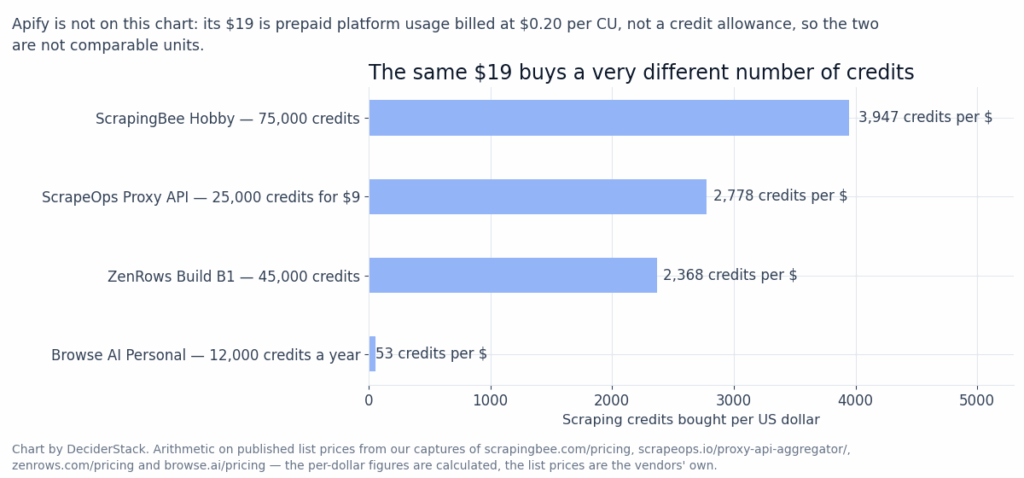
Which vendor offers the largest credit allowance per dollar?
ZenRows Growth G1 ($199/mo, 1,200,000 credits per month per the published ZenRows annual pricing) and Browse AI Premium ($500/mo annual, 600,000+ credits/yr) offer the most credits per dollar among self-serve plans. At different units (per request vs per row + Premium multiplier).
Can I run my own code on each one?
Apify, yes — Actors are Docker containers running Node.js, Python or any Docker-friendly language. Browserless is the most code-native — Puppeteer / Playwright / Selenium APIs against a hosted browser. ScrapingBee, ZenRows and Bright Data’s Web Scraper API are all HTTP APIs. Browse AI publishes no custom-code path; the recorder is the runtime.
What changes at annual billing?
Apify: 10% off. Browse AI: 20% off (Personal $48 → $19, Professional $87 → $69). ZenRows: 10 months for 12 (~17% off), full-year allowance up front. Bright Data, ScrapingBee, ScrapeOps and Browserless publish monthly-only plans.
Verdict: which Apify alternatives to pick in 2026
Apify is the right pick when the workload is compute-bound and the bill is dominated by long-running Actors, large RAM, or heavy proxy bandwidth.
The seven Apify alternatives divide by workload shape:
- Browse AI when the workload is a small set of pages watched on a schedule and the recorder can be handed to a non-technical teammate.
- ZenRows when the workload is request-shaped and you want fixed multipliers and a permanent free tier.
- ScrapeOps when you want one endpoint aggregating 20+ proxy APIs behind it, with an account that pauses on credit-out.
- Bright Data when you need to scrape at scale across 195 countries, need the strongest anti-bot product, and can absorb $499/month Residential minimum plus KYC.
- ScrapingBee when you want auto-mode with
max_cost, dedicated vertical APIs, and US-state geotargeting. - Browserless when you already write Puppeteer / Playwright / Selenium code and want a hosted browser with proxies as an add-on.
Spend the free credits on each before you commit — our editorial policy sets out why unverified figures are marked rather than estimated. The cost on your workload is the only number pricing pages cannot give you.
How we put this comparison together: plan prices, billing units, free-tier limits, proxy rates, credit costs and concurrency ceilings come from official pricing and documentation pages.
apify.com/pricing, docs.apify.com/platform/account/billing, browse.ai/pricing, help.browse.ai/article/137-premium-sites, docs.zenrows.com/first-steps/pricing, scrapeops.io/proxy-api-aggregator/, brightdata.com/pricing/*, scrapingbee.com/pricing/, browserless.io/pricing/ — captured via self-hosted Firecrawl, quoted in USD as displayed.
We have not run a paid account on any of the seven vendors.
Figures that depend on real-world success rates, Actor runtime costs, anti-bot bypass rates, or per-target Premium-site multipliers are flagged where they appear in the text instead of being estimated.
Our scoring criteria and the rule that bars us from linking vendors who prohibit trademark bidding are documented on the methodology page.
Apify, Browse AI and ZenRows prohibit paid advertising on their brands — they appear in this article as plain-text mentions only, without affiliate or partner links.
Disclosure: this article contains affiliate links. If you buy through them we may earn a commission at no extra cost to you. Commission never changes our scoring or the order of a ranking.