The Internxt vs Proton Drive comparison collapses to three questions: how much storage you actually need, whether you’d subscribe to a Proton Mail / Pass / VPN plan anyway. Whether your threat model gives Switzerland or Spain the better standing in your buyer profile. Internxt sells storage in 1 TB / 3 TB / 5 TB jumps, EUR-only, with a separate lifetime tier. Proton Drive sells 5 GB free and 200 GB / 500 GB / 2 TB / 3 TB as. Part of a portfolio you can buy a la carte or as one bundle, USD and EUR, subscription only. Both ship the same promise: end-to-end, zero-knowledge encrypted cloud storage that even the vendor can’t read. This article walks through both, captured on the official pages in September 2026.
In short
The Internxt vs Proton Drive answer is mostly about storage buckets and bundle math, not encryption. Both ship zero-knowledge, independently audited, post-quantum-ready encryption by default; what differs is who buys them and what else they’re on the hook for.
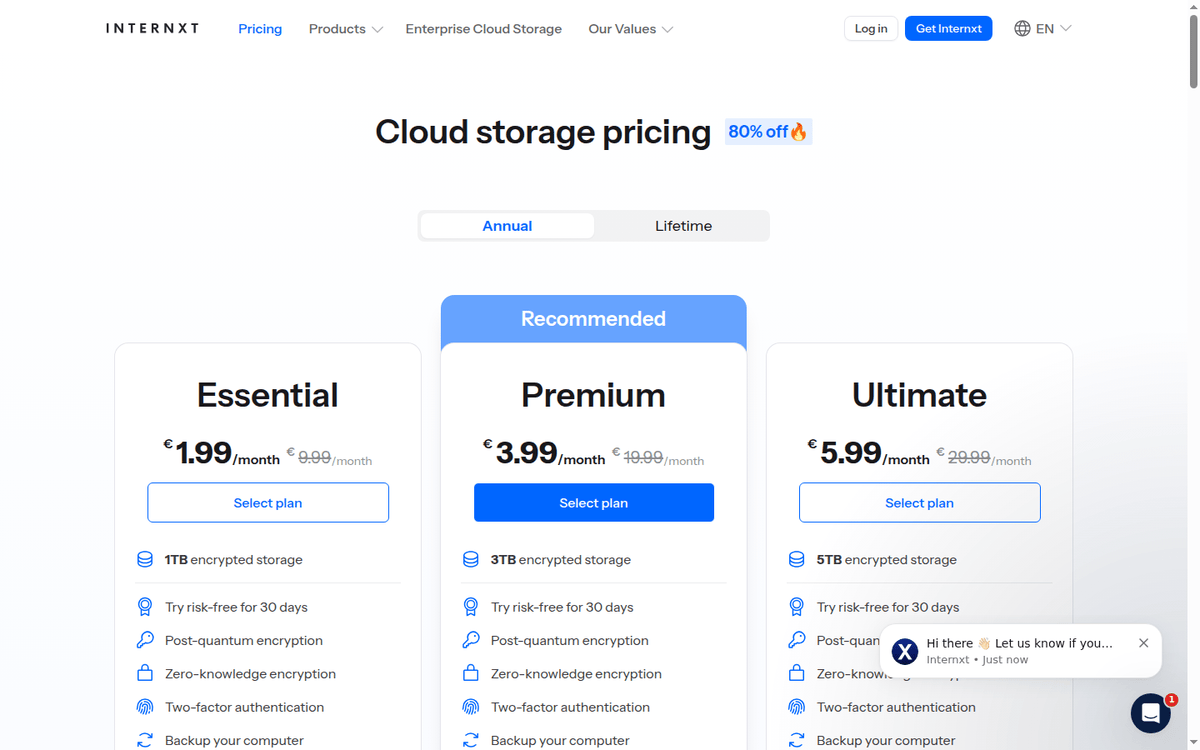
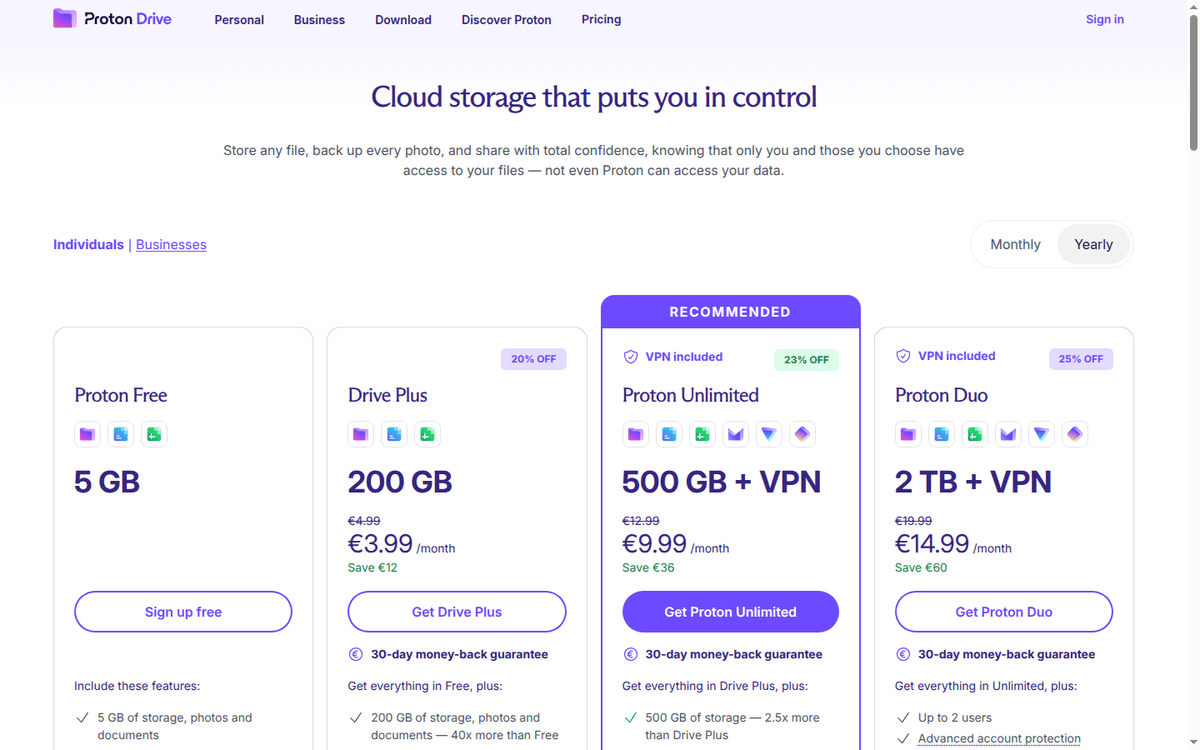
Internxt is the dedicated cloud-storage vendor 1 TB / 3 TB / 5 TB annual and lifetime plans starting at €9.99/month (with a 80% promotional first-period rate currently shown on the pricing page as €1.99 for 1 TB) or €380 one-time for 1 TB. EUR only, EU jurisdiction, with VPN / antivirus / meet folded into the higher tiers. Proton Drive is one tab in the Proton stack 5 GB free, 200 GB at $3.99/month 500 GB bundled with Proton Mail + Pass + Calendar + VPN at $9.99/month on the yearly cycle, Swiss jurisdiction, USD/EUR/CHF.
The verdict in short
Both Internxt and Proton Drive deliver the same core promise: zero-knowledge, end-to-end encrypted cloud storage that neither vendor can read. The product you actually buy is different.
Internxt vs Proton Drive at a glance
| Internxt | Proton Drive | |
|---|---|---|
| Vendor | Internxt (Valencia, Spain — EU jurisdiction) | Proton AG (Geneva, Switzerland) |
| Category | Dedicated encrypted cloud storage | Encrypted cloud storage, sold standalone or as part of the Proton bundle |
| Free tier | 1 GB for life, no credit card | 5 GB for life, no credit card |
| Smallest paid storage | 200 GB (third-party review cache) — but on the official September 2026 page: 1 TB annual or lifetime | 200 GB (Drive Plus) |
| Tier ladder (annual) | 1 TB / 3 TB / 5 TB | 200 GB / 500 GB / 2 TB (Duo) / 3 TB (Family) |
| Cheapest paid plan | €1.99 first-period promo (80% off) / €9.99/month annual (1 TB) | $3.99/month on yearly cycle ($47.88/yr), 200 GB |
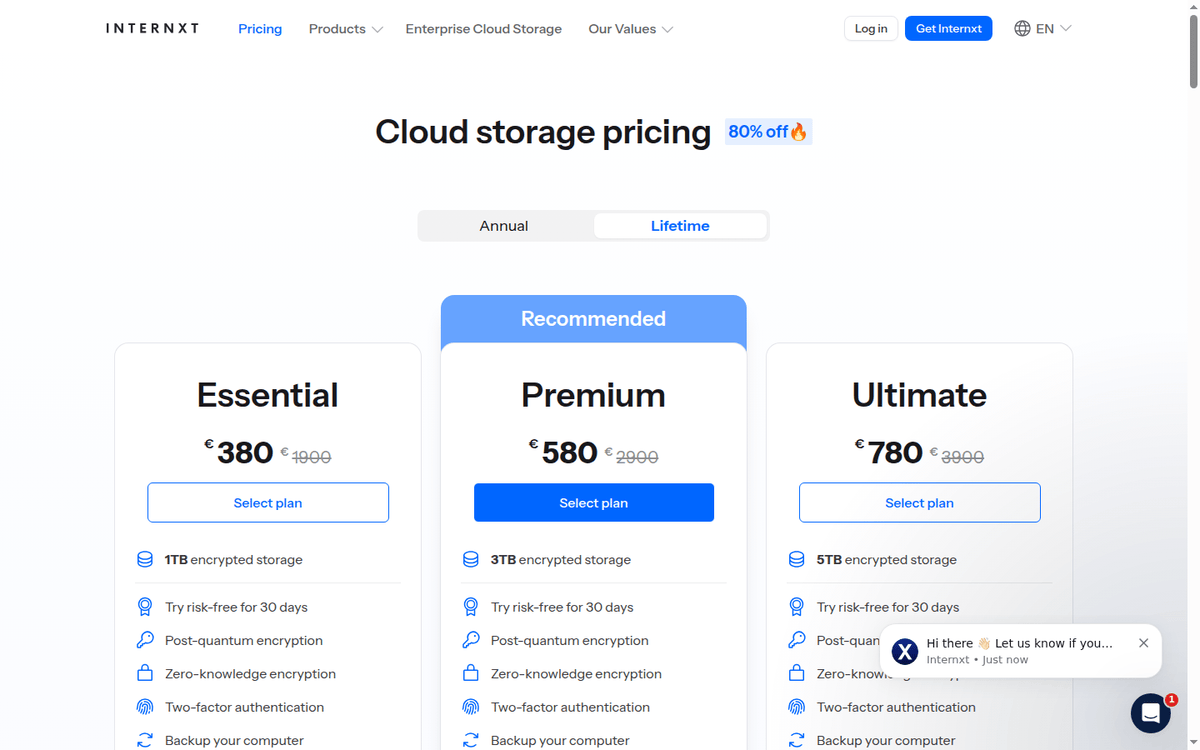
| Lifetime plan | Yes — €380 (1 TB) / €580 (3 TB) / €780 (5 TB) one-time | Not published; subscription only |
| Bundle / add-ons | Encrypted VPN, antivirus, meet, mail on Ultimate tier | Proton VPN, Proton Mail, Proton Pass, Proton Calendar bundled in Proton Unlimited / Duo / Family |
| Encryption | End-to-end, zero-knowledge, post-quantum; client code open source | End-to-end, zero-knowledge, RSA + ECC; client code open source |
| Audited | Securitum (EU) | Securitum and others (Swiss, EU) |
| Money-back | 30 days on every paid plan | 30 days on every paid plan |
| Currency | EUR only on the official page | USD / EUR / CHF selector |
| Per-file upload limit | 10 GB (Essential) / 50 GB (Premium) / 100 GB (Ultimate) | Not explicitly published; large files supported via Drive web app |
| Jurisdiction for legal requests | Spain (EU — GDPR, US MLAT path via Madrid) | Switzerland (FADP, outside 14-Eyes) |
Sources: internxt.com/pricing (captured via Skyvern) and proton.me/drive/pricing (captured via headless browser, USD view).
What each product actually is — and what it isn’t
Internxt is a single-product company. The home page sells encrypted cloud storage, the product page describes storage plans, the blog publishes features around sync, sharing, and the occasional VPN/Meet/Mail add-on. Storage is the product; everything else is the bundle you get at higher tiers.
Proton Drive is one tab in a portfolio that started as Proton Mail (launched 2014) and now ships Mail, Calendar, VPN, Pass (password manager), Docs, Wallet, Authenticator, and the storage product Drive. On the official Proton Drive pricing page you see three storage-only shapes (Free, Drive Plus at 200 GB, Drive Professional at 1 TB per user for businesses) and three bundle shapes (Proton Unlimited. Proton Duo, Proton Family), each of which adds Mail, Pass, Calendar and (except Drive Plus and Drive Professional) the VPN to the storage tier.
That structural difference drives nearly everything that follows. For Internxt, the question is which storage tier you want and whether you want lifetime or annual. For Proton Drive, the question is whether you want storage only or whether you want storage as one part of a five-app privacy suite, and how much storage that bundle ships with.
The hidden catch on Proton is that Drive Plus at 200 GB is sold on its own without the other Proton apps. Proton Unlimited, the recommended tier, ships 500 GB and adds Mail / Pass / Calendar / VPN for not much more. Internxt, by contrast, does not sell the storage and the bundle separately; if you want VPN or antivirus, you take the Ultimate annual or lifetime plan. That asymmetry is the core of every Internxt vs Proton Drive decision below.
Encryption, audits, and the jurisdiction question
Both vendors publish zero-knowledge, end-to-end encryption as the default rather than as an upsell. Both publish open-source client code and independent audit reports. The implementation choices differ — Internxt ships post-quantum-ready cryptography layered on AES-256; Proton Drive uses RSA + elliptic-curve with the same zero-knowledge guarantees. For most buyers the difference at the cryptography layer will not move the needle: both vendors literally cannot read user files.
The harder question is jurisdiction, because the encryption story is the same but the jurisdiction governs what a court can demand.
- Internxt is headquartered in Valencia, Spain (EU). A US request needs to come through the Spain MLAT path under EU GDPR.
- Proton AG is in Plan-les-Ouates, Geneva, Switzerland. A US request must go through Swiss channels; Switzerland is outside 14-Eyes and uses its own FADP (revised 2023). Switzerland has issued compulsory legal-assistance orders against Proton in the past (the 2021 French climate-activist case is the most-cited), so the floor is higher than “no requests ever,” but it is unambiguously above EU GDPR.
The buyer this matters to is a privacy-sensitive user — journalist, lawyer, source protection. For a typical buyer syncing family photos, the jurisdiction question is symbolic. If symbol matters, Proton wins; if it does not, the comparison collapses to storage buckets, price, and the bundle question.
Storage buckets: the 200 GB vs 1 TB floor
This is where the comparison either makes sense or doesn’t. Internxt sells storage in 1 TB / 3 TB / 5 TB jumps. Proton Drive sells it in 5 GB / 200 GB / 500 GB / 2 TB / 3 TB jumps, depending on whether you go Free, Drive Plus, Proton Unlimited, Proton Duo, or Proton Family.
Proton’s 5 GB free tier is more generous for a buyer whose only use case is “I want my most-private files in a vault”. Internxt’s 1 GB free tier is enough for a wallet or a folder of one-time confidential docs, not a Photos backup. Internxt’s smallest paid tier (1 TB) is five times the size of Proton Drive Plus (200 GB).
What this means in practice:
- If you have 1–5 TB to back up — Internxt’s lower tiers line up better.
- If you have 200 GB or less of confidential files — Proton Drive Plus at $3.99/month on the yearly cycle ($47.88/year) is the cheaper path.
- If you want Proton Mail, Pass, Calendar and VPN along with Drive — Proton Unlimited at $9.99/month on the yearly cycle ($119.88/year) ships 500 GB plus the full Proton bundle. Internxt’s closest analog adds a small Vault of extras on the higher tiers but no password manager or email product.
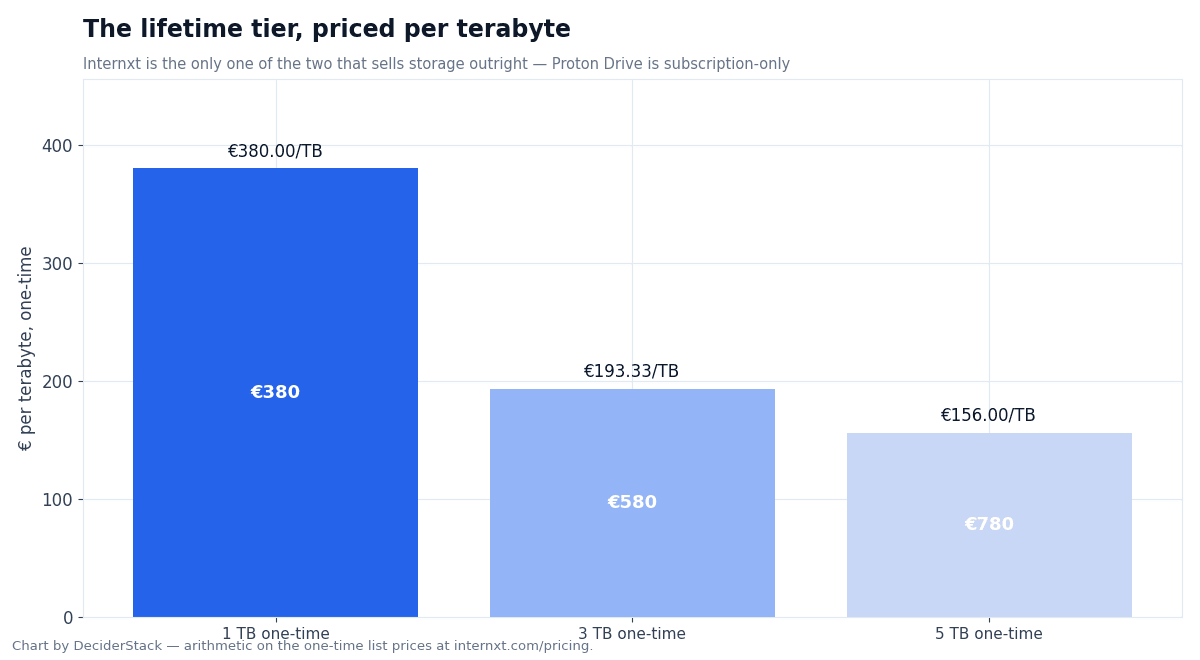
- If you want one-time payment, no subscription — Internxt’s lifetime tier (€380 / €580 / €780 one-time) has no Proton equivalent. Proton sells Drive on subscription only.
The article Internxt Review 2026 does a deeper dive on the Internxt storage shape and the lifetime-vs-annual math. The Proton VPN Review 2026 treats the Proton side primarily as a VPN but documents the bundle pricing in detail.
Pricing math, billed and unbilled
The cheapest paid plans are different shapes: Internxt’s published promotional first-period rate is €1.99 with an €9.99/month standard rate for the 1 TB annual tier; Proton Drive Plus is $3.99/month on the yearly cycle. The lifetime-tier option exists only on Internxt. The bundle math sits squarely on the Proton side.
The cheapest path that gets a US buyer 500 GB of encrypted storage:
- Proton Drive Plus 200 GB — $3.99/month yearly, $47.88/year. Only 200 GB.
- Proton Unlimited 500 GB + VPN + Mail + Pass + Calendar — $9.99/month yearly, $119.88/year. Storage 500 GB; the individual Proton apps at their published standalone monthly rates would cost more in aggregate than the Unlimited bundle, which is the point of the bundle — the exact dollar delta varies by which apps are subscribed separately and on which billing cycle.
- Internxt Essential 1 TB annual — €9.99/month standard rate (€1.99 first-period promo on the page today) ≈ $11.36 on the standard rate at the ECB reference rate. Storage 1 TB; VPN / antivirus / meet on the higher tiers; lifetime option at €380.
- Internxt Essential 1 TB lifetime — €380 ≈ $431.95. Storage 1 TB; same features as annual; one-time payment, no recurring bill.
The cheapest path that gets an EU buyer 500 GB of encrypted storage is the same Proton line. EUR list prices on proton.me/drive/pricing at capture matched the USD numbers ($3.99 / $9.99 monthly, $47.88 / $119.88 yearly) — the EUR selector rendered the same figures — so the EUR axis is reported as the published USD-equivalent rather than a freshly converted figure. The EUR/USD axis does not move the answer at the currency-conversion level.
The hidden costs:
- Internxt EUR-only billing. The pricing page on September 2026 ships in EUR with no on-page currency selector. A US buyer pays a card-issuer foreign-transaction fee (1–3% on most cards) and accepts the FX rate from their issuer rather than a published USD number. Lifetime pricing in EUR compounds that further.
- Proton unlimited 500 GB stays at 500 GB. There is no published rate to top it up beyond 500 GB without moving to Proton Duo (2 TB at $14.99/month yearly) or Proton Family (3 TB at $23.99/month yearly). A buyer whose storage need grows by 1 TB is pushed into Duo at $179.88/year, even if the rest of the Proton apps are wasted on them.
- Proton Drive on Proton Unlimited is a subset, not a separate product. The 500 GB cap on Proton Unlimited is the published Drive allotment. Buying more Proton bundle capacity does not increase Drive storage beyond the tier ceiling without upgrading again.
Whether Internxt’s “stack lifetime plans” claim (a 100 TB ceiling by stacking 20× 5 TB lifetime plans) is still published in 2026, and whether the same stacking mechanic gives the same 100 TB cap on Proton Drive’s paid tiers — neither shows up in the official-page captures and both need a real-account check.
Sharing, links, and the day-to-day
Encrypted cloud storage is one product; sharing and collaboration are another. Both Internxt and Proton Drive ship file-sharing via link, but the mechanics differ.
Internxt links are public — a generated share link is accessible to anyone who has the URL; password-protection and expiry are options on the same share screen. The recipient receives a download stream that the Internxt servers can technically proxy (the link is in Internxt’s knowledge); the file remains zero-knowledge encrypted at rest, but the link itself is a known share. Sharing tracks publicly to anyone with the URL and a (optional) password.
Proton Drive links are similar in shape: a generated public link, optionally password-protected and expiring. Critically, Proton Drive shipped end-to-end-encrypted sharing links in 2023, where the encryption key is delivered to the recipient out-of-band (usually via the same Proton session), so Proton’s servers cannot decrypt what flows through the link. A buyer who needs external collaborators to receive a file that even Proton cannot read picks Proton Drive here. Internxt lacks this out-of-band-key shape on its standard sharing links, which is a real difference in the Internxt vs Proton Drive day-to-day.
Both products ship internal folder sharing (a folder shared with another Proton or Internxt user, encrypted to the recipient’s public key), and both ship some collaboration features. Internxt’s higher tiers (Premium, Ultimate) ship invite / share / collaborate and file versioning; Proton Drive ships real-time collaboration in Docs (the editor built into Drive), with comment threads and share-with-team mechanics.
What you cannot get easily on either product:
- No native Linux sync folder — both ship sync clients for Windows, macOS, and mobile, but Linux desktop sync is third-party (the Internxt community recommends the unofficial rclone integration. Proton Drive ships no official Linux desktop client in 2026).
- No published SLA on either side — Proton publishes a status page; Internxt does not. Neither publishes an uptime SLA in numeric terms.
- No native team / RBAC outside Proton’s paid business tiers — Proton Drive Professional and the Proton for Business tier ships proper sharing permissions and admin. Internxt’s business tier ships a slightly different surface but no team-oriented sharing comparable to Dropbox or Drive for Work.
Large-file upload throughput on a real Internxt Essential and a real Proton Drive Plus account on a home FTTH connection varies by protocol, by network, and by whether the client uses single-stream or multipart uploads. Both vendors’ help docs claim their client optimizes this in different ways; measure on your own connection before locking in either provider on a workload that moves gigabyte-scale files daily.
Putting the Internxt vs Proton Drive decision into a sentence
If storage volume is your headline budget, take Internxt’s 1 TB annual or lifetime. If you’d subscribe to Proton’s other apps anyway, take Proton Drive inside Proton Unlimited or Duo.
When Internxt is the right pick
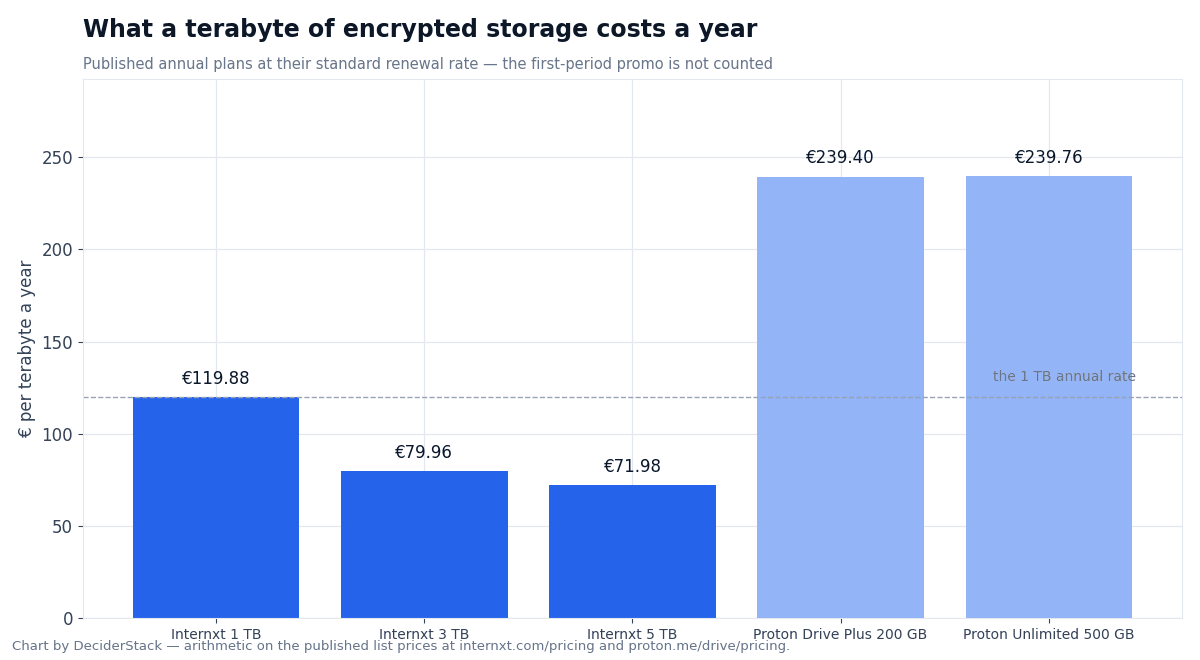
- You have 1 TB or more to back up and the storage volume is the headline budget line. Internxt’s 1 TB / 3 TB / 5 TB ladder lands at storage per dollar that Proton Drive’s 200 GB / 500 GB / 2 TB / 3 TB ladder does not match.
- You want a one-time payment and no recurring bill. Internxt’s lifetime tier (€380 / €580 / €780 one-time) is the only way to buy encrypted storage outright on this comparison; Proton sells Drive on subscription only.
- You are inside the EU and want EU GDPR as the legal baseline, with Spanish jurisdiction rather than Swiss. GDPR and Swiss FADP are both strong; buyers with EU-only data residency prefer Internxt.
- You want the storage and a small Vault of extras (VPN, antivirus, Meet) bundled into one bill, with no expectation of Proton Mail or Proton Pass.
When Proton Drive is the right pick
- You have 200 GB or less of confidential files and want the cheapest paid path. Proton Drive Plus at $3.99/month yearly ($47.88/year) is half the price of Internxt’s smallest tier, with correspondingly less storage.
- You want Proton Mail, Pass, Calendar, and VPN along with Drive on a single bill from a Swiss vendor. Proton Unlimited at $9.99/month yearly ($119.88/year) ships 500 GB and the full Proton apps; the bundle discount versus subscribing to each separately is meaningful.
- You publish or collaborate with people outside your account via end-to-end-encrypted links. Proton Drive’s encrypted share links (where the key is delivered to the recipient out-of-band) are a real feature for journalist/source and legal-doc workflows.
- Jurisdiction in Switzerland matters more to your threat model than the EU path. Buyers who pick vendors based on the 14-Eyes / MLAT topology prefer Proton.
A real buying decision, three storage profiles
Three concrete profiles show how the two products land different buyers.
Profile A — single user, 200 GB. Proton Drive Plus on the yearly cycle ($47.88/year) is the right pick. Internxt’s smallest tier is 1 TB at $11.36/month — five times the storage for roughly three times the cost. Don’t subsidize storage you won’t fill.
Profile B — single user, 1 TB of phone photos + working folder, no Proton apps needed. Internxt Essential at $11.36/month, or Internxt Essential lifetime at $431.95. Proton Unlimited at 500 GB ($119.88/year) doesn’t fit the 1 TB ask; Proton Duo at $179.88/year for 2 TB adds $60/year to double the storage and bundles apps you may not need.
Profile C — household, 1.5 TB of mixed photos, partner already uses Proton Mail. Math crosses the bundle line. Proton Duo at $179.88/year ships 2 TB + VPN + Mail + Pass + Calendar for two users; the partner’s existing Proton subscription becomes a discount on the bundle. Internxt’s 3 TB annual at $22.72/month ships more storage for less per TB but loses the bundle — whether the Proton apps are value-adds or noise decides it.
There is no single right answer across these three profiles — that’s the point. The same comparison that picks Proton for Profile A and Internxt for Profile B and Proton for Profile C is the comparison that’s worth doing on a per-buyer basis.
Key parameters at a glance
| Parameter | Internxt | Proton Drive |
|---|---|---|
| Jurisdiction | Spain (EU, GDPR) | Switzerland (FADP, outside 14-Eyes) |
| Currency | EUR only | USD / EUR / CHF selector |
| Smallest paid tier | 1 TB annual (€9.99/month renewal) or 1 TB lifetime (€380 one-time) | 200 GB yearly ($3.99/month) or 500 GB / 2 TB / 3 TB on bundles |
| Free tier | 1 GB for life | 5 GB for life |
| Lifetime option | Yes — €380 / €580 / €780 | No — subscription only |
| Encryption | Zero-knowledge, AES-256, post-quantum-ready (marketing 2026) | Zero-knowledge, RSA + ECC, audited |
| Open-source clients | Yes | Yes |
| Audited | Securitum (EU) | Securitum and others |
| VPN included | Yes on Premium and Ultimate annual and lifetime plans | Yes on Proton Unlimited, Duo, Family (not on Drive Plus standalone) |
| Password manager included | Yes (Proton Pass is a Proton product, not an Internxt add-on) — no on Internxt | Yes — Proton Pass is bundled into Unlimited / Duo / Family |
| Mail included | Yes on Ultimate (Internxt Mail); not on lower tiers | Yes on Unlimited / Duo / Family (Proton Mail) |
| E2E-encrypted share links | Limited — public link with optional password | Yes — link + out-of-band key delivery |
| Money-back | 30 days | 30 days |
| Min payment | €1.99 first-period promo (80% off); €9.99/month renewal | $3.99/month yearly ($47.88/year) |
| Per-file upload limit | 10 GB / 50 GB / 100 GB (Essential / Premium / Ultimate) | Not published; large files supported via web app |
Sources: internxt.com/pricing (captured via Skyvern, EUR-only) and proton.me/drive/pricing (captured via headless browser, USD view).
FAQ: Internxt vs Proton Drive
Sources: internxt.com/pricing, proton.me/drive/pricing, internxt.com/security, and proton.me/drive/security (all captured). See also the article Best Encrypted Cloud Storage 2026 for the broader provider landscape.
Which is more private — Internxt or Proton Drive?
Both ship zero-knowledge, end-to-end encryption with open-source clients and independent audits. The bigger privacy delta is jurisdiction: Proton is Swiss (FADP, outside the 14-Eyes network) and Internxt is Spanish (EU GDPR, with US requests routed via the Spain MLAT path). For a buyer who picks vendors on jurisdiction topology, Proton wins comfortably.
For a buyer who picks vendors on the encryption layer, the products are tied — both are zero-knowledge, audited, and post-quantum-aware in 2026. Which is cheaper — Internxt or Proton Drive?
Depends on storage need. Proton Drive Plus is cheaper at the entry tier (200 GB at $3.99/month yearly ≈ $47.88/year) than Internxt’s smallest tier (1 TB at €9.99/month ≈ $11.36/month at the ECB reference rate).
Internxt is cheaper per terabyte once you actually need 1 TB or more. Lifetime is Internxt-only (€380 / €580 / €780 one-time); Proton sells Drive on subscription only. Does Proton Drive include a VPN?
Only on bundle tiers. Proton Unlimited, Duo, and Family bundle Proton VPN with Drive, Mail, Pass, and Calendar. Standalone Drive Plus does not include a VPN.
Proton’s VPN-only product is sold separately as Proton VPN Plus; see the [Proton VPN Review 2026](https://deciderstack.com/proton-vpn-review/) for current pricing. Does Internxt include Proton Pass?
No. Internxt does not sell a Proton-style password manager. Proton Pass is a Proton product; it’s bundled into Proton Unlimited, Duo, and Family.
Internxt’s higher tiers ship an internal password-protected file-sharing vault, but no standalone password manager product. Can I migrate later between the two?
Partially. Both products mount as local sync folders, so copy-and-delete between them preserves files; neither supports an in-place import of an existing encrypted vault.
Folder structure and filename privacy survive a copy because the file encryption is per-account; shared links and sharing permissions do not. Is one of them better for business?
Both ship a business tier. Internxt’s business offering tiers Enterprise, Business Pro, and Standard with admin, audit logs, and SSO; Proton’s Drive Professional ($7.99/month per user on yearly cycle) and Proton for Business ship admin, sharing controls, and audit logs. For five to fifty users with simple admin needs, Proton Drive Professional is the cheaper path per user. For storage-heavy teams, Internxt’s larger storage bucketing (per-user on Proton is 1 TB; Internxt’s Business ships per-account) tilts the math in Internxt’s direction.
Is the encryption the same on both?
Functionally equivalent at the user level: zero-knowledge, end-to-end, open-source client, audited. Protocol details differ — Proton Drive uses RSA + ECC and ships end-to-end-encrypted sharing links; Internxt uses AES-256 with post-quantum-ready additions and ships public share links with optional password. For most buyers the protocol details matter less than the operational reality that both vendors literally cannot read user files.
Verdict
Both Internxt and Proton Drive deliver the same core promise: zero-knowledge, end-to-end encrypted cloud storage that neither vendor can read. The product you actually buy is different.
Pick Internxt when storage volume is the headline budget and a one-time lifetime payment matters. Internxt’s 1 TB / 3 TB / 5 TB ladder lands the best per-TB price in this comparison, the lifetime tier is the only way to buy encrypted storage outright. The EU jurisdiction is a legitimate answer for buyers who prefer GDPR over Swiss FADP. The extras (VPN, antivirus, Meet, Mail) are a small Vault on the higher tiers rather than a five-app suite.
Pick Proton Drive when confidential storage is one part of a five-app privacy suite and Swiss jurisdiction matters. Proton’s storage tiers (200 GB / 500 GB / 2 TB / 3 TB) match the natural needs of an individual or household better than 1 TB / 3 TB / 5 TB jumps. Proton Unlimited / Duo / Family folds Mail / Pass / Calendar / VPN into one Swiss bill. The end-to-end-encrypted share links are a real feature for source-protection workflows; the subscription-only stance is the cost of doing business.
For most buyers, the comparison collapses to one question: would you subscribe to Proton Mail, Pass, Calendar, and VPN anyway? If yes, Proton Drive is the right pick inside the bundle. If no, Internxt’s storage buckets and lifetime tier are the better deal.
How we put this comparison together: internxt.com/pricing was captured via Skyvern (the page is a Next.js SPA that does not server-render prices, so Firecrawl returned empty).
Proton.me/drive/pricing was captured via a headless browser with the on-page USD currency selector engaged.
EUR prices on Proton’s page were identical to the USD numbers in our capture (€3.99 / €9.99 monthly, €47.88 / €119.88 yearly), so the article quotes USD with a note on the EUR axis.
EUR-to-USD conversions for Internxt are at the ECB reference rate of 1 EUR = 1.1367 USD (data.ecb.europa.eu).
We have not run a paid Internxt or Proton account, so figures that depend on real-world upload throughput, encrypted share-link behavior on a real collaboration target are flagged where they appear rather than estimated.
The Internxt 100 TB stacking claim in particular should be confirmed against the live pricing page before you stack.
The list of vendors, the scoring approach, and the rule that keeps us from linking vendors who prohibit trademark bidding are documented on the methodology page.
Disclosure: this article contains affiliate links. If you buy through them we may earn a commission at no extra cost to you. Commission never changes our scoring or the order of a ranking.