$7.00/GB on the 1 GB plan — the lowest published rate among residential proxies.
Pool: 64M+ residential IPs across 195+ countries; rotating every 1, 10 or 30 minutes.
Sessions: sticky for up to 7 days — the longest window published. PAYG top-ups never expire.
The gaps: no published SOC 2 Type 2 attestation, and a pool smaller than Bright Data’s 400M+ or Oxylabs‘ 175M+.
Start on the 1 GB plan: under 100 GB/month on PAYG, this is the most flexible published option in the category.
IPRoyal’s residential pricing is built on a single idea: you should not have to sign a 12-month contract to use a residential proxy. The published pricing page lists four subscription tiers (1 GB, 2 GB, 10 GB, custom from 10 TB) and a parallel Pay As You Go ladder. Both columns are billed in bandwidth.
Only the PAYG side has no monthly minimum. The “Most popular” badge sits on the 10 GB subscription at $5.25/GB; the cheapest published rate is $1.75/GB on a 10 TB custom deal.
What that pricing ladder looks like, what the 64M+ IP pool actually delivers, and where IPRoyal fits relative to bright data, oxylabs, and smartproxy are the questions this review answers. Every number on the price ladder and on the feature list comes from iproyal.com/pricing/residential-proxies.
Anything that depends on a real workload running against a real target — your success rate on a cloudflare-fronted site, your sticky-session hit rate across a 7-day window, your p95 latency on a specific country — is marked as an estimate where it appears.
What IPRoyal actually sells in 2026
Four products, one residential pool. The pricing page calls out the residential line first, but the dashboard also lists datacenter proxies, ISP proxies (static residential), and mobile proxies under separate product headers.
The residential pool is the headline product and the one this review covers; the other three are mentioned at the end for completeness.
IPRoyal’s residential pool is the headline product. The other three lines (datacenter, ISP, mobile) sit on separate pricing pages and use different billing units. Mixing them in the same comparison makes the residential pricing look less competitive than it is.
The published residential pool is 64M+ IPs across 195+ countries, with city-level targeting and both rotating and sticky sessions. Rotating cycles are 1, 10, or 30 minutes; sticky sessions run up to 7 days, which is the longest sticky window in the published proxy category. HTTP(S) and SOCKS5 are both supported.
The pricing page also publishes an Instant IP Change feature (one-click or API-call swap) and unlimited concurrent sessions.
The competitive set on the published pricing is the same set every other residential proxy comparison points at: bright data (the largest pool and the widest product catalog), oxylabs (the highest-priced, enterprise-leaning option), and smartproxy (the lowest published 1 TB rate).
What stands out is that the published pricing is the lowest entry-tier price in the category — without giving up the rotating + sticky feature set.
The pricing ladder in detail
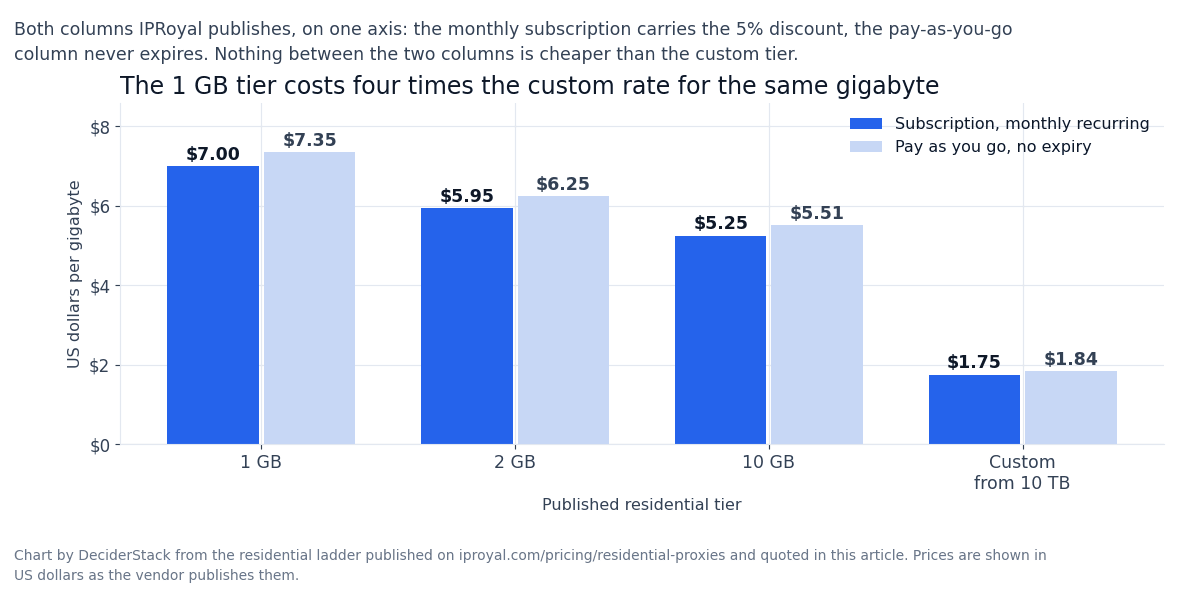
The published residential pricing ladder splits into two parallel columns: a Subscription column with a 5% discount (paid monthly) and a Pay As You Go column billed by traffic drawdown with no expiry. Both columns start at the same place (1 GB) and both end at a custom tier (10 TB and up).
| Plan | Bandwidth | Subscription ($/GB) | Subscription monthly total | PAYG ($/GB) | PAYG expiry |
|---|---|---|---|---|---|
| 1 GB | 1 GB | $7.00 | $7.00 | $7.35 | No expiry |
| 2 GB | 2 GB | $5.95 | $11.90 | $6.25 | No expiry |
| 10 GB (POPULAR) | 10 GB | $5.25 | $52.50 | $5.51 | No expiry |
| Custom (from 10 TB) | 10,000+ GB | $1.75 | $17,500+ | $1.84 | No expiry |
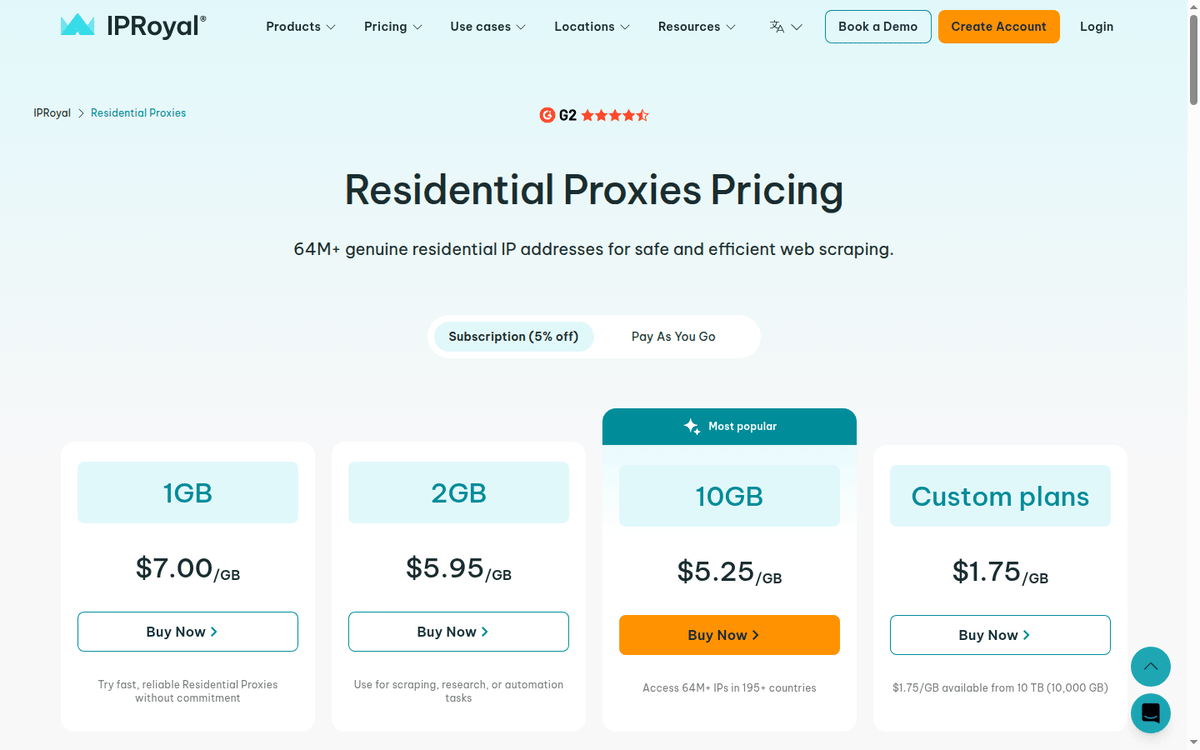
The Subscription column bills monthly on a recurring plan and earns a 5% discount versus PAYG; the PAYG column is a one-time top-up that does not run on a monthly minimum. There is no “annual commit” tier on the public pricing page.
Bulk customers who need a contract-style deal move to the Custom 10 TB tier or contact sales; the published Custom tier starts at $1.75/GB subscription or $1.84/GB PAYG at the 10 TB threshold.
The 5% subscription discount only applies to the monthly recurring billing. PAYG customers who let their wallet run dry and want to top up again pay the PAYG rate, not the subscription rate.
If you are not ready to commit to a monthly plan, the PAYG math is slightly worse per GB but the freedom from a recurring charge is the actual product.
The free trial is not advertised on the pricing page. The 1 GB plan at $7.00/GB is the closest thing to a low-risk entry point, and the dashboard supports a $7.00 one-time purchase that burns the bandwidth as you use it. Anything below that floor requires a custom conversation with sales.
Two structural advantages IPRoyal publishes that most competitors don’t:
- PAYG traffic never expires. A $7.35 top-up in March is still usable in November. The category default is “use it or lose it within the billing cycle” — IPRoyal does not enforce that on the PAYG side.
- Sticky sessions run up to 7 days, not the more common 30 minutes to 24 hours. If your workload is a multi-day login wall (account creation, slow checkouts, long-running scrapers that hold state), IPRoyal is the only published residential provider that supports that window natively.
The pool, locations, protocols, and session model
The published residential pool is 64M+ IPs across 195+ countries with city-level targeting. HTTP(S) and SOCKS5 are supported on every plan. Sessions are configurable as rotating (every 1, 10, or 30 minutes) or sticky (up to 7 days).
Auto-Rotate is a dashboard toggle that swaps the session IP at the configured interval; Instant IP Change forces a swap via a dashboard click or an API call.
The ethically sourced framing — “real users, never get blocked” — is the standard proxy-category pitch.
What sets the vendor apart in this area is the breadth of the published third-party award list:
- Crozdesk Quality Choice
- G2 Winter Leader
- G2 Best Security Software
- SourceForge Top Performer
- Gold Winner
- Geekflare Award
- Top Business
- Top Performer Slashdot
The PCMag quote on the pricing page cites “over 195 countries of coverage, more than thirty two million IP addresses”. Note the gap between the 64M+ pool size in the marketing block and the 32M+ figure PCMag references. The 64M+ number is the current published claim. The 32M+ figure is from an older PCMag review.
The published “no contracts” framing applies to PAYG and to monthly subscriptions. The Custom tier that starts at 10 TB is the only place where a longer commitment is implied. If you are evaluating the 1 GB, 2 GB, or 10 GB tiers, there is no lock-in beyond the monthly recurring charge on the Subscription column.
The two product features that most affect real workload behavior — IP rotation cadence and sticky-session length — are both published on the pricing page and both configurable from the dashboard. The 7-day sticky window is the headline feature for any workflow that holds session state longer than a 30-minute rotation cycle would allow.
Performance claims and what they actually measure
The published success rate, response time, and IP fraud score figures on the official site all come from third-party review sites (PCMag, TechAdvisor, TechRadar) and Proxyway’s annual market research.
A headline uptime figure appears on the vendor’s own dashboard as a marketing claim; it is not published on the pricing page, and we could not check it against a public benchmark.
Proxyway runs its annual benchmark against a global CDN target with 500 requests per endpoint, measuring HTTP 200 response counts and total time. The success rate is a comparable number across the providers Proxyway tests:
- bright data
- oxylabs
- smartproxy/decodo
- soax
- netnut
- iproyal
Any uptime figure the vendor quotes is a proprietary marketing number and is not directly comparable across providers.
| Metric | Published | Source | Comparable across providers? |
|---|---|---|---|
| Pool size | 64M+ residential IPs | IPRoyal official page | Marketing figure, not audited |
| Locations | 195+ countries | IPRoyal official page | Marketing figure |
| Sticky session length | Up to 7 days | IPRoyal official page | Yes — published feature |
| Rotation cadence | 1 / 10 / 30 min | IPRoyal official page | Yes |
| Uptime | Not on the pricing page | IPRoyal marketing | No — proprietary figure |
| Avg success rate | Third-party cited | Proxyway / PCMag | Yes — same methodology |
Your success rate on a real workload depends on the target and the session type. Treat any vendor-published success rate as a directional figure rather than a guarantee. The 64M+ pool claim is marketing; what matters is the count of unique IPs you actually get on the country you target, which you can only verify by running the trial.
Who IPRoyal fits in 2026
Three personas fit cleanly into the published offer, and two should look elsewhere.
Best fit: small-to-mid volume scraping teams who want predictable pricing and want to avoid a 12-month contract. The 10 GB / $52.50/month plan is the natural entry point for a single scraping engineer running a moderate daily request volume against a moderately defended target.
The 5% subscription discount versus PAYG matters on the 10 GB tier and below; above that, the PAYG tier starts to look like the more honest pricing.
Best fit: workloads that need sticky sessions longer than 30 minutes. Account creation flows, multi-step checkouts, login-walled scrapers that hold session state for hours — these are the workloads where the 7-day sticky window is the differentiator. Most published residential providers cap sticky at 30 minutes or 24 hours; the vendor publishes 7 days.
Best fit: customers who want PAYG without an expiry window. The “no expiry” framing on the PAYG column is unusual for the category, where unspent traffic is commonly written off after a multi-month window. The vendor’s PAYG traffic stays in your wallet until you spend it.
Worth shopping elsewhere: enterprise procurement teams who need SOC 2 Type 2 with a documented audit trail, ISO 27001, and a published enterprise MSA. The residential pricing page does not publish a SOC 2 Type 2 attestation. For enterprise compliance posture, bright data and oxylabs are the more documented options.
Worth shopping elsewhere: customers who need mobile proxy coverage on a published pricing ladder. The vendor publishes mobile proxies as a separate product but does not include them on the residential pricing page. If your workload is mobile-first (in-app ad verification, app store scraping), the mobile line at bright data or soax is a better starting point.
FAQ: pools, sessions, and pricing
Is IPRoyal a real proxy provider?
Yes. IPRoyal is a residential proxy vendor with a published pool of 64M+ residential IPs across 195+ countries. The company has been in the proxy market for several years and is listed on G2, Capterra, and SourceForge with generally positive reviews. Pricing is published on the official pricing page and is verifiable by anyone with a browser.
How much does IPRoyal residential proxy cost?
From $7.00/GB on the 1 GB subscription to $1.75/GB on the 10 TB custom deal. The Pay As You Go ladder runs $7.35/GB (1 GB) to $1.84/GB (10 TB). The “Most popular” badge sits on the 10 GB subscription at $5.25/GB.
Does IPRoyal offer a free trial?
No formal free trial is published. The 1 GB subscription at $7.00 is the lowest entry point, and the PAYG top-up at $7.35 is a one-time wallet credit with no expiry. The pricing page does not advertise a “free trial” CTA; if you need a trial, contact sales.
What is the IP pool size?
64M+ residential IPs across 195+ countries with city-level targeting. HTTP(S) and SOCKS5 are both supported on every plan. Rotating sessions cycle at 1 / 10 / 30 minutes; sticky sessions run up to 7 days.
Does IPRoyal have a no-expiry PAYG option?
Yes. PAYG traffic purchased via the Wallet does not expire. The $7.35 top-up you make in March is still spendable in November. This is the published PAYG model on the official pricing page.
What is the sticky session length?
Up to 7 days. This is the longest published sticky window in the residential proxy category. Most competitors publish caps far below that — Oxylabs, for example, documents 24 hours.
What protocols are supported on IPRoyal?
HTTP(S) and SOCKS5 on every residential plan. No additional protocol support is published on the residential pricing page. SOCKS5 is useful for non-HTTP workloads (email scraping, gaming traffic) that don’t run cleanly over HTTP CONNECT.
How does IPRoyal compare to Bright Data on price?
IPRoyal’s published 10 GB plan is $5.25/GB subscription ($52.50 total). Bright Data lists residential PAYG at $8/GB, discounted to $4.00/GB with its published promo code, and its monthly plans start at $3.50/GB (141 GB for $499) down to $2.50/GB on the 798 GB plan ($1,999). At the 10 TB+ custom tier IPRoyal publishes $1.75/GB.
Bright Data wins on the widest product catalog (mobile, ISP, datacenter, Web Unlocker); IPRoyal wins on the entry-tier 1 GB price and the 7-day sticky window.
Can I get a refund?
The pricing page does not publish a formal refund window. The PAYG traffic does not expire, which is a softer form of refund protection — you can stop spending any time and your wallet balance remains. Subscription customers cancel via the dashboard; the relationship is month-to-month by default.
What payment methods are accepted?
Visa, Mastercard, PayPal, Discover, Amex, Alipay, and Crypto. The merchant of record is not named on the pricing page.
Check these numbers yourself
IPRoyal residential proxy pricing IPRoyal residential product page IPRoyal dashboard
How we put this together: subscription and pay-as-you-go rates, pool size, location coverage, session and rotation settings come from iproyal.com/pricing/residential-proxies/, quoted as displayed. We have not run a paid IPRoyal account.
Figures that depend on a real workload, a real target or a real integration are flagged where they appear in the text rather than being estimated.
Disclosure: this article contains affiliate links. If you buy through them we may earn a commission at no extra cost to you. Commission never changes our scoring or the order of a ranking.