This is the rebrand review — the proxy network is the same network, the company is the same company, the licensing is the same.
What changed is the brand and the dashboard domain. What is new is that Decodo now competes head-to-head with Bright Data on the headline price rather than trailing it.
Smartproxy is now Decodo. The rebrand happened quietly across 2025 and into early 2026.
And the page you land on when you type smartproxy.com into a browser now serves you a footer that reads “© 2018–2026 decodo.com (formerly smartproxy.com).” same company, same residential pool, same dashboard at dashboard.decodo.com, just a different wordmark on the front page.
If you came here for a “Smartproxy review” in 2026, the honest answer is that you are evaluating Decodo, and most of the third-party listicles you will find elsewhere still call it Smartproxy.
This review walks through what Decodo actually ships in 2026: the residential pricing ladder.
The proxy pool size and locations, the success-rate and uptime claims, the target audience, where smartproxy fits relative to Bright Data and Oxylabs, and the questions worth asking before you wire $200 to a dashboard.
Every number on the pricing table comes from decodo.com/pricing and the residential proxy page on the official site, read in September 2026.
The metrics that depend on a real workload — your actual success rate on a Cloudflare-class target, your sticky-session hit rate, the cost per successful scrape in production — are flagged as unverified in this review, the same convention we use in our best residential proxies catalog.
Entry $3.75/GB on the 3 GB plan, $11.25 a month.
Cheapest on volume $2/GB on the 1 TB Enterprise plan, against Bright Data’s published $2.50/GB.
Pay as you go a flat $4/GB through a wallet top-up rather than a subscription.
Pool 115M+ IPs across 195+ locations, targeting from continent down to ASN.
Trial three days and 100 MB, no credit card.
What changed in the Smartproxy-to-Decodo rebrand
Three things changed and three things did not.
What changed. The wordmark across the site, the docs subdomain, and the dashboard URL. decodo.com replaced smartproxy.com as the public-facing domain; dashboard.decodo.com replaced dashboard.smartproxy.com; help.decodo.com replaced help.smartproxy.com.
The marketing copy on the homepage leans harder into “easy-to-integrate” and “ethical sourcing” framing than the older “every budget” framing Smartproxy used before.
Three things did not change: the company (the same Lithuania-rooted proxy vendor), the residential IP pool, the pricing ladder, the customer accounts, the billing relationships, the affiliate links. The third-party awards — Proxyway Best Value, G2 Spring 2025 badges, TechRadar 2025 “Best Proxy” — all carried over.
If you are an existing Smartproxy customer, nothing on your account changes. If you are new to the brand, the only practical difference you will notice is the name on the dashboard.
The brand-switch is best understood as Smartproxy preparing to split its consumer proxy line from other product lines the company runs, not as a product overhaul. Most third-party comparison pages still rank “Smartproxy” and “Decodo” as the same entity, which is correct.
The rebrand is the reason most of the SERP for “smartproxy review” still serves up articles written before 2025 and titled “Smartproxy Review.” Read those with the understanding that the product underneath is the same one you would evaluate under the Decodo name.
Smartproxy/Decodo residential proxy pricing in 2026
The residential pricing ladder is the cleanest part of the Smartproxy/Decodo offer. Monthly subscriptions run from $3.75/GB (3 GB plan, total $11.25) to $2.75/GB (100 GB, total $275); Enterprise plans start at $2.50/GB (250 GB) and bottom out at $2/GB on the 1 TB plan.
Pay As You Go is a flat $4/GB and runs through a Wallet top-up rather than a recurring subscription. Every paid plan includes the same 115M+ residential IP pool and free advanced targeting.
| Plan | Bandwidth | Per GB | Monthly total | Geotargeting | Session types |
|---|---|---|---|---|---|
| 3 GB | 3 GB | $3.75 | $11.25 | Free advanced targeting | Rotate + sticky (up to 30 min) |
| 10 GB | 10 GB | $3.50 | $35 | Free advanced targeting | Rotate + sticky |
| 25 GB (POPULAR) | 25 GB | $3.25 | $81.25 | Free advanced targeting | Rotate + sticky |
| 50 GB | 50 GB | $3.00 | $150 | Free advanced targeting | Rotate + sticky |
| 100 GB | 100 GB | $2.75 | $275 | Free advanced targeting | Rotate + sticky |
| Pay as you go | Top-up GBs | $4.00 | Variable | Free advanced targeting | Rotate + sticky |
| Enterprise 250 GB | 250 GB | $2.50 | $625 | Free advanced targeting | Rotate + sticky |
| Enterprise 1 TB | 1,000 GB | $2.00 | $2,000 | Free advanced targeting | Rotate + sticky |
A 14-day money-back window applies to the regular monthly plans if you have not used more than 20% of the plan’s traffic. The 3-day free trial with 100 MB is a separate opt-in — if you take the trial you forfeit the 14-day refund, a fairly standard split.
The trial is gated by selecting a paid plan during signup and clicking “Start free trial”; you must cancel before the trial ends or the plan charges.
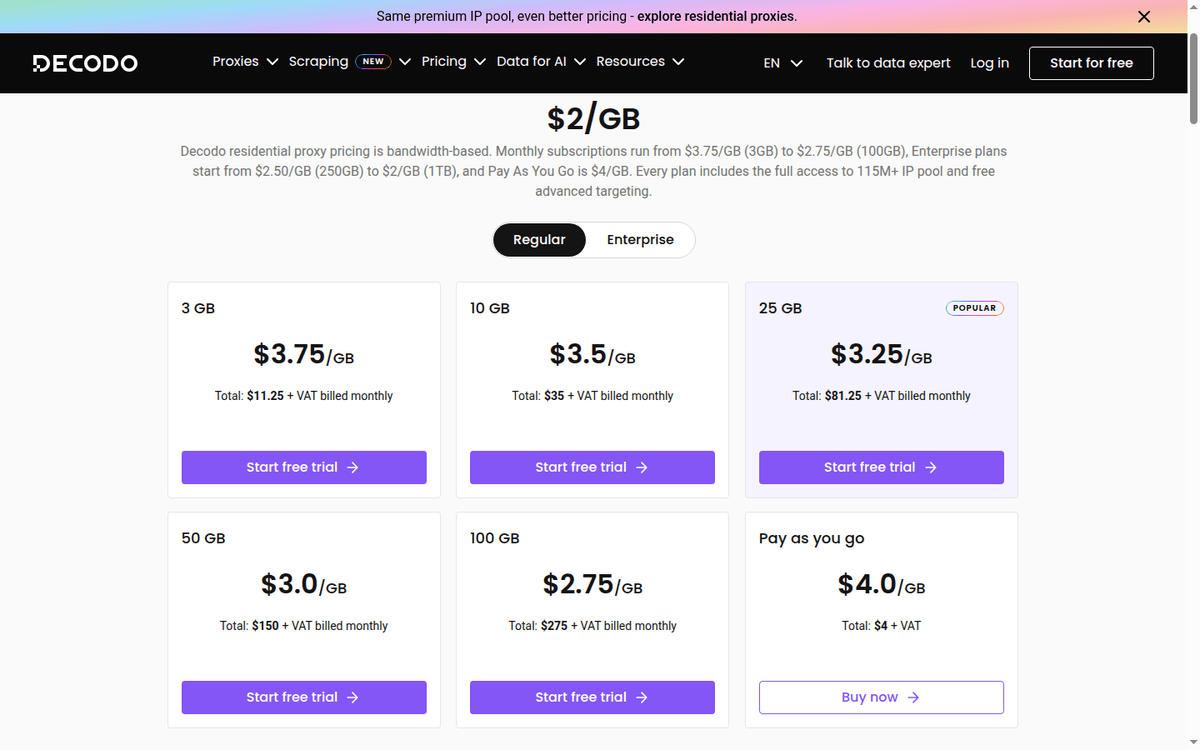
Decodo’s pricing is the strongest single argument for the platform: $2/GB on 1 TB sits $0.50/GB under Bright Data’s published $2.50/GB at its deepest tier and within a few cents of Oxylabs’ published entry rate.
Pay-as-you-go at $4/GB is the same price Bright Data charges for residential PAYG. The decision is no longer “cheaper than Bright Data by default”; it is “matches Bright Data on price, depends on the network for the differentiation.”
The proxy pool, locations, and protocols
Decodo publishes 115M+ ethically sourced IPs across 195+ locations, plus HTTP(S) and SOCKS5 support on every plan. The targeting granularity on the official pricing page lists continent, country, state, city, ZIP code, and ASN-level targeting — that is more granular than a country-only targeting offer.
Sessions are configurable as rotating or sticky (up to 30 minutes), which covers both the “one request per IP” sneaker-style workload and the “sticky login for a checkout flow” workload.
The ethically-sourced framing is not just marketing: Decodo publishes an IP Quality Score and reports an average fraud score of 32.72 against the IPQualityScore database. Compared to a global pool average of 45.57 (lower is better).
The number comes from the IPQualityScore database, sampled against 10K US IPs and 20K global IPs, and is the same number Proxyway reports in its independent proxy market research. Treat the figure as directional, not as a guarantee of how clean your specific IPs will be.
Geographic targeting at the ASN level matters if you are scraping a CDN-fronted site that geo-routes by ASN rather than by IP. Most competitors cap at country; Decodo’s ASN targeting is one of the smaller differentiators that quietly wins on jobs where ASN-routing matters.
Performance claims and what they actually measure
The numbers on the Decodo pricing page — 99.92% success rate, 99.99% uptime, <0.5s average response — come from Proxyway’s annual research, not from Decodo’s own benchmarks. Proxyway runs a custom Python script against a global CDN target with 500 requests per endpoint.
Rotating sessions, sent from the same country’s vpn as the endpoint, measured by http 200 response counts and total time divided by 500.
The methodology is published on Proxyway’s site and is broadly comparable to what other vendors publish as “success rate.” The 99.92% figure is a Proxyway figure, not a Decodo-proprietary benchmark.
Treat it as comparable to other Proxyway-tested vendors — Oxylabs, Bright Data, IPRoyal, SOAX, NetNut — and not directly comparable to a vendor’s own benchmark on its own targets — which always runs higher.
For real workload numbers there is no substitute for the trial: your success rate on a specific Cloudflare-fronted site, your sticky-session hit rate across a 30-minute window, your p95 latency on a real target. The 3-day / 100 MB trial is enough to run a 1,000-page pilot on a real target, which is the minimum sample size to trust any number you see in production.
| Metric | Claim | Source | Comparable across vendors? |
|---|---|---|---|
| Success rate | 99.92% | Proxyway annual research | Yes — same methodology |
| Uptime | 99.99% | Proxyway annual research | Yes |
| Avg response time | <0.5s | Proxyway annual research | Yes — same target |
| IP pool size | 115M+ | Decodo official page | Marketing figure; comparable but not audited |
| Locations | 195+ | Decodo official page | Marketing figure |
| IP fraud score | 32.72 (lower = better) | Proxyway / IPQualityScore | Yes |
The success rate you see in production depends on which target you scrape and which session length you use. Treat any vendor-published success rate as a directional figure rather than a guarantee for your workload.
Who Smartproxy/Decodo actually fits in 2026
Three personas fit cleanly into Decodo’s residential offer, and two personas will be happier elsewhere.
Best fit: small and mid-volume scraping teams who want predictable pricing and don’t need to manage infrastructure. The 25 GB / $81.25/month plan is the sweet spot for a single scraping engineer running 50K-100K requests per day against a moderately defended target.
The sticky session support handles login-walled workflows; the ASN targeting handles geo-routing edge cases; the 195+ location count handles multi-region price intelligence jobs.
Best fit: developers who need fast onboarding and don’t want to negotiate an enterprise contract. The free trial requires no enterprise sales call. The pricing is published in dollars on the public pricing page. The dashboard is self-serve. For an engineer evaluating proxies for a side project or a new product line, this is the lowest-friction option in the category.
Best fit: teams who run multi-region ad verification or market research at scale. The 195+ locations and free advanced targeting make this a strong default for ad verification jobs that need to hit specific country/state/city endpoints on a schedule.
Worth shopping elsewhere: enterprise procurement teams that need SOC 2, ISO 27001, and dedicated compliance contacts on a contract. Decodo publishes its GDPR and ISO 27001:2022 posture on its trust page. The published ladder stops at the 1 TB Enterprise plan — beyond that you talk to sales, and the price stops being public.
For teams that need published enterprise SLAs, Bright Data remains the more documented choice.
Worth shopping elsewhere: workloads that need mobile proxy coverage. Decodo does sell mobile proxies as a separate product line, but the residential pricing page does not include mobile in the per-GB ladder.
If your workload is mobile-first (app store scraping, in-app ad verification), the dedicated mobile product line at a different vendor — Bright Data Mobile, IPRoyal Mobile, SOAX Mobile — is a better starting point.
Decodo’s enterprise tiers start at 250 GB / $2.50/GB and are not enterprise in the “named-account, custom MSA, dedicated CSM” sense. The “Enterprise” label on Decodo is a pricing tier, not a procurement tier. If you need an enterprise MSA, budget the procurement separately.
How Decodo stacks against Bright Data and Oxylabs
The competitive set Smartproxy has always competed in — and that Decodo now competes in — is Bright Data and Oxylabs at the top end, IPRoyal and NetNut in the mid-tier, SOAX and Webshare on the budget end. The rebrand did not change the competitive set; it changed how the marketing positions itself within it.
| Provider | Residential per GB (PAYG) | Residential per GB (lowest published) | Pool | Targeting | Free trial | Trust signals |
|---|---|---|---|---|---|---|
| Decodo (Smartproxy) | $4.00 | $2.00 (1 TB Enterprise) | 115M+ | Continent → ASN | 3 days / 100 MB | Proxyway Best Value 5 years, G2 Spring 2025 |
| Bright Data | $4.00 | $2.50 (Business tier published) | 400M+ across product lines | Country → city → ASN | Trial on request, then paid | SOC 2 Type II, ISO 27001, Big Four audit customers |
| Oxylabs | Not published | ~$2.50 (published entry) | 175M+ residential | Country → city | Trial on request | ISO 27001, GDPR |
Three takeaways from the comparison.
First, on price. Decodo’s $2/GB on 1 TB is the strongest public residential number in the category; Bright Data and Oxylabs both go lower on private enterprise quotes but do not publish those numbers. If you are a sub-TB buyer, the published price ladder matters; if you are a multi-TB buyer, you need a custom quote from all three.
Second, on pool size. Decodo’s 115M+ is the smallest pool of the three by a wide margin. For workloads where pool size is the bottleneck (large-scale scraping of one site from many IPs), Bright Data’s 400M+ residential pool gives more room. For most workloads under 50K requests/day, 115M+ is more than enough.
Third, on procurement. Bright Data is the only one of the three with a Big Four audit customer base and a published enterprise sales motion. If your team needs to fill out a vendor risk assessment questionnaire and have a procurement contact, Bright Data remains the lower-friction choice.
Decodo’s 99.92% success rate comes from Proxyway; Bright Data’s comparable figure also comes from Proxyway; Oxylabs’ figure also comes from Proxyway. The three vendors are tested by the same methodology on the same targets, which is why the numbers cluster within a percentage point.
Setup and integration: what the first hour looks like
Setup is one of the cleanest parts of the Decodo offer. The dashboard accepts an email verification, the plan selector takes a credit card, and the proxy endpoint is generated in under a minute. Authentication is username:password or whitelisted IPs. Session type is rotate-per-request or sticky up to 30 minutes. Output formats include endpoint:port, HTTPS, and SOCKS5.
Chrome and Firefox extensions ship free with every residential plan, and the help docs include integration recipes for Chrome, Firefox, Edge, FoxyProxy, Insomniac, SwitchyOmega, and Ghost Browser. The Python requests integration is a one-liner: pass the proxy URL and credentials through the proxies argument.
For Scrapy, the proxy middleware is configured in settings.py with two lines.
The free add-on list — a Chrome proxy extension and a Firefox add-on — is a small touch that saves the first hour of testing for engineers who would otherwise have to install FoxyProxy or a paid proxy manager just to verify the credentials work.
Integration guides on help.decodo.com cover every common Python and Node HTTP client, plus the browser-extension angle. For a first-time proxy user, the help docs are unusually thorough; this is one area Decodo out-executes Bright Data on for the sub-100 GB buyer.
Smartproxy vs Bright Data: when the cheaper price actually matters
The single most common comparison shoppers run is Smartproxy vs Bright Data. Both publish per-GB residential pricing, both serve the same target market, and both publish pool sizes in the nine-figure range.
The price comparison: on published PAYG pricing, Decodo is $4/GB and Bright Data is $4/GB. On the deepest published tier, Decodo is $2/GB (1 TB Enterprise) and Bright Data is $2.50/GB ($1,999/month Business, 800 GB published).
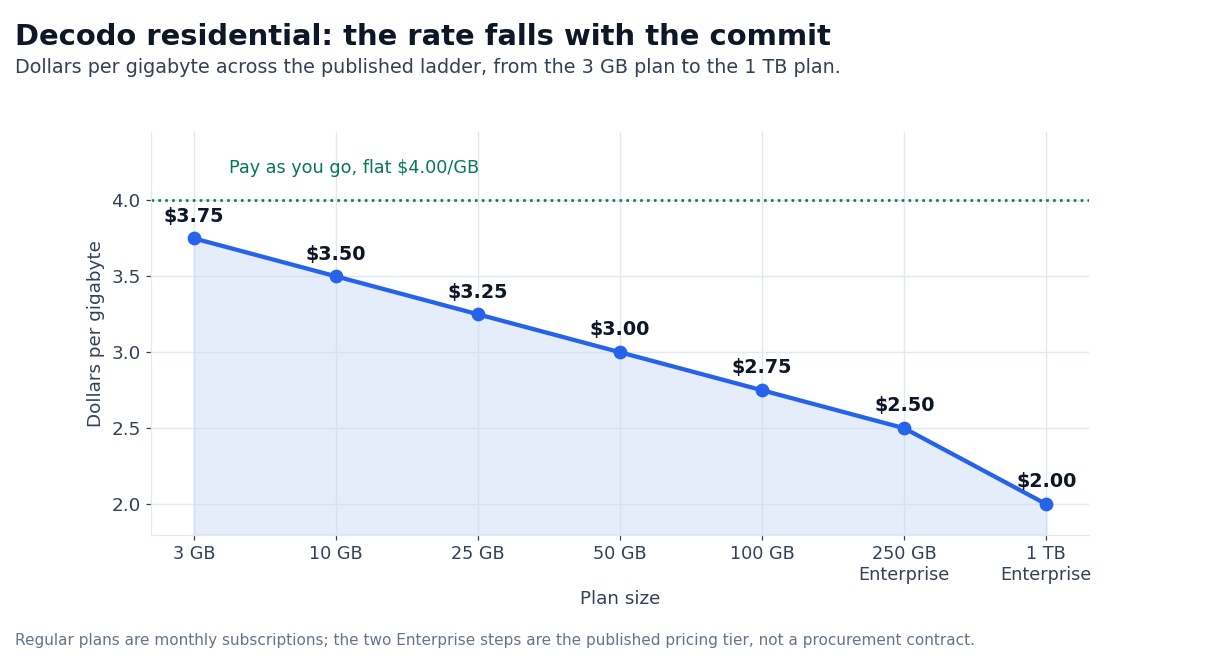
Decodo is cheaper at scale by $0.50/GB. At 1 TB/month that is a $500/month difference, which is the kind of number that justifies a switch for a sub-mega-TB buyer.
The pool comparison: Bright Data’s residential pool is in the 400M+ range across product lines; Decodo’s published pool is 115M+. If your workload demands fresh IPs at a higher rate than Decodo’s pool can supply, Bright Data wins by default.
The product fit comparison: Bright Data publishes a broader product catalog:
- residential proxies.
- ISP proxies.
- datacenter proxies.
- mobile proxies.
- Web Unlocker.
- Scraping Browser.
- the SERP API.
Decodo’s published catalog is narrower. If you need Web Unlocker (managed anti-bot bypass), Bright Data has the wider surface area.
The honest decision: for residential-only workloads under 1 TB/month, Decodo wins on price and onboarding. For multi-product stacks that need managed anti-bot, Bright Data wins on breadth. For ad verification at scale, both work and the deciding factor is usually the procurement story.
The verdict in short
Smartproxy in 2026 is Decodo. Decodo is what it has been for the last five years of proxyway awards: a clean residential proxy product at a competitive published price, with a self-serve onboarding flow and a 3-day trial that fits in a lunch break. The rebrand did not change what is underneath; it changed the name on the dashboard.
The case for Decodo in 2026 is the price ladder and the trial. At $2/GB on 1 TB and $4/GB on PAYG, Decodo is the cheapest published residential price in the category at scale; the 3-day / 100 MB trial removes the cost of a first pilot.
The case against is the 115M+ pool (smaller than Bright Data) and the narrow product catalog (residential plus separate ISP, datacenter and mobile lines, and a Site Unblocker anti-bot product).
If your workload is residential scraping under 1 TB/month and you have already decided you do not need a Big Four audit story, Decodo is the lowest-friction choice in the category in 2026. If you need more than that, compare Decodo, Bright Data, and Oxylabs on a per-workload trial before you commit.
Frequently asked questions
Is Smartproxy the same as Decodo?
Yes. Smartproxy rebranded to Decodo in 2025–2026; the company, IP pool, pricing, and dashboard are unchanged. The footer on decodo.com reads “© 2018–2026 decodo.com (formerly smartproxy.com).”
How much does Smartproxy/Decodo residential proxy cost?
From $2/GB on the 1 TB Enterprise tier to $3.75/GB on the 3 GB entry plan. Pay-as-you-go is $4/GB via Wallet top-up. All paid plans include 115M+ IPs and free advanced targeting.
Does Decodo offer a free trial?
Yes. The 3-day / 100 MB free trial is opt-in at signup. No credit card required for the trial itself, but you must select a paid plan and cancel before the trial ends, or the plan charges.
What is the IP pool size?
115M+ residential IPs across 195+ locations, with HTTP(S) and SOCKS5 support on every plan. Targeting granularity runs from continent down to ZIP code and ASN.
How does Decodo compare to Bright Data on price?
Decodo’s published PAYG is $4/GB, the same as Bright Data. On the deepest published tier Decodo is $2/GB (1 TB) vs Bright Data’s $2.50/GB (Business, 800 GB). Decodo is cheaper at scale; Bright Data has the wider product catalog.
What is the success rate?
Decodo publishes 99.92% success, 99.99% uptime, and <0.5s average response time. The numbers come from Proxyway’s annual research, using a custom Python script against a global CDN target with 500 requests per endpoint.
Can I get a refund?
Yes, within 14 days of the first transaction. On the first purchase, if you have not used more than 20% of the plan’s traffic on a regular residential plan or 10% on enterprise. The 14-day refund does not apply if you took the 3-day free trial.
What payment methods are accepted?
Credit cards, PayPal, Alipay, Google Pay, Apple Pay, and cryptocurrency (excluding ISP proxies). Orders are processed by Paddle as Merchant of Record.
Does Decodo have an enterprise plan?
Yes, but the published “Enterprise” tier is a pricing tier (250 GB / $2.50/GB and 1 TB / $2/GB), not a procurement-tier contract. For SOC 2 / MSA-style enterprise procurement, contact sales directly.
Sources
Decodo residential proxy pricing Decodo dashboard
How we put this together: the residential rate ladder, the pool and targeting figures, the performance claims and the payment terms come from decodo.com/proxies/residential-proxies/pricing and help.decodo.com, read in September 2026. We have not run a paid Decodo account.
Disclosure: this article contains affiliate links. If you buy through them we may earn a commission at no extra cost to you. Commission never changes our scoring or the order of a ranking.