
Envoy proxy is the L7 proxy and communication bus that quietly runs as the default data plane for half the service mesh deployments in production. It was born at Lyft in 2016, donated to the CNCF in 2017, graduated in 2018, and has been the upstream project for Istio, Consul, and a dozen other service-mesh control planes ever since.
It is also the data plane for several ingress controllers (Emissary-Ingress, Gloo Edge) and edge gateways (Tetrate, Solo.io). By 2026 it is hard to find a “service mesh” page in production that doesn’t have Envoy proxy somewhere underneath, even if the marketing doesn’t say so. This review is about whether that dominance is still warranted, eight years in.
The review covers what Envoy proxy actually is in 2026, the architecture decisions that made it the default, the honest comparison with Nginx and HAProxy, and where Envoy is the wrong tool. There is no pricing table — Envoy proxy is open-source under Apache 2.0, with no commercial licensing fees from the project itself.
The “cost” is operational: the engineering hours to configure, deploy, and maintain a fleet of Envoy proxy instances at scale. Anything that depends on a real production workload — your p99 latency on gRPC streaming, your cold-start time on the Envoy proxy data plane, your control-plane CPU cost on Istio — is flagged as unverified in this review, same convention as our other reviews.
Envoy proxy is still the right default for new service-mesh deployments and high-volume L7 routing in 2026.
It is open-source (Apache 2.0, CNCF graduated) with no licensing fees.
The operational cost is real.
Nginx/HAProxy still win on raw throughput and configuration simplicity for the 80% case.
Why Envoy became the default data plane
Envoy is an L7 proxy and communication bus. Three architectural decisions made it the default:
First, out-of-process architecture. Envoy is a self-contained process that runs alongside every application server. Each Envoy forms a transparent communication mesh. Each app sends and receives messages to localhost and is unaware of the network topology.
This works with any application language — Java, Go, Python, PHP, C++ and Rust — and lets you deploy and upgrade Envoy across the entire infrastructure without touching application code. The trade-off is operational: you now have a sidecar fleet to manage, not just a library.
Second, L3/L4 filter chain architecture. At its core, Envoy is an L3/L4 network proxy. A pluggable filter chain mechanism lets you write filters to perform different TCP/UDP proxy tasks. Filters are written for raw TCP proxy, UDP proxy, HTTP proxy, TLS client certificate authentication, Redis, MongoDB, Postgres, and Kafka.
The filter chain is where Envoy’s extensibility shows up vs Nginx (which has a more rigid module system).
Third, HTTP L7 filter layer. HTTP is critical enough to modern applications that Envoy layers an HTTP L7 filter subsystem on top. HTTP filters can plug into HTTP connection management to do buffering, rate limiting, routing, forwarding, sniffing of DynamoDB requests, and many more. This is the layer that makes Envoy a credible API gateway, not just a TCP proxy.
The reason Envoy won the service-mesh data-plane race is that the same proxy code that runs as an ingress controller also runs as a sidecar in the mesh and as an edge gateway.
You don’t have to learn three different tools. Nginx-as-sidecar is awkward; HAProxy-as-sidecar is rare; Envoy is the only one designed for all three roles from day one.
HTTP/2, HTTP/3, gRPC, and the protocol story
Envoy’s HTTP story is the most important reason to pick it over Nginx or HAProxy for modern workloads.
Envoy supports HTTP/1.1 and HTTP/2 natively, with HTTP/3 (alpha as of 1.19.0) added upstream and downstream. It can translate between any combination of HTTP/1.1, HTTP/2, and HTTP/3 in either direction — a property that becomes operationally important when you have clients on HTTP/1.1 and services on HTTP/3.
The recommended service-to-service configuration uses HTTP/2 between all Envoys to create a mesh of persistent multiplexed connections. Nginx added HTTP/2 support years ago but the HTTP/3 story is less mature; HAProxy added HTTP/2 in its 1.8 release in 2017, and HTTP/3 is more recent.
For gRPC, Envoy supports all the HTTP/2 features required to be used as the routing and load-balancing substrate for gRPC requests and responses. gRPC is built on HTTP/2 multiplexing, so an Envoy mesh that speaks HTTP/2 between services can route gRPC without any special config.
This is the practical reason Envoy became the data plane for Istio — Istio’s gRPC routing story relies entirely on Envoy’s HTTP/2 + gRPC support.
HTTP/3 is still alpha in Envoy as of late 2025 — usable in production for non-critical paths, not yet the default. The project carries HTTP/3 behind the --//bazel:http3=False flag in its own Bazel builds. If you are betting on HTTP/3 today, run a separate validation cluster before promoting.
Service discovery and dynamic configuration
The other thing Envoy does that Nginx and HAProxy do not is dynamic configuration via xDS APIs. Envoy consumes a layered set of dynamic configuration APIs (CDS, EDS, LDS, RDS, SDS) for centralized management.
The layers provide an Envoy with dynamic updates about: hosts within a backend cluster, the backend clusters themselves, HTTP routing, listening sockets, and cryptographic material.
For simpler deployments, backend host discovery can be done through DNS resolution (or skipped entirely with static config files), with the further layers replaced by static config files.
The dynamic config story is what makes Envoy the right fit for a service mesh — you can change routes, add canary splits, rotate certificates, and adjust load-balancing weights without restarting the proxy fleet. With Nginx, you typically need a config push + SIGHUP; with HAProxy, you typically need a runtime API call for some changes and a reload for others.
This is the most important trade-off. Envoy’s xDS is more powerful than anything in Nginx or HAProxy, but it’s also more complex to set up. A simple HTTP routing use case doesn’t need xDS; a Kubernetes service mesh with thousands of services needs xDS or it doesn’t scale.
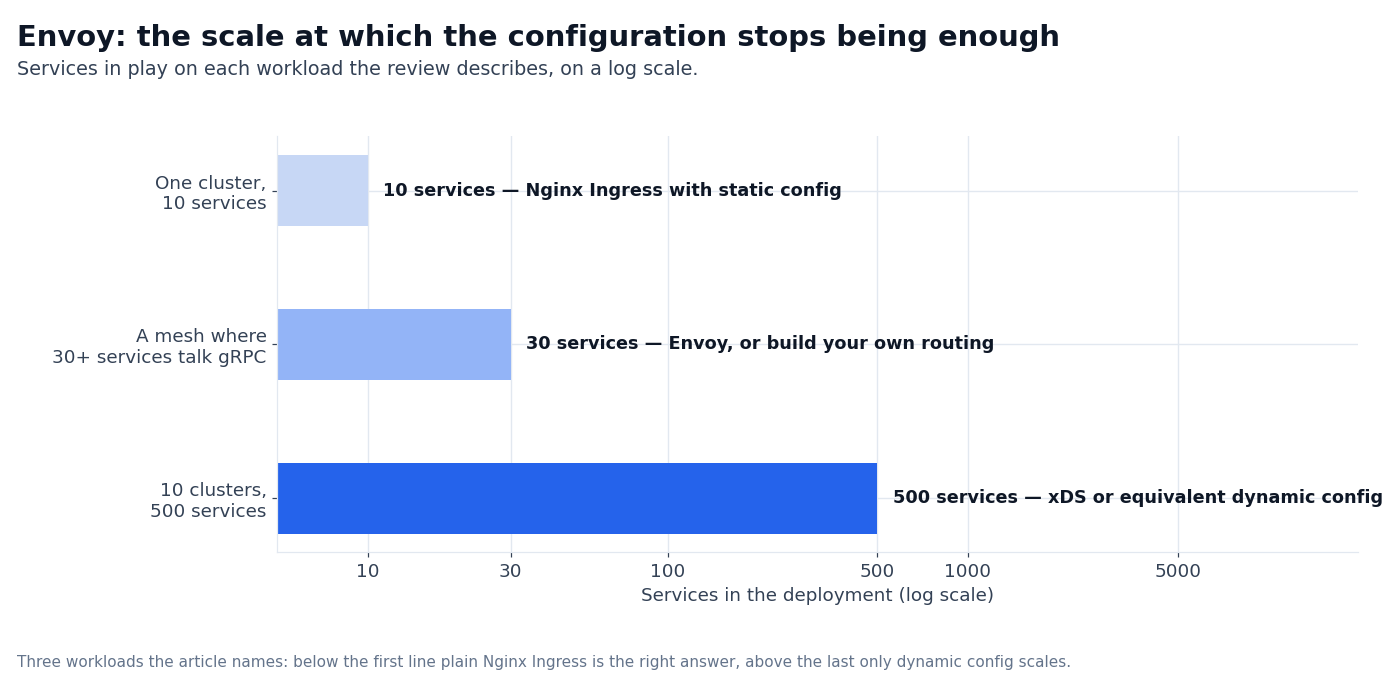
xDS adds operational complexity that the simple case does not need. If you are routing 10 services in a single-cluster Kubernetes, plain Nginx Ingress with static config is the right answer. If you are routing 500 services across 10 clusters with canary routing, mTLS, and rate limits, you need xDS or equivalent dynamic config.
Envoy vs Nginx, HAProxy, and Istio in 2026
The honest comparison question for any Envoy review in 2026 is: when do you pick each?
| Proxy | Best fit | Strength | Weakness |
|---|---|---|---|
| Envoy | Service mesh data plane, API gateway, gRPC routing | Dynamic xDS config, HTTP/2 + gRPC + HTTP/3, multi-language sidecar | Operational complexity, learning curve |
| Nginx (open-source) | Web server, reverse proxy, ingress controller | Battle-tested, simple config, low resource use | No native xDS, weaker gRPC story |
| Nginx Plus | Enterprise reverse proxy, advanced LB | Premium support, advanced health checks, dynamic config | Licensing cost, still no xDS equivalent |
| HAProxy | TCP/L7 load balancer, edge proxy | Raw TCP throughput, simple ops, mature | Configuration language limits |
| HAProxy Enterprise | Enterprise load balancer | Premium support, advanced features | Licensing cost, no xDS |
| Istio | Service mesh control plane | Built on Envoy, full mTLS, traffic management | Adds operational complexity on top of Envoy |
| Linkerd | Service mesh | Rust-based micro-proxy (linkerd2-proxy) | Smaller ecosystem than Envoy-based meshes |
The practical rule for 2026: if you are doing single-cluster Kubernetes with simple ingress, Nginx is still the right answer. If you are doing multi-cluster with mTLS and traffic shifting, Envoy-based — Istio, Consul or plain Envoy xDS — is the right answer. If you are doing TCP-only load balancing at very high throughput, HAProxy wins on raw speed.
When Envoy is the wrong tool
Envoy has honest limits that matter for some use cases.
If your workload is HTTP-only and your routing needs are simple — path-based, host-based, weighted —, Nginx is simpler to operate and has a much larger community of operators who have already debugged your edge case. Envoy’s xDS power is wasted on a simple reverse proxy.
If your workload is raw TCP without an L7 component, HAProxy is faster and the configuration language is more straightforward. Envoy can do TCP proxy, but the operational overhead of an Envoy mesh is overkill for a layer-4 load balancer.
If your team is small (5 engineers) and you don’t have a dedicated platform team, the operational complexity of Envoy is a tax you don’t want to carry. Plain Nginx + a managed Kubernetes service is enough for most SMB teams.
If you are running a closed-ecosystem API gateway that doesn’t need dynamic config, Envoy is overkill. Kong or Tyk are simpler gateways for the typical 50–200 endpoint case.
If you don’t need gRPC and don’t need HTTP/3, Envoy’s protocol advantages disappear. Nginx and HAProxy match Envoy on HTTP/1.1 and HTTP/2 for the common case.
Envoy’s learning curve is real. The first time you set up xDS, you will spend a week on it. The second time, a day. The tenth time, an hour. If you only deploy it once, the week is a serious investment; if you deploy it every quarter, it amortizes fast.
Where Envoy wins outright
Three workloads have no real alternative to Envoy in 2026.
Service mesh data plane. Istio, Consul, Tetrate Service Mesh, Solo.io Gloo Mesh — all run Envoy as the data plane. There is no credible alternative. Linkerd has its own Rust micro-proxy but it’s a different architecture. Cilium Service Mesh uses Envoy under the hood. AWS App Mesh is built on Envoy. Google Cloud’s Anthos Service Mesh is built on Envoy.
The market has consolidated around Envoy.
gRPC service-to-service routing. Envoy’s HTTP/2 + gRPC story is the most mature in the industry. If you are building a microservice architecture where 30+ services talk to each other via gRPC, the routing, retry, circuit-breaking, and load-balancing story is Envoy or build-your-own.
Multiprotocol edge proxy. Envoy’s filter chain supports HTTP, gRPC, TCP, UDP, MongoDB, Redis, Postgres, Kafka, DynamoDB in one binary. If your edge proxy needs to terminate TLS, route HTTP to your API, route gRPC to your microservices, and proxy Kafka to your event bus, Envoy is the only proxy that does all of that natively.
The fact that Envoy is the data plane for so many service meshes is also its biggest risk: if Envoy’s maintenance slows, half the service mesh ecosystem is affected.
The CNCF graduation gives some confidence, but the project is still primarily Lyft-and-community maintained. Watch the GitHub commit activity and the maintainer roster if this matters to you.
FAQ
Is Envoy still the default service mesh data plane in 2026?
Yes. Istio, Consul, Tetrate, Solo.io, Cilium Service Mesh, AWS App Mesh, and Google Cloud Anthos all run Envoy as the data plane. There is no credible alternative for new service mesh deployments.
Is Envoy better than Nginx?
For simple reverse proxy and ingress controller use, Nginx is simpler and has more community knowledge. For service mesh, gRPC routing, and multiprotocol edge proxy, Envoy is the right answer. The two coexist in most production stacks — Nginx at the edge, Envoy in the mesh.
Is Envoy better than HAProxy?
For raw TCP load balancing at very high throughput, HAProxy is faster and simpler. For HTTP/2 + gRPC + dynamic config + service mesh, Envoy wins.
Does Envoy cost money?
No — Envoy is open-source under Apache 2.0. There are no licensing fees from the project itself. Commercial distributions (Tetrate, Solo.io) charge for support and management tooling, but the upstream proxy is free.
Can Envoy replace an API gateway?
For Kubernetes-native API gateways (Kong, Tyk, Ambassador), Envoy is the typical data plane underneath. For closed-ecosystem API gateways with built-in analytics and developer portals, you still want Kong or Tyk on top.
Is Envoy hard to operate?
Yes, relatively. The first xDS setup takes a week of focused work for a team new to Envoy. The xDS API surface is large and the documentation assumes you already understand service-mesh concepts. Plan for a real learning curve.
What’s the difference between Envoy and Istio?
Envoy is the data plane (the proxy that handles traffic). Istio is the control plane (the system that configures and manages a fleet of Envoys). You can run Envoy without Istio; you can’t run Istio without Envoy.
Is Envoy a service mesh?
No, Envoy is one component of a service mesh (the data plane). A complete service mesh also has a control plane (Istio, Consul, Linkerd) and observability tooling: Prometheus, Jaeger and Zipkin.
Sources
- Envoy: What is Envoy — feature list, architecture description
- Envoy GitHub repo — version tracking, release notes, issue activity
- Istio architecture — Envoy’s role as Istio data plane
- Nginx documentation — comparison data for Nginx section
- HAProxy documentation — comparison data for HAProxy section
How we put this together: the architecture notes, the protocol support matrix, the comparison table and the operational thresholds come from the Envoy project documentation and its own release notes, quoted as displayed.
There is no pricing table to quote: Envoy proxy is open-source under Apache 2.0 and carries no licensing fee from the project itself. We have not run an Envoy proxy fleet in production and no figure here comes from a load test of our own.
Figures that depend on a real workload, a real target or a real integration are flagged where they appear in the text rather than being estimated.
Disclosure: this article contains affiliate links. If you buy through them we may earn a commission at no extra cost to you. Commission never changes our scoring or the order of a ranking.