Delphi AI sells “Digital Minds” — voice and chat clones trained on the user’s own content. The product targets creators, coaches, experts, and public figures who want a bot that can answer fan questions and handle intro calls without the user being present.
Delphi AI’s pricing page is short, the four tiers are clearly stated, and the headline use case (an always-on AI stand-in for the creator) is unambiguous.
We read through the Delphi AI pricing page, the public marketing site. The customer testimonials to map out who the product fits, where the training cap runs out, and how the annual discount stacks up (delphi.ai/pricing, read in September 2026).
The product — one Digital Mind trained on your own content, answering by voice and chat.
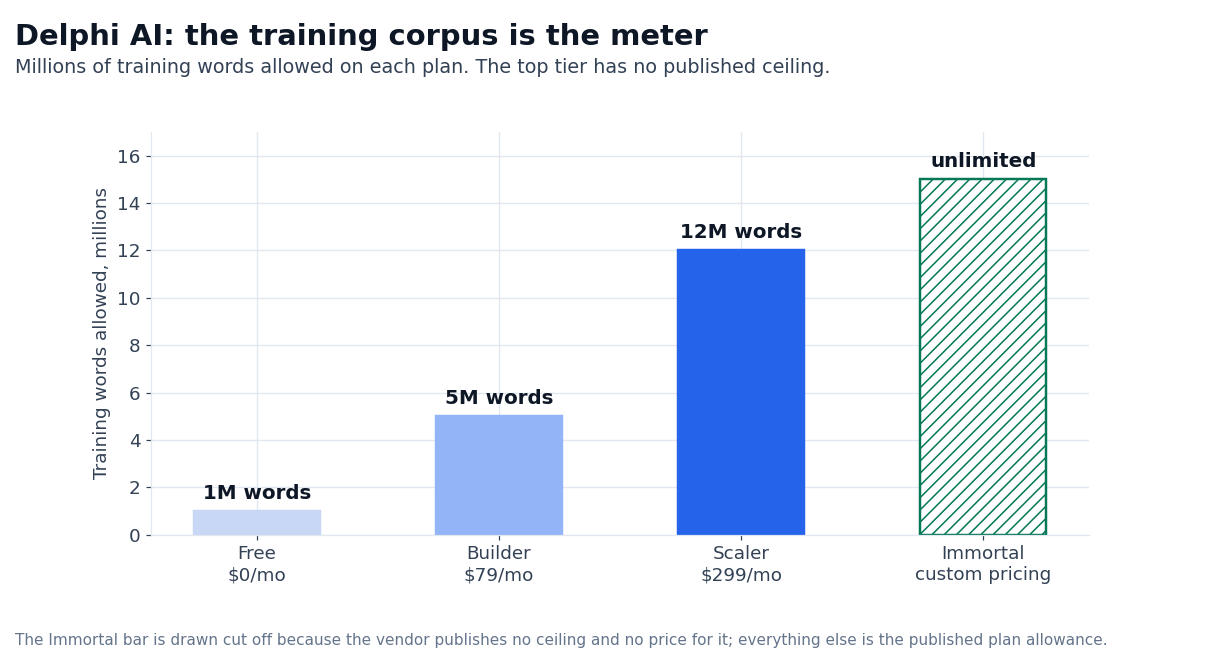
The meter — the training corpus in words — 1M, 5M, 12M, then unlimited at the top tier.
The channels — voice and chat everywhere; SMS, WhatsApp and an API only on Immortal.
The catch — no published behavior for out-of-corpus questions, and no analytics depth.
The fit — creators and experts with a large archive and a steady volume of repeat questions.
What Delphi AI actually is
The product sells an AI Digital Mind that mirrors your tone, voice, and knowledge. It is trained on the content you already produce — documents, websites, social accounts, and videos — and it answers people on your behalf through voice calls, chat, and embedded widgets (delphi.ai).
The headline pitch is the introductory call you do not have time for, the context question you have already answered twice, and the inbox triage that could be automated.
The customer quote on the pricing page (“It has completely changed the game in terms of people having on-demand access to my mind”) is from Matthew Hussey, a relationship coach.
The audience skews toward creators, experts, consultants, and public figures who already have a substantial content archive (delphi.ai/pricing).
This is not a chatbot builder. Delphi AI is a tool for producing one specific bot that talks like you and knows what you know.
Unlike a FAQ widget, a Delphi AI Mind is trained on whatever you feed it — articles, transcripts, slide decks, raw notes — and the corpus can be re-trained as your library evolves. The implementation is closer to a personal-RAG-with-voice than to a typical AI agent.
Where pricing is and is not
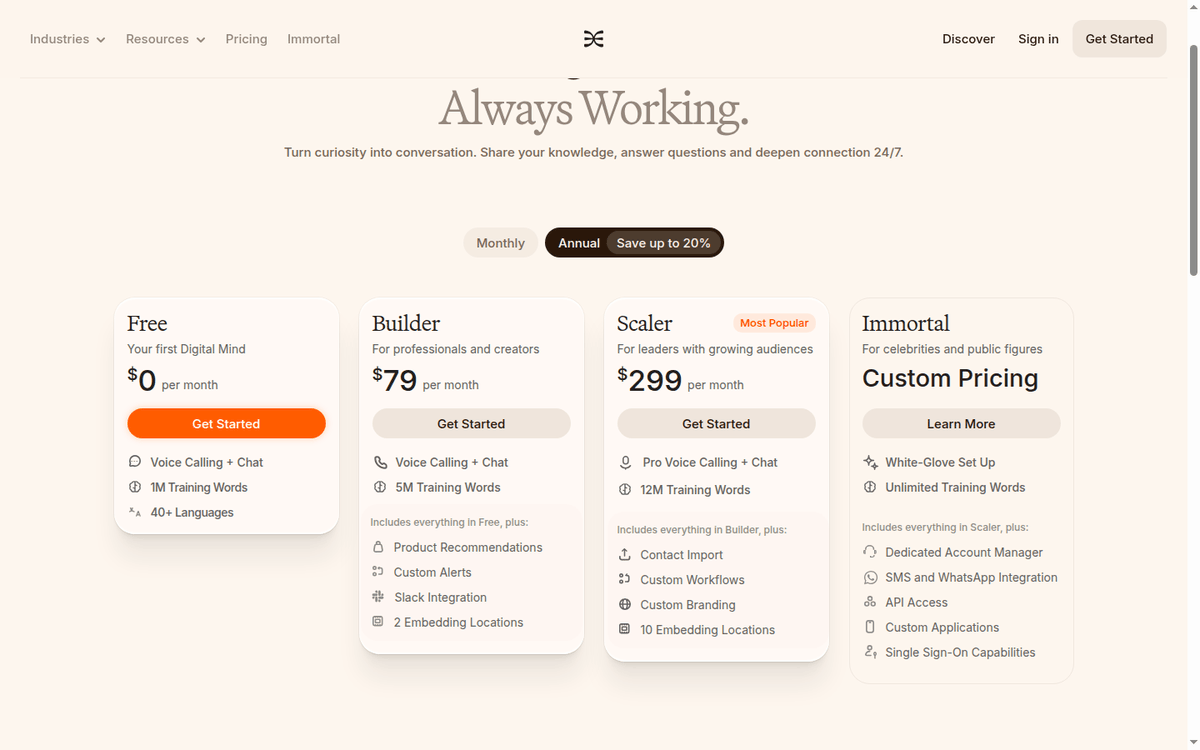
Pricing is published. The page publishes monthly rates for the three paid tiers and an annual toggle labeled “Save up to 20%”; the annual totals themselves are not shown.
There is a clear table for Free, Builder, Scaler, and Immortal. The most expensive tier is explicitly labeled “Custom Pricing” with a “Learn More” link to a separate Immortal page (delphi.ai/immortal).
There is no hidden seat fee, no usage-based charge. No credit system on the lower three tiers. The only meter is the training corpus (in words), and that cap is published in plain numbers on each plan.
We did not provision a Digital Mind or make a real call to test voice quality, voice cloning, or how the system handles out-of-corpus questions. The descriptions below come from the pricing page and the marketing site. The claims about voice quality and language coverage are vendor claims.
What each plan includes
| Plan | Monthly | Annual billing | Training words | Embed locations | Channels |
|---|---|---|---|---|---|
| Free | $0/mo | n/a | 1M | 0 | Voice + chat |
| Builder | $79/mo | Save up to 20% | 5M | 2 | Voice + chat, Slack, recommended products, custom workflows, analytics dashboard |
| Scaler (Most Popular) | $299/mo | Save up to 20% | 12M | 10 | Adds contact import, custom branding, Pro voice |
| Immortal | Custom | n/a | Unlimited | Custom | Adds SMS, WhatsApp, API, dedicated manager, SSO |
Free: one Digital Mind
The Free tier ships one Digital Mind with a 1M training word cap and 40+ language support. Voice calling and chat are both included. There is no embedding allowance — the Free tier is for personal use, not for putting a clone on a customer-facing site.
The 1M training word cap is roughly the size of a few hundred published articles or a substantial book. For most creators, that hits well within their existing content archive. If you have a YouTube channel with hundreds of videos, you might outgrow this cap.
Builder: most solo creators
Builder costs $79/mo. It raises the training word cap to 5M, opens up two embedding locations, and adds recommended products, custom workflows, an analytics dashboard and the Slack integration. For solo creators with a newsletter, podcast, or active blog, this is the right starting tier.
The 5M word cap covers the entire archive of a mid-size creator — books, hundreds of articles, video transcripts. The two embedding locations let you put the Digital Mind on a personal site and on a sales page, or run two different clones with different training corpora.
Scaler: most popular
Scaler is the most popular tier on the pricing page. It costs $299/mo, less again on annual billing (the page publishes the discount, not the annual total). It lifts the training cap to 12M words, expands embedding locations to 10, and adds contact import, custom workflows, custom branding, and “Pro Voice Calling” (the higher-tier voice channel).
Scaler is the right tier for established experts, mid-size creators with multiple brands, or small agencies running clones for multiple clients. The custom workflows and contact import start to matter at this scale — you can wire the clone into a CRM, pipe captured leads into an email sequence, or run a custom chat flow before the bot takes over.
Immortal: white-glove and unlimited
The top tier is custom-priced and ships unlimited training words, all integrations (SMS, WhatsApp, API), SSO, and a dedicated account manager. The published quote is “White-Glove Set Up”. This tier is aimed at celebrities, public figures, and enterprise thought-leadership programs where the training corpus is essentially the entire public footprint of the person being cloned.
Immortal pricing is not published and we did not request a quote. The tier is positioned for high spend and the “custom” label is the vendor-suggested path, not a published rate.
Where Delphi AI works well
The product is built for:
- Solo creators and experts with a large content archive who want a passive channel for routine questions.
- Coaches and consultants who already screen inbound by voice or text and could offload the intake call.
- Public figures and authors where the audience is large enough that direct access is no longer practical.
- Small teams that want a Slack-native expert bot for internal Q&A.
- Agencies running clones for multiple clients under the Immortal tier.
Delphi AI is a real fit when there is enough first-party content to train on, and the use case fits the “answer as if it were me” model. The “as if it were me” framing matters because some questions — pricing, billing, policy boundaries — should not be answered by the Mind. Plan for a fallback.
Where Delphi AI does not work well
- Anyone whose content is mostly in video with no transcripts. Delphi AI trains on documents, websites, social, and video — if your video is the asset but the transcripts are not produced, the corpus is empty.
- Brands where the “voice” is collective rather than personal. Delphi AI clones an individual, not a brand persona.
- Anyone who needs a real-time conversational agent for sales or support. The product is positioned as a personal stand-in, not as a customer-support AI.
- Anyone who needs strict compliance. The top tier has SSO; HIPAA, FINRA, or other regulated frameworks are not mentioned on the pricing page.
- Anyone who needs a deep analytics stack. The page lists an analytics dashboard from Builder up, but nothing comparable to a dedicated reporting tool.
Compared with adjacent products
- Delphi AI vs Heyday: Heyday is a conversational AI for ecommerce customer support. Delphi AI is a personal AI stand-in. Different problems.
- Delphi AI vs Twinning / Personal AI: Personal AI lets you build a personal clone with ongoing edits to the corpus. Delphi AI ships a more polished product surface, fewer editing tools, and a higher baseline of polish.
- Delphi AI vs RAG chatbots like Chatbase or CustomGPT: those products train on a corpus and serve a chat widget. Delphi AI goes further with voice cloning and a 40-language phone channel. The trade-off is the price floor and the white-glove positioning.
The right alternative depends on whether you need voice vs text vs both, and whether your use case is personal (Delphi AI, Personal AI) vs support (Heyday) vs general RAG (Chatbase, CustomGPT).
If your content lives mostly in video transcripts and your audience asks by text, the math on Chatbase or CustomGPT is friendlier. If your audience calls you on the phone and your content is in audio, Delphi AI is the closest fit.
The verdict in short
Delphi AI is a polished, narrow product for a specific kind of customer — experts and creators with large content archives who want a passive AI stand-in. The pricing is straightforward: Free for a single clone, Builder for most solo creators, Scaler for established experts, Immortal for public-figure programs.
The hidden cost is the corpus work — getting the training data into Delphi AI, keeping transcripts produced, and updating the Mind as the user’s voice evolves. If you have a large archive and a routine volume of inbound, the math works. If you need a general chatbot, a support agent, or a brand-level AI, Delphi AI is not the product.
FAQ
What is a “training word”?
The pricing page describes the cap as “training words” — the size of the corpus the Digital Mind is trained on. It is a coarse measure: the actual token count and language coverage depend on how the source content tokenizes. For English text, 1M words is roughly the size of a short book.
How does Delphi handle out-of-corpus questions?
We did not test this. The pricing page does not describe the fallback policy. Most AI clone products either say “I do not know” or escalate to a human handoff. Delphi has no published behavior chart.
Can I bring my own LLM?
The pricing page does not mention BYOL or BYOK. The product is sold as a full stack.
What languages are supported?
40+ across all tiers. The published list covers the major Latin, Germanic, Romance, and Asian languages. Voice cloning quality in non-English languages is not documented.
How does annual billing work?
Annual saves up to 20% across Builder and Scaler — the page publishes the discount rather than the annual total. Free and Immortal (custom) have no annual rate at all.
Can I cancel anytime?
The pricing page does not publish cancellation terms. For most SaaS subscriptions, annual plans bill up front and do not refund for partial years. We did not test this.
Sources
How we put this together: the plan prices, the training word caps, the embedding allowances and the channel list come from delphi.ai/pricing and delphi.ai, read in September 2026. We have not provisioned a Digital Mind or made a test call.
Figures that depend on a real workload, a real target or a real integration are flagged where they appear in the text rather than being estimated.
Disclosure: this article contains affiliate links. If you buy through them we may earn a commission at no extra cost to you. Commission never changes our scoring or the order of a ranking.