Gorgias is the helpdesk that Shopify brands reach for when their customer-service volume starts to drown the team that used to handle it in Gmail. The product is not new; the 2026 model is. Gorgias used to charge per agent seat the way every other helpdesk did.
The current model prices by ticket volume instead, and the AI Agent that lives on every plan is metered by the conversation it resolves without a human handoff.
That combination — per-ticket sizing plus per-resolved-conversation AI — is the single biggest shift in ecommerce support tooling this year, and it changes what “the right plan” means for a brand.
This review walks through the four-tier Gorgias ladder (Starter / Basic / Pro / Advanced), the AI Agent economics, the Voice and SMS add-ons, the integration story with Shopify and the four other ecommerce platforms Gorgias supports. The head-to-head with Zendesk and Klaviyo that almost every Shopify brand runs in their first month.
The dollar figures come from gorgias.com/pricing, read in September 2026; the plan cards render client-side, so they come from the page’s own embedded pricing data.
Anything that needs a paid account to verify — actual resolve rate on a Shopify-class catalog, real overage math on a peak sale day, the rollout cost of Voice or SMS — is flagged as unverified in this review. Same convention we use across our review pieces.
What Gorgias ships in 2026
Gorgias is one platform with two products: Helpdesk and AI Agent. Helpdesk is the inbox, the rules engine, the macros, the integrations, the Shopify order-context card that pops up next to every ticket.
AI Agent is the conversational layer that lives on top of it — an always-on agent trained on 18+ ecommerce verticals that resolves support questions, runs actions like cancel / discount / apply. Only bills the brand when it actually closes the ticket without a human handoff.
The two products share a single unified inbox; the agents in your team move between human and AI conversations without switching surfaces.
The customer-side shape is what buyers actually feel. Email, chat, social — Instagram, Facebook, Messenger and WhatsApp — and the Gorgias Help Center all land in the same inbox with shared macros and shared order context.
A returning customer on Instagram gets the same view of their last three orders that the email agent sees. A Shopify Plus merchant sees line items, refund eligibility, and lifetime value right next to the message.
That context card is what the platform was originally built around, and it is still the feature that wins the head-to-head against Zendesk on Shopify stores specifically.
The 2026 differentiator is the AI Agent. Orthofeet, a Gorgias customer cited on the pricing page, set a goal of 30% automated resolution in 30 days and landed above 50%.
The pattern matters: AI Agent is metered per resolved conversation, not per agent seat. Means a brand that automates 60% of its volume pays Gorgias for 40% of its volume plus a fraction of the agent seats it used to need. The unit economics are why this matters.
Gorgias pricing in 2026: four tiers
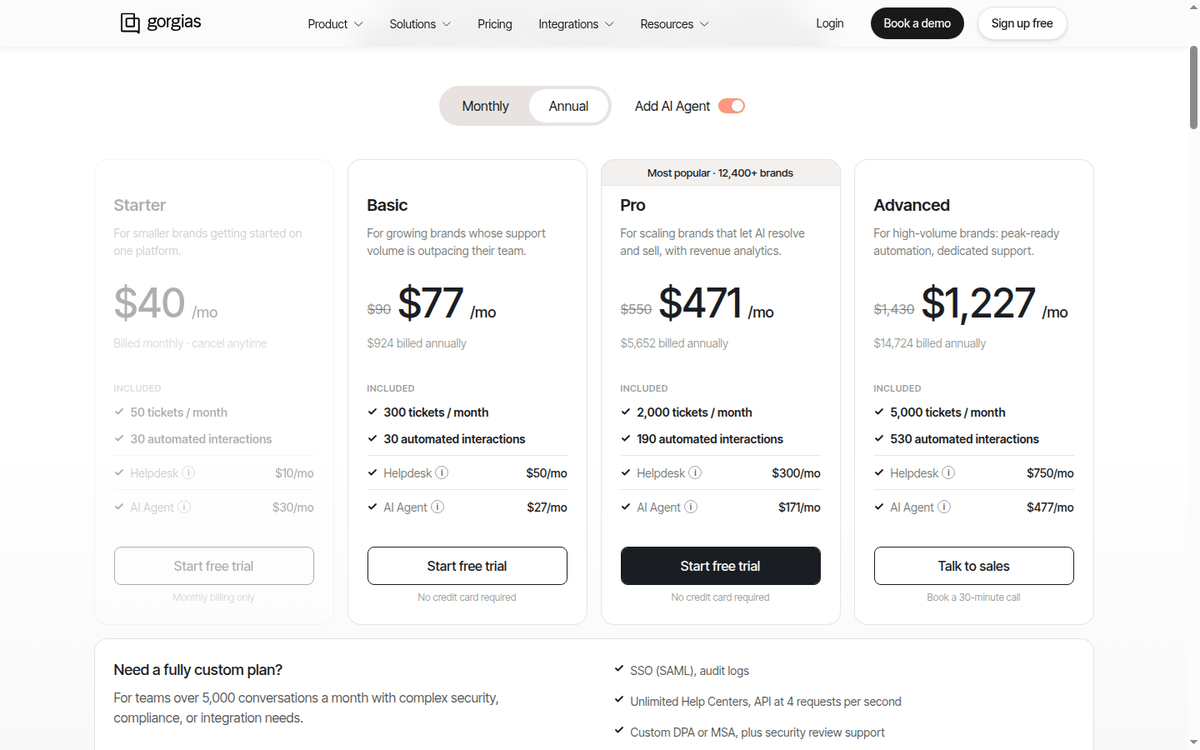
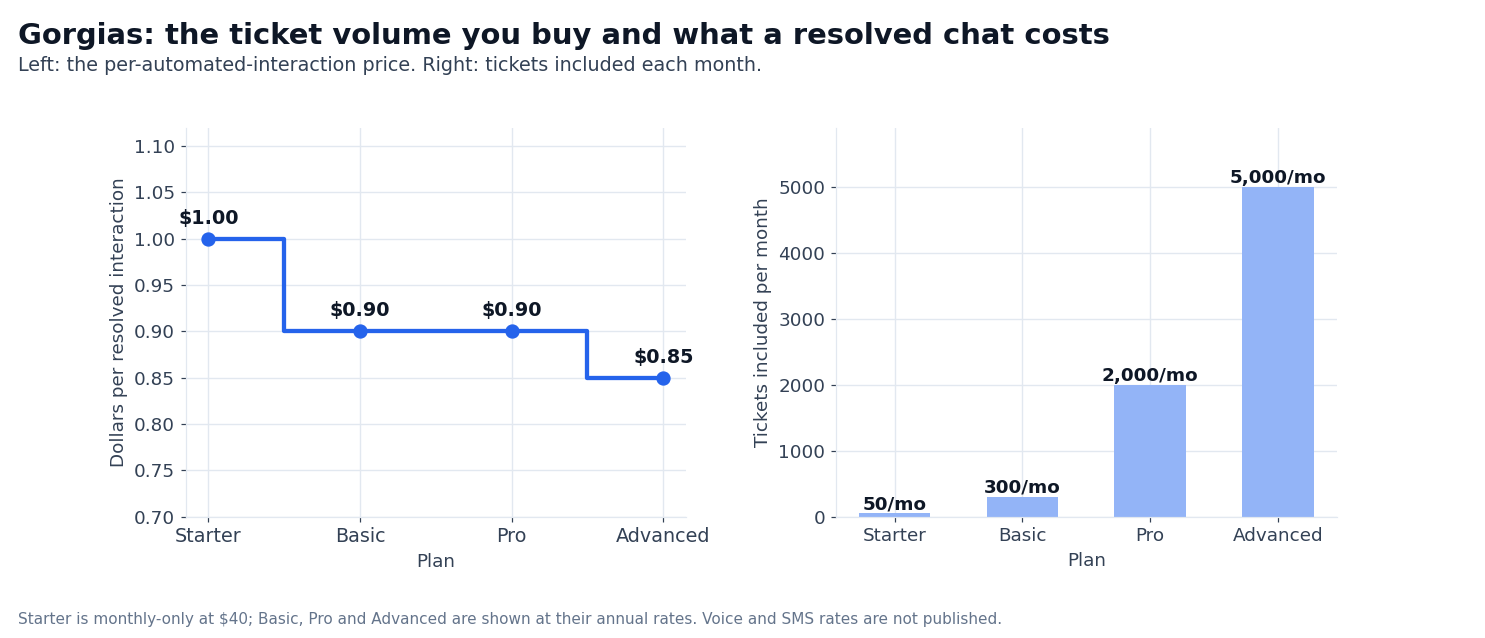
Gorgias prices by ticket volume, not by agent seat. Starter is monthly-only at $40/mo and includes 50 tickets + 30 automated interactions; everything above Starter offers both monthly and annual billing, with up to 14% off on annual. The pricing below reflects the Annual option for Basic/Pro/Advanced where it is the cheaper line.
| Plan | Monthly | Annual /mo | Tickets | Auto-interactions | Over-100 tickets | Per interaction |
|---|---|---|---|---|---|---|
| Starter | $40 | — (monthly only) | 50/mo | 30 | $0.40 / ticket | $1.00 |
| Basic | $90 | $77 | 300/mo | 30 | $40 / 100 | $0.90 |
| Pro | $550 | $471 | 2,000/mo | 190 | $36 / 100 | $0.90 |
| Advanced | $1,430 | $1,227 | 5,000/mo | 530 | $36 / 100 | $0.85 |
Pro is the one most Shopify brands land on — Gorgias calls it “Most popular · 12,400+ brands” on the pricing page. The resolution and automation features all sit at this tier: brand voice, guardrails, the cancel / discount / apply Actions, revenue attribution and 1:1 onboarding.
Advanced is the move for brands crossing 5,000 tickets/mo with peak-sale risk; the dedicated CSM and SLA land here. Anything above 5,000 tickets/mo is Enterprise custom.
A note on what the line items mean. The numbers above ($77, $471, $1,227) are the total monthly bill on annual billing — not per-agent pricing. Each plan bundles a Helpdesk module and an AI Agent module into that single line.
AI Agent is on every plan; the per-automated-interaction price drops as you climb tiers — $1.00 at Starter, $0.90 at Basic/Pro, $0.85 at Advanced.
Overage on tickets is billed at the rate per 100 — that is the line that bites on a Cyber Five weekend or a product launch. Is the place we recommend stress-testing with your real peak-day math. We cannot quote the overage bill on your own traffic pattern here.
User seats are a separate dimension and worth understanding on its own. Starter caps at 3 user seats — that is enough for a single founder-led brand. Basic/Pro/Advanced all raise the seat cap to 500, which is comfortably above what most Shopify brands need for the support team.
The seat cap is not the binding constraint at the Pro tier; the binding constraint is the ticket volume (2,000/mo) and how quickly it grows during a sale. Gorgias sizes the plan on volume and treats seat count as a generous default, which is the inverse of how Zendesk sizes the bill.
The full plan-comparison matrix is on gorgias.com/pricing — that page is where every figure above comes from.
The Voice and SMS add-ons
Voice and SMS are add-ons, not built into the helpdesk tiers. Both are annual-billed and sized against the call and text volume you run; neither has a starting rate published on the pricing page.
A conversation becomes a Voice ticket the moment a call connects; unlimited follow-up calls on that ticket are included. Call queues with flexible routing, call flows and IVR menus, call recording and transcription, and voice tickets with ecommerce context are all in.
A conversation becomes an SMS ticket the moment a text is exchanged; unlimited follow-up texts are included. Two-way SMS, MMS / media support, international sending coverage, and built-in opt-out compliance are the headline features.
The honest version on these add-ons: the per-ticket pricing works the same way the helpdesk pricing does — you estimate volume and Gorgias sizes the tier. A brand that runs 200 calls/mo and 1,000 SMS/mo pays materially more than a brand that runs 50 calls/mo and 200 SMS/mo. We cannot quote the call and text math for your real support traffic here.
The integration story
Gorgias is built around Shopify. Shopify and Shopify Plus are first-class integrations with order, refund, and line-item context flowing into every ticket; the same applies to WooCommerce, BigCommerce, and Magento (BigCommerce from Basic, Magento from Pro). PrestaShop is supported but without the deep order-context card.
Beyond ecommerce platforms, the integration catalog includes 150+ apps: Klaviyo, Yotpo, Loop, Attentive, and Recharge, and most of the rest of the Shopify Plus app store.
The integration depth matters because the AI Agent only resolves well when it has the context. An AI that can see the order, the refund history, and the customer’s last three conversations is a useful AI; an AI that sees only “Hi, I need a refund” is a brittle one. The Gorgias integrations are how the AI gets the context.
Gorgias vs Zendesk in 2026
The head-to-head that almost every Shopify brand runs is Gorgias vs Zendesk. The split is sharper than it looks.
Zendesk is the broadest support platform — email, chat, voice, social, help center, AI agents, workforce management — and is the right pick when you need enterprise-grade routing, full Salesforce/ServiceNow integration, and global SLA enforcement.
Gorgias is the right pick when your volume is dominated by ecommerce tickets and your team needs Shopify order context to be one click away. Both will run on a Shopify brand; the deciding question is whether the cost of Gorgias’s narrower scope is offset by the productivity gain of having order context built in.
The pricing math reinforces the split. Gorgias Pro on annual is $471/mo for 2,000 tickets; the equivalent Zendesk Suite Team tier lands higher per agent and lower per ticket, so the breakeven depends on the agent-to-ticket ratio. A brand with high ticket volume and a small agent team wins on Gorgias; a brand with a large agent team and varied ticket sources wins on Zendesk.
Gorgias vs Klaviyo in 2026
Gorgias and Klaviyo overlap on Shopify brands, but they sit on opposite sides of the support/marketing line. Klaviyo is the email + SMS marketing platform (our Tidio review covers the neighboring tier of that market); Gorgias is the support inbox.
The two integrate (and the integration is well-documented on Gorgias’s app catalog), but they do not compete. If you need to send a cart-abandonment flow, Klaviyo. If a customer replies to that flow asking where their order is, Gorgias picks it up with the order context already populated.
The brands that pick “Gorgias vs Klaviyo” are usually trying to decide whether one platform covers both, and the honest answer is no — neither replaces the other for a Shopify brand at scale.
When Gorgias is the wrong tool
Three workloads where Gorgias is the wrong pick. First, non-ecommerce support. Gorgias is built around the order context card, and without it the value drops sharply. A SaaS company or a B2B services company would do better on Zendesk, Front, or Help Scout. Second, multi-region routing with global SLA enforcement.
Gorgias supports SLA only at Advanced; Zendesk is the right pick for brands that need SLA baked in at the standard tier. Third, brands under 30 tickets/mo. The $40/mo Starter line is fine for testing the platform, but a brand doing 10 tickets/mo is overpaying for any helpdesk — Gmail + a shared inbox will do.
The honest version on Gorgias in 2026
The 2026 product is the strongest version of Gorgias we have seen, and the AI Agent per-resolved-conversation pricing is the right model for ecommerce support. The risk worth naming is concentration: Gorgias is tightly coupled to the Shopify ecosystem.
A brand that diversifies into Walmart, Target, or Amazon-native marketplaces will eventually need a second helpdesk underneath, because Gorgias is optimized for the Shopify + BigCommerce + WooCommerce shape rather than the broader retail landscape.
For a brand whose volume stays inside that shape, Gorgias is the right pick and the AI Agent transition is the right time to consolidate. For a brand whose volume is going to expand outside that shape, the procurement conversation is more nuanced.
The second honest version is on the unit economics. The AI Agent per-resolved-conversation price ($0.85-1.00) is competitive with a human agent handling the same conversation, but the math depends on the resolve rate.
At a 50% resolve rate, AI Agent halves your support cost on the AI-handled half and pays for itself on the rest. At a 20% resolve rate, the AI Agent line item is mostly overhead.
The brand that gets the most out of Gorgias is the one that invests in macro quality, brand voice training. The Actions library — the things that push resolve rate above 40% rather than below it.
What we couldn’t verify (and what to test yourself)
Three classes of figures in this review depend on real workload measurement and we could not benchmark them without a paid customer account. They are flagged as unverified in this review and we recommend you test them on your own catalog before committing.
The first is the actual resolve rate on a Shopify-class catalog. The Orthofeet case study (50%+ automation) is the cited benchmark, but every catalog is different — subscription products have different question patterns than one-off purchases, and BFCM traffic skews the model. The second is the real overage math on a peak day.
The per-100 ticket overage is straightforward in dollar terms but the volume forecast on a viral product launch is not — a brand that misses the forecast pays a Cyber Five bill that hurts. The third is the AI Agent transition curve.
The first 30 days usually land below the steady-state automation rate, and the steady-state rate depends on the macro library you bring in. Run a 30-day pilot before sizing the plan.
Frequently Asked Questions
Is Gorgias only for Shopify?
Shopify is the deepest integration, but Gorgias also supports BigCommerce, Magento, WooCommerce, and PrestaShop. The order-context card lands in every one; Shopify and Shopify Plus get the richest view.
How does the AI Agent billing work?
AI Agent is on every plan and bills only when it resolves a conversation without a human handoff. The per-automated-interaction price drops with tier — $1.00 at Starter, $0.90 at Basic/Pro, $0.85 at Advanced.
Does Gorgias replace Zendesk?
For Shopify stores specifically, Gorgias is often the better fit because of the order context. For non-ecommerce support or for brands with multi-region routing and global SLA, Zendesk is the more general tool.
What is Gorgias’s pricing for Voice?
Voice is an annual-billed add-on scaled to call volume, and the pricing page lists no starting rate. A call becomes a Voice ticket on connect; unlimited follow-ups on the same ticket are included.
Can I switch from Zendesk to Gorgias?
Yes. Gorgias imports tickets from most major helpdesks. The custom routing rules and the Salesforce/ServiceNow integrations have to be rebuilt, but the historical data ports cleanly.
Sources
- Gorgias pricing — four-tier pricing ladder, ticket overage rates, Voice and SMS add-ons (captured September 2026, via Playwright because the page is JS-rendered).
- Gorgias home — Helpdesk + AI Agent positioning, customer logos, vertical coverage (captured September 2026).
- Gorgias vs Zendesk — Gorgias-published comparison
- Gorgias vs Klaviyo — Gorgias-published comparison
- Gorgias Shopify integration — order context card and Shopify Plus positioning.
How we put this together: the four-tier ladder, the ticket allowances, the automated-interaction rates and the add-on terms come from gorgias.com/pricing, read in September 2026; the plan cards render client-side, so the figures come from the page’s own embedded pricing data. We have not run a paid Gorgias account.
Disclosure: this article contains affiliate links. If you buy through them we may earn a commission at no extra cost to you. Commission never changes our scoring or the order of a ranking.