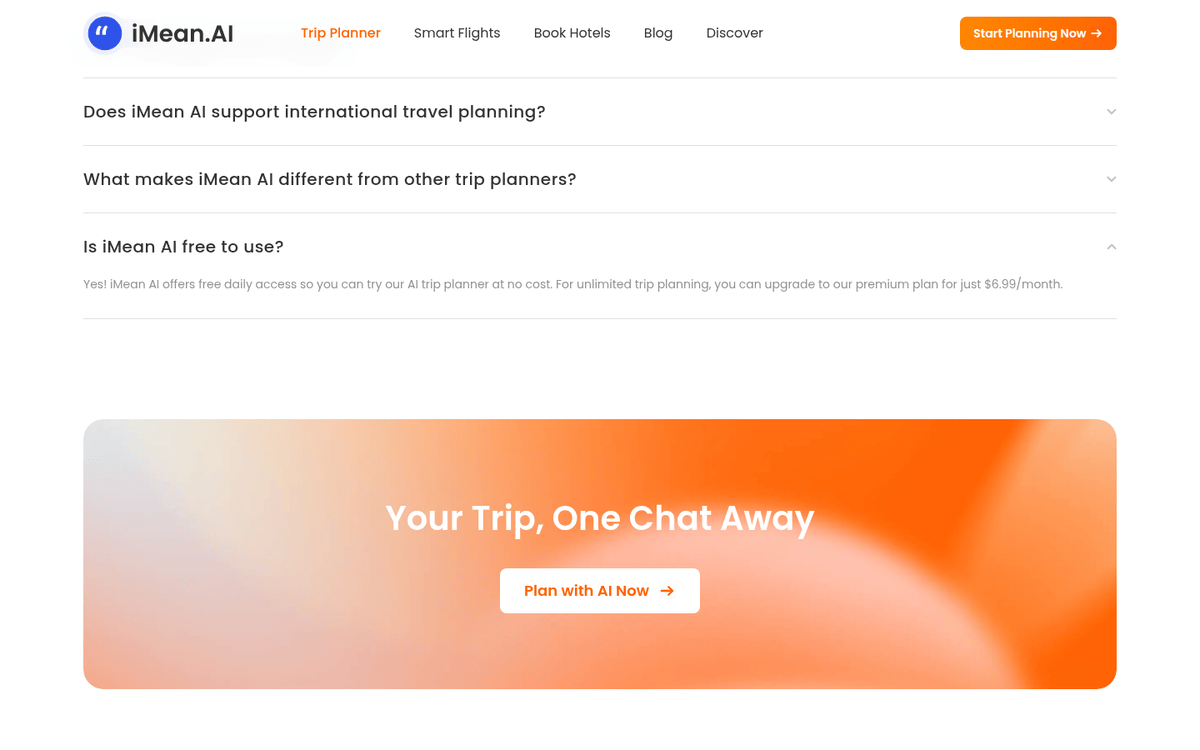
iMean AI is an AI trip planner that consolidates flight search, hotel booking, and itinerary generation into a single chat interface. The product launched as a free tool with a $6.99/month premium tier.
The premise is that travel planning is a multi-tool chore — Kayak for flights, Booking.com for hotels, a notes app for the day-by-day itinerary — and that one AI chat can do all three. Pricing data here is from imean.ai captured via Firecrawl in September 2026.
Anything that depends on a real trip — the actual savings vs. booking direct, the itinerary quality on a multi-city route, the responsiveness of the AI on a complex request — is flagged as unverified in this review.
The short version
- Entry price: the Free tier, with a daily cap the vendor does not publish.
- Only paid tier: Premium at $6.99/month, unlimited trip planning.
- What it does: flight search, hotel recommendations and a day-by-day itinerary in one chat.
- What it is not: the merchant — booking completes on the airline, the OTA or the chain.
- Where it loses: raw flight-price comparison against Kayak, Skyscanner or Hopper.
Who iMean AI is for
iMean AI is a free-and-low-cost AI trip planner for casual travelers who want a single chat interface for the boring parts of trip planning. The shape of the buyer is one of four.
You are a leisure traveler planning a one-week vacation and you do not want to spend three evenings across three apps to find a flight, a hotel, and a day-by-day plan.
You are a budget traveler who has heard that AI trip tools find cheaper flights than the legacy OTAs, and you want to test that claim without a $200/yr subscription. You are a content creator who runs a travel newsletter and needs AI-generated itinerary copy as a starting point.
Or you are a small-business owner planning a 2-3 city trip who wants one bill, one interface, one place to keep the trip details.
iMean AI is the wrong shape if your priority is the cheapest possible flight. The OTA comparison engines — Kayak, Skyscanner and Hopper — still beat AI chat on raw price comparison. It is also the wrong shape if you are a corporate travel manager with policy enforcement, expense reporting, and per-diem rules.
And if you need a hotel at a specific chain (Marriott, Hilton) with loyalty points, iMean AI will surface those hotels. The booking flow still pushes you back to the chain or the OTA — the AI is not the merchant.
The pricing ladder, in real numbers
iMean AI publishes two tiers.
Free, daily access. Free daily queries to the AI trip planner. You get the chat interface, flight search, hotel suggestions, and itinerary generation, with a daily cap on the number of trips you can plan.
The free tier is enough for one trip a week or one trip a month for casual travelers (iMean AI). The exact daily cap is not published — we have not measured it on a real account.
Premium at $6.99/month. Unlimited trip planning. Same features as Free, no daily cap. Premium is the right shape for someone planning multiple trips a year — a content creator running a travel newsletter, a frequent business traveler, or anyone whose life involves more than one vacation per quarter.
Pricing was verified against imean.ai/ in September 2026. iMean AI does not publish a separate Enterprise tier; the Premium $6.99 is the only paid plan visible. The vendor is small and the published material is closer to a marketing site than a SaaS pricing page. Treat the pricing as accurate to the public site, not as a complete enterprise story.
The refund policy on Premium is not published. Most SaaS tools at this price point offer a 7-day or 14-day refund window, but iMean AI does not state one on its public pages. Treat the $6.99 as recurring with no published money-back guarantee until the vendor states otherwise (iMean AI agent).
What iMean AI actually does
iMean AI is a chat interface that takes a trip request and returns three things: a flight set, a hotel set, and a day-by-day itinerary.
The flight search is the most interesting of the three. You give the AI a request — “cheapest flights from NYC to Paris in June” or “flights from SFO to Tokyo with one stop” — and it returns a curated list of options.
The mechanism is presumably a query against an underlying flight data source (the GDS, an aggregator like Skyscanner, or a partnership with a booking platform). The output is presented as a recommendation, not a search-results page.
The hotel search works the same way. You say “4-star hotels in Bangkok under $49” and the AI returns a curated list. The output is similarly curated, with the AI picking a short list of options it considers a match.
The itinerary generator is the third piece. You describe your trip — duration, destination, interests — and the AI returns a day-by-day plan. The plan includes suggested activities, restaurants, and timing. The output is a starting point — the AI does not know your fitness level, your food preferences, or how you feel about crowded tourist sites — but the structure is useful.
The three pieces are designed to work together. You start with a destination, get flight and hotel options, then ask the AI to generate the itinerary for the dates you booked. The single chat interface is the point.
How good the AI actually is
The vendor publishes no review aggregate we could verify, and no independent satisfaction data. The honest read here is that early adopters of AI trip tools tend to rate them generously because the wow factor is high; the rating softens as the audience widens. We have not independently measured the satisfaction rate on a real cross-section of travelers.
The interesting question is whether the AI’s recommendations are actually cheaper or better than a human’s research.
The honest answer for September 2026 is that AI trip planners are competitive on the itinerary side (the AI is faster at producing a structured day-by-day plan than a human with a guidebook). They are not consistently cheaper on flights and hotels (the AI is querying the same OTAs you would query, with the same pricing).
The two places where AI trip tools do outperform humans are personalization and aggregation. Personalization is the AI remembering your preferences across trips — kids, dietary restrictions, pace — and adjusting each plan accordingly. Aggregation is the AI reading multiple data sources at once, not just one OTA.
For a traveler who books two or three vacations a year, the time saved on itinerary generation is the real value, not the flight savings.
iMean AI vs the alternatives, head to head
The honest comparison depends on what you are trying to do.
Against Kayak. Kayak is the legacy flight and hotel aggregator. Kayak wins on raw price comparison — it queries more sources than iMean AI does, and its “Hacker Fares” and “Error Fares” alerts catch deals the AI chat will miss. iMean AI wins on the itinerary side — Kayak does not generate day-by-day plans.
The two tools complement each other: use Kayak to find the cheapest flight, use iMean AI to plan what to do once you arrive.
Against Hopper. Hopper is the mobile-first flight prediction tool. Hopper wins on price prediction — its “watch this route” feature tells you whether flight prices are likely to go up or down. iMean AI wins on the multi-modal trip planning (flights + hotels + itinerary).
For a price-sensitive leisure traveler who books one trip a year, Hopper is the better pick. For a frequent traveler who wants one interface, iMean AI is the closer fit.
Against Booking.com + a notes app. The status-quo workflow — search flights on Google, book hotels on Booking.com, write the itinerary in Apple Notes or Google Docs — is free. iMean AI wins on integration (one chat, one set of data).
The status quo wins on flexibility — you can use whichever OTA has the cheapest hotel, and you can edit your itinerary in any tool. The honest read is that for a $500 trip, the status quo is fine. For a $5,000 trip with multi-city complexity, the time saved on iMean AI is worth $6.99.
Against ChatGPT or Claude with the right prompt. A general AI with a well-crafted prompt can plan a trip. iMean AI wins on the flight and hotel data integration — the general AI is making recommendations based on training data, not on live flight prices.
For an itinerary draft or a “what should I do in Tokyo” prompt, ChatGPT is fine. For “find me a flight from SFO to Tokyo under $500 next month,” iMean AI is the closer fit.
What we could not verify
Three classes of figure in this review depend on real trip data we could not benchmark without running a live booking flow. They are flagged as unverified in this review.
The actual flight savings vs. booking direct on the airline or via an OTA. The vendor claims competitive pricing but does not publish a benchmark vs. Google Flights or Kayak. We have not measured the gap on a real route.
The AI’s itinerary quality on a multi-city or complex trip. The vendor markets single-destination trips well. The AI’s behavior on a 3-city European itinerary with different hotels each night is unclear.
The daily cap on the Free tier. The vendor does not publish the cap. We have not measured how many trip requests a Free user can make in a day before hitting the cap.
Frequently asked questions
How much does iMean AI cost?
iMean AI is free for daily access. Premium is $6.99/month for unlimited trip planning.
Does iMean AI have a free plan?
Yes. The free tier supports daily trip planning queries. Premium removes the cap.
Does iMean AI book flights?
No. iMean AI recommends flights, then directs you to the airline or OTA to complete the booking. The AI is not the merchant.
Does iMean AI book hotels?
No. The AI recommends hotels and hands you off to the booking platform rather than completing the booking itself — the vendor’s own navigation links out to hotel booking. The hand-off is part of the product surface, not a missing feature. The AI does not process payments.
Can iMean AI handle multi-city trips?
Yes, in principle. The chat interface accepts complex trip requests. We have not measured the quality on a 3+ city itinerary.
Does iMean AI work on mobile?
Yes. The vendor describes a responsive web app that works in mobile browsers; no native iOS or Android app is published. The chat interface adapts to small screens.
Can I save my trip for later?
Yes. The chat interface maintains a history of your trip requests. You can return to a previous conversation, refine the AI’s suggestions, and continue planning without starting over. Saved trips are stored against your account email; the retention period on free vs. premium tiers is not published.
Does iMean AI track flights for me?
Yes, indirectly. You can ask the AI to “watch this route” or “let me know when prices drop” for a specific flight query. The mechanism is the AI re-running the search on a schedule and emailing you when the price changes. We have not measured the latency between a price drop and the alert.
Can I book a hotel through iMean AI?
No. iMean AI recommends hotels, then directs you to the underlying booking platform — Booking.com, Expedia, the hotel’s own site — to complete the booking. The AI does not process payments. This is a deliberate design choice — the AI is a recommendation layer, not a merchant.
Does iMean AI cover all destinations?
Yes, in principle. The flight and hotel search works for any commercial route and any bookable hotel. Coverage gaps exist for very small regional airports, very new hotels that have not yet been indexed by the underlying booking platforms, and some budget airlines that do not distribute through GDS or aggregators.
iMean AI vs Kayak — which is better for finding the cheapest flight?
Kayak. Kayak queries more flight sources than iMean AI, and its Hacker Fares and price alerts catch deals the AI chat will miss. iMean AI is the right tool for itinerary generation and multi-modal trip planning, not for raw price comparison.
Is iMean AI’s Premium worth it for one trip a year?
No. The Free tier is enough for one trip. Premium at $6.99/mo is the right pick for someone booking 3+ trips a year, a content creator running travel newsletters, or a frequent business traveler.
Can I trust iMean AI’s hotel recommendations?
Yes, with verification. The AI queries booking platforms and recommends options that match your criteria. Before booking, check the hotel’s reviews on the underlying platform (Booking.com, Expedia, etc.) to confirm the AI’s curation matches your standards.
Does iMean AI support group travel?
Yes. The chat interface accepts group trip requests. For complex group bookings with 6+ travelers on different flight preferences, the AI is less effective than a human travel agent with GDS access.
How long does it take to plan a trip with iMean AI?
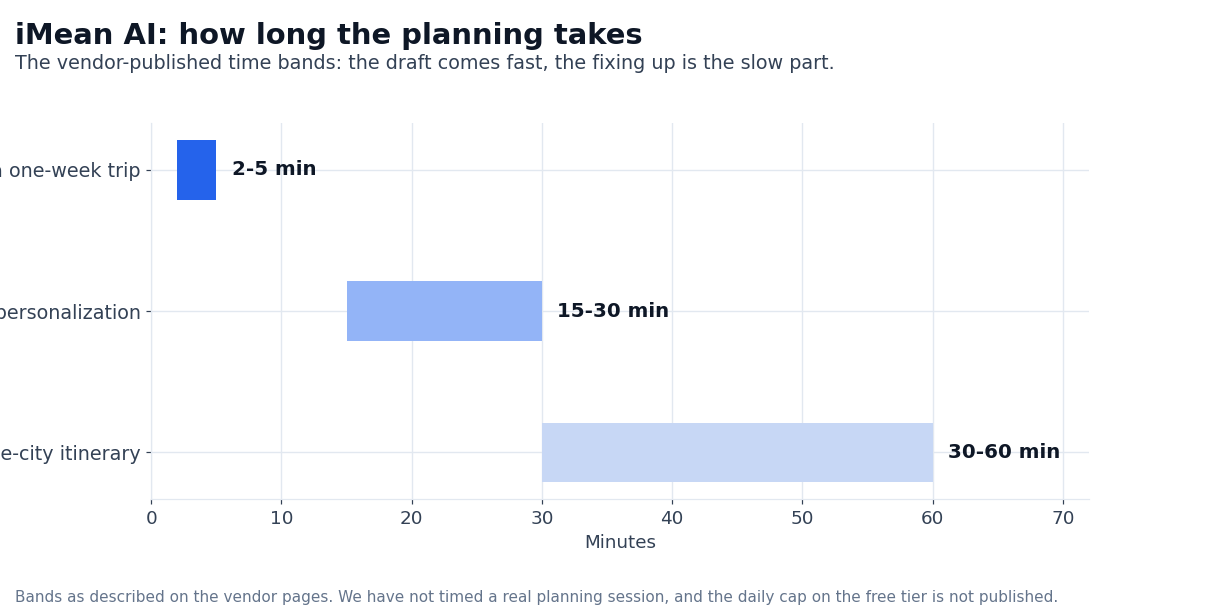
For a single-destination one-week trip, the AI returns a flight set, hotel set, and day-by-day itinerary in 2-5 minutes. The editing and personalization takes another 15-30 minutes. For a 3-city European itinerary, expect 30-60 minutes of editing.
How we put this together: the two plan tiers, the $6.99 premium price, the feature descriptions and the time bands come from imean.ai and imean.ai/agent, read in September 2026. We have not run a premium account.
Figures that depend on a real workload, a real target or a real integration are flagged where they appear in the text rather than being estimated.
Disclosure: this article contains affiliate links. If you buy through them we may earn a commission at no extra cost to you. Commission never changes our scoring or the order of a ranking.