Local Falcon is the local-SEO rank tracker that prices on credits, where one credit is one map pin in a geo-grid scan. The platform’s headline push in the 2026 cycle is AI Visibility tracking — monitoring how a business appears across ChatGPT, Gemini, Google AI Overviews, Google AI Mode, and the Local Map Pack.
The published pricing runs Starter at $24.99/mo for 7,500 credits, Basic at $49.99/mo for 15,150 credits, Pro at $99.99/mo for 31,250 credits. Premium at $199.99/mo for 63,150 credits, with annual up-front discounts that bring the same plans down to $299.88, $599.88, $1,199.88, and $2,399.88 per year respectively.
This review is what an editorial team looks at before recommending Local Falcon to a local SEO agency running multiple small-business clients, a multi-location brand tracking hundreds of storefronts, or an SEO consultant evaluating the local-rank-tracking category.
We walk through the credit model, the four published tiers, the AI Visibility surface, the MCP server, and the honest places where Local Falcon is not the best fit. Pricing comes from localfalcon.com captured via Firecrawl. Anything that requires a paid account to verify on real grid scans is flagged as unverified in this review.
Entry Starter at $24.99/mo for 7,500 credits, or $299.88 paid annually up front.
Volume Premium at $199.99/mo for 63,150 credits, 7.5% off on annual.
Unit one credit is one map pin, so a 9×9 grid costs 81 credits and a 21×21 grid 441.
AI surfaces ChatGPT, Gemini, Google AI Overviews and Google AI Mode, per location.
Stops at citation building, and the one-time audit a free tool already covers.
Who Local Falcon actually fits
Local Falcon is the local-SEO tool that bets on a credit model rather than a seat model. The unit of billing is the map pin in a geo-grid scan; a 5×5 grid costs 25 credits, a 9×9 grid costs 81 credits, a 21×21 grid (the largest published) costs 441 credits. The choice between tiers is the volume of credits a buyer expects to burn through in a billing cycle.
Three audiences that genuinely fit. First, local SEO agencies running multiple small-business clients. The credit model scales with the agency’s scan volume. A single Starter account at $24.99/mo with 7,500 credits can cover several small-business clients if the scans are weekly and the grid sizes are modest (5×5 to 7×7).
Second, multi-location brands tracking hundreds of storefronts. The Premium tier at $199.99/mo with 63,150 credits covers the largest published grid scans at scale; for brand-side tracking of 100+ locations with weekly 9×9 grids, the Premium math works. Third, AI-search-aware SEO consultants.
Local Falcon publishes an AI Visibility surface that tracks rankings across ChatGPT, Gemini, Google AI Overviews. Google AI Mode at the location level, and BrightLocal has since added a local AI visibility tracker to its entry Track plan. For an SEO consultant advising clients on the AI-search shift, that surface is the reason to look at Local Falcon.
Two audiences that should probably look elsewhere. First, a single-location business owner who needs a one-time audit. Local Falcon’s credit model assumes recurring scans; a one-time audit is over-bought at the Starter tier.
A free audit tool (Google Business Profile audit, free trials of BrightLocal or Whitespark) is a better fit. Second, brands whose primary local-SEO need is citation building. Local Falcon does ship “Find Relevant Citations” but the product is a rank tracker first, not a citation builder.
A brand whose SEO backlog is mostly NAP consistency and citation cleanup should evaluate Whitespark or BrightLocal first.
The credit model, explained
Local Falcon’s billing unit is the credit. One credit = one map pin in a geo-grid scan. The grid is the rectangle of points around a center coordinate; the larger the grid, the more credits the scan costs.
| Grid size | Credits per scan |
|---|---|
| 3×3 | 9 |
| 5×5 | 25 |
| 7×7 | 49 |
| 9×9 | 81 |
| 11×11 | 121 |
| 13×13 | 169 |
| 15×15 | 225 |
| 17×17 | 289 |
| 19×19 | 361 |
| 21×21 | 441 |
The published usage guide says the average user tracks about 10 keywords per location. A weekly 9×9 grid on 10 keywords for one location consumes 10 × 81 = 810 credits per week, or roughly 3,240 credits per month.
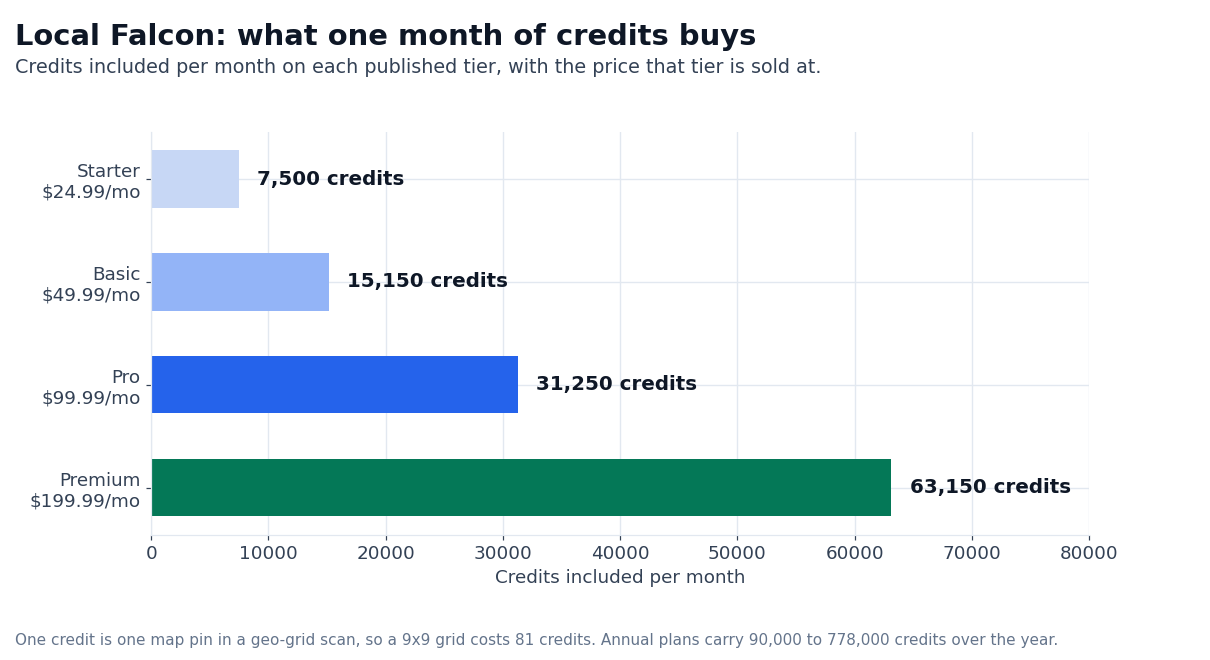
A monthly account on Starter at $24.99/mo with 7,500 credits covers about 2 locations at that usage profile. The Premium tier at 63,150 credits covers about 19 locations.
The credit model is not the only variable. Falcon AI analysis on a scan report costs 25 credits per report. The Sales Enablement tool costs 1 credit per lookup. Pay-as-you-go credits are available at $0.05/credit, never expire, and can be purchased in addition to the monthly or annual package.
Credit expiration is per billing cycle. Monthly plan credits expire at the end of each month; annual plan credits expire at the end of each year. A buyer who under-uses a monthly plan loses the unused credits at month-end; a buyer on an annual plan has the same rollover pattern at year-end.
There is no published mechanism for carrying over monthly credits, but the annual plans effectively give 12 months of credit accumulation.
The pricing reality: four tiers, monthly or annual
Local Falcon runs a Starter / Basic / Pro / Premium ladder with monthly or annual billing. The annual up-front pricing is published at a meaningful discount versus the monthly equivalent.
| Plan | Monthly | Annual up-front | Monthly credits | Annual credits | Savings on annual |
|---|---|---|---|---|---|
| Starter | $24.99/mo | $299.88/yr | 7,500 | 90,000 | ~0% |
| Basic | $49.99/mo | $599.88/yr | 15,150 | 183,000 | 1.5% |
| Pro | $99.99/mo | $1,199.88/yr | 31,250 | 383,000 | 6% |
| Premium | $199.99/mo | $2,399.88/yr | 63,150 | 778,000 | 7.5% |
The annual plans are not as steep a discount as some SaaS competitors (Buffer’s published annual discount is 20%); Local Falcon’s annual plans save between 0% (Starter) and 7.5% (Premium). The honest read is that the annual plans exist for budget predictability more than for savings.
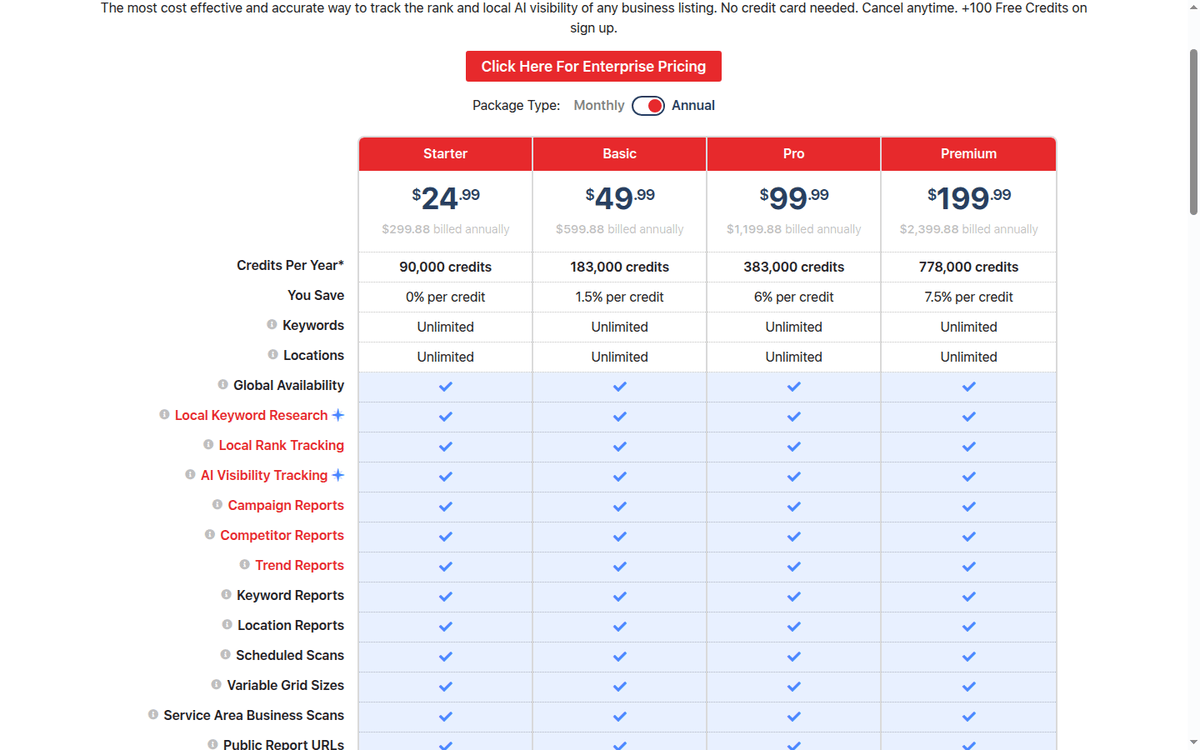
The Starter plan’s 0% savings is essentially the same price for monthly or annual — $24.99/mo vs $24.99/mo annualized. Basic saves ~1.5% on annual ($50/mo monthly vs $49.99/mo annual). Pro saves ~6% ($100/mo monthly vs $99.99/mo annual). Premium saves ~7.5% ($200/mo monthly vs $199.99/mo annual).
Enterprise plans run $499-$4,999/mo for 159,500-1,668,000 monthly credits, or $5,988-$59,988/yr for 1,974,000-21,180,000 annual credits. Enterprise pricing is on a separate page (/enterprise-pricing).
Trial: 100 free credits on signup, no credit card required. Trial credits are one-time; they do not renew each billing cycle.
Additional costs beyond the subscription:
- Pay-as-you-go credits: $0.05/credit, never expire.
- Falcon AI analysis: 25 credits per report.
- Sales Enablement tool: 1 credit per lookup.
- On-demand API: $199/mo + $0.0032/request.
- Looker Studio + Zapier + n8n integrations: free with Basic monthly or Starter annual.
- Local Falcon MCP server (Claude connector): free with any subscription.
AI Visibility: the 2026 differentiator
The AI Visibility tracking surface is the most consequential new feature in the 2026 local-SEO category.
The published framing: “Local Falcon’s local rank tracking and local AI search visibility tracking provides the data needed to improve brand visibility across generative AI answer engines and traditional local search results.
It monitors how a business shows up, at the location level, across ChatGPT, Gemini, Google AI Overviews, Google AI Mode. The Local Map Pack.”
The local-SEO category has historically tracked three surfaces: Google Maps (the Local Map Pack), Google Search (the organic results), and Apple Maps. The 2026 shift adds four more surfaces: ChatGPT, Gemini, Google AI Overviews, and Google AI Mode.
The AI-search volume is growing; for local-intent queries (“plumber near me,” “best dentist in [city]”), AI Overviews and Gemini citations are increasingly the answer the user sees first.
Local Falcon’s AI Visibility surface lets a local SEO agency track whether a client’s business appears in those AI answers at the location level. The tracking is per-keyword, per-location, per-AI-surface. The published product pitch is that the agency gets visibility into the AI-search surface alongside the traditional local-search surface, on the same credit model.
The competitive landscape on this surface is sparser than on the classic map-pack trackers. BrightLocal has since added a local AI visibility tracker to its entry Track plan, which is the first direct rival to this surface; Whitespark publishes nothing comparable as of the captured pages.
Yext runs its own AI-search surface, but it is bundled into Yext’s broader listings-management product rather than sold as a standalone rank tracker. For an SEO consultant advising clients on the AI-search shift, Local Falcon’s AI Visibility is the more developed of the two published products in the category.
The MCP server: a quiet differentiator
Local Falcon publishes an MCP (Model Context Protocol) server that lets Claude or another MCP-compatible AI agent initiate scans and pull reports from Local Falcon directly. The published product framing: “There’s no additional charge to use the Local Falcon Claude Connector.
Keep in mind, however, that initiating scans through Claude draws from your Local Falcon credits just as they would if run directly through the platform. Pulling reports, reviewing existing data, and other account lookups don’t consume credits.”
The MCP integration is operationally meaningful. An SEO consultant who runs Local Falcon + Claude can ask “scan the top 5 keywords for [client] at the 9×9 grid and tell me which keyword dropped” without leaving the Claude interface. The scan consumes credits; the report query does not.
Local Falcon is the only local-SEO tool with a published MCP server as of the captured page. For an agency already running Claude (or another MCP-compatible agent) as the operational layer for client reporting, the MCP server is a workflow accelerator that no other local-SEO tool publishes at the same price point.
Where Local Falcon earns it
Three workloads where Local Falcon is the strongest published option. First, local SEO agencies running multiple small-business clients.
The credit model scales with the agency’s scan volume, the AI Visibility surface is one of only two published in the category, and the MCP server lets the agency operationalize the scans through Claude. Second, multi-location brands tracking hundreds of storefronts.
The Premium tier at $199.99/mo with 63,150 credits covers the largest published grid scans at scale; brand-side tracking of 100+ locations with weekly 9×9 grids is the sweet spot.
Third, AI-search-aware SEO consultants who want to track ChatGPT, Gemini, Google AI Overviews, and Google AI Mode alongside the traditional local surfaces.
The AI Visibility surface is the differentiator, and the published API + MCP server + Looker Studio + Zapier + n8n integration stack means the data flows into the consultant’s existing reporting surface.
For these workloads, the math is anchored on the credit model. A buyer who under-uses the monthly credits loses them at month-end; a buyer on an annual plan pays roughly the same effective rate but with 12 months of credit accumulation. Pay-as-you-go credits at $0.05/credit are the safety valve when the monthly allocation is exhausted.
Where Local Falcon is not the right pick
Three workloads where a different tool is the better fit. First, single-location business owners who need a one-time audit. Local Falcon’s recurring credit model is over-bought at the Starter tier for a one-time audit; BrightLocal’s free trial or Whitespark’s free report generator is a better fit.
Second, brands whose primary local-SEO need is citation building. Local Falcon ships “Find Relevant Citations” but the product is a rank tracker first; a brand whose SEO backlog is NAP consistency and citation cleanup should evaluate Whitespark’s citation service or BrightLocal’s citation tracker first.
Third, enterprise multi-location brands whose scan volume exceeds 1.668M credits/mo on the Premium annual-equivalent tier.
The published Enterprise tier tops out at 1,668,000 monthly credits (or 21,180,000 annual credits); brands running daily 21×21 grids across thousands of locations may need to negotiate a custom contract above the published Enterprise ladder.
The comparison angles
Local Falcon vs BrightLocal. BrightLocal is the dominant local-SEO suite with a broader product surface: citation tracking, review monitoring and local rank tracking.
BrightLocal’s published pricing starts higher than Local Falcon’s: the entry Track plan is $31/mo billed annually and the Manage tier that carries the deeper tracking is $40/mo, against Local Falcon’s $24.99/mo.
Local Falcon wins on price, AI Visibility tracking, and the MCP server. BrightLocal wins on product breadth and brand recognition in the local-SEO category.
Local Falcon vs Whitespark. Whitespark is the local-SEO specialist focused on citation building and reputation management. Whitespark’s pricing is on a per-citation or per-package basis for citation services; the local rank tracker is a separate product. Local Falcon wins on the all-in-one scan model; Whitespark wins on the citation service depth.
Local Falcon vs Yext. Yext is the enterprise listings-management platform with AI-search products. Yext does not publish a list price for its AI-search products, so the two are hard to compare on cost. Local Falcon wins on the SMB/mid-market price point; Yext wins on the enterprise listings-management depth.
A credit-budget walkthrough
The credit model is best understood through a worked example. The buyer picks a grid size, the number of keywords per location, and a scan cadence. The product is the consumption.
One location, weekly cadence. 10 keywords × 9×9 grid × 4 scans/month = 3,240 credits/month. On Starter at 7,500 credits, the buyer has headroom for occasional Falcon AI reports (25 credits each) and Sales Enablement lookups (1 credit each). On Basic at 15,150 credits, the buyer has double the headroom.
Five locations, weekly cadence. 5 × 3,240 = 16,200 credits/month. Basic at 15,150 covers this with the help of pay-as-you-go credits at $0.05/credit for the overage; Pro at 31,250 covers it without overages.
Twenty locations, weekly cadence. 20 × 3,240 = 64,800 credits/month. Premium at 63,150 is roughly breakeven; the buyer will need pay-as-you-go credits or upgrade to an Enterprise plan.
One hundred locations, weekly cadence. 100 × 3,240 = 324,000 credits/month. Premium monthly is insufficient; Enterprise at 159,500-1,668,000 monthly credits is the published range. A buyer at this scale is likely an agency running a portfolio of multi-location clients, and the per-month spend will exceed $5,000/mo on the annual Enterprise plan.
FAQ
What is a credit?
One data point, often a “map pin,” on the geo-grid scan. A 5×5 grid uses 25 credits; a 9×9 grid uses 81 credits.
Does Local Falcon offer a free trial?
100 free credits on signup, no credit card required. Credits are one-time, not recurring.
How many Local Falcon credits will I need?
Depends on grid size, number of keywords, number of locations, whether Falcon AI is on, and scan frequency. The platform publishes a Credit Explorer inside the account.
What happened to pay-as-you-go pricing?
Still available after monthly/annual quota is exhausted, at $0.05/credit. Credits never expire.
How much does Falcon AI cost?
25 credits per report, applied automatically.
How much does Falcon Agent cost?
Included free with all credit packages ($24.99+).
Do Local Falcon credits expire?
Monthly credits expire at end of month. Annual credits expire at end of year. Pay-as-you-go credits never expire.
Does using the Local Falcon Claude Connector cost anything extra?
No, but scans initiated through Claude consume credits.
Sources
- Local Falcon home — AI Visibility positioning, MCP server mention, integrations.
- Local Falcon pricing — credit model, four published tiers, Enterprise reference.
- Local Falcon local rank tracking — geo-grid scan mechanics
- Local Falcon AI visibility — AI Visibility tracking surface
- Local Falcon MCP server — Claude connector documentation
- Local Falcon Enterprise pricing — enterprise tier references
How we put this together: the tier prices, the annual up-front totals, the credit allowances and the geo-grid credit costs come from localfalcon.com/pricing and localfalcon.com/enterprise-pricing, read in September 2026. We have not run a paid Local Falcon account.
Disclosure: this article contains affiliate links. If you buy through them we may earn a commission at no extra cost to you. Commission never changes our scoring or the order of a ranking.