Every feature is switched on from the first paid tier, the trial runs thirty days without a card, and the same ladder starts at 500 contacts and runs to 1,000,000 on a quote.
Moosend sells the one thing a small email list actually wants: a $7-per-month plan with every feature switched on, and a 30-day trial that does not ask for a card.
From a small team of email marketers in Greece, the platform built its reputation on the simplest pricing ladder in the category.
Pro starts at $7 per month on annual billing (up to 500 subscribers), the platform includes a 30-day free trial with no credit card, and the published tier ladder scales from a 500-contact side project to a 1M-contact enterprise on quote. Moosend+ (the plan tier above Pro) bundles advanced features for medium-sized businesses.
Enterprise custom quotes add SSO, SAML, transactional emails, dedicated IPs, and an account manager. Customers cited on the pricing page include HPE, Sephora, and Domino’s.
This review is what an editorial team looks at before recommending Moosend to a small business owner, an ecommerce brand on Shopify, or a B2B marketer who needs landing pages and subscription forms but does not want the Mailchimp price tag.
It sits with the rest of our SaaS and business tools coverage.
We walk through the platform shape (Pro + Moosend+ + Enterprise, landing pages, subscription forms, automation templates, SMTP and transactional email) and the pricing reality (Pro at $7/mo annual up to 500 subscribers with the feature set included, plus the email-credits add-on).
The contact-tier economics for a 1,000-, 5,000- and 25,000-list are in the pricing section below, and the head-to-head with Mailchimp, Klaviyo, ActiveCampaign, Brevo and HubSpot is in the alternatives table.
Pricing comes from moosend.com captured via Firecrawl in September 2026. The figures that would need a paid account to measure on a real campaign send are collected at the end of this review rather than filled in with an estimate.
What the platform does out of the box
Moosend runs three publishing surfaces plus the plan ladder. The first is the Email Campaign Builder — the standard newsletter and promo-send workflow with templates, drag-and-drop blocks, image hosting, and a small library of pre-tested designs.
The second is the Automation Workflow Builder — a visual flow editor for sign-up welcome sequences, abandoned-cart recovery, post-purchase follow-up, win-back, and the rest of the standard ecom flow library.
Whether the platform’s builder or a general-purpose automation tool is the better home for those flows is the same question our Make.com review works through. The automation recipes ship pre-built per use case.
The third is the Landing Page Builder — a hosted landing-page product with form integration, A/B testing, and direct integration with the email platform. The subscription form builder sits alongside.
Beyond those, the platform ships Transactional as a separate add-on via SMTP or a dedicated API. The transactional product covers password resets, order confirmations, shipping notifications, and any other send-the-receipt use case. Pricing on transactional is per send.
The 2026 product also has a “Social AI” surface — a published add-on that connects a Moosend account to a social scheduling layer for cross-channel publishing. Pricing for Social AI sits on the public pricing page; what the AI layer actually writes is on the list of things this review does not measure.
Pro, Moosend+ and Enterprise on one ladder
Moosend runs a single published Pro plan, a Moosend+ plan for medium businesses, and Enterprise quote. The plan tier is gated by feature. Pro includes the full feature set for solo senders and small businesses; Moosend+ adds advanced features for mid-market; Enterprise adds SSO, SAML, transactional volume, dedicated IPs, and an account manager.
| Tier | Use case | Pricing | Features |
|---|---|---|---|
| Pro (annual) | Solo / small business, up to 500 subscribers | $7/mo annually (Save 20%) | Unlimited campaigns, automation, landing pages, forms, SMTP, transactional |
| Pro (biannual) | Same, biannual billing | $8/mo biannually (Save 15%) | Same |
| Pro (monthly) | Same, monthly billing | $9/mo monthly | Same |
| Pro tier pricing for 1,000 subscribers | Growing list | Scales per contact; UI selector on the pricing page | Same feature set |
| Pro tier pricing for 5,000 subscribers | Mid-market | Scales per contact | Same feature set |
| Pro tier pricing for 25,000 subscribers | Larger list | Scales per contact | Same feature set |
| Moosend+ | Mid-market bundling | Custom | Advanced features for medium-sized businesses |
| Enterprise | High volume + procurement | Custom | SSO, SAML, transactional at volume, dedicated IPs, account manager, priority support, custom reports |
The Pro pricing is the workhorse: published at $7/mo on annual with a 20% discount, $8/mo on biannual with a 15% discount, and $9/mo on monthly. Biannual and annual billing is the more cost-efficient path.
Moosend+ is the bundling tier for medium-sized businesses. The published pricing page does not list a per-month dollar amount for Moosend+; the contact-tier is set on the same UI selector, and the Moosend+ add-on is added on top.
Enterprise adds what procurement teams at larger companies usually need:
- SSO
- SAML
- transactional volume
- dedicated IPs
- account manager
- the custom reports surface
Beyond the plan tier is the email-credits add-on:
| Pack | Credits | Price |
|---|---|---|
| 350,000 credits | 350,000 emails | $350 |
| 500,000 credits | 500,000 emails | $500 |
| 750,000 credits | 750,000 emails | $750 |
| 1,000,000 credits | 1,000,000 emails | $1,000 |
Email credits are the additional sends beyond what the plan tier covers. Most small-business senders stay inside the Pro plan allotment. Senders running high-volume transactional or one-off broadcast campaigns buy credit packs.
A note on the published contact-tier ladder. The Moosend pricing page shows a contact-size selector that runs from 500 to 1,000,000 contacts, in uneven steps.
The published Pro price of $7/mo applies to the 500-contact step. Above that, the dollar amount scales per contact; the exact math for each step is visible on the pricing UI when a subscriber count is selected.
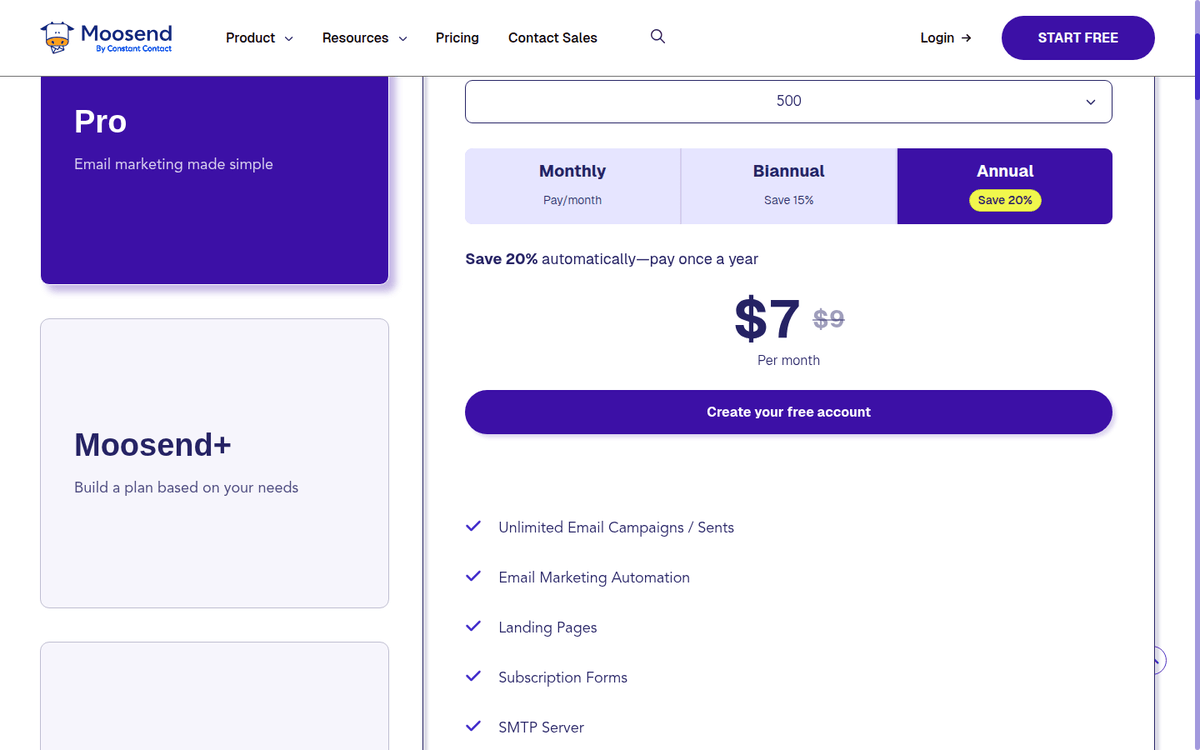
We did not buy an account to read every step off the selector. The dollar amounts a brand pays from 1,000 up to 100,000 contacts are the ones this review states only where the vendor publishes them, and the rest stay unmeasured.
The customer logos (HPE, Sephora, Domino’s) are from the pricing page and represent enterprise case studies; we did not cross-validate the customer mix through a third-party source.
The features Pro ships with
Pro is the full feature set. We list the shape here so the rest of the review lands in context.
Unlimited email campaigns / sends. Pro plans include unlimited sends inside the contact allotment. The published Pro marketing emphasizes “send as many campaigns as you need” — the limit is on contacts and on email credits, not on campaigns.
Email Marketing Automation. The visual workflow builder with the standard recipe library:
- sign-up welcome
- abandoned cart
- post-purchase
- browse abandonment
- win-back
- anniversary
Landing Pages. Hosted, drag-and-drop landing pages with form integration, A/B testing, and direct hand-off into the email campaign builder.
Subscription Forms. Embedded and popover forms for newsletter capture, with the same form library on every plan.
SMTP Server. A standard SMTP relay for transactional sends at low volume. High-volume transactional use moves to dedicated IPs on Enterprise.
Transactional Emails. Separate API or SMTP path for receipts, password resets, shipping notifications. Pricing on volume is per send.
SSO & SAML. Enterprise only. SSO via Okta, Azure AD, Google Workspace, or any SAML 2.0 provider.
Account Manager. Enterprise only. A named human accountable for the account, the renewals, and the design partnership.
The feature parity between the three plans is what makes the pricing story work. Pro is the workhorse; Moosend+ adds the mid-market features; Enterprise adds the procurement pieces. No plan on the vendor’s own pricing page gates a standard email-marketing feature behind a higher tier.
The three workloads where it wins
Three workloads where Moosend is the strongest available option. First, small business and side-project email marketing on a budget. Pro at $7/mo annual for up to 500 subscribers is the most cost-efficient published tier in the category.
A newsletter that ships weekly and is targeting a 500–2,500 subscriber list will run comfortably on Pro. Second, ecommerce brands on a budget running Shopify or WooCommerce who want abandoned cart and post-purchase sequences without the Klaviyo price tag. The automation library covers the standard ecom flows.
Third, mid-market senders who need a Custom plan and Enterprise features (SSO, SAML, transactional volume) but do not want a Mailchimp or HubSpot price. Moosend Enterprise is the cost-efficient mid-market alternative.
For these workloads, the per-subscriber math is the clearest in the category. The published $7/mo anchor at 500 subscribers is the entry price. A 1,000-subscriber brand pays $13/mo on annual billing ($16/mo monthly). A 5,000-subscriber brand pays $38/mo on annual billing ($48/mo monthly).
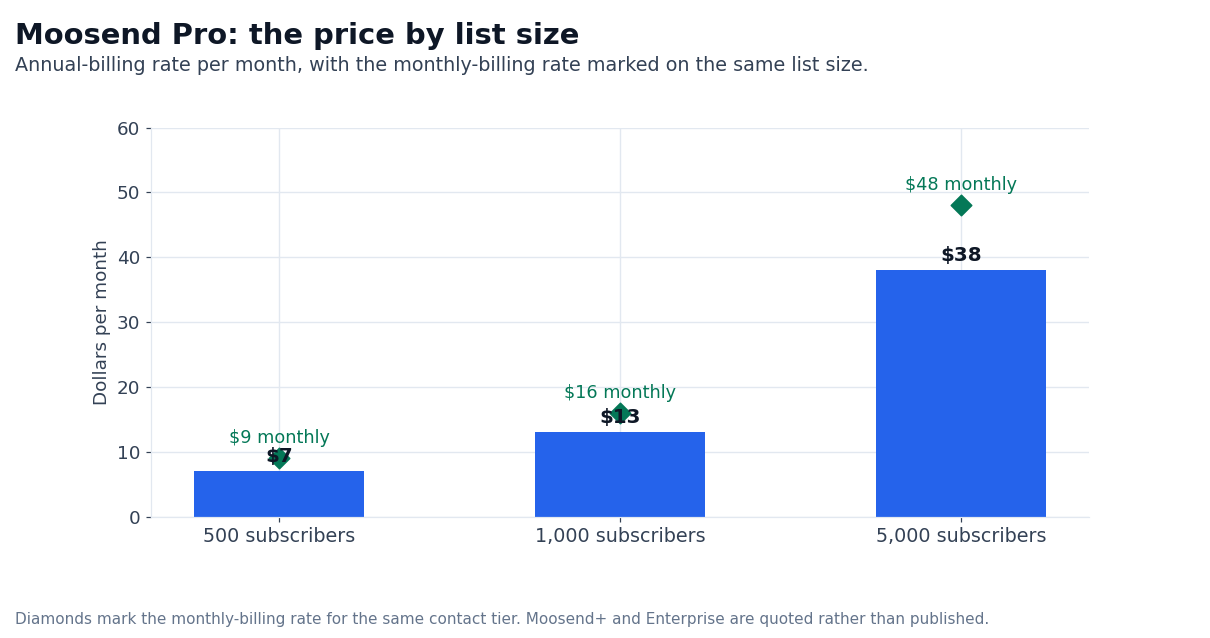
Compared to Mailchimp’s Standard tier (where the per-subscriber cost climbs faster), the platform is the cost-efficient pick for the small-to-mid market.
Three workloads where Moosend is not the best fit, in the same order. First, high-volume ecommerce brands with AI-segment orchestration.
The automation library covers the standard ecom flows; Klaviyo ships deeper ecommerce-specific orchestration:
- predicted LTV segments
- AI subject-line generation
- AI send-time optimization
- integration with every major ecom platform at schema-level
A Shopify brand doing $1M+ revenue that needs AI-segment orchestration should look at Klaviyo. Second, large enterprise senders with strict deliverability requirements. The platform’s deliverability tools are basic.
Enterprise senders with strict inbox-placement rates (financial services, healthcare) should benchmark Moosend’s actual deliverability on a real campaign of their own first. Third, senders who need a full marketing automation platform including SMS, push, and advanced segmentation.
Moosend is email-first. ActiveCampaign, HubSpot, and Brevo cover the broader marketing-automation category at higher price tiers.
Moosend against Mailchimp, Klaviyo and Brevo
| Vendor | Differentiator | Best for | Watch out for |
|---|---|---|---|
| Moosend | Simplest pricing, Pro at $7/mo annual, all features included | Small business + budget-conscious mid-market, side projects | Less depth in ecommerce automation, basic deliverability tools |
| Mailchimp | Industry standard, deepest integrations, brand recognition | Established SMB senders, brand-name procurement | Pricing climbs fast over 500 contacts; Standard tier higher per-subscriber |
| Klaviyo | Ecommerce-first automation, AI segments, schema-level integrations | Shopify brands doing $1M+ revenue | Pricing climbs fast at scale; not for non-ecommerce senders |
| ActiveCampaign | Deepest automation builder in the category, CRM add-on | Senders who need automation depth + CRM | Higher per-tier prices; CRM is an add-on |
| Brevo (Sendinblue) | Generous free tier, transactional + marketing unified | Senders who mix transactional + marketing | SMS is a paid add-on; UI dated |
| HubSpot | Full marketing automation platform with CRM | B2B senders, mid-market and enterprise | Most expensive; complex to set up at the entry tier |
The honest comparison in 2026: Mailchimp wins for brand recognition and integration depth. Klaviyo wins for high-volume ecommerce orchestration. ActiveCampaign wins for automation depth on the non-ecommerce side. Brevo wins for transactional + marketing unification. HubSpot wins for full marketing-automation suites.
The platform wins for the simplest pricing on the small-to-mid-market email-marketing use case.
What the pricing page does not say out loud
The published ladder is unusually candid for the category: three Pro price points, a contact-step selector with named steps, and credit packs priced in dollars.
The pricing clarity (Pro / Moosend+ / Enterprise + email credits), the no-card 30-day trial, the feature parity across the published tiers and the HPE / Sephora / Domino’s case studies carry most of the procurement story on their own. SSO, SAML and transactional volume on Enterprise close it for a small-to-mid-market email marketing buy.
The honest version is on the deliverability surface. Moosend’s published deliverability tools cover the basics:
- authentication (SPF, DKIM, DMARC)
- bounce handling
- suppression lists
- ISP feedback loops
They do not cover the more advanced deliverability features (engagement-based sending, AI subject-line optimization for deliverability, advanced inbox placement testing) that Mailchimp and ActiveCampaign ship at higher tiers.
A sender with a strict inbox-placement requirement (financial services, healthcare, government) should run a live campaign on a small list before scaling up.
The second honest version is on the automation depth. The Moosend automation library covers the standard ecom flows. It does not cover the AI-segment orchestration (predicted LTV, AI send-time, AI subject-line) that Klaviyo ships for ecommerce. A Shopify brand doing $1M+ revenue with specific AI-segment needs will find Moosend’s automation library too thin.
The numbers a paid account would add
Five classes of figures in this review depend on a real Moosend account that we did not run for this piece, and we would test all five on your own list before you switch.
The first is the actual deliverability rate on your own domain. Benchmark inbox placement at 1,000–5,000 subscribers on a small list before you scale. The second is the actual dollar amount for your contact tier. The published Pro anchor is $7/mo annual for 500 subscribers.
Above that, the per-subscriber cost is visible in the pricing UI on the contact-size selector; we did not run a paid account to capture the exact tier-by-tier math. The third is the automation depth on your ecom flow library.
The published recipes cover the standard flows; we did not run a real ecom store to benchmark the custom-event coverage for non-standard Shopify themes. The fourth is the Social AI add-on: it is priced on the public pricing page, and what it produces is not something this review measured.
The fifth is transactional volume pricing on Enterprise, which is quoted per send rather than published.
FAQ: the questions buyers send us
How much does this cost per month?
The Pro plan starts at $7/mo on annual billing for up to 500 subscribers. The published pricing UI on moosend.com/pricing shows the per-subscriber scale from 1K to 1M contacts, in uneven steps. Moosend+ is a custom plan-tier for medium-sized businesses. Enterprise is a custom quote for high-volume + procurement needs.
Is the platform free?
The platform offers a 30-day free trial with no credit card required. The trial includes the full Pro feature set. After the trial, the smallest paid plan is Pro at $7/mo annual for up to 500 subscribers.
Does the platform replace Mailchimp?
For small business + budget-conscious mid-market senders, this is the cost-efficient alternative. Mailchimp wins on brand recognition and integration depth.
For senders who need advanced automation + AI segments + ecommerce integration depth, look at Klaviyo. For senders with strict deliverability requirements at scale, look at ActiveCampaign or HubSpot.
Does the platform work with Shopify?
Yes. Standard ecommerce-platform integrations for Shopify, WooCommerce, and other common platforms are supported. The published automation recipes cover the standard ecom flows. A Shopify brand with deep AI-segment orchestration needs should benchmark Klaviyo against alternatives before moving.
What is Moosend+?
Moosend+ is the plan-tier above Pro, designed for medium-sized businesses. It bundles advanced features; the exact pricing is set on the contact-tier UI. Enterprise adds SSO, SAML, transactional at volume, dedicated IPs, account manager, and the custom reports surface.
Can the platform send transactional email?
Yes. An SMTP server ships on every Pro plan for low-volume transactional. Enterprise plans add dedicated IPs and high-volume transactional API access. The pricing model is per send on the transactional side.
Does the platform have landing pages?
Yes. Landing pages are a published Pro feature on the platform. The hosted landing-page builder ships with form integration, A/B testing, and direct handoff into the email campaign builder.
Sources we read and dated
- Moosend pricing — the three-plan ladder (Pro $7/$8/$9, Moosend+ custom, Enterprise custom), contact-tier selector, email credits packs, customer logos (HPE / Sephora / Domino’s) (captured September 2026).
- Moosend features — feature parity across plans, automation library, landing pages, subscription forms (captured September 2026).
- Moosend home — company positioning and customer case studies; moosend.com/about redirects here (captured September 2026).
- Moosend vs Mailchimp — vendor-published head-to-head (referenced from pricing)
How we put this together: the Pro rate, the contact-tier steps, the trial terms and the feature list come from moosend.com/pricing and the vendor’s own product pages, read in September 2026. We have not bought a paid Moosend plan.
Figures that depend on a real workload, a real target or a real integration are flagged where they appear in the text rather than being estimated.
Disclosure: this article contains affiliate links. If you buy through them we may earn a commission at no extra cost to you. Commission never changes our scoring or the order of a ranking.