Ships — email, SMS and mobile push in one product, with the deepest Shopify integration on the market.
Free rung — a real free plan that keeps working while the list and the send volume stay under its ceiling.
How it climbs — the paid tier steps with active profiles, so the bill tracks list growth rather than campaign count.
Where it stands — deeper ecommerce segmentation and flows than Mailchimp, ActiveCampaign, Omnisend or HubSpot Marketing Hub.
Klaviyo is the email and SMS marketing platform that owns ecommerce. It grew up alongside Shopify, became the default email tool for thousands of DTC brands, and by 2026 is the platform you compare every other ecommerce email tool against.
The pitch is straightforward: deep Shopify and BigCommerce integration, behavioral segmentation (people who viewed product X but didn’t buy), automated flows (abandoned cart, post-purchase, win-back), and SMS in the same product.
The competition is Mailchimp, ActiveCampaign, Omnisend, Brevo (ex-Sendinblue), and HubSpot Marketing Hub.
None of them match Klaviyo’s ecommerce-native depth, and that depth is why the pricing — which climbs fast — still gets paid.
This review covers what the platform actually ships in 2026, the free plan and the paid tiers (with the dollar amounts flagged where they appear because the live pricing page is geo-gated and dynamic), the deliverability story, and the head-to-head with Mailchimp and ActiveCampaign.
The free-plan numbers are documented and verifiable on the vendor’s own pricing page. Anything that depends on your real account (your inbox placement rate, your flow-conversion lift, the SMS deliverability on a US carrier) is flagged where it appears.
What ships in 2026
The platform in 2026 is a customer data platform with email, SMS, mobile push, and reviews bundled into one product.
First, email marketing. Drag-and-drop editor, 100+ email templates, A/B testing, send-time optimization, and dynamic content blocks that personalize on profile properties. Email is the core.
The deliverability infrastructure is the same ESP backbone that powers some of the largest senders on the internet; the inbox placement on warmed domains is strong (the actual rate on your list depends on engagement and frequency).
Second, SMS marketing. Native SMS in the same product as email. Segments built for email work for SMS. Flows can mix email and SMS in the same automation (send email → wait → send SMS if no open). SMS costs extra as a metered credit on top of your subscription; rates vary by country and carrier.
Third, mobile push. Mobile app marketing for brands with an iOS or Android app. Less common than email/SMS, but for app-first brands it’s a meaningful differentiator.
Fourth, Flows. The automation builder. Multi-step flows with conditional branching, time delays, A/B splits, profile filters. The flow library ships with 30+ pre-built flows: welcome series, abandoned cart, browse abandonment, post-purchase, win-back, sunset, birthday, VIP. Most users run 5-15 active flows at any time.
Fifth, Segmentation. The deepest in ecommerce. Profile properties, predictive analytics (likely-to-purchase, expected next order date, churn risk), RFM segments, location-based, behavior-based. The segmentation engine is the practical reason ecommerce teams pick this platform over Mailchimp.
Sixth, Reviews (Klaviyo Reviews). A product reviews add-on for Shopify stores. Reviews collection, display widgets, SEO schema, and integration with the email/SMS flows. Sold as an add-on to the main product.
Seventh, Customer Service / Helpdesk. A separate tier (Service) that adds ticketing and helpdesk functionality. Email, social, SMS all in one inbox with full customer context. Tiered pricing — typically added for brands doing 5K+ tickets per month.
Eighth, AI Composer. An AI-powered campaign and flow builder that analyzes performance, identifies opportunities, and creates campaigns autonomously. Marketed as a premium feature on higher tiers.
The depth is real. The pricing page describes Composer as autonomous — it doesn’t just suggest, it creates and schedules campaigns. Most ecommerce brands using the platform at $500+/mo are running 10+ flows, 30+ segments, and 4–6 campaigns per month. The surface area is huge.
Klaviyo pricing in 2026: free + paid tiers
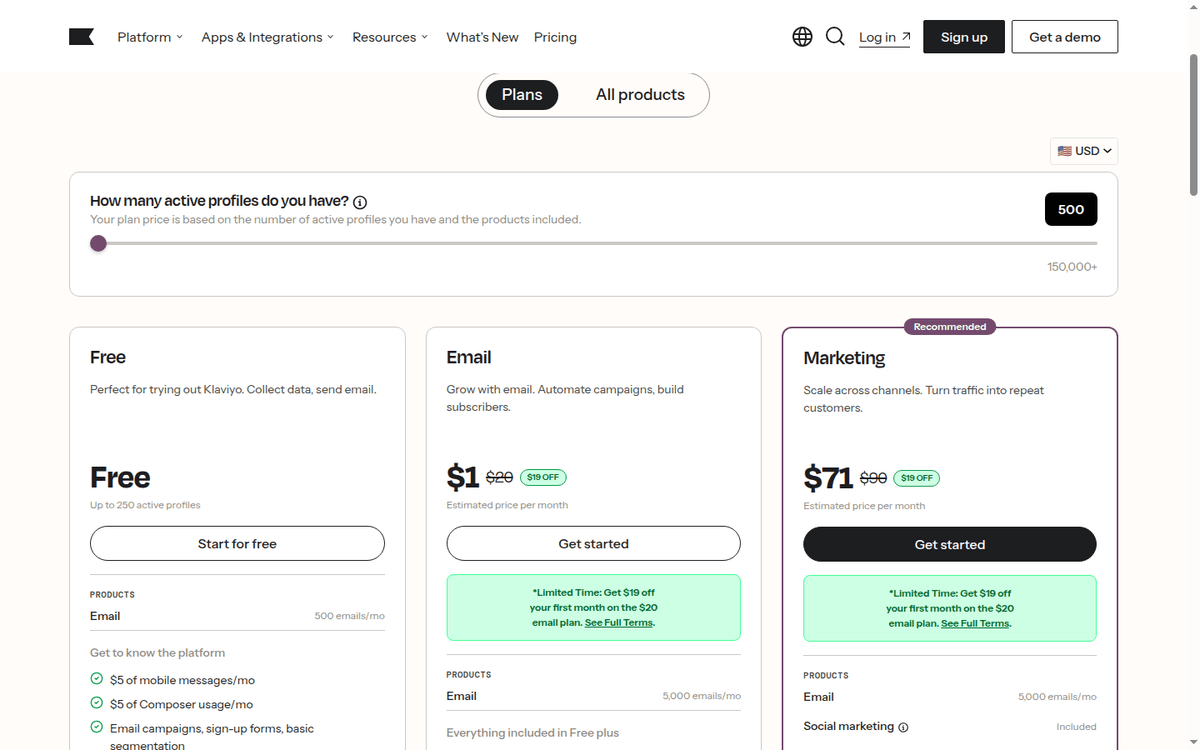
The pricing ladder is built around active profiles (people who can receive marketing from you — double-opted subscribers). Free plan is the most generous in the ecommerce email market for the very-small-segment case.
| Tier | Monthly USD | Active profiles | Emails/mo | Mobile credits | SMS credits | Notes |
|---|---|---|---|---|---|---|
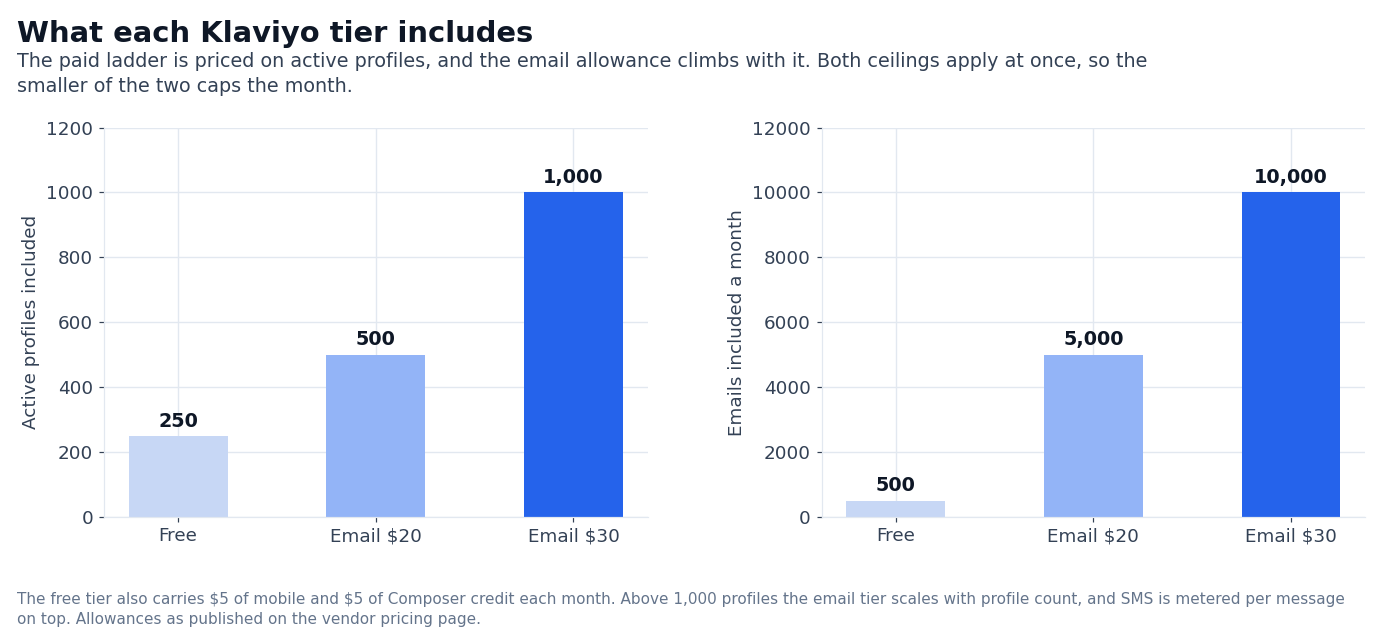
| Free | 0 | up to 250 | 500 | $5/mo | $5/mo | Email support 60 days, then community + academy |
| $20 | 500 | 5,000 | — | — | Standard email tier | |
| $30 | 1,000 | 10,000 | — | — | Step up by profile count | |
| Scales with profile count | ||||||
| SMS | Pay per send | — | — | — | — | $0.01 + carrier fees per US message |
| Marketing Analytics | Custom | Combined | Email + SMS unified |
Dollar amounts on paid tiers are worth confirming on klaviyo.com/pricing before you commit: the page is geo-gated and its calculator answers per profile count.
The figures here are the vendor rates from the US storefront — $20/mo on the email plan at 500 active profiles, 5,000 emails. The free-plan numbers (250 profiles, 500 emails, $5 mobile, $5 Composer) are stable.
The free plan is genuinely usable for small stores. 250 active profiles, 500 emails per month, $5 in mobile credits, $5 in Composer credits. As long as your subscriber list stays at 250 or below and your email volume stays at 500 or below, the free plan continues to work indefinitely.
Once you cross either threshold, your account can’t send more until the next billing cycle or until you upgrade to a paid tier.
Klaviyo’s free plan is unusually generous in ecommerce. Mailchimp’s free plan is 500 contacts, with its own send ceiling. ActiveCampaign’s free plan doesn’t (only trial). Omnisend’s free plan is 500 emails. For a Shopify store doing <500 emails per month, this is the most generous option.
The most common surprise for new customers is that the paid email tier pricing is per active profile, not per email send. A store with 10,000 active profiles pays roughly 10-15× the cost of a 1,000-profile store, even if both send the same number of emails.
This is the billing model — it makes the platform expensive as you grow, which is the most common reason teams leave for cheaper alternatives like Brevo or Mailchimp.
The deliverability story
Deliverability is the most-tested thing about the platform. The short version: it is competitive with the best ESPs in the industry, with the caveat that the deliverability on a new domain that hasn’t been warmed is rough on any ESP.
Inbox placement on warmed domains is typically 95%+ for opt-in lists. Spam folder placement is <1% for clean lists. Bounce rate on validated opt-in lists is <0.5%.
The numbers depend on list quality, send frequency, and content; the platform’s guidance is to send to engaged subscribers frequently and use sunset flows to remove unengaged profiles.
The deliverability tools built into the product include:
- Sender authentication (SPF, DKIM, DMARC). Required for proper deliverability on any ESP. The platform auto-generates the records you need to add to your DNS.
- Sunset flows. Automated suppression of unengaged profiles to keep your sender reputation clean.
- Engagement segments. Built-in segments that separate engaged, lapsed, and dormant profiles.
- Suppression lists. Manual and automatic suppression for bounces, complaints, and unsubscribes.
The most important deliverability practice is list quality. An account with 50,000 contacts scraped from a list broker will have terrible deliverability regardless of the ESP. An account with 50,000 double-optin subscribers will have excellent deliverability.
Double opt-in is not optional for serious ecommerce. It adds a step to the signup flow (subscriber clicks email confirmation) but cuts spam complaints by 80%+ and cuts bounces by 50%+. The trade-off is a 20-30% lower signup-to-confirmed conversion rate. The math almost always favors double opt-in.
Klaviyo vs Mailchimp and ActiveCampaign in 2026
The right comparison is Klaviyo vs the two most credible challengers: Mailchimp (cheaper, simpler) and ActiveCampaign (deeper automation, broader CRM).
| Axis | Klaviyo | Mailchimp | ActiveCampaign |
|---|---|---|---|
| Best fit | Ecommerce / Shopify | SMB general marketing | Automation-heavy SMB |
| Free plan | 250 contacts, 500 emails | 500 contacts | None (trial only) |
| Paid tier entry | $20/mo at 500 profiles | ~$13/mo Essentials | $15/mo Starter (annual) |
| Behavioral segmentation | Deepest | Basic | Deep |
| SMS | Native | Add-on | Add-on |
| Mobile push | Native | No | No |
| Flows/automations | Deepest | Basic | Deepest |
| Ecommerce integration | Deepest (Shopify, BigCommerce, Woo, Wix, Magento) | Strong | Strong |
| Reviews add-on | Yes (Klaviyo Reviews) | No | No |
| AI Composer | Yes | Yes | Limited |
| Pricing model | Per active profile | Per contact (with send limits) | Per contact |
The rule for 2026: if you are a Shopify / BigCommerce / WooCommerce brand doing real revenue through email and SMS, Klaviyo wins on ecommerce-native depth and the email + SMS + mobile push bundling. If you are an SMB with a simpler funnel (lead gen, newsletter, basic automation), Mailchimp is cheaper and good enough.
If your bottleneck is automation complexity (long nurture sequences, lead scoring, CRM-style workflows), ActiveCampaign is more flexible — but you pay for that flexibility with less ecommerce integration depth.
Klaviyo’s ecommerce edge is meaningful for serious stores. The Shopify integration syncs product catalog, customer events (Placed Order, Refunded, Shipped), and customer properties in real time, so abandoned-cart flows can pull the actual abandoned products and personalize the copy.
Mailchimp and ActiveCampaign need Zapier or custom work for the same depth.
When Klaviyo is the wrong pick
Klaviyo is purpose-built for ecommerce. Three cases where it fits poorly:
- B2B lead-nurture with long cycles. Klaviyo is profile-based, and profiles are tied to consumer behavior (browse, cart, purchase). B2B funnels run on companies, accounts, and lead stages — ActiveCampaign or HubSpot speak that vocabulary natively. You can fake it with custom properties, but you’ll fight the data model.
- Newsletter-only publishers. A 5,000-subscriber newsletter with one weekly send does not need behavioral segmentation, predictive analytics, or an SMS channel. Mailchimp or Beehiiv at $13-$15/mo cover the same job for one tenth the bill.
- EU-only shops with strict data-residency rules. Klaviyo’s data centers are US-based. If your customers are EU and your DPA requires EU-only processing, Klaviyo is not the right fit regardless of feature depth.
There is also a softer case: if your team has no one who can write flows, segmentation rules, and SMS opt-in copy, the platform’s depth is wasted. Klaviyo is a power tool. A power tool on autopilot still needs someone who understands the controls.
What we couldn’t verify (and what to test yourself)
Three things on this review are flagged where they appear because they need your real account to measure:
- Paid tier dollar amounts. The pricing page is geo-gated and its calculator answers per profile count and bundle. The figure here — $20/mo on the email plan at 500 active profiles — is the vendor rate for the US storefront; other profile bands and the marketing+email+SMS bundle price differently, so confirm your own band on the live page.
- Inbox placement on your warmed domain. Run a 1,000-send seed through GlockApps / Inboxalytics / Mail Tester before scaling. The exact placement varies by content, sender domain reputation, and recipient domain.
- SMS deliverability on your carrier mix. US carriers (AT&T, Verizon, T-Mobile) have different filtering policies. Test on your target list before launching an SMS campaign — short code vs long code registration has different lead times.
For all three, the practical path is the same: build your real flows on the free plan (or 14-day trial of paid), measure the deliverability and conversion lift, then decide if the per-profile pricing is worth it.
FAQ
Is Klaviyo worth it in 2026?
For Shopify / BigCommerce / WooCommerce brands doing real revenue through email and SMS, yes — the ecommerce-native integration depth, the email + SMS + mobile push bundling, and the flow builder are the best in the market. For SMB teams with a simpler funnel (lead gen, newsletter), Mailchimp at lower cost is enough.
How much does Klaviyo cost per month?
Free for up to 250 active profiles and 500 emails per month. Paid tiers start at $20/mo at 500 active profiles (recheck the figure on klaviyo.com/pricing) and scale with your active profile count. SMS is metered separately by message and country.
Can you use Klaviyo for free?
Yes. The free plan ships 250 active profiles, 500 emails per month, $5 mobile credits, and $5 Composer credits. As long as you stay under both limits, the free plan continues to work indefinitely. Email support is included for the first 60 days, then you fall back to community + academy.
What’s the cheapest Klaviyo paid plan?
The Email tier at $20/mo at 500 active profiles (recheck the figure on klaviyo.com/pricing). There is no cheaper entry into Klaviyo’s paid features.
Does Klaviyo replace Mailchimp?
For ecommerce brands, mostly yes — the Shopify integration, behavioral segmentation, and flow builder are deeper than Mailchimp. For non-ecommerce marketing (lead gen, newsletter, basic CRM), Mailchimp at lower price is enough.
Is Klaviyo better than ActiveCampaign?
For ecommerce, yes — Klaviyo’s Shopify integration and the email + SMS + mobile push bundle beat ActiveCampaign’s broader CRM. For automation-heavy non-ecommerce marketing, ActiveCampaign’s CRM and lead scoring are deeper.
How much does Klaviyo SMS cost?
SMS is metered separately, not bundled. SMS pricing varies by destination country and carrier. US SMS typically costs $0.01-$0.03 per message; international rates vary widely.
Can Klaviyo send transactional emails?
Yes — Klaviyo has a transactional email API. The pricing for transactional is separate from the marketing tier (per-email send pricing, not per-profile pricing). For pure transactional at high volume, a dedicated transactional ESP (Postmark, SendGrid, Mailgun) is usually cheaper.
Sources
- Klaviyo pricing — free plan numbers, paid tier structure
- Klaviyo Help Center — feature documentation, deliverability guides
- Mailchimp pricing — comparison data for Mailchimp section
- ActiveCampaign pricing — comparison data for ActiveCampaign section
- Klaviyo Developers docs — transactional API, integrations
How we put this together: the free-plan ceilings, the $20 and $30 email tiers, the per-send SMS model and the competitor entry prices come from klaviyo.com/pricing, quoted as displayed; the page is geo-gated and its calculator answers per profile count. We have not run a paid Klaviyo account.
Figures that depend on a real workload, a real target or a real integration are flagged where they appear in the text rather than being estimated.
Disclosure: this article contains affiliate links. If you buy through them we may earn a commission at no extra cost to you. Commission never changes our scoring or the order of a ranking.