Three named roles, one per-minute engine: the product is sold as a workflow, not as three separate tools.
Receptionist, Speed-to-Lead and Mass Outbound are presets on the same stack — same voice models, same CRM — so a role answers the workload question and the platform question at once.
It fits a founder or agency owner who wants inbound triage, speed-to-lead follow-up or a reactivation blast answered without adding headcount.
It is the wrong pick for long, branching calls, compliance-grade scripts, or a procurement team that wants an independent benchmark against a named rival.
Capacity, latency and minute rates in this review are the vendor’s published figures; where one depends on your own call list, the review says so instead of guessing.
Nova Echo sells AI phone employees, not a chatbot with a phone number bolted on.
The home page pitches “A call center in your pocket”, and the line holds up: the bill is a monthly plan plus a meter that counts minutes, so what you pay follows call volume rather than contact count or concurrent calls.
This review is what an editorial team would tell a founder or agency owner who is sizing AI voice against an outsourced BPO, an in-house SDR team, or another conversational-AI vendor (Bland, Retell, PolyAI, Vocode).
Pricing comes from novaecho.ai captured via Firecrawl in September 2026. Where a figure depends on real call volume, a specific telephony setup, or a production test on a prospect list, the review says so rather than estimating it.
What the vendor comparison table claims
The vendor publishes a comparison table that puts AI voice at 1,500+ calls per minute and sub-1500ms latency. The table compares against the 10-60 calls/minute and 2,000-3,000ms latency of unnamed “competitors” and the 1 call/minute and human-reaction latency of, well, humans.
The framing is one-sided, but the numbers are the published marketing claim; we do not have an independent benchmark on either side.
Who Nova Echo is for
Nova Echo is the right pick when the workload is high-volume phone triage, speed-to-lead follow-up, or appointment booking where a human-sounding voice and sub-1500ms response latency matters more than a deep custom workflow.
It is the wrong pick when the workload depends on long, branching conversations with bespoke compliance scripts.
It is also the wrong pick when the integration depends on deep CRM wiring a no-code admin cannot do in a week, or when the procurement team needs a published real-world benchmark against a named competitor.
The three Echo roles on the home page
Nova Echo packages the platform around three named roles. They are productized on the home page and each has a separate landing page.
Receptionist. Greets inbound callers, answers common questions, fills out intake forms, schedules appointments. The Receptionist role is the most natural fit for service businesses (dental, legal, HVAC, home services).
The phone is the primary lead channel, and the call is short: name, reason for calling, schedule a slot.
Speed-to-Lead. Calls new leads within 60 seconds of form submission, runs a dynamic sales pitch, then either transfers the hot ones to a human or books an appointment on the call.
The 60-second response time is the explicit hook: a published claim is “<1 minute” against a human SDR team’s 5-120 minute typical response time. The Speed-to-Lead role is the closest match for solar, home improvement, insurance, and high-ticket B2C sales.
Mass Outbound Calling. Uploads an opt-in lead list or a past-customer list and dials every record with a sales pitch, handing off hot prospects or booking appointments.
The Mass Outbound role is what an agency would deploy for a client’s reactivation campaign or a B2B list-cleanse project.
All three roles run on the same underlying engine — same voice models, same per-minute billing, same CRM. The role is a workflow preset, not a separate product.
The pricing reality: $99 Light to $1,299 Hyper, plus minute rates
Nova Echo publishes three plans and the same per-minute billing model on all three. The plan tier gates the seat count, the onboarding model, and the per-minute rate; the feature set is mostly the same across Light and up.
| Plan | Seat | Inbound | Outbound | Onboarding | Notes |
|---|---|---|---|---|---|
| Light | 1 user | $0.25/min | $0.25/min | Weekly group support calls | Unlimited contacts, unlimited concurrent calls, full CRM |
| Super | 3 users | $0.20/min | $0.15/min | White-glove onboarding, private Slack channel, personal account manager | Everything in Light |
| Hyper | Unlimited users | $0.18/min | $0.13/min | 2x monthly performance consultations, prompt review, priority support | Everything in Super |
A few notes on what is and is not in the published pricing. Every plan includes unlimited contacts and unlimited concurrent calls — those caps are not the binding constraint. The binding constraint is the per-minute rate.
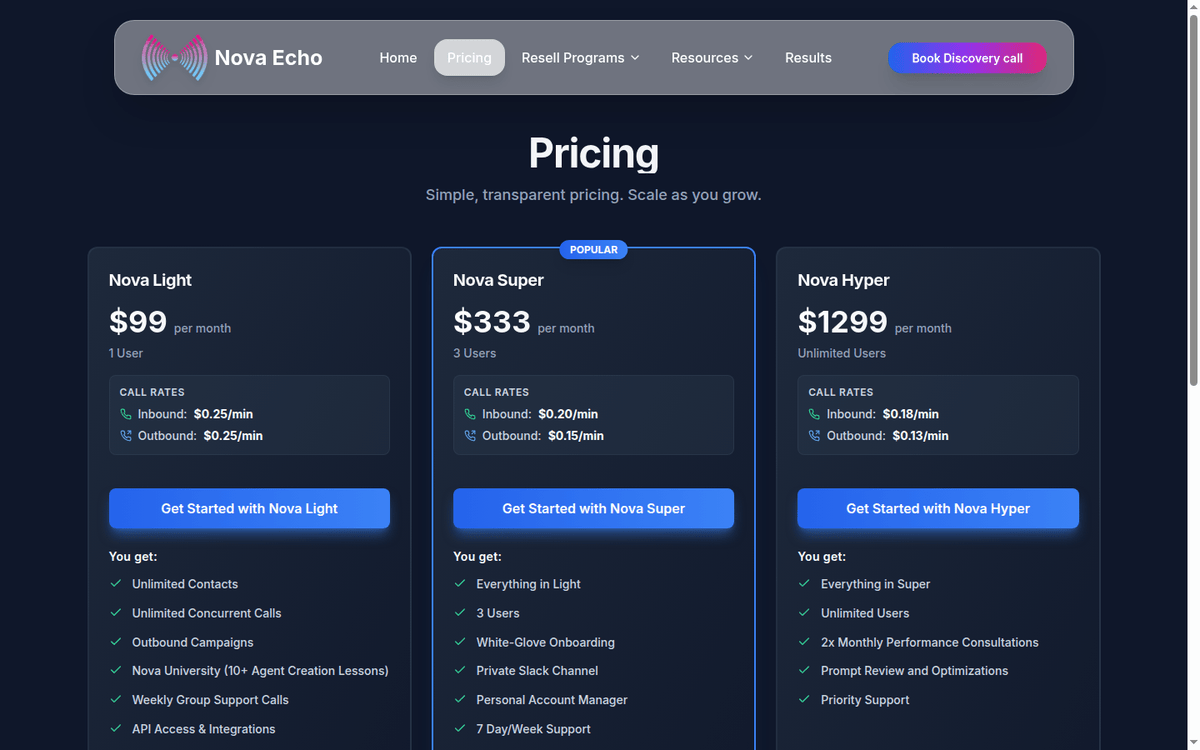
The CRM, the API access, the Advanced V2 Voice Models, and the rest of the feature set all ship from Light up. The higher tiers mostly trade cheaper minutes and human support for a higher monthly bill.
The per-minute math at Light is straightforward. A 5-minute inbound call costs $1.25 in minute fees plus the $99 monthly subscription.
A 10-minute inbound call costs $2.50 plus the subscription. A 1,000-minute month (about 17 hours of call time, which is roughly two full-time agent shifts at a BPO) costs $250 in minute fees plus the subscription.
At Hyper’s $0.18 inbound rate, the same 1,000 minutes costs $180 — saving $70/mo against Light at the same minute volume, on top of the unlimited seats.
The minute rates drop meaningfully as you move up tiers. Outbound at Hyper is $0.13/min, against $0.25/min at Light — a 48% drop. A 5,000-minute outbound month at Light costs $1,250 in minute fees; at Hyper it costs $650.
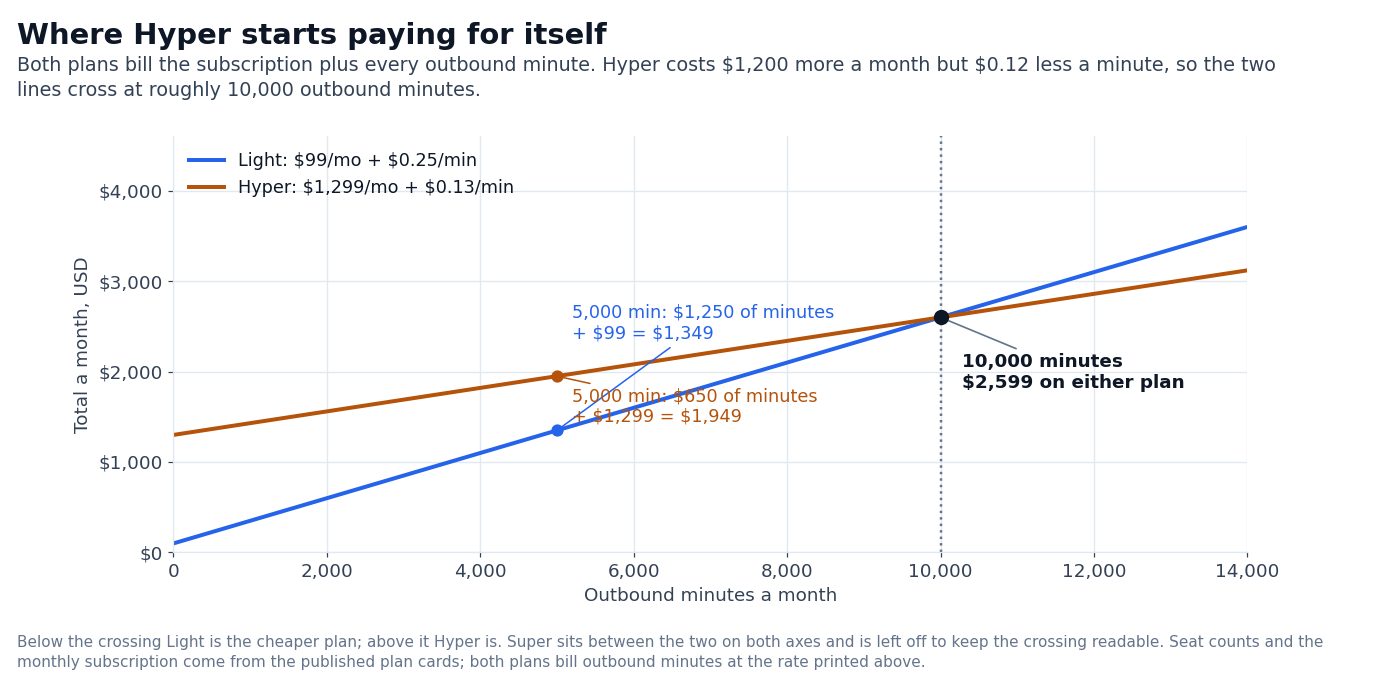
Add the $1,200 monthly subscription difference ($1,299 Hyper vs $99 Light) and Hyper saves money on outbound as soon as the volume clears roughly 10,000 minutes per month. That is about 5.6 hours of outbound per business day across a 30-day month.
Below that threshold, Light is the cheaper pick.
Beyond the three published plans are two quote-only paths. Done-For-You setup is a custom-quote service where Nova Echo’s team writes the prompts, wires the integrations, and tunes the agent for the specific business workflow.
Nova Enterprise is a custom-quote plan with minute-volume discounts at scale, custom development, a dedicated CSM, brand and AI-ethics governance work, and prompt-guardrail authoring.
Pricing on both is “Custom Quote” on the home page; the published numbers stop at Hyper.
What we couldn’t verify
Three classes of figures in this review depend on a real Nova Echo deployment that we did not run. They are called out below, and we recommend you test them on your own call list before you sign anything.
The first is the actual latency and voice quality on your own telephony and your own prospect list.
The published numbers are sub-1500ms and “hyper human-like”; the only honest way to confirm is a paid demo call to your own number with a real prospect script.
The second is the per-minute cost at production volume against the published Light-to-Hyper tier ladder.
The math we walk through above assumes the published rates hold at your minute volume, which they do, but Nova Echo’s Enterprise path includes “minute volume discounts” — that negotiation is quote-only.
The third is the conversion rate on Speed-to-Lead and Mass Outbound campaigns against a human SDR baseline.
The vendor publishes customer quotes (8 qualified transfers in 20 minutes, “best purchase I’ve made this year”); we did not run a controlled test against a human team.
What comes in the box from Light up
The published feature list on the pricing page is long, and it does not change between tiers except for the support tier. We list the shape here so the rest of the review lands in context.
Voice models and languages. Advanced V2 Voice Models on every plan. The hero block publishes 30+ languages; the comparison table says 35+. We assume the difference is “supported at launch” versus “currently shipped.”
Voice customization is “extensive tone & speed control” on the comparison.
The unnamed competitors get “basic options only.”
Calling capacity. The published number is 1,500+ calls per minute platform-wide. For a single customer this means the platform can run a 100-concurrent-call outbound blast without breaking a sweat.
The Capacity comparison row reads 1,500+ for the vendor, 10-60 for “competitors,” and 1 call/minute for humans. We treat that row as the vendor’s strongest marketing claim; it does not name the comparison set.
CRM. A “full CRM system” on every plan — meaning contacts, call history, notes, tags, and the standard small-business CRM surface. This is enough for the Speed-to-Lead and Receptionist roles.
Brands with a Salesforce or HubSpot CRM of record will wire the platform in via API or Zapier rather than using the built-in CRM as the system of record.
API and integrations. “API Access & Integrations” on Light up. The home page lists 10+ native integrations and 3,000+ third-party integrations; the practical read is that anything on Zapier or Make is reachable, plus the vendor’s direct connectors.
The published “integrations” comparison row claims 10+ native for the vendor against “third-party only” for competitors and “limited by learning curve” for humans.
Appointment Booking, Live Call Transferring, Form Collection, Agent Guardrails. All four ship from Light up. Live Call Transferring is the workflow where the AI escalates to a human rep mid-call.
Agent Guardrail Customization is the prompt-level control over what the AI is and is not allowed to say on a call.
Call History & Analytics. Standard on every plan. The published comparison row says “Full analytics & reporting” for the vendor, “Limited dashboards” for competitors, and “Minimal recall” for humans.
Implementation speed. “48 hours” on the published comparison, against “2-4 weeks” for competitors and “3-6 weeks” for humans.
The 48-hour claim is for a standard deployment with a published workflow; custom enterprise builds with bespoke CRM wiring and a Done-For-You engagement take longer and are not part of this comparison row.
Speed-to-lead time. “<1 minute” on the published comparison, against “<1 minute” for competitors (tied) and “5-120 minutes” for humans.
The vendor frames AI as tied with the fastest AI competitors and dramatically faster than human teams — the human response-time gap is the entire pitch for Speed-to-Lead.
Where Nova Echo is the right pick
Three workloads where Nova Echo is the strongest available option for AI voice.
The first is speed-to-lead on a high-intent inbound funnel. A solar, home-improvement, insurance, or legal-intake business whose lead form converts at 10-30% when called within 5 minutes and collapses to single digits when called within an hour has the textbook Speed-to-Lead workload.
Nova Echo’s “<1 minute” published response time, the Mass Outbound Calling role, and the unlimited concurrent calls make this a strong fit. The minute-cost math against a human SDR lands here.
At Light’s $0.25/min outbound, a 1,000-minute Speed-to-Lead campaign costs $250 in minutes plus the $99 subscription. The same 1,000 minutes against a $25/hr human SDR with a 10-minute average call costs about $417 in loaded labor.
The second is after-hours and overflow reception. A dental, HVAC, legal, or medical practice whose phone rings after the office closes and whose staff cannot answer every call during the day has the textbook Receptionist workload.
Nova Echo’s 24/7 model, sub-1500ms latency, and appointment booking ship from Light up. The cost case is strong against an answering service ($200-500/mo per line at a BPO for live human coverage) or an after-hours staffing model.
The third is mass outbound reactivation. An agency owner, a B2B list vendor, or a SaaS company running a reactivation campaign against a stalled customer base has the Mass Outbound workload.
Nova Echo’s unlimited concurrent calls and the $0.13/min outbound rate at Hyper make this the cheapest published option for a single-vendor, single-workflow blast.
The published 1,500+ calls-per-minute capacity is overkill for most reactivation campaigns and is the relevant ceiling for a list of a few thousand records.
Where Nova Echo is the wrong pick
Three workloads where Nova Echo is not the best fit, based on the published feature set.
The first is deep compliance and clinical conversations. AI voice vendors handle HIPAA, PCI, and regulated-industry conversations inconsistently.
The platform publishes “Detailed compliance features & prompt guardrail creation” under Nova Enterprise; Brands in healthcare, finance, or government with strict compliance requirements should benchmark the vendor’s BAA, data-retention, and audit-log story on their own compliance review.
They should test before they pick a tier.
The Done-For-You engagement is the most realistic path to compliance-grade deployment.
The second is long, branching service conversations. AI voice agents handle short, structured calls (booking, qualification, triage) well.
They struggle on long, open-ended calls where the customer pivots topic, asks open-ended questions, or expects a domain expert.
Nova Echo’s published latency and voice-quality story is strong; the practical limit on call length and call complexity is where a human rep wins. A B2B sales call with a multi-stakeholder buyer still goes to a human rep.
The third is brands that need a published independent benchmark against a named competitor. The comparison table is the vendor’s marketing claim against generic “competitors” and “humans.”
Brands whose procurement process needs a published Gartner, Forrester, or G2 benchmark against a named competitor will not find that here.
Vendors like Bland, Retell, PolyAI, and Vocode each publish their own comparison tables; the cross-vendor benchmark lives on G2, Capterra, and TrustRadius rather than on any single vendor’s home page.
The honest version on Nova Echo
The 2026 Nova Echo is the strongest version of the platform the vendor has shipped. The pricing clarity lands the story. The role-based product framing (Receptionist, Speed-to-Lead, Mass Outbound) lands it.
The 30+ language support and the 1,500+ calls-per-minute capacity claim land it.
The Done-For-You + Enterprise path for procurement-grade deployments lands it. A founder or agency owner who needs AI voice at scale hears a coherent pitch.
The honest version is on the comparison table. The published comparison is the vendor’s marketing claim against “competitors” and “humans” without naming either.
The sub-1500ms latency, the 1,500+ calls/minute, the 48-hour implementation, the 80% lower cost — all are vendor-published numbers, not independent benchmarks.
We did not run an independent head-to-head against Bland, Retell, PolyAI, or Vocode, and we did not benchmark Nova Echo’s actual latency on a real prospect call.
The right way to validate is a paid demo call to your own number with your own script and a 30-minute production test on a real prospect list.
The second honest version is on the seat economics at the entry tier.
Light at $99/mo with one user seat and $0.25/min on both directions is the cheapest published path for a solo founder who wants to test AI voice on their own phone line.
A team of three SDRs running AI voice on a shared Speed-to-Lead campaign needs Super ($333/mo, 3 seats) or Hyper ($1,299/mo, unlimited seats).
The Hyper plan’s per-minute discount pays for the higher subscription only at outbound volumes above roughly 10,000 minutes per month; below that threshold Light or Super is the cheaper pick.
Above Hyper, the Done-For-You setup and Nova Enterprise are custom-quote plans. The minute rates are the binding cost driver, not the subscription.
The right way to confirm on your own funnel is a paid demo call to your own number with a real prospect script and a 30-minute production test on your own list.
For long, branching conversations with complex compliance, multi-stakeholder B2B sales, or clinical conversations, a human rep wins.
Voice cloning is not published as a feature on the pricing page; the Advanced V2 Voice Models ship from Light up.
A brand with a Salesforce or HubSpot CRM of record will wire Nova Echo in via API or Zapier rather than using Nova Echo’s built-in CRM as the system of record.
FAQ
How much does Nova Echo cost per month?
Three published plans: Light at $99/mo with 1 seat and $0.25/min on both directions. Super at $333/mo with 3 seats and $0.20 inbound / $0.15 outbound. Hyper at $1,299/mo with unlimited seats and $0.18 inbound / $0.13 outbound.
Is Nova Echo free?
There is no published free tier on the pricing page. The home page runs a live demo call form (“Enter your details and customize your AI agent for an instant demo call”) that lets a brand hear the voice quality before paying. The cheapest paid plan is Light at $99/mo.
How fast can Nova Echo respond to a lead?
The published comparison claims “<1 minute” for speed-to-lead time. The published latency on a phone call is “sub-1500ms.” Both numbers are vendor-published.
Does Nova Echo replace a call center?
For short, structured calls (inbound triage, appointment booking, qualification, speed-to-lead), Nova Echo is the published per-minute alternative to a BPO at 1,500+ calls/minute platform capacity.
What languages does Nova Echo support?
The home page hero block says “30+ Languages” and the comparison table says “35+.” The published comparison row ties the vendor with unnamed competitors at 35+ and contrasts with “1-2” for human teams.
Does Nova Echo integrate with Salesforce or HubSpot?
The published integrations row says “10+ native, 3000+ third-party.” The practical read is that anything on Zapier or Make is reachable, plus the vendor’s direct connectors.
Sources
- Nova Echo pricing — three published plans (Light $99, Super $333, Hyper $1,299) and per-minute billing model (captured September 2026)
- Nova Echo home — role-based product framing (Receptionist, Speed-to-Lead, Mass Outbound), comparison table, customer logos (Google, U.S. Army, Salesforce, Citi, Apple, Microsoft, Ford, Oracle, IBM, AWS, TD Bank, AT&T, The Home Depot), customer quotes (captured September 2026)
- Nova Echo results — vendor-published customer case studies and conversion claims (referenced from the home page)
- Nova Echo done-for-you — custom-quote Done-For-You setup service (referenced from the home page)
How we put this together: the plan cards (Light $99, Super $333, Hyper $1,299), the minute rates, the seat counts, the onboarding each tier carries, the comparison rows and the customer quotes come from novaecho.ai/pricing and the vendor homepage, quoted as displayed. We have not run a paid Nova Echo account.
Figures that depend on a real workload, a real target or a real integration are flagged where they appear in the text rather than being estimated.
Disclosure: this article contains affiliate links. If you buy through them we may earn a commission at no extra cost to you. Commission never changes our scoring or the order of a ranking.