The banner at the top of the Equally AI pricing page reads: Equally AI has been acquired by AudioEye. That is the first sentence in September 2026 — a banner with the AudioEye ticker (Nasdaq: AEYE) and a celebratory rocket emoji. The banner does not change the published price ladder.
The published price ladder is unchanged by the acquisition: Essential and Growth are still quoted on the pricing page, and Ultimate is still a custom quote. The widget still installs as a single line of code; it scans the site, applies AI fixes, and adds a manual validation layer once a paid plan is active.
That acquisition banner is the headline of any honest Equally AI review in 2026. AudioEye is itself an accessibility vendor with its own widget and its own enterprise contracts. When the same company owns two products, the question shifts.
It is no longer “is Equally AI good?” but “is Equally AI still its own product, and for how long?” The pricing page still shows three Equally AI tiers. The customer examples page still quotes the Equally AI brand. We have no public announcement of a merger of the widgets.
We treat Equally AI as a live product for now, with the acquisition noted as the most material 2026 event.
What follows is what Equally AI actually sells, what it costs in real numbers, the full integration list pulled from /integrations, and where the widget sits next to accessiBe, UserWay, the AudioEye flagship, and EqualWeb.
Pricing and product facts come from the public Equally AI pages captured in September 2026. We did not buy a plan, so figures are read off the published pricing page, the home page, the /how workflow page, and the integration directory.
Equally AI is now an AudioEye company — what that means in practice
AudioEye is a publicly traded accessibility vendor (Nasdaq: AEYE) that has been in the overlay business since 2005. The Equally AI widget launched later and positioned itself as the “all-in-one” AI-powered overlay; the brand was acquired by AudioEye in 2025 — the exact close date is not on the public pages we captured.
What is on the pages is the persistent banner and a footer that still brands the widget as Equally AI.
For a buyer, three things change and one does not:
- Pricing is still published. No “contact sales for the new AudioEye pricing.” Three tiers, three prices, three page-view caps.
- Roadmap and product direction are no longer Equally AI’s alone. AudioEye already has its own overlay (the original AudioEye widget). Two overlapping products owned by one company usually means consolidation, but it can also mean a stronger engineering team behind the smaller product. We do not know which way this goes.
- Compliance posture may carry forward differently. AudioEye has had shareholder litigation around its accessibility claims in past years; Equally AI’s claims remain its own. Treat the two as distinct products even though one owns the other.
- The 7-day free trial still exists. No credit card required. That detail is unchanged.
If your decision is “should I buy Equally AI today,” the answer is unchanged from before the acquisition. Pick it if you want a published, AI-driven widget with a manual validation step. Caveat: the longer roadmap is now AudioEye’s call.
The pricing ladder on /pricing, in real numbers
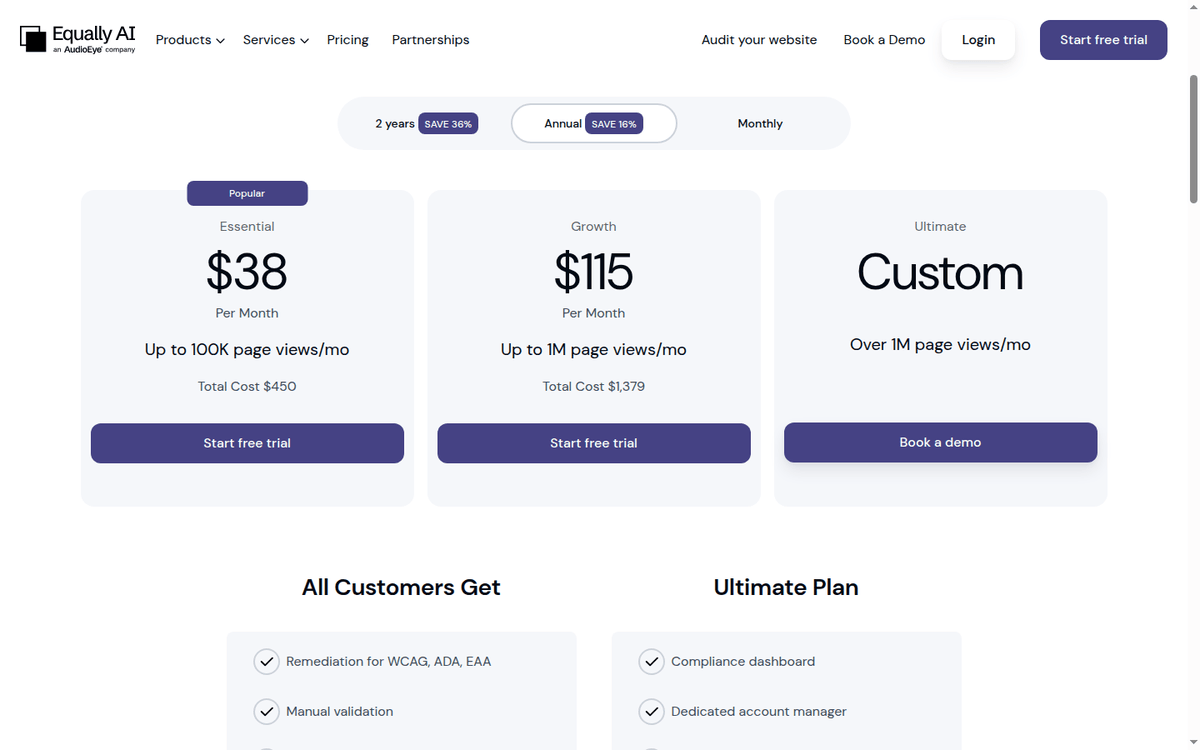
The pricing page renders client-side. The HTML alone shows the heading and the FAQ; the plan cards populate after JS executes. Reading the rendered DOM, the published ladder is:
| Plan | Monthly price (USD) | Page views included | 2-year total cost | Billing cycle savings |
|---|---|---|---|---|
| Essential | $38 | up to 100,000 / month | $450 | 36% on 2-year billing |
| Growth | $115 | up to 1,000,000 / month | $1,379 | 36% on 2-year billing |
| Ultimate | Custom | over 1,000,000 / month | Custom | — |
A few details that the page itself explains:
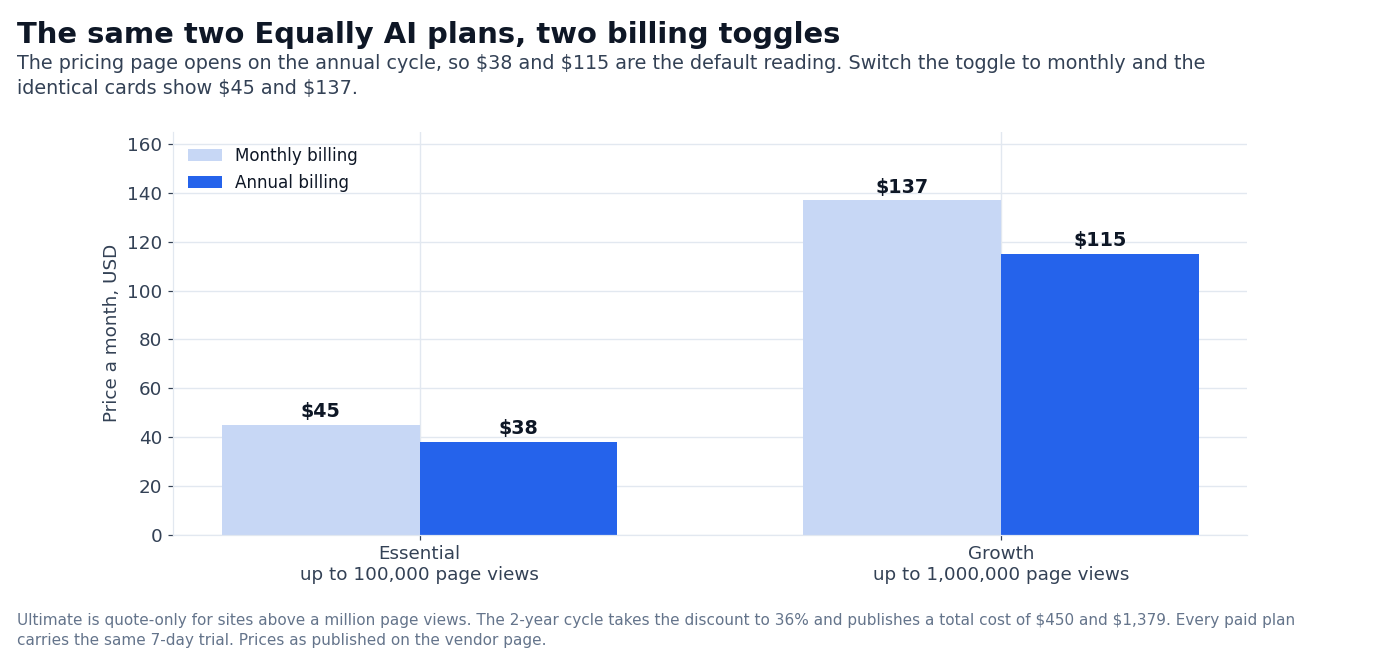
- Three billing cycles. Monthly, Annual (save 16%), and 2 years (save 36%). The displayed $38 / $115 are the per-month figures on the annual cycle, which is the vendor default; switch the toggle to Monthly and the same cards read $45 and $137. The 2-year column shows the total you pay if you commit for two years up front.
- 7-day free trial on every paid plan. No credit card required to start.
- The page also publishes a U.S. ADA tax credit claim of up to $5,000 annually for “accessible and compliant SMEs.” The vendor does not pay you the credit; the U.S. federal program does. The framing matters because a small business that remediates can often claim the credit back on its taxes. Useful for SMB readers, but it is not a discount from Equally AI.
- All three paid plans ship the same compliance baseline. Remediation for WCAG, ADA, and EAA; manual validation; certified attorney accessibility statement; routine compliance checks; notifications for critical source-code issues; 24/5 support.
What is locked to Ultimate: the compliance dashboard, a dedicated account manager, multiple subdomains, White Label, a 24-hour support SLA, and the $10,000 legal-defense pledge. The pledge is a published marketing claim; read the legal terms before relying on it as actual coverage.
What the $29 vs $38 discrepancy actually is
The home page hero reads: “Affordable starting from $29/mo, no credit card, free trial.” The published Essential plan on /pricing reads $38/month. These two numbers disagree, and Equally AI does not explain the gap on the public pages.
Three plausible readings, none of them confirmed by the vendor on the captured pages:
- The $29 figure reflects annual-billing math. Some vendors display a per-month number that averages the annual discount. The published annual discount on
/pricingis 16%, which would land a $38/month plan at roughly $32/month on annual billing. That still does not get to $29, so this reading does not fully fit. - The $29 figure is a legacy marketing line. The home page hero is older copy. The pricing page was rebuilt to show the new floor. The brand has not bothered to reconcile the two. This is the most common reason for this kind of disagreement in our experience.
- The $29 figure is a promotional anchor for a specific campaign. Affiliate partners, a partner channel, or a first-month discount. Not visible on the captured pages.
We treat $38/month as the canonical Essential price — it is the number the pricing page shows, and the pricing page is the legal artifact a buyer signs against.
We treat $29 as a marketing floor that may or may not be reachable depending on a billing path not explained on the public pages. If you are quoted $29, ask what billing cycle and what term it assumes. Do not budget on $29 unless the vendor confirms the mechanism.
The 5-step widget workflow, step by step
The /how page lays out the workflow as five steps. We pulled the wording verbatim:
- Install Widget. Add a single line of code to your website. The integration page says the snippet goes before the closing
</body>tag. - AI Analysis. The widget scans the entire site in minutes.
- Automatic Fixes. Issues that the AI can remediate are fixed automatically.
- Manual Verification. Once a paid subscription is active, Equally AI runs a manual validation. The free trial includes the AI steps; the manual validation step is gated behind payment.
- Ongoing Compliance. Continuous monitoring ensures lasting accessibility.
Two practical implications:
- Step 4 is the legal-defense wedge. The published compliance baseline on every paid plan is the manual validation plus the certified attorney accessibility statement. The free trial does not include step 4 in any meaningful form. If your reason to buy is “I need a manual check by humans because the AI misses edge cases,” the paid tier is the actual product. The widget on its own is an interim measure.
- Step 5 is the difference between an audit and an ongoing program. Most ADA lawsuits target a specific page on a specific date. A widget that remediates once and never checks again leaves you exposed the next time you push a new page. Continuous monitoring is what binds the brand’s “$10k legal-defense pledge” to a real obligation.
The widget also ships with an accessibility interface — a customizable overlay that visitors open to adjust profiles. The four listed profiles cover screen reader users, vision impairments (low vision, color blindness, and others), motor impairments, and cognitive impairments such as ADHD or autism spectrum.
This is the visitor-facing piece; the AI fixes the source code, and the interface gives end users a way to override the site’s behavior at runtime.
Coverage by platform and CMS: the full integration list
The /integrations page lists 25 platforms with installation guides, from mainstream CMSs down to a raw-HTML install path. We pulled the list verbatim:
- CMS and site builders: WordPress, Wix, Squarespace, Weebly, Drupal, Joomla, Webflow, Duda, Strikingly, Tilda, Spacecraft, Umbraco, Dreamweaver, Elementor, Moodle.
- Ecommerce: Shopify, WooCommerce, Magento, BigCommerce, PrestaShop.
- CRM: HubSpot, GoHighLevel.
- Tag managers and raw: Google Tag Manager, Cloudflare, raw HTML (any site).
The published research summary in our notes lists five integrations (WordPress, Wix, Shopify, Webflow, Drupal). That list is incomplete. If you are on Squarespace, Magento, HubSpot, WooCommerce, or any of the smaller builders, the widget still has a published installation guide.
Three caveats:
- “Installation guide” is not the same as “deep integration.” Most installation guides show how to drop the JS snippet into the platform. The brand does not publish a list of platforms that integrate at the CMS data layer (the way, say, a CDP integrates with the customer record). Treat the list as “supported install paths,” not “supported data integrations.”
- The widget is platform-agnostic by design. Any site that accepts a script tag can run it. The named integrations exist because Equally AI has written step-by-step guides for those platforms; the underlying widget code is the same.
- The widget works on the rendered DOM, not the source code. If your platform generates inaccessible markup (e.g., missing alt attributes on a CMS upload form), the widget can remediate the rendered output but cannot fix the source. The notifications for critical source-code issues that ship on every plan are Equally AI’s way of flagging this gap.
The tax-credit claim, and what it actually pays for
The pricing page surfaces the U.S. ADA tax credit prominently: “The U.S. government offers an ADA tax credit of up to $5,000 annually to accessible and compliant SMEs.” The page directs you to find out if you are eligible.
Two things worth stating clearly:
- The credit is a federal program, not an Equally AI discount. It comes from IRS Section 44 (Disabled Access Credit), which lets small businesses claim 50% of eligible accessibility expenditures between $250 and $10,250 per year. If you spend $1,000 remediating your site, the credit is roughly $500. If you spend $10,000, the credit caps at $5,000.
- The brand does not handle the paperwork for you. The credit is claimed on your tax return. The pricing page surfaces the option because it makes the net cost of the widget look lower in marketing copy.
The honest version: if you are a U.S. small business spending on the widget, ask your accountant whether the spend qualifies. The widget subscription itself may or may not count, depending on the structure of your tax return. The brand’s role here is informational, not transactional.
Equally AI vs accessiBe, UserWay, AudioEye, EqualWeb — quick reference
The accessibility-widget market has consolidated around four to five names, with Equally AI now part of the AudioEye orbit. Side-by-side notes on the publicly stated price floors and the marketing angle, captured at the time of this review:
- accessiBe. The most advertised overlay widget, with a published “starting from” headline around the same band as Equally AI’s $38 floor. accessiBe has had an FTC matter in its past around accessibility claims. The accessibility community has argued for years whether overlays meaningfully remediate sites or just paper over them.
- UserWay. A long-running overlay player. Published pricing is similar in shape to Equally AI — tiered by page views and features. Generally well-known in the agency channel.
- AudioEye (the flagship). The parent company now owns Equally AI. The AudioEye widget has its own enterprise positioning and a different sales motion (mostly quote-based). Buyers comparing AudioEye and Equally AI in 2026 are essentially comparing two products from one company.
- EqualWeb. A heavier-duty overlay with a published enterprise tier. More focused on enterprise and government than on SMB.
Two reference points that come up in third-party comparisons and that we have not independently verified:
- One published 2026 comparison (ratedwithai.com / aitoolbox.hk, surfaced via search) places Equally AI in the SMB-friendly tier with AudioEye in the enterprise tier.
- One frontdeskreview.com piece confirms Equally AI’s acquisition by AudioEye via the publicly visible
equally.ai/aboutpage and lists Equally AI among the names with published prices.
We do not name those sources as primary references because the underlying numbers (a competitor’s pricing page or another review’s claims) were not directly captured for this review.
The honest summary: if you want a published, self-serve widget with a manual validation step, the $38/month Essential tier is competitive with accessiBe and UserWay at the same page-view band. The catch is the parent company: AudioEye now owns both AudioEye and Equally AI.
If you are enterprise and want a quote-based contract with a single-vendor accountability path, AudioEye direct may be the right conversation — but you will not find a published price.
Where Equally AI is the wrong pick
Four situations where the widget either will not solve your problem or will create a new one.
You need genuine source-code remediation. The widget remediates the rendered DOM. If your CMS outputs inaccessible markup at the data layer — a form builder that omits labels, an image uploader that strips alt text, a theme with broken heading hierarchy — the widget masks the problem for visitors. It does not fix the source.
You need a VPAT or a formal audit deliverable. Equally AI offers audit, VPAT, and verify services under /solutions/services/, but these are separately scoped professional services, not part of the widget subscription.
If your procurement department needs a completed VPAT for a government contract, plan a separate engagement.
You need a free, open-source remediation path. The widget is a managed SaaS. There is no community edition, no source-available codebase, and no way to run the AI remediation locally. If data residency or full control of the runtime is non-negotiable, an overlay is the wrong shape.
You are outside the SMB band and want a self-serve price. Ultimate is quote-only. The published ladder stops at $115/month on Growth. If you have 5M page views a month and need a published price to budget on, Equally AI’s published ladder does not have one for you.
The page does not promise that the Ultimate tier will return a price inside a stated band.
What we did not verify
A handful of facts that we could not confirm independently and that you should sanity-check before you commit:
- The published G2, Capterra, Software Advice, and GetApp ratings come from the home page social-proof strip. We did not enumerate those review platforms to confirm the star counts or the review volume.
- The Joe Brown quote (“Effortful Compliance CEO”) is published on the home page. We did not verify Effortful Compliance as a customer beyond the named quote on the page.
- The $10,000 legal-defense pledge is an Ultimate-only marketing claim. The legal terms on
/resources/legaldefine what triggers a payout; we did not read the legal terms in detail for this review. - The 2-year “Total Cost” numbers on
/pricing($450 for Essential, $1,379 for Growth) are the math of $38 × 12 with a 36% discount for Essential and $115 × 12 with a 36% discount for Growth. The brand does not explicitly state how it computes “Total Cost” — it is presented as a single number next to “Per Month.” - The AudioEye acquisition close date is not stated on the public pages we captured. The banner is persistent; the date is not.
- The “5 stars in Capterra and G2” claim is from the home page. Capterra and G2 each return 403 to an automated fetch. The star counts and review totals are not independently confirmed in this review.
- The integration list at
/integrationsis the count we captured for this review. The brand may have added or removed guides since.
Treat them as two products from one parent until the company announces a merger of the widgets.
Ultimate is a custom quote for over 1M page views and adds a compliance dashboard, dedicated account manager, multiple subdomains, White Label, a 24-hour support SLA, and a $10,000 legal-defense pledge. Annual billing saves 16%; 2-year billing saves 36%.
For teams where performance is a hard constraint, the practical move is to run the widget through Lighthouse and WebPageTest against the same page with the widget off and on, and budget on those numbers before subscribing.
The underlying widget code is the same; the installation guides document where to drop the snippet on each platform.
Confirm eligibility with your accountant before assuming the credit applies to your Equally AI spend.
FAQ
Is Equally AI still its own product under AudioEye?
Not in product. The Equally AI widget is now owned by AudioEye (the banner on /pricing and the footer confirm this). The Equally AI widget is still a separately branded product with its own pricing page, integrations page, and marketing site.
How much does Equally AI cost?
The published floor is $38/month for the Essential tier (up to 100,000 page views). Growth is $115/month for up to 1M page views.
Is there an Equally AI free trial?
Yes. Every paid plan has a 7-day free trial, and no credit card is required to start it. The free trial covers the AI analysis and automatic fixes; the manual validation step (step 4 in the workflow) is gated to paid subscriptions.
Does Equally AI cover WCAG, ADA, and EAA?
The published baseline on every paid plan is remediation for WCAG, ADA, and EAA. The brand also publishes compliance coverage for Section 508, AODA, IS 5568, and the Stanca Act. The compliance baseline includes manual validation, a certified attorney accessibility statement, and routine compliance checks.
Will Equally AI slow down my website?
The FAQ on /pricing answers this directly: the widget is designed to have minimal performance impact. We did not benchmark performance independently.
Does Equally AI work on WordPress, Shopify, and Webflow?
Yes — the /integrations page publishes installation guides for WordPress, Wix, Squarespace, Weebly, Shopify, Drupal, Magento, Webflow, Duda, HubSpot, WooCommerce, Joomla, BigCommerce, GoHighLevel, Google Tag Manager, Cloudflare, raw HTML, Elementor, Dreamweaver, Strikingly, Spacecraft, Tilda, PrestaShop, Moodle, and Umbraco.
What is the $5,000 ADA tax credit, and is it a discount?
The credit is a U.S. federal program (IRS Section 44) that lets small businesses claim back part of their accessibility expenditures. The brand does not give you the credit; the IRS does. The credit caps at $5,000 per year for eligible SMEs. The pricing page surfaces the option as a budgeting hint.
Can I customize the Equally AI widget?
Yes. The home page and the FAQ on /pricing confirm that the accessibility interface (the visitor-facing overlay) is customizable. Style adjustments are described in the customization documentation. The widget behavior (the AI remediation layer) is not user-configurable; it ships as a managed service.
Sources
All four primary pages were read via a Playwright DOM render.
- Equally AI pricing — plan ladder, billing cycles, page-view caps, tax-credit claim, compliance baseline, Ultimate-only features, FAQ.
- Equally AI home — hero pricing headline (“from $29/mo”), social-proof strip, “5 stars in Capterra and G2,” customer quote.
- Equally AI — How the widget works — five-step workflow (install, AI analysis, automatic fixes, manual verification, ongoing compliance).
- Equally AI integrations directory — full list of 25 named platforms with installation guides.
- Equally AI — About / AudioEye company status — acquisition banner and corporate status. Referenced via the persistent banner and footer attribution on
/and/pricing; the about page itself was not fetched in this review.
How we put this together: the Essential, Growth and Ultimate prices on each billing cycle, the page-view caps, the two-year totals, the compliance baseline, the ADA tax-credit claim and the integration list come from a rendered capture of equally.ai/pricing, equally.ai/how and equally.ai/integrations, quoted as displayed. We have not bought an Equally AI plan.
Figures that depend on a real workload, a real target or a real integration are flagged where they appear in the text rather than being estimated.
Disclosure: this article contains affiliate links. If you buy through them we may earn a commission at no extra cost to you. Commission never changes our scoring or the order of a ranking.