
Webshare publishes 80M+ residential IPs in 195 countries, with an uptime claim of 99.97%. The published ladder runs $3.50/GB on the 1 GB plan down to $1.40/GB at 3,000 GB, with the discount marked in the table itself. Static residential is billed per proxy, from $0.30 down to $0.225 at 10,000 proxies. Run a pilot before you commit.
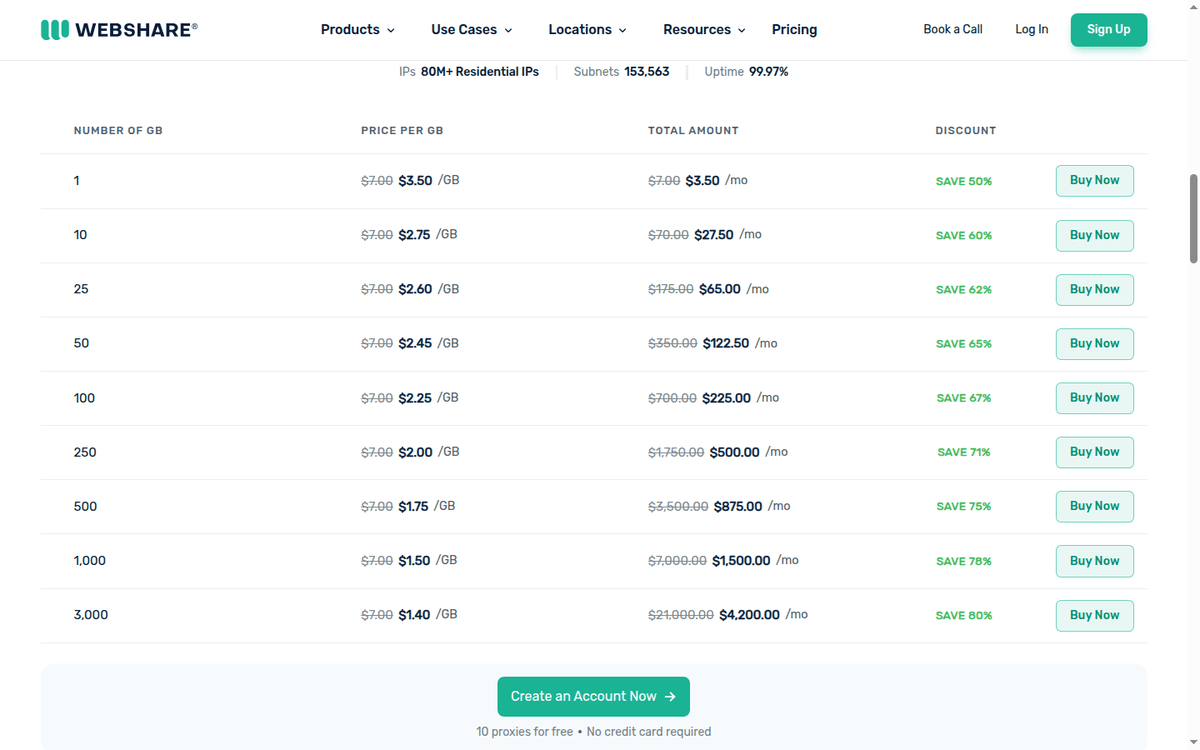
Webshare is the residential proxy provider that publishes one of the lowest per-gigabyte rates in the category — and the discount sits inside the per-gigabyte table as a SAVE 50% to SAVE 80% mark rather than in a banner.
The residential-proxy page leads with “Affordable pricing as low as $1.40/GB”, and the pricing page splits the catalog into three tabs: Rotating Residential, Static Residential and Proxy Server. Webshare also publishes a separate static residential line (datacenter-attached residential IPs, billed per IP rather than per GB) and a long-time datacenter proxy specialty.
The published pool is 80M+ residential IPs across 195+ countries, with an uptime claim of 99.97%. The promo is real and shows up as a per-gigabyte mark on the published ladder. This review walks through that ladder, what the promo does to the bill, and where the published model fits in 2026. Every number comes from webshare.io/residential-proxy and webshare.io/pricing.
Anything that depends on a real workload running against a real target is flagged as unverified in this review.
Webshare in 2026 — the case for and the case against.
Price — one of the lowest published per-gigabyte rates in the category, with the discount marked in the table itself.
Pool — a mid-pack pool that no longer trails IPRoyal, and still smaller than Bright Data and Oxylabs.
Lines — bundling residential, static residential and datacenter onto a single dashboard, which is the published differentiator.
Compliance — the absence of published compliance certifications.
Pricing — promo-dependent: the same ladder reads higher without the discount marks.
If your workload is bandwidth-heavy residential scraping with a price-sensitive buyer, this is the strongest published option in the category when the promo is active.
If your workload needs a larger pool, a published compliance trail, or a published sticky session window, compare with Bright Data, Oxylabs or IPRoyal before you commit.
Reading the published ladder, tab by tab
Webshare’s public pricing page is unusual in the residential category for three reasons:
- The discount is printed as a SAVE mark on the per-gigabyte table, so the list price and the promo price sit in the same row.
- The page splits the catalog into three tabs — Rotating Residential, Static Residential and Proxy Server — and the tab you land on decides which billing unit you are looking at.
- The residential product page and the pricing page print the same ladder, so the per-gigabyte math can be checked without logging in.
The residential ladder is published in-line: the Rotating Residential tab lists every plan from 1 GB to 3,000 GB with its per-gigabyte rate. The Static Residential tab is the one that switches billing unit, quoting a price per proxy instead of a price per gigabyte, which is why the two tables should not be compared line by line.
The published pricing math we can verify from the Firecrawl scrape of the residential-proxy product page:
| Plan | Bandwidth | Price per GB | List price per GB | Discount mark |
|---|---|---|---|---|
| 1 GB | 1 GB | $3.50/GB | $7.00/GB | SAVE 50% |
| 10 GB | 10 GB | $2.75/GB | $7.00/GB | — |
| 25 GB | 25 GB | $2.60/GB | $7.00/GB | — |
| 100 GB | 100 GB | $2.25/GB | $7.00/GB | — |
| 250 GB | 250 GB | $2.00/GB | $7.00/GB | — |
| 500 GB | 500 GB | $1.75/GB | $7.00/GB | — |
| 1,000 GB | 1,000 GB | $1.50/GB | $7.00/GB | — |
| 3,000 GB | 3,000 GB | $1.40/GB | $7.00/GB | SAVE 80% |
The ladder above is the published table on webshare.io/pricing, read in September 2026. The same rows appear on the residential-proxy product page, whose hero line quotes the deepest rate, $1.40/GB.
The promo is a mark on the table rather than a code you apply at checkout, and the terms can change without notice — re-read the table before committing.
The discount applies across the whole ladder rather than to one plan. Against the $7.00/GB list price the saving is 2x on the 1 GB plan and 5x on the 3,000 GB plan, which is where the SAVE 80% mark comes from. Whether the promo is still running when you read this is a risk to price in.
Static residential, datacenter, and the per-IP math
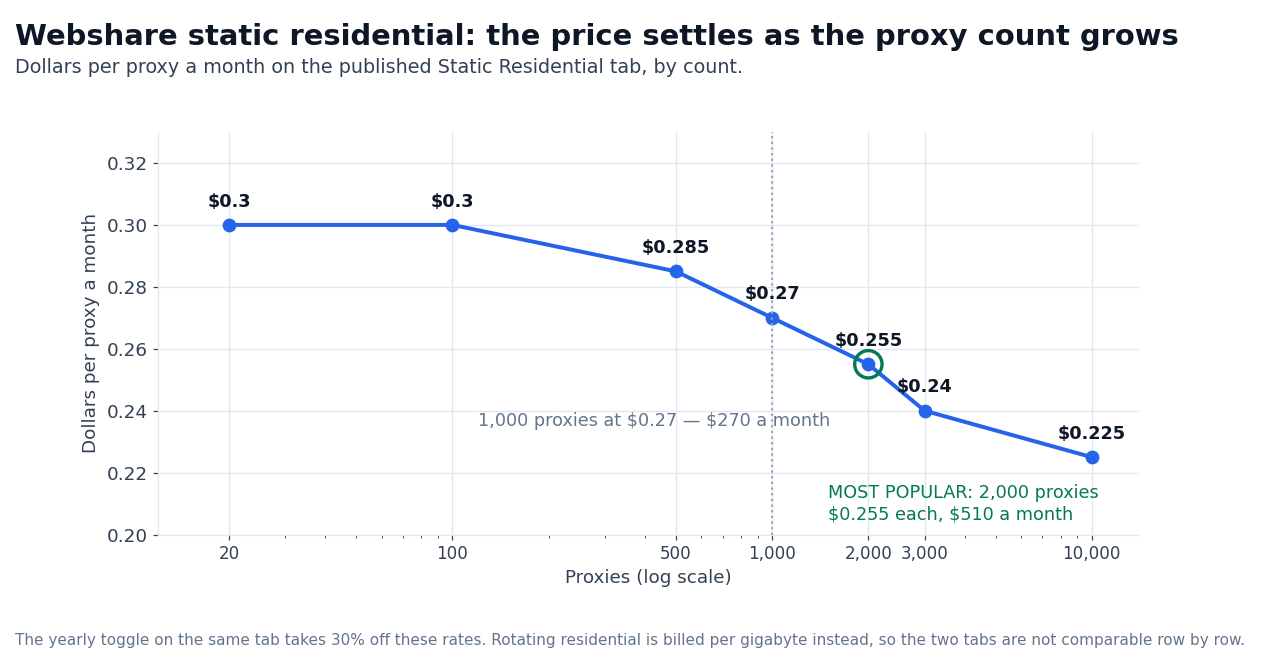
Webshare publishes a separate static residential proxy line — datacenter-attached residential IPs billed per IP rather than per GB. The Static Residential tab on the pricing page lists the per-proxy rates as:
| Static Residential Plan | Proxies | Per proxy (monthly) |
|---|---|---|
| 20 proxies | 20 | $0.30/proxy |
| 100 proxies | 100 | $0.30/proxy |
| 500 proxies | 500 | $0.285/proxy |
| 1,000 proxies | 1,000 | $0.27/proxy |
| 2,000 proxies | 2,000 | $0.255/proxy |
| 3,000 proxies | 3,000 | $0.24/proxy |
| 5,000 proxies | 5,000 | $0.24/proxy |
| 10,000 proxies | 10,000 | $0.225/proxy |
The yearly toggle on that tab is marked save 30%, which applies to the per-proxy rate. The datacenter proxy line is Webshare’s long-time specialty and is priced per proxy on its own tab, with the MOST POPULAR mark on the 2,500-proxy column — outbound bandwidth is included up to a published per-IP cap.
The static residential and datacenter proxies are billed per IP, not per GB. If your workload is per-GB budgeting, the rotating residential line is the only published option that fits.
The static lines are for workloads where you need a fixed set of IPs over a long period — account management, persistent login state, sneaker-style copping — not for high-bandwidth scraping.
The “MOST POPULAR” badge on the static residential tab sits on the 2,000-proxy column at $0.255/proxy, which is $510 a month; the 1,000-proxy column beside it is $0.27, or $270 a month. The per-proxy rate keeps falling past the badge, to $0.225 at 10,000 proxies, so the badge marks the volume the vendor expects most buyers to land on rather than the cheapest rate on the tab.
Pool, locations, and what the 80M+ figure actually measures
The published residential pool is 80M+ residential IPs across 195+ countries. The published uptime claim is 99.97%. That figure sits below Bright Data (400M+), Oxylabs (175M+) and Smartproxy/Decodo (115M+), and above IPRoyal (64M+).
The trade-off is no longer the smallest pool in the category: Webshare publishes a mid-pack pool next to one of the lowest per-gigabyte rates, which is a different bargain from the one the leading vendors sell.
The published trade-off is per-gigabyte price against pool size. Webshare’s 80M+ pool is no longer the smallest among the majors — IPRoyal publishes 64M+ — but Bright Data (400M+) and Oxylabs (175M+) publish several times more. The uptime claim is a published figure, not a workload-specific measurement.
If your workload needs fresh IPs at a higher rate than the pool can supply, a larger-pool competitor will perform better on the same target.
HTTP(S) and SOCKS5 are both supported on the published residential line. Sticky session length is not printed on the product or the pricing page — treat it as a feature to verify on your pilot rather than as a published number.
Free trial, refunds, and the published billing model
Webshare publishes a free datacenter plan with limited bandwidth — 10 proxies at $0/month, no card required. The residential line does not publish a free trial; the 1 GB subscription at $3.50/GB is the closest published low-risk entry point.
The FAQ does publish a refund window: a customer who cancels within two days of the original payment can ask for a refund, subject to volume conditions.
The published free datacenter plan is the cleanest “try before you buy” entry in the published category for Webshare.
It does not test residential proxies (different IP pool, different billing unit), but it does test the dashboard UX and the support response time. If you want a residential pilot, the 1 GB subscription at $3.50/GB is the closest published option.
Payment methods are card-based methods plus Google Pay and Apple Pay, per the vendor FAQ. PayPal, crypto, Alipay and bank wire are not advertised. Webshare does not list a SOC 2 attestation or ISO 27001 certification on the residential pricing page — for published compliance posture, oxylabs is the strongest reference.
What Webshare fits in 2026
Three personas fit cleanly into the published Webshare offer, and three should compare with alternatives.
Best fit: price-sensitive scraping teams that want the lowest published per-gigabyte rate in the category. The promo brings the 3,000 GB tier to $1.40/GB, and the yearly toggle takes it to $0.98/GB. If your workload is bandwidth-heavy and your buyer cares about per-gigabyte cost more than pool size, this is the strongest published option.
Best fit: teams that need both residential and static residential on a single dashboard. Webshare publishes residential, static residential, and datacenter on the same dashboard. If your workload mixes high-bandwidth residential scraping with low-volume static residential account management, Webshare is the only published provider that bundles all three on a single billing relationship.
Best fit: developers who want a $0/mo entry point to test the dashboard UX. The published free datacenter plan (10 proxies at $0/month) lets you verify the support response time, the dashboard ergonomics, and the API before you commit to a residential subscription.
Worth shopping elsewhere: enterprise procurement teams that need a published audit trail. Webshare does not list SOC 2 or ISO 27001 on the residential pricing page. Oxylabs is the strongest published reference.
Worth shopping elsewhere: workloads that need the largest published pool size. Webshare’s 80M+ residential pool is smaller than Bright Data’s 400M+, Oxylabs’s 175M+ and Smartproxy/Decodo’s 115M+. For workloads where pool size matters more than per-gigabyte price, those competitors win.
Worth shopping elsewhere: customers who need published sticky session lengths. Webshare publishes rotating and sticky sessions but does not list the sticky window on the pricing page. IPRoyal publishes 7 days, Oxylabs 24 hours and Smartproxy/Decodo up to 60 minutes. Webshare’s published gap on this metric makes a pilot the only reliable reference.
FAQ
Is Webshare a real proxy provider?
Yes. Webshare is a residential and datacenter proxy vendor with a published residential pool of 80M+ residential IPs across 195+ countries. The company publishes a 99.97% uptime claim on the residential pricing page and has been a long-time datacenter proxy specialist.
How much does Webshare residential proxy cost?
The published ladder runs $3.50/GB on the 1 GB plan down to $1.40/GB on the 3,000 GB plan, with the SAVE 50% and SAVE 80% marks printed in the table. Against the $7.00/GB list price that is a 2x to 5x saving. Re-read the table before committing — the promo terms can change.
Does Webshare offer a free trial?
No formal residential free trial is advertised. The closest published free option is the datacenter plan (10 proxies at $0/month), which tests the dashboard UX but not residential proxies. The 1 GB residential subscription at $3.50/GB is the lowest-risk residential entry point.
What is the IP pool size?
80M+ residential IPs across 195+ countries. That is smaller than Bright Data (400M+), Oxylabs (175M+) and Smartproxy/Decodo (115M+), and larger than IPRoyal (64M+).
Does Webshare have a SOC 2 attestation?
SOC 2 and ISO 27001 are not advertised on the residential pricing page. For published compliance posture, oxylabs is the strongest reference in the residential category.
What is the sticky session length?
Webshare publishes rotating and sticky sessions but does not list the sticky window on the pricing page. Treat it as a feature to verify on a pilot.
How does Webshare compare to Smartproxy?
At the bottom of the ladder Webshare’s 3,000 GB tier is $1.40/GB against Smartproxy/Decodo’s 1 TB Enterprise at $2.00/GB, and the yearly toggle takes Webshare to $0.98/GB. Webshare is cheaper at scale; Smartproxy/Decodo publishes a larger pool (115M+ against 80M+) and a simpler per-gigabyte model with no promo marks.
How does Webshare compare to Bright Data?
On per-gigabyte price, Webshare’s promo rates are below Bright Data’s published pay-as-you-go, which lists at $8/GB and drops to $4.00/GB with the vendor’s coupon. On pool size, Bright Data’s 400M+ is several times larger. On product catalog, Bright Data is wider: Web Unlocker, mobile, ISP and datacenter.
What payment methods are accepted?
Card-based methods, Google Pay and Apple Pay, per the vendor FAQ. PayPal, crypto, Alipay and bank wire are not advertised.
Does Webshare support HTTP/3?
No. HTTP(S) and SOCKS5 are both supported; HTTP/3 is not advertised.
Sources
Webshare residential proxy Webshare pricing Webshare static residential pricing Bright Data residential proxies Decodo residential pricing
How we put this together: the per-gigabyte ladder, the static residential rates, the pooled IP count, the location count and the uptime claim come from webshare.io/residential-proxy and webshare.io/pricing, quoted as displayed.
We have not run a paid Webshare account or measured the pool from a live workload of our own.
Figures that depend on a real workload, a real target or a real integration are flagged where they appear in the text rather than being estimated.
Disclosure: this article contains affiliate links. If you buy through them we may earn a commission at no extra cost to you. Commission never changes our scoring or the order of a ranking.