
There is no published monthly rate at the lower tiers, only annual billing, and the headline number on every plan does not include state fees.
— the pricing model this review starts from
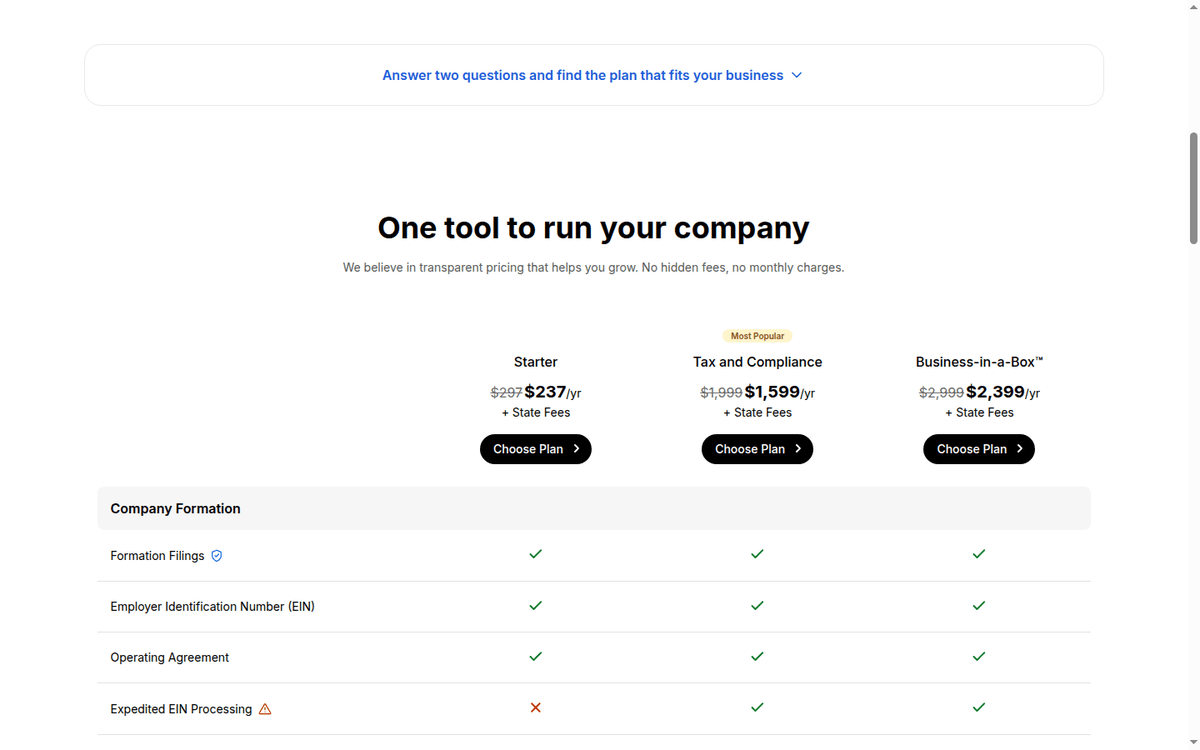
Most US LLC formation services stop at the formation itself. The platform we cover here starts there and bundles bookkeeping, tax filings, registered agent, and a compliance dashboard into annual subscriptions marketed at non-US founders.
We pulled the live pricing data to break down what each tier actually includes, where the extra charges land, and who should pick which subscription (doola.com/pricing, captured [2026-09]).
All plans bill annually — only the top tier offers a monthly installment option.
State fees are added on top of every plan at formation time.
Expedited EIN is included on annual billing.
Trial — the 30-day free trial is on Pulse only; the other three plans charge from day one.
What the platform actually does
The product is positioned as an all-in-one back-office stack for non-resident and remote founders who want to form a US company and stay compliant (doola.com/pricing).
The platform handles the LLC or C-Corp filing, gets the EIN (Employer Identification Number) from the IRS, drafts the Operating Agreement, acts as the registered agent, supplies a virtual mailing address in the state of formation, and offers bookkeeping and tax prep as paid add-ons.
For solo founders and small teams who do not want to coordinate a formation service, a bookkeeper, a CPA, and a registered agent separately, the bundle is the actual product. The cheapest plan is formation-focused. The most expensive is the full stack, with financial statements and quarterly tax estimates on top.
The target audience is non-US founders and remote-first entrepreneurs who want a US entity but cannot easily open a US bank account, get a registered agent, or file their own taxes from abroad. The pricing page is candid about scope: not every industry or entity type fits the standard package (doola.com/pricing).
Where pricing is and is not
The pricing lives at doola.com/pricing. All four plans are billed annually by default. Only the top tier shows a monthly installment rate alongside the annual one. State fees are line items added on top of each plan. Public pricing covers LLCs, C-Corps, and most of the common state filings.
Foreign qualifications (forming in a state you do not live in) and certain add-ons require a quote.
We did not check out a plan, form a real LLC, or contact the sales team. The numbers below come from the pricing page read in September 2026. We could not verify the published “Get 40+ hours/month back” claim on the top tier against any external benchmark.
What each plan includes
| Plan | Annual list price | Intro first-year price | Trial | Includes |
|---|---|---|---|---|
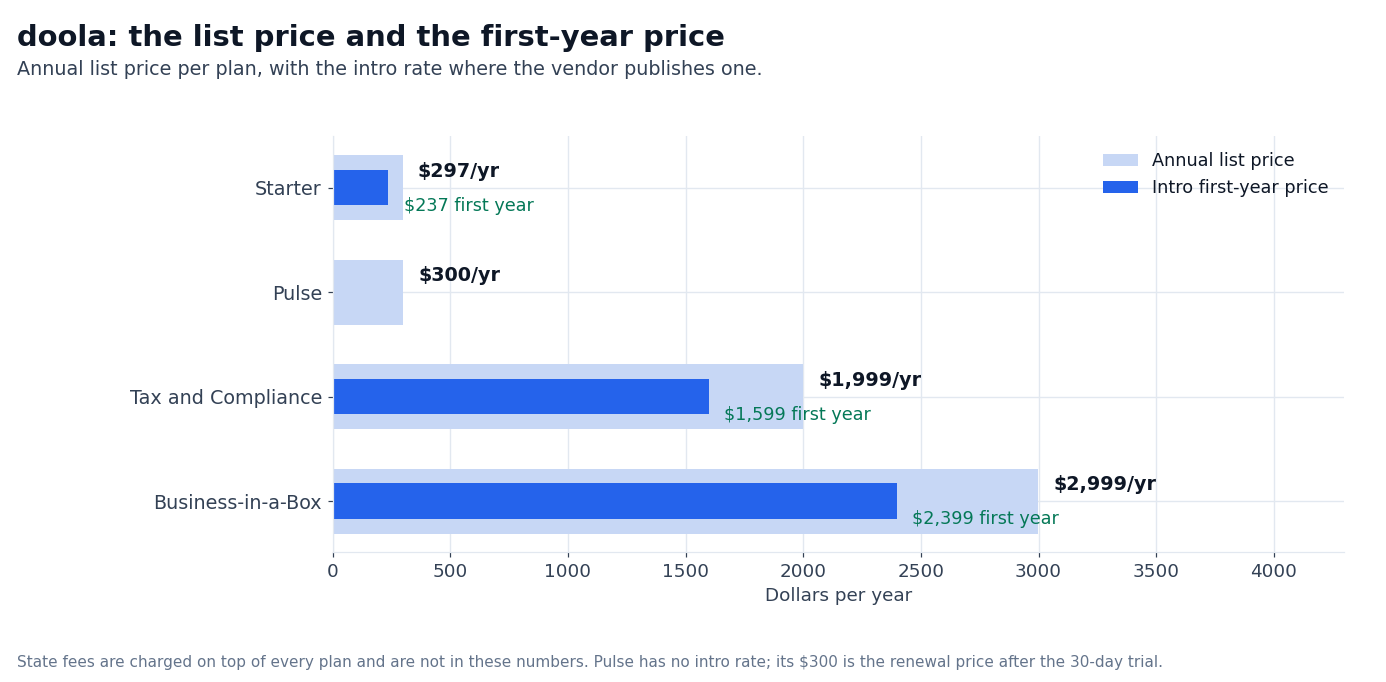
| Starter | $297/yr | $237/yr (save $60) | None | LLC or C-Corp formation in 1–2 business days, EIN, Operating Agreement, Registered Agent, Virtual Mailing Address, Compliance Dashboard, Expedited EIN Processing (annual only) |
| Pulse | $300/yr (renewal) | n/a | 30-day free trial | Automated bookkeeping — categorization, reconciliation, monthly close — plus payout tracking, expense monitoring |
| Tax and Compliance | $1,999/yr | $1,599/yr (save $400) | None | Federal and state tax filings and a 1:1 tax consultation |
| Business-in-a-Box™ | $2,999/yr | $2,399/yr (save $600) | None | Everything in Starter + Pulse + filings tier, plus monthly financial statements, synced bookkeeping and estimated quarterly taxes |
The monthly installment on the flagship tier lists at $329/mo, drops to $263/mo with the intro annual discount. State fees are separate on every plan.
Starter: formation only, no bookkeeping
Starter is the right product if all you need is a US LLC or C-Corp filed fast. For $297 list / $237 intro you get the formation filing in 1–2 business days, the EIN, the Operating Agreement, the Registered Agent service for the year, a virtual mailing address in the state of formation, and the compliance dashboard (doola.com/pricing).
What it does not include: bookkeeping, tax filings, annual report filings. Those are separate paid tiers. If your company transacts more than a few thousand dollars a month, expect to add Pulse or an outside bookkeeper within the first year.
The intro discount is for the first year only. Renewal reverts to the $297 list price. Canceling before the year is up does not unwind a formation that has already been filed. The page publishes a money-back guarantee for errors in the formation itself rather than a general refund.
Pulse: bookkeeping for a flat $300/yr
Pulse is the bookkeeping product, sold separately from the formation services. The pricing model is straightforward: 30-day free trial, then $300/year flat (doola.com/pricing). For that fee you get categorized transactions, bank and payment processor integrations, payout tracking, expense monitoring, and a monthly close.
At $25/month, Pulse is cheaper than most US bookkeeping services targeted at non-resident founders. The catch is scope: Pulse is bookkeeping, not tax. You still need the Tax and Compliance plan if you also want federal and state filings handled.
The 30-day trial is the only free trial across the four plans. The other three charge from day one. Pulse does not include formation, so if you start a Pulse trial without a Starter subscription, the bookkeeping happens but the company is not yet filed.
Tax and Compliance: the most popular plan
Tax and Compliance is flagged “Most Popular” on the pricing page (doola.com/pricing). Annual list is $1,999, intro is $1,599 (save $400). It covers federal and state tax filings and a 1:1 tax consultation. The plan does not bundle bookkeeping, so most users pair it with Pulse.
This tier compares well for founders who would otherwise pay a CPA $400 to $800 per filing. The catch is the same as Pulse: this only handles filings, not the operations layer underneath.
For a single-member US LLC with no payroll, the federal tax filing is the 1040 with Schedule C (or 1120-S). For multi-member LLCs, the tax prep is heavier. The pricing page does not break out the filings tier per-entity-type; it is a flat $1,999/yr regardless.
Business-in-a-Box: the all-in-one
Business-in-a-Box is the flagship — it packages Starter, Pulse, and Tax and Compliance into one annual subscription and adds monthly financial statements, synced bookkeeping and estimated quarterly taxes. The annual list is $2,999, intro $2,399 (save $600). Monthly installments are listed as $329/mo, dropping to $263/mo with the annual discount.
This is the only plan where a monthly rate is published alongside the annual one. The math is the same: $2,399/year ≈ ~$200/month, but billing monthly carries the higher rate.
The published claim is “Get 40+ hours/month back”. This is the vendor’s own marketing copy and we did not verify it with a third-party survey (doola.com/pricing). What we can say is that the bundle replaces three vendors — a formation service, a bookkeeper and a CPA — for most solo-founder scenarios.
State fees: the line item most people miss
Every plan lists pricing “plus state fees”. This is a separate charge per formation that varies by state. Delaware, Wyoming, and New Mexico are usually the cheapest. California and Massachusetts are typically the most expensive. For a Delaware LLC, state fees are typically $90.
For a California LLC, the state’s LLC franchise tax alone can add several hundred dollars on top of the filing fee.
The pricing page does not publish a state fee table. You see the exact state fee inside the checkout flow once you pick your state and entity type.
We did not run a checkout to capture exact state fees. The numbers above are widely reported by third-party formation comparison sites, not by the platform directly. Your actual state fee depends on the Secretary of State schedule on the day you file.
When this platform fits
A good fit when:
- You are a non-US founder who wants to form a US LLC or C-Corp without coordinating three vendors.
- You want bookkeeping and tax prep handled through one subscription.
- You are willing to pay annual rather than monthly.
- You want a registered agent included for the first year.
When it does not fit
- Founders who only need formation and already have a US-based CPA and bookkeeper. The Starter price is competitive, but the bundle math gets worse if you only need the formation line.
- Anyone who needs monthly-only billing on the lower tiers. Only the top tier publishes a monthly installment rate.
- Founders in regulated industries (fintech, healthtech) where the standard package is not enough and a custom compliance stack is required.
- Teams that prefer open-source tooling. The platform is closed-source SaaS.
Compared with adjacent formation services
- Northwest Registered Agent is cheaper for registered-agent-only buyers. Northwest does not bundle bookkeeping and tax prep the way this stack does.
- Incfile / Bizee offers basic LLC formation for $0 plus state fees, but does not bundle tax prep.
- Firstbase targets the same non-US founder audience with similar bundled pricing. The comparison usually comes down to which bundle fits the entity choice and which state you plan to form in.
- The platform’s edge is the integrated back-office (formation + bookkeeping + tax) as a single annual subscription.
For solo founders and remote teams, the strongest alternative to consider is Firstbase. The strong comparison page on most third-party review sites tends to lean on price-per-feature, not time saved.
The verdict in short
The Starter plan is competitive for non-US founders who only need formation + EIN + Registered Agent. The math gets interesting at Pulse ($300/yr flat for bookkeeping) and Tax and Compliance ($1,999/yr for filings) — both come out ahead of typical CPA fees for a single LLC.
Business-in-a-Box is the right pick for founders who would otherwise stitch three vendors and would value the bundled statements and quarterly tax estimates. State fees are the hidden variable; check them inside the checkout flow before you commit.
FAQ
Does the platform charge monthly?
Only the top tier publishes a monthly installment. Starter, Pulse, and Tax and Compliance are billed annually. The flagship plan can be paid $329/month, dropping to $263/month with the annual intro discount (doola.com/pricing).
Is the intro price for the first year only?
Yes. Each plan lists a higher “renewal” rate (or reverts to the list price after the intro year on annual plans). Renewal pricing kicks in automatically unless you cancel.
Is the EIN included?
Yes on Starter and the flagship tier, with expedited processing on annual billing. Pulse and Tax and Compliance do not include formation, so EIN is not on those plans because there is no formation to file for.
Does Pulse handle tax filing?
No. Pulse is bookkeeping only. Tax filings are part of Tax and Compliance or Business-in-a-Box.
What are state fees?
State-specific filing fees charged by the Secretary of State at formation. They are not part of the subscription and vary by state. The pricing page does not publish a full state-fee table (doola.com/pricing).
What happens if I cancel mid-year?
The formation has already been filed. The bookkeeping or tax subscription stops at the next renewal cycle, and the page publishes a money-back guarantee only for errors in the formation itself, not a general refund.
Sources
How we put this together: the four plan prices, the intro rates, the monthly installment and the state-fee notes come from doola.com/pricing, quoted as displayed.
We have not formed an entity through the platform, run its bookkeeping or contacted its sales team, so the state-fee figures stay flagged as third-party estimates.
Figures that depend on a real workload, a real target or a real integration are flagged where they appear in the text rather than being estimated.
Disclosure: this article contains affiliate links. If you buy through them we may earn a commission at no extra cost to you. Commission never changes our scoring or the order of a ranking.