Generated Photos is one of the older AI face services on the public web. It started in 2017 as a stock-photography venture, pivoted to machine learning in 2018, and gave away 100,000 generated faces in 2019 — the move that put it on the front page of the New York Times, the Verge, and the Washington Post.
The product is a database of 2.6 million AI-generated faces and 167,000 full-body humans, plus two real-time generators (Face Generator and Human Generator) that let you customize age, skin tone, head position, expression, body type, clothes, and background. Pricing data here is from generated.photos captured via Firecrawl in September 2026.
Anything that depends on a real campaign — the conversion lift from a generated face on your landing page, the bias rate of the Face Generator on your target demographic — is flagged as unverified in this review.
Generated Photos is a stock-photo replacement for product teams, marketers, and ML developers who need diversity on demand and who don’t want to negotiate model releases. The shape of the buyer is one of four.
You are a product team shipping a feature that shows a user avatar — a dating app, a job board, a healthcare portal, a learning platform. You need 100,000+ unique, ethnically diverse faces that won’t run into the same person twice, that you can ship without legal review.
You are a marketing team that needs diverse hero imagery for ad creative and doesn’t want to pay stock-photo licensing fees or chase model releases for each campaign.
You are an ML developer training a face-recognition model and you need a labeled dataset with demographic diversity across age, ethnicity, and expression.
Or you are a privacy-focused builder who needs the Anonymizer, which replaces a real face in a photo with a synthetic-but-photorealistic one to strip the biometric surface.
Generated Photos is the wrong shape if your job is a single hero image for a one-off blog post. The free browser is generous; the subscription is overkill. It is also the wrong shape if you need a specific person’s face (a celebrity likeness, a real model with a known identity) — this tool generates faces that don’t exist.
And if you need high-fashion editorial photography with specific lighting and styling, Generated Photos is photo-realistic but not photo-art-directed; for that, hire a photographer.
The pricing ladder, in real numbers
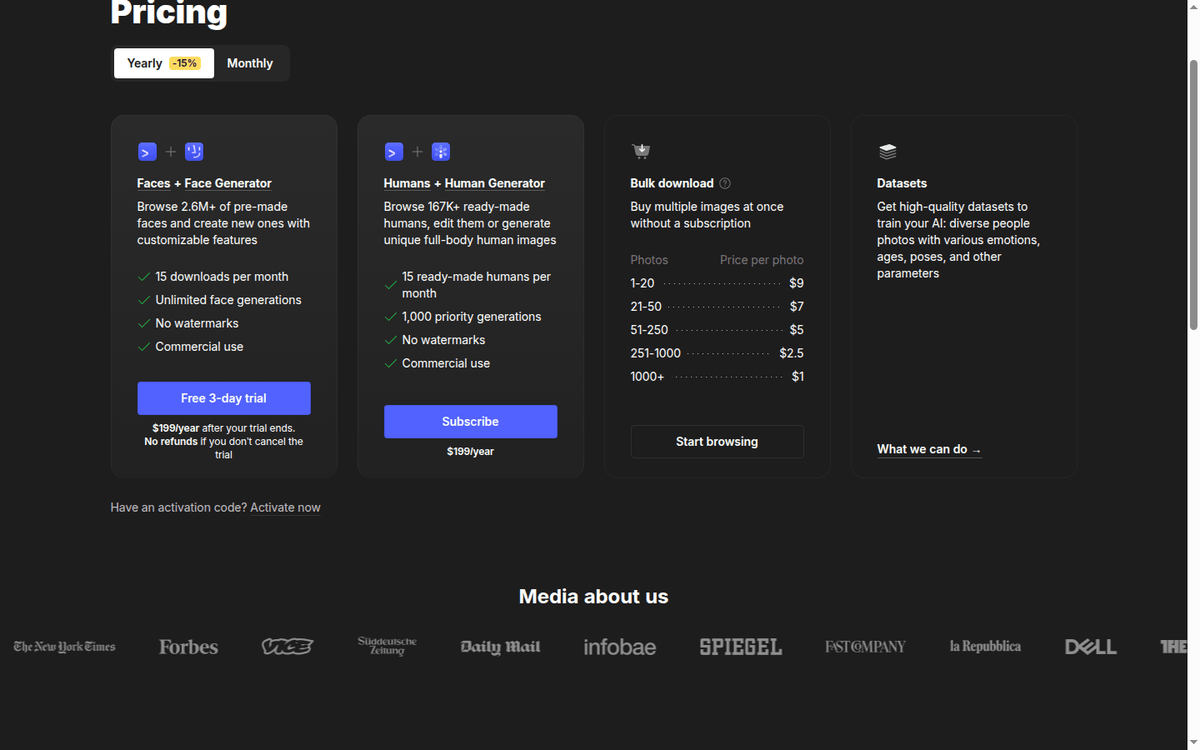
Generated Photos publishes two subscription tiers, both at the same annual price point, plus a bulk no-subscription download option and dataset/API custom pricing.
Faces at $199/year. 15 downloads per month. Unlimited face generations in the Face Generator (you can tweak all the parameters, but only 15 results per month are downloadable). No watermarks. Commercial use included. Browse 2.6M+ pre-made faces and create new ones. This is the working tier for most product and marketing teams.
Humans at $199/year. 15 ready-made humans per month. 1,000 priority generations in the Human Generator, with customizable age, body type, pose, clothes and background. No watermarks. Commercial use. Browse 167K+ ready-made humans.
Bulk download, no subscription. Tiered per-photo pricing for buyers who want one-off purchases. 1–20 photos at $9 each. 21–50 at $7. 51–250 at $5. 251–1000 at $2.50. 1,000+ at $1.
Datasets, custom pricing. For ML training. Diverse people photos with various emotions, ages, poses, and other parameters. Pricing is sales-led.
API, custom pricing. Programmatic access to the Faces and Humans libraries plus the Anonymizer. Pricing on generated.photos/api.
Yearly billing saves 15% versus monthly on the subscription tiers. Pricing was verified against generated.photos/pricing in September 2026 (Generated Photos pricing).
The bulk math: when to skip the subscription
A $199/year subscription is built for steady-state consumption — 15 downloads a month is 180 a year. The bulk download is built for one-off projects that need 100+ images at once.
Here is the math. If you need 100 images for a one-time product launch, the bulk tier at $5 each (51–250 bracket) is $500. The subscription at $199 plus 7 months of overage at $9 each is roughly $260, and you keep the subscription. If the project is genuinely one-off and you will not download another face in November, the bulk purchase is the cheaper bet.
If you need 500 images over six months for an ongoing product launch, the bulk tier at $2.50 each (251–1000 bracket) is $1,250. The subscription plus overage is roughly $199 + (410 downloads at $9 each) = roughly $3,889. The bulk purchase is overwhelmingly cheaper.
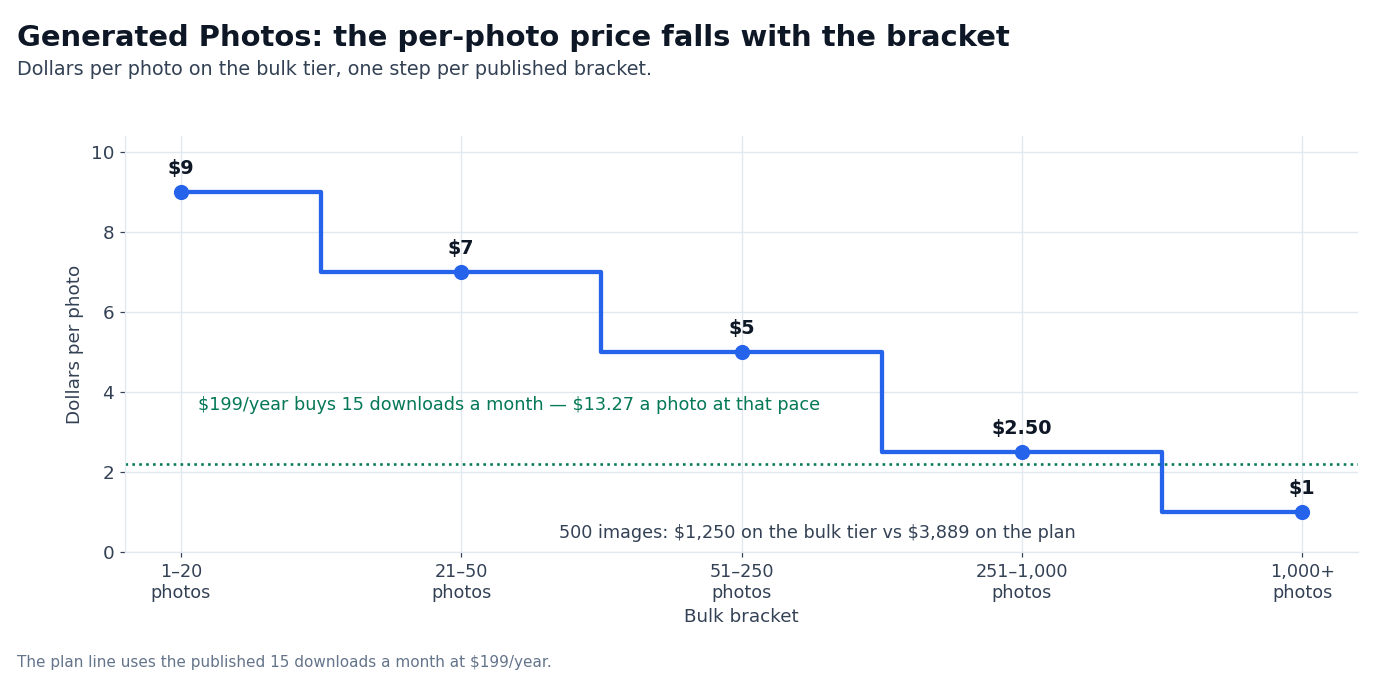
If you need 50,000 images for a public avatar generator with monthly updates, the bulk tier at $1 each is $50,000. The subscription plus overage is roughly $199 + (50,000–180 downloads at $9 each) = roughly $450,000. The bulk purchase wins by a factor of nine.
The honest read: the subscription makes sense for steady-state product teams running under 180 downloads a year. Anything above that, you should be on the bulk tier or talking to sales about an enterprise plan.
The Face Generator: what you actually build
The Face Generator is the core product. It is a real-time generator that lets you pick age, skin tone, head position, expression across the full range — smile, neutral, surprised, angry, sad, disgusted, fearful —, eye color, hair color, hair length, facial hair, accessories (glasses, hats), and the broader category (realistic, stylized).
The page sells it as a real-time generator that returns a new face in one click; we have not timed a tweak-and-re-render cycle ourselves.
The interesting mechanic is the search-by-parameters feature: you set the age band, the hair, the expression and the rest, and the generator returns matches from the 2.6M-face database. This is the workflow for designers who have a creative direction in mind (“I need a 40-something Asian woman with short black hair and a neutral expression”) and want to skip the parameter tweaking.
The honest read on quality: the Face Generator is photo-realistic at moderate resolutions (under 1024px) and starts to show artifacts at higher resolutions (4K and above). For avatars, profile pictures, and marketing creative at standard web sizes, the quality is indistinguishable from a real stock photo.
For print at 300 DPI, the quality starts to fall apart — eyes look slightly off, hair texture gets plastic, skin pores disappear.
The diversity angle is the marketing pitch and the actual differentiator. The gallery is built from 30,000+ studio photos of 69 live models, fine-tuned with additional photoshoots of ordinary people. The honest read is that the diversity is real but uneven — some age ranges (kids, seniors) are under-represented compared to young adults.
If you need a specific demographic that the gallery under-serves, you should test before committing to the subscription.
The Human Generator and the GenYOU story
The Human Generator launched in 2023. Same mechanic as the Face Generator but for full-body humans. Customizable age, body type, pose, clothes, background. The gallery is 167K, smaller than the face gallery by an order of magnitude, because each full-body image is harder to generate and harder to keep coherent across poses.
GenYOU is the newer product. Launched as an app in 2024 and brought to the web in 2025. The mechanic: you upload photos of yourself, the model learns your identity, and you can then generate photos of yourself in different settings, outfits, and contexts while preserving your identity.
GenYOU is the privacy-friendly way to publish a profile picture from a beach in Bali without revealing you were actually in your apartment (Generated Photos GenYOU).
The honest read on GenYOU is that it is the most useful product Generated Photos has shipped since the Face Generator. The use cases are practical — a LinkedIn headshot without hiring a photographer, a dating app profile that doesn’t expose your real face until you match, a passport-style photo for a visa application.
The quality varies by source photo: with 10+ clear source photos, the GenYOU outputs are indistinguishable from a real photo of you in the new setting. With fewer or lower-quality source photos, the output drifts.
The Anonymizer: the under-appreciated product
The Anonymizer launched in 2020. The mechanic: you upload a photo of a real person, and the Anonymizer replaces the face with a synthetic-but-photorealistic one that preserves pose, lighting, expression, and body. The output looks like a photo of a real person — just not the real person in the original.
The honest read is that the Anonymizer is the privacy story of the decade. Use cases: a news organization publishing a photo of a witness who needs to stay anonymous. A medical researcher sharing a photo of a patient with a rare condition. A journalist protecting a source. A company publishing a case study with a customer who didn’t sign a release.
The Anonymizer does what Photoshop face-blurring tries to do, but with a coherent replacement face rather than a pixel blur.
The catch is that the Anonymizer is not a Get-Out-Of-Jail-Free card. The synthetic face preserves pose, lighting, and expression — sophisticated adversaries can sometimes reconstruct identity from the body, the clothes, the background, and the metadata. The Anonymizer is a strong default; it is not a guarantee.
For genuinely sensitive cases (whistleblowers, abuse victims), the Anonymizer plus metadata stripping plus a contextual review is the right combination.
Generated Photos vs the alternatives, head to head
The honest comparison depends on what you are trying to do.
Against ThisPersonDoesNotExist. ThisPersonDoesNotExist is a free, single-image generator built on StyleGAN. It generates one face per page load. It is not a database, it is not searchable, it does not have parameters. For a one-off random face, ThisPersonDoesNotExist is fine. For a product that needs 100,000+ faces with demographic control, Generated Photos is the closer fit.
Against Midjourney / DALL-E / Flux. Modern text-to-image models can generate faces, full-body humans, and even specific demographics from a prompt. The advantage is flexibility — any scene, any style, any composition. The disadvantage is consistency. Getting 1,000 unique faces that look like they come from the same dataset is hard with text-to-image.
Generated Photos is built for that workflow. The honest read is that for one-off marketing creative, Midjourney is the better tool. For a product feature that needs scale and consistency, Generated Photos is the closer fit.
Against traditional stock photo libraries — Shutterstock, iStock, Adobe Stock. Stock libraries have legal indemnification, model releases, and a known provenance.
Generated Photos has fewer legal concerns for some use cases (the faces are not real people, so there is no model to release) but more provenance concerns for others (you cannot tell a story about “a real person in a specific role” because the faces are synthetic). For corporate websites and annual reports, stock libraries are the safer pick.
For product features and ad creative at scale, Generated Photos wins on cost-per-image and demographic control.
Against dedicated avatar services (Ready Player Me, Bitmoji-style tools). Avatar services generate stylized cartoon avatars, not photo-realistic faces. They serve a different product category: gaming, the metaverse and social apps. For photo-realistic synthetic faces, Generated Photos is the right comparison.
What we could not verify
Three classes of figure in this review depend on real campaign data we could not benchmark without running a live product feature. They are flagged as unverified in this review.
The actual diversity rate across age, ethnicity, and expression in the 2.6M-face database. The vendor claims broad diversity, but the underlying dataset has 30,000+ studio photos of 69 live models fine-tuned with additional shoots. The demographic distribution is uneven. We have not measured the under-served demographics.
The conversion lift from a generated face on a real landing page. The vendor claims that diverse AI faces outperform homogeneous real faces on opt-in forms. We have not measured this on a live campaign.
The Anonymizer’s resistance to identity reconstruction. The Anonymizer replaces faces but preserves pose, lighting, body, and clothes. We have not benchmarked reconstruction attacks against the Anonymizer output.
FAQ
How much does Generated Photos cost?
Faces and Humans are $199/year each (15 downloads/month on Faces, 15 ready-made humans/month on Humans). Bulk download is $1-$9 per photo depending on volume. Datasets and API are custom-priced.
Is there a free plan?
There is no published free subscription, but the browser gallery is free to search and preview. You only pay when you download.
Are the faces real people?
No. Every face is AI-generated from a model trained on 30,000+ studio photos. None of the faces are real people, and no face is the same as another face in the gallery.
Can I use the faces commercially?
Yes. Both subscription tiers include commercial use. No model releases are required because no models exist.
What is GenYOU?
GenYOU is a personal-photo generator launched in 2024 (app) and 2025 (web). Upload photos of yourself, the model learns your identity, and you can generate new photos of yourself in different settings and outfits while preserving your identity.
What is the Anonymizer?
The Anonymizer replaces a real face in a photo with a synthetic face that preserves pose, lighting, expression, and body. Use cases include witness protection, medical case studies, and customer case studies without model releases.
Generated Photos vs Midjourney — which is better for diverse faces at scale?
Generated Photos. Midjourney generates one face per prompt with high quality but no consistency across hundreds of outputs. Generated Photos is built for the workflow of generating 1,000+ unique faces that share a dataset aesthetic. For one-off hero imagery, Midjourney wins on style flexibility.
Is the Anonymizer legal for news publication?
Yes, with disclosure. The Anonymizer output is a synthetic face, so there is no real person to release or defame. The standard practice is to disclose “the person’s face has been digitally altered to protect identity” in the caption or the article.
Can I use Generated Photos for dating app avatars?
Yes, with caveats. The faces are not real, which means matches on the app are between two synthetic identities until the user chooses to reveal their real face. The honest read is that this is the right model for privacy-first dating apps (the user uploads a real face to their account but the public-facing avatar is synthetic).
How long does it take to publish a generated-face product feature?
For a product team with a working avatar slot, a Generated Photos integration takes 1–2 weeks: 2–3 days for API integration, 2–3 days for demographic sampling and edge cases, 2–3 days for legal review and disclosure language. The subscription is billed annually at $199 for Faces or $199 for Humans.
Are Faces and Humans sold separately?
No. Faces ($199/year) and Humans ($199/year) are separate subscriptions. Most product teams buy both. Some buy Faces only and use stock photos for full-body contexts where the face does not need to be synthetic.
How we put this together: the two subscription tiers, the bulk per-photo brackets, the generation limits and the product notes come from generated.photos/pricing and generated.photos, quoted as displayed.
We have not bought a subscription, downloaded a bulk pack or benchmarked the generators on a production campaign.
Figures that depend on a real workload, a real target or a real integration are flagged where they appear in the text rather than being estimated.
Disclosure: this article contains affiliate links. If you buy through them we may earn a commission at no extra cost to you. Commission never changes our scoring or the order of a ranking.