What it is — one library of 1,720 labs behind two businesses: a free-to-join community side and a paid workforce side.
Who is already on it — 4.3M members and roughly 19M hours of playtime, with Deloitte, Toyota, Puma and Siemens on the customer wall.
What decides the buy — whether the team is onboarding juniors or benchmarking AI security agents, which is where the AI Range comes in.
The catch — the public enterprise page now reads “Let’s talk”, so the budget conversation runs through sales rather than a checkout.
Hack The Box is the platform most security managers name first when the conversation turns to hands-on training, and in 2026 it is two businesses under one brand.
After a decade of community-built CTFs and a pivot to enterprise cyber-readiness, HTB is the largest active cybersecurity skills platform on the market. 1,720 labs, 4.3M members, and roughly 19M hours of playtime on the books as of September 2026.
Forrester named HTB a Leader in Cybersecurity Skills and Training Platforms, and the customer wall on its pricing page carries:
- Deloitte
- Toyota
- Puma
- Verizon
- Emerson
- AWS
- Siemens
- Intel
- Booking
- Autodesk
- Bugcrowd
It sits in our privacy and security coverage alongside the VPN and storage vendors that show up in the same procurement conversations.
The single piece that distinguishes HTB in 2026 is the AI Range — first of its kind for benchmarking AI security agents against human operators.
This review is what an editorial team looks at before recommending HTB to a security team lead or to a SOC analyst looking for the next move.
We walk through the platform shape (Academy, Labs, Pro Labs, Battlegrounds, Cloud Labs, AI Range), pricing for individual members and for security teams (Build, Grow, Scale, Workforce Development), and the AI Range against a traditional range. The last section covers where HTB stops being the right pick.
Pricing comes from hackthebox.com captured in September 2026, with a Wayback snapshot of the January 2026 Build / Grow / Scale tier page for the only published per-seat number. The figures that would need a paid team account to verify are collected at the end of this review rather than estimated here.
What Hack The Box is in 2026
HTB runs two product surfaces on one platform. The first is a free-to-join community for individual learners and security professionals, the “Hacker” side. The second is a paid enterprise workforce-development program for security teams and SOCs, the “Business” side. Both surfaces share the same content library.
As of September 2026 its own counters read 1,720 hacking labs, and the tier page describes 700+ offensive and defensive security labs on Build with 1,000+ additional labs on Grow. The same platform runs a CTF-style red-team versus blue-team exercise engine.
The platform retired an earlier content-tier naming (VIP, Pro) into a simpler free / paid split, but the individual side retains VIP, Pro, and Academy-on-top as the three components an individual can buy.
The community runs active. New machines and challenges ship every week. The Academy side (academy.hackthebox.com) hosts guided learning paths covering beginners through senior practitioners, with content authored by working security professionals.
Content is browser-based — you get a target machine IP and a browser-attached hacking console, with no local VM setup. That last piece is what closed the gap between HTB and TryHackMe for the entry-level user; HTB used to require local Kali installation, and the browser-based labs removed the friction.
The content library spans all major cybersecurity domains:
- offensive (web, binary, AD, mobile)
- defensive (DFIR, SOC analysis, threat hunting)
- cloud (AWS, GCP, Azure)
- specialized tracks like AI red-teaming
The generalist range is competitive with the best cybersecurity training vendors in the industry.
The deep specialist tracks — particularly AI red-teaming — are where HTB is the first-mover in 2026.
The platform pieces, briefly
| Layer | What it is | Audience | Notes |
|---|---|---|---|
| Starting Point | Educational machines with tutorials | Beginners | Walks a learner through an easy machine with hand-holding |
| Machines | Single Linux/Windows targets | All skill levels | New machines each week; ranks by points + difficulty |
| Challenges | CTF-style tasks (crypto, reversing, web, etc.) | Intermediate+ | Smaller in scope; great for skill-sharpening |
| Sherlocks | DFIR / forensics labs | Blue teamers | Log dumps to investigate |
| Pro Labs | Multi-machine enterprise networks | Mid-senior offensive | Dante, Offshore, RastaLabs, Cybernetics, etc. |
| Battlegrounds | Cloud-hosted red vs blue exercise range | Enterprise teams | Multi-tenant scenarios with replay |
| Cloud Labs | AWS, GCP, Azure target environments | Cloud security | Multi-cloud targets with realistic misconfigurations |
| AI Range | Adversarial range for AI agents | New in 2026 | Released early 2026, first of its kind for benchmarking AI security agents vs human operators |
| Academy | Guided learning paths | All levels | Browser-based, exam vouchers + certifications |
| Pwnbox | Browser-based hacking console | All users | No local Kali required |
The platform is the closest thing to a one-stop shop for hands-on cybersecurity skill development that exists in the market in 2026. The piece no other vendor has shipped yet is the AI Range, where AI agents and human operators are scored against each other on the same scenarios.
That release alone makes HTB the obvious vendor of record for any AI red-team program that wants to evaluate Anthropic, OpenAI, or open-weight models against realistic attack chains.
What Hack The Box costs, seat by seat
The two pricing tracks have very different transparency.
Individual pricing
The Hacker side is free to join. Free members get access to a subset of the machine library and the public challenges. Paid individual tiers run on the HTB account page (app.hackthebox.com/plans). The published tier names have shuffled in 2025–2026. The underlying structure is a free tier + VIP tier, with Academy as a separate add-on subscription.
- Free: Access to the public library (about a third of the total machine list), community forum access, Pwnbox console. Resets new content at a slower cadence than paid.
- VIP / Pro (individual): Full library, weekly new machines + challenges, Pro Labs access, dedicated VIP machines, exam vouchers for HTB certifications (CPTS, CWEE, CDSA and the Offensive AI Expert track). Annual and monthly options; the annual runs materially cheaper per month.
- Academy add-on: Subscription for guided learning paths and instructor-led content; can be purchased standalone or bundled.
The HTB certifications — CPTS, CWEE and CDSA, plus the Offensive AI Expert (COAE) track launched in 2026 — all use the in-platform labs as the practical exam environment.
That is the only meaningful reason to take a paid individual plan: you need the in-platform access to sit the practical exam, and you want it during the weeks before the exam attempt.
A certification is a hiring signal rather than a guarantee, and the resume side of that hunt is what our Rezi review covers.
Enterprise pricing
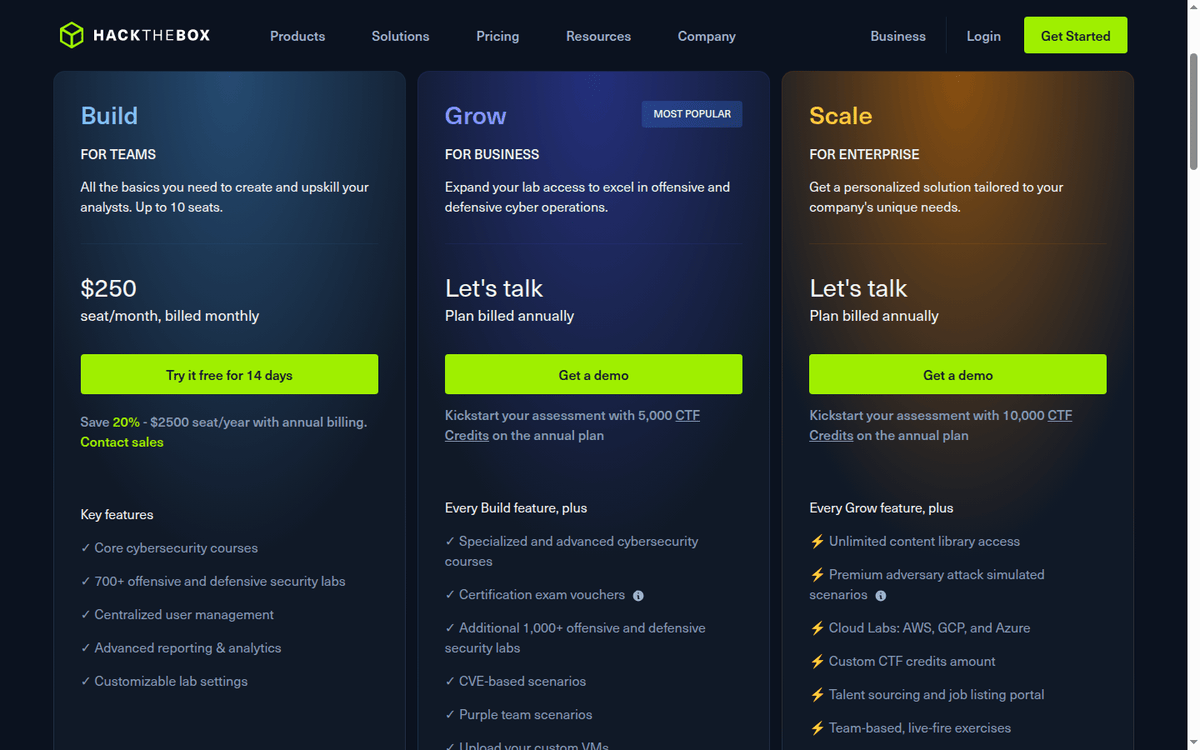
The enterprise side bills per seat or per organization. The publicly visible pricing transitioned to “Get a demo” / “Let’s talk” in 2026. The actual tier structure is in the Wayback Machine snapshot of January 2026 and in HTB’s enterprise pitch decks (the captured Build/Grow/Scale numbers are from the January 2026 Wayback capture of hackthebox.com/pricing).
| Plan | Audience | Pricing (Jan 2026) | Headline features | Wrap |
|---|---|---|---|---|
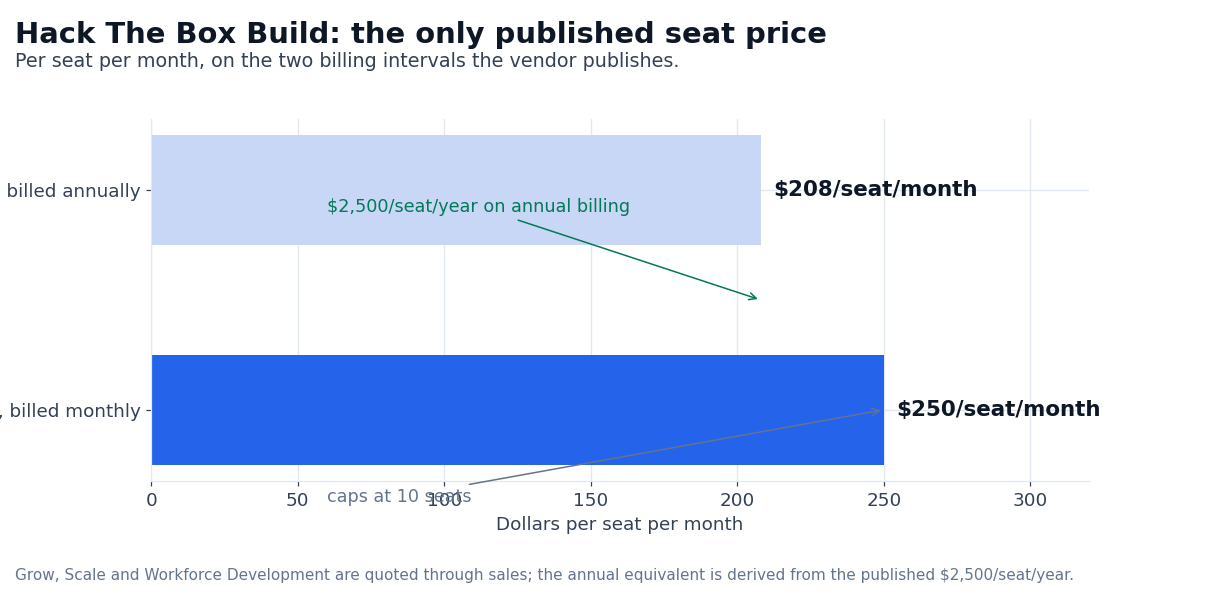
| Build | Teams up to 10 seats | $250/seat/month, billed monthly | 700+ offensive and defensive labs, core courses, 14-day free trial, customizable lab settings, centralized user management, advanced reporting | Annual: $2,500/seat/year, a 20% saving (≈$208/seat/month) |
| Grow | Business (Most Popular) | Let’s talk (annual) | Specialized + advanced courses, 5,000 CTF credits, certification vouchers, 1,000+ additional labs, CVE-based scenarios, purple-team scenarios, custom VM upload, dedicated CSM, industry-mapped library | The plan every SOC profiler and red-team manager should ask about |
| Scale | Enterprise | Let’s talk (annual) | Unlimited content access, premium adversary attack simulation, Cloud Labs on AWS / GCP / Azure, custom CTF credit amounts, talent sourcing and job listing portal, team-based live-fire exercises, dedicated CSM | 10,000 CTF credits; the platform CTOs and CISOs buy |
| Workforce Development | Public sector | Let’s talk | Unlimited course library + certification vouchers, training plan mapping to MITRE ATT&CK and NIST NICE KSA, LTI compliance, LMS integration, ANAB-accredited certificate programs | Education and federal procurement path |
The mechanics of the pricing that buyers should understand:
- Per-seat cap matters at Build only. Build caps at 10 seats; Grow and Scale expand that cap. The per-seat number changes only at the Build tier; at Grow and Scale you negotiate on team size and content access.
- CTF credits kick in at Grow (5,000/year) and Scale (10,000/year). CTF credits run internal Capture-the-Flag exercises on the platform; if your team runs quarterly CTFs, this is the line item worth asking about.
- Cloud Labs is Scale-only. If your team’s training need is centered on AWS / GCP / Azure misconfigurations and modern attack chains, you are in Scale — there is no Grow-equivalent for cloud-only training.
- The free trial is Build-tier (14 days). Public sector, education, and federal procurement tracks do not get a self-serve trial; they go through a sales motion.
The pricing model has shifted toward “negotiate” since mid-2025. Buyers who prefer published-per-seat pricing for procurement comparison should use the Build tier as the anchor and ask the sales team for the seat-equivalent figures on the Grow and Scale tiers in writing. That is also the data point your finance team will need to file with the security budget.
The AI Range: what it does, and what it doesn’t
The HTB AI Range launched in 2026 as the first controlled adversarial environment built to test and benchmark autonomous AI security agents against human operators. It is a cyber range where AI agents from any vendor (Anthropic, OpenAI, open-weight, internal-built) compete with human operators on real-world attack scenarios, with controlled environments and side-by-side scoring.
The point is measurement, not training. AI red-teaming is a new discipline — most enterprises have no way to know whether the AI agent their team built (or plans to buy) is competent at the attack chains their SOC actually faces.
The HTB AI Range provides an environment where you can run an AI agent against the same target set a human red-teamer would face. Comparable metrics. A clear answer on whether the AI is ready for production use.
The AI Range is the most differentiated feature HTB ships in 2026. No other vendor in the cybersecurity training space has a comparable offering. Buyers who are evaluating AI security tooling as a separate procurement line should expect HTB to come up in vendor briefings more than once over the next 18 months.
When HTB is the right training buy
HTB is the strongest available option in three workloads. First, building a SOC or red team from a junior cohort. The Academy content and the structured progress (Starting Point → Machines → Pro Labs) train junior analysts on real-world scenarios. The certifications are an objective signal of competence for hiring panels.
Second, running adversarial exercises for an enterprise security team. The Cloud Labs on AWS / GCP / Azure (Scale tier) match the modern enterprise environment. The AI Range (early access via Scale) provides benchmarking for AI agents.
Third, running CTFs and adversarial exercises for public-sector teams and federally aligned programs. The Workforce Development plan maps to MITRE ATT&CK and NIST NICE KSA, the framework most federal cyber training buys against.
For learners at the individual level, HTB is the largest free-to-join hands-on cybersecurity community in the world and the most cost-effective on-ramp to the CPTS or CWEE certifications. For enterprise security teams, HTB is the leading platform among cybersecurity skills and training platforms per Forrester and the most widely deployed in Fortune 500 SOCs and red teams.
Three workloads where HTB is not the best fit, in the same order. First, certification-only buyers who want a quick cert on a budget. OffSec PEN-200 and the SANS Institute GIAC tracks deliver more immediately-credible paper for less time on the platform. Second, teams that need vendor-specific tooling training.
HTB is broad across cloud, web, AD, mobile — but Cisco- or Palo-specific training tracks are usually cheaper with the vendor’s own training credits. Third, organizations that need strict on-prem deployments. HTB labs run in the browser against cloud-hosted targets.
If compliance forces a fully air-gapped training environment, look at RangeForce’s on-prem and the SANS Institute on-prem Cyber Range offerings. The data-residency half of that question is the one our encrypted cloud storage roundup puts to storage vendors.
HTB against TryHackMe, OffSec and SANS
| Vendor | Differentiator | Best for | Watch out for |
|---|---|---|---|
| Hack The Box | Largest library, AI Range, Forrester Leader, free individual tier | Junior cohort + enterprise skills + AI red-teaming | Enterprise pricing is negotiable, not published |
| TryHackMe | More guided, friendlier for absolute beginners | Beginners, learners who want a story-driven path | Less deep at senior levels, smaller Pro Labs selection |
| OffSec (PEN-200 / OSCP) | OSCP cert is the industry gold standard | Career switchers targeting OSCP | Older tooling, no live-fire community |
| LetsDefend | Blue-team / SOC focus, IR scenarios | SOC analysts, defenders | No offensive depth, smaller content library |
| RangeForce | On-prem + cloud, NIST NICE mapping | Federal / highly regulated orgs | Higher price point, smaller community |
| SANS Institute | GIAC, instructor-led, on-prem cyber range | Government, defense, regulated industries | Most expensive, hard to self-fund |
The honest comparison in 2026: TryHackMe is the better on-ramp for a learner who has never touched a Linux terminal. LetsDefend is the better on-ramp for a SOC analyst who needs to do incident response. OffSec is the better bet for the OSCP resume line.
HTB is the better bet for the broad cybersecurity skills platform with the largest community, the deepest AI red-team program, and the strongest enterprise procurement story of the four.
Where the published numbers stop
The AI Range launch, the Forrester Leader position, the customer logos, the LetsDefend acquisition and the depth of the content library do back the marketing claim — that part checks out. HTB is the largest cybersecurity skills and training platform on the market.
The honest version: HTB is a community-first platform in the early user journey and an enterprise procurement product in the later stage, and the company has spent 2024–2026 building the muscle to support enterprise procurement. The pricing page is the part that is still under-served.
“Get a demo” is not where most security managers want to start. The Build-tier price is the only line a SOC manager can pin down without a sales conversation. A procurement process that starts with a target per-seat figure for HTB usually needs a 4–6-week sales cycle and the published Build-tier number as the anchor.
If your enterprise procurement process needs a fully self-service purchase, the platform will push you to the Build tier in writing and the Grow / Scale pricing in the demo call.
The second honest version is on pricing predictability for individuals. The free tier is genuinely large and genuinely useful. The individual VIP tier is the right upgrade if you are working toward any of the HTB certifications (CPTS, CWEE or CDSA) and need the in-platform exam access.
The annual price is the most cost-efficient; the monthly price is the way to test whether you actually use the platform. Most learners who pay monthly for two months switch to annual in the third month — that is the inflection point.
What a paid team account would have measured
Four classes of figures in this review depend on a real workload measurement that we could not benchmark without a paid team account. We would test every one of them on your own team first.
The first is the actual Grow / Scale seat-equivalent pricing. The Build tier is $250/seat/month billed monthly, or $2,500/seat/year on annual billing — that is the published number. The Grow and Scale tiers are quoted only in sales conversations; pricing varies by team size, content bundle, and contract length.
The second is the actual AI Range access pattern. AI Range is in the Scale tier; the standalone availability for individual or two-person teams is not visible on the public site at capture time. The third is the Workforce Development public-sector pricing.
That track quotes on a per-organization basis; the public-sector team should plan on a 30-day RFP / sales cycle.
The fourth is everything on the individual side. The app.hackthebox.com/plans page is JS-rendered and returned no values to our capture. The VIP monthly number, the Academy standalone price and the exact annual discount are therefore missing from this review rather than guessed.
It has been gaining seniority since 2024, and the Offensive AI Expert (COAE) certification for AI red teamers launched alongside it in 2026.
The exception is the individual Academy content: guided paths run in a browser-attached VM, and the same exercises can be replicated locally from the labs documentation. What you lose is the platform’s grading and exam environment.
The certification list on academy.hackthebox.com names:
- Penetration Testing Specialist
- Web Exploitation Specialist
- Web Exploitation Expert
- Active Directory Pentesting Expert
- Defensive Security Analyst
- Junior Cybersecurity Associate
- Offensive AI Expert
A bug-bounty-hunter certificate is not among them, even though the acronym still circulates in blog posts about the platform.
The pages behind these numbers
- Hack The Box home — platform positioning, customer logos, AI Range, Forrester Wave mention (captured September 2026).
- Hack The Box Hacker — individual / community side, lab count (1,720), member count (4.3M), playtime hours (19M) (captured September 2026).
- Hack The Box pricing — enterprise Build / Grow / Scale tier names and “Let’s talk” pricing (captured September 2026).
- Wayback Machine — Hack The Box pricing, January 2026 snapshot — captured Build ($250/seat/month or $2,500/seat/year), Grow (5,000 CTF credits), Scale (10,000 CTF credits + Cloud Labs + AI Range) tier pricing.
HTB FAQ
Is Hack The Box free?
Yes, the Hacker side has a permanent free tier that includes a subset of the machine library, the Pwnbox browser console, and the community forum. The free tier is enough for a beginner learner to start, but the practical exam environments for the HTB certifications (CPTS, CWEE and CDSA) are gated on the paid individual VIP tier.
How much does Hack The Box cost for a team?
Public pricing on the team side moved to “Get a demo” in 2026. The only currently published team tier is Build at $250/seat/month, billed monthly. Build caps at 10 seats and includes 700+ labs and a 14-day free trial. Grow (Most Popular) and Scale (Enterprise) are negotiated via sales. Plan for a 4–6-week sales cycle.
What is the AI Range?
AI Range is HTB’s new (early 2026) adversarial range for benchmarking autonomous AI security agents against human operators. It runs in the Scale tier. Buyers evaluating AI security tooling (e.g., AI red-teamers, AI SOC analysts) should ask for access to AI Range as part of any Scale eval.
Is Hack The Box harder than TryHackMe?
Yes, the median HTB machine is harder than the median TryHackMe room. HTB’s Starting Point and Academy content are designed to close the gap for beginners, but the platform’s center of gravity is at the mid-level practitioner. TryHackMe’s center of gravity is at the beginner. Both are good — pick the one that matches where your skill is now.
What is the CPTS certification?
CPTS (Certified Penetration Testing Specialist) is HTB’s flagship offensive certification. The exam is a practical, hands-on test against an HTB network environment. The cert is respected in the industry. It is not yet as widely recognized as the OSCP or SANS GPEN.
Can I self-host Hack The Box?
No. HTB is a SaaS platform that runs the labs in the browser and the targets in cloud-hosted environments. If your compliance requires strict on-prem deployments, look at RangeForce or SANS Institute’s on-prem Cyber Range.
Does HTB have a public bug bounty program?
HTB runs a corporate bug-bounty program for the platform itself through HackerOne.
How we put this together: the Build seat price, the certification list and the AI Range details come from hackthebox.com/pricing and academy.hackthebox.com, with a January 2026 Wayback snapshot for the retired tier page, read in September 2026. We have not bought a paid HTB team account.
Figures that depend on a real workload, a real target or a real integration are flagged where they appear in the text rather than being estimated.
Disclosure: this article contains affiliate links. If you buy through them we may earn a commission at no extra cost to you. Commission never changes our scoring or the order of a ranking.