Rezi is an AI resume builder built around a single claim: most job seekers never get past the Applicant Tracking System (ATS), and most AI-written resumes read the same way to the person screening them.
It started in 2015 as a weekend project in Seoul and now claims about 4.5 million users and a 62% interview rate among them. Pricing data here is from rezi.ai captured via Firecrawl in September 2026.
Three things here depend on a real job search rather than on the vendor’s own pages. This review does not benchmark them: the actual interview rate on your resume, the offer rate after applying through Rezi, and the AI Writer output quality on your specific career history.
What decides the buy is not the feature list. It is whether the Rezi Score’s 23 metrics match the job description you are applying against, and whether the AI Writer draft survives a human edit. The last question is billing: one Lifetime payment, or a Pro subscription that carries the human resume review.
Who Rezi is built for, and who it is not for
Rezi is a resume builder for job seekers who care about ATS scoring, who want one bill instead of three tools (resume builder + cover letter + LinkedIn optimizer). It is not for anyone who wants to learn LaTeX. The shape of the buyer is one of four.
You are a recent graduate or first-time job seeker who has been rejected from roles you are clearly qualified for. The Rezi Score is the headline feature for that buyer — 23 metrics scoring your resume against ATS filters, the same family of scoring most Fortune 500 HR departments use.
You are a mid-career professional changing industries, where the keyword gap between your last role and the new one is the bottleneck. The AI Keyword Targeting reads the job description and patches your bullet points to match.
You are a freelancer who sends a tailored resume per proposal — Rezi’s unlimited-resumes model on Pro at $29/mo is built for that workflow. Or you are a university career services office — Enterprise at $99/mo per 200 users is the playbook.
Look elsewhere if your job search is “send the same CV to 500 recruiters.” The tool is built for tailoring, not for blasting. It is also the wrong shape if you need a CV in a non-English language other than Spanish or Mandarin — Rezi’s templates are English-first.
For creative roles (designer, copywriter, art director), Rezi’s templates are conservative. The resume needs to look like the role, not like the tool.
The pricing ladder, in real numbers
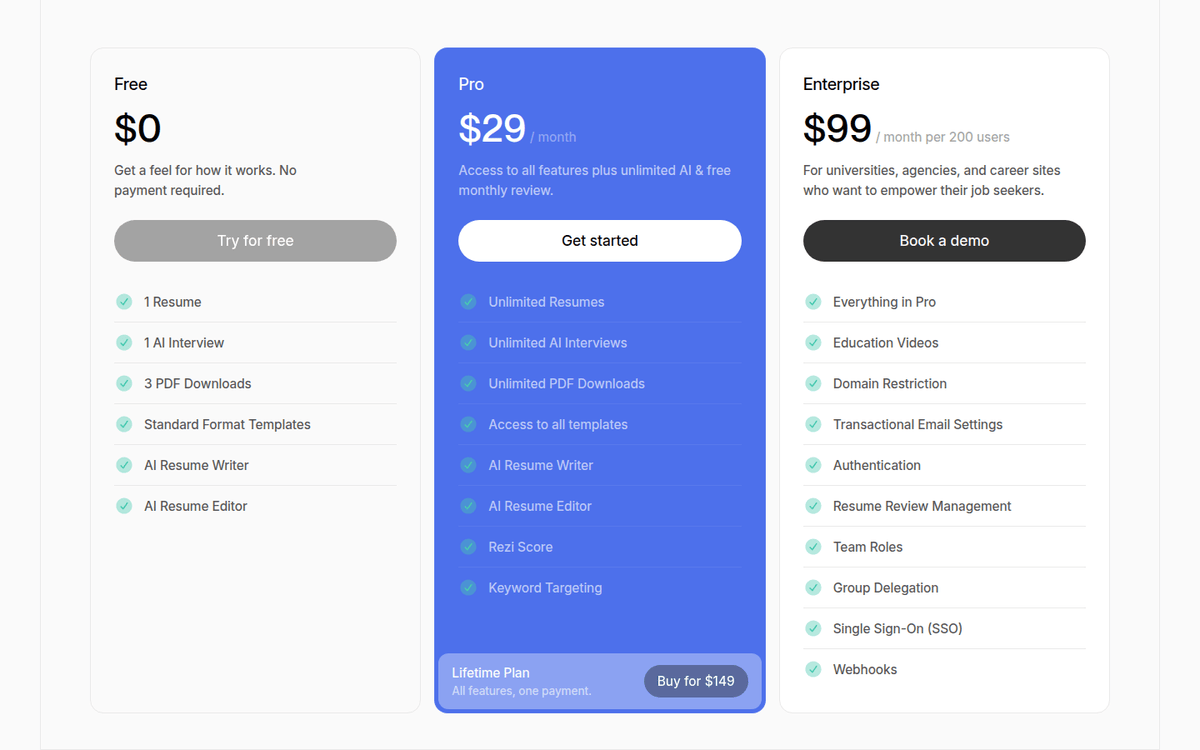
Rezi publishes four tiers. The Lifetime tier is the unusual one — a $149 one-time payment that unlocks the same features as Pro but without the monthly bill. For a job seeker who will be on and off the tool for 3–5 years, the Lifetime math is the most important decision in the price ladder.
| Tier | Price | What it covers |
|---|---|---|
| Free | $0 | 1 resume, 1 AI Interview, 3 PDF downloads, the Standard templates, unlimited cover and resignation letters, no credit card |
| Pro | $29/mo | Unlimited resumes, unlimited AI Interviews and PDF downloads, every template, the AI Writer and AI Editor, Rezi Score, AI Keyword Targeting, one free human Resume Review a month |
| Lifetime | $149 one-time | Everything in Pro, with no monthly bill; the free monthly human review is excluded |
| Enterprise | $99/mo per 200 users | Everything in Pro plus Education Videos, Domain Restriction, Transactional Email Settings, Authentication, Resume Review Management, Team Roles, Group Delegation, SSO and Webhooks |
Pro at $29/mo. Unlimited resumes, unlimited AI Interviews and unlimited PDF downloads. All templates, the AI Resume Writer and Editor, Rezi Score and AI Keyword Targeting are included, plus one free Rezi Resume Review per month (a human reviewer, not AI). Pro is the working tier for most job seekers.
Lifetime at $149 one-time. Everything in Pro:
- unlimited resumes
- AI tools
- downloads
- all templates
Excludes the free monthly human review (you can still buy it a la carte from $8 per review). Lifetime is built for the job seeker who plans to be active for more than six months.
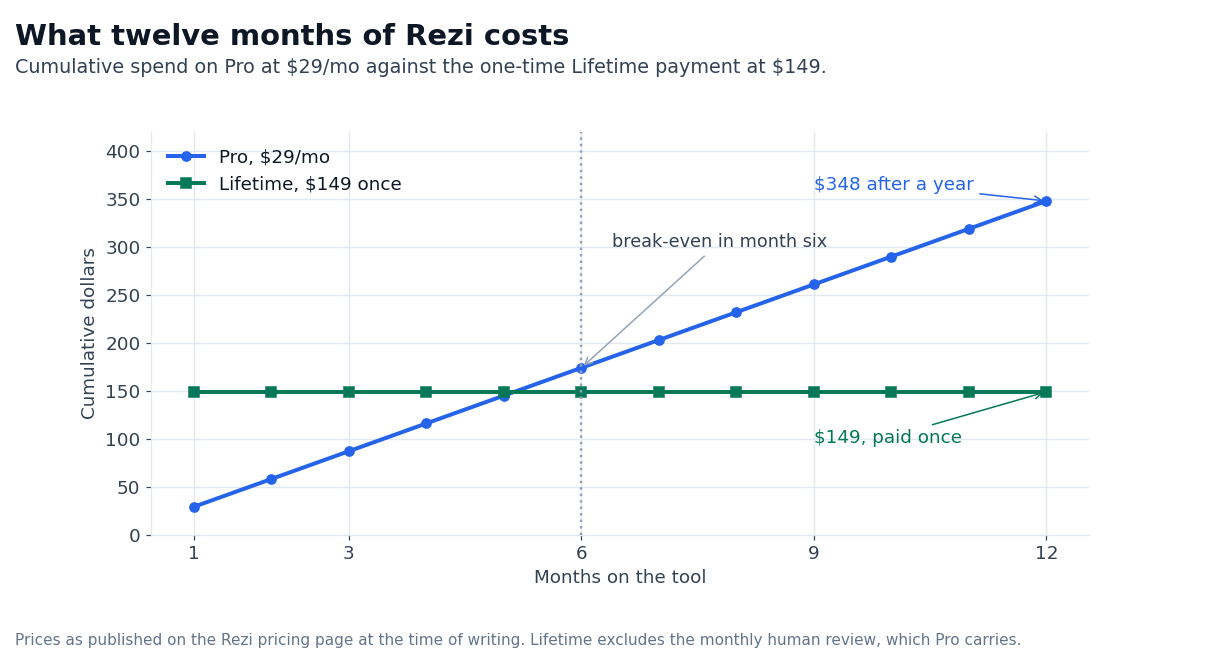
At Pro’s $29/mo, Lifetime breaks even at month six. It saves $199 in that first year – Pro’s $348 annual bill against the $149 one-time payment – and the full $348 in every year after.
Enterprise at $99/mo per 200 users. Everything in Pro, plus:
- Education Videos
- Domain Restriction
- Transactional Email Settings
- Authentication
- Resume Review Management
- Team Roles
- Group Delegation
- SSO
- Webhooks
A 70% Commission on Upgrades for the institution if users upgrade to a paid plan.
Enterprise is built for universities, government workforce programs, and outplacement agencies.
Add-on: Rezi Resume Review is the human-reviewed service, from $8 per review. Pro includes one free per month; on Free or Lifetime it is an add-on you buy. The reviewer is a real person, not AI — useful if you want a second opinion on a critical application.
All paid plans carry a 100% money-back guarantee within 30 days. Pricing was verified against rezi.ai/pricing in September 2026 (Rezi pricing).
Lifetime against paying monthly, in dollars
The unusual decision in Rezi’s pricing is the Lifetime tier at $149. For most SaaS, this is a marketing gimmick. For Rezi it is the right fit for the audience.
Pro at $29/mo over a year is $348. Pro over two years is $696. Lifetime at $149 is a one-time bill. The break-even is at month six. After six months of active job searching, every additional month is savings.
The honest read: if your job search will be active for more than six months, Lifetime pays for itself. If your job search will be active for less than six months — a layoff, a single switch, a return to work — Pro at $29/mo is the cheaper bet. You stop paying when you stop.
If you are a freelancer who will rewrite their resume twice a year for the next decade, Lifetime at $149 vs Pro at $348/yr is the most lopsided financial decision you will make today.
The Lifetime tier excludes the free monthly human review. The math still works: a paid review starts at $8 per review, so a Lifetime buyer pays review by review and still stops paying the $29 monthly Pro bill from month six on. The review is the only meaningful Pro-only-on-monthly feature on the Lifetime tier.
The Rezi Score: 23 metrics that decide whether you get past the ATS
The headline feature is the Rezi Score — a 0–100 score across 23 metrics that evaluates how well your resume will perform against Applicant Tracking Systems. The score is computed live as you edit, and updates with every bullet change.
The 23 metrics break into four families, and the split is the most useful part of the feature. Format metrics (14 of the 23):
- single-column layout
- no tables
- no headers/footers
- consistent date formats
- no images
ATS software parses a resume top-to-bottom. The format scoring rewards the boring, parseable layout.
Content metrics (5 of the 23) check for:
- quantified bullet points (numbers, percentages, dollar amounts)
- strong action verbs
- no filler words
- 1–2 line bullets
- and no first-person pronouns
Length metrics (2 of the 23) enforce 1 page for under 10 years experience, 2 pages for senior, and no overflow.
Keyword metrics (2 of the 23) score the AI Keyword Targeting result and the keyword density against the target job description.
The Rezi Score is not the same as an ATS. It is a heuristic that approximates how an ATS would parse and score your resume. Rezi’s score is closer to a grammar check than to a full ATS simulation. The rules it enforces are correct. But no scoring system can predict the actual recruiter who opens your PDF.
The score is most useful as a guardrail: if your Rezi Score is below 70, your resume is going to fail the ATS at most Fortune 500 companies. If your Rezi Score is above 85, you have done what you can do on the formatting side, and the rest is up to the strength of your experience.
The Pro-only feature on the score is “Full” vs “Limited.” On Free, you get the score with caps on the content and keyword checks. On Pro, the full 23-metric score runs on every edit.
AI Keyword Targeting: the feature that actually moves the needle
The other headline feature is AI Keyword Targeting. The mechanic is straightforward. You paste the job description into Rezi. The tool scans the description for keywords an ATS would look for. It then suggests edits to your bullet points to incorporate those keywords without keyword stuffing.
The honest read is that this is the feature that justifies the upgrade from Free to Pro.
If the writing bottleneck is the content around the application rather than the resume itself, our Castmagic review covers the AI engine built for podcast and video repurposing, and the Scalenut review covers long-form drafting.
The reason is the gap between “what the job description says” and “what your resume says.” Most job seekers write their resume once and submit it to every role. Most job descriptions are tailored. The Keyword Targeting closes that gap.
A typical workflow: you are a sales manager applying to a RevOps role.
The job description mentions:
- pipeline management
- CRM administration
- cross-functional collaboration
- data-driven decision-making
Your resume says you managed a team of 12 reps and grew revenue 28% YoY. Keyword Targeting rewrites the bullet to include the description’s keywords. The resume reads worse, but it matches the job description.
The catch: this feature is what makes AI-generated resumes similar. If every applicant is running their resume through AI Keyword Targeting against the same job description, the resumes converge.
The honest answer is to use Keyword Targeting for the structure and the keyword density, then rewrite the first sentence of each role in your own voice. The result is a resume that is both ATS-friendly and human-readable.
The editor: what you actually build
A Rezi resume is built in a left-side editor and right-side preview. The editor has five sections:
- header (name, contact, links)
- summary
- experience
- education
- and skills
Each experience entry takes a company, a role, a date range, and a list of bullet points
Each bullet has:
- a length indicator
- an action-verb indicator
- a quantification indicator
- and a Rezi Score impact indicator
The AI Writer, on Pro, generates bullets from a one-line prompt. The prompt is “What did you do at [company] in [role]?” The output is three to five bullets that follow the action-verb / quantified / outcome pattern. AI Writer is best for filling out roles you cannot remember clearly. It is not best for the role you care about.
The generic AI output reads like generic AI output.
The AI Editor, on Pro, rewrites existing bullets. You write “Responsible for managing team.” The Editor rewrites it to “Led a 7-person team to deliver [outcome] across [scope].” The Editor is the more useful of the two AI features. It does not replace your judgment; it enhances it.
The Chrome Extension, new in 2026, lets you autofill job applications on LinkedIn, Indeed, and Greenhouse from your Rezi resume. The mechanic: the extension reads the form fields, maps them to your Rezi data, and submits. Useful for the volume applicant; less useful for the tailored applicant.
The Rezi Resume MCP, new in 2026, is the most interesting feature for AI-aware users. It exposes your Rezi data through the Model Context Protocol, the same protocol that powers Claude Desktop and Cursor.
The mechanic: an AI assistant can read your resume, edit your bullets, and write tailored cover letters, all using your live Rezi data.
Rezi documents the endpoint, the tool list and the supported clients on its own site. The Rezi Resume MCP documentation is the reason some buyers choose Rezi over Resume.io or Teal.
The format story: ATS, PDFs, and the DOCX trap
Rezi exports to PDF, DOCX, and Google Drive. The PDF is the default and the recommended export for ATS submissions — most ATS software reads PDFs and DOCX, but the DOCX is a known failure mode.
The reason: many ATS systems misparse DOCX tables, headers, and footers, and Rezi’s DOCX export preserves the layout structure that breaks the parser. The PDF flattens the layout to a single column with no headers, which is what most ATS want.
The 5 Rezi formats — Standard, Compact, Modern, Bold, Alternative — cover the four main resume conventions. Standard is the conservative single-column layout. Compact is the dense one-pager. Modern is the most current. Bold is the experimental. Alternative is the academic CV style.
For most job seekers, Standard or Compact is the right choice; Modern is fine for tech roles where a slight design premium is acceptable; Bold is for designers; Alternative is for researchers and academics.
The Cover Letter Builder, the Resignation Letter Builder, the AI Interview Practice, and the Job Search tool round out the suite. The Cover Letter Writer on Pro is good — it pulls from your resume data and the target job description, same mechanic as Keyword Targeting.
The Resignation Letter Writer is a one-shot tool, useful once in your career. The AI Interview Practice, on Pro, is unlimited — it simulates interview questions, scores your answers, and gives feedback on structure. The Job Search tool is a job board aggregator built into Rezi. It is lighter than LinkedIn but uses the same mechanic.
Rezi vs the alternatives, head to head
The honest comparison depends on what you are trying to do.
Against Resume.io. Resume.io is the closest direct competitor — ATS-aware resume builder, similar tier ladder, similar feature set. Resume.io is slightly cheaper at the entry tier and has more language support.
Rezi wins on the AI features (Rezi’s AI Writer and AI Keyword Targeting are more polished) and on the Lifetime tier ($149 one-time, where Resume.io publishes no comparable lifetime plan). Resume.io wins on language support (it builds resumes in more languages; Rezi is English-first with limited Spanish and Mandarin).
For a US job seeker, Rezi is the right call. For an international job seeker, Resume.io is closer.
Against Teal. Teal is the resume-plus-job-search-tracker. Teal’s strength is the job tracker — it logs every application, every status update, every recruiter contact. Teal’s resume builder is functional but lighter than Rezi’s. The honest comparison: Rezi is the resume tool; Teal is the job-search tool. Most job seekers end up using both. Rezi’s free tier is more usable than Teal’s.
Against Kickresume. Kickresume is the resume-plus-website builder. Kickresume’s strength is the website export — you can publish your resume as a personal website. Kickresume’s AI Writer is less polished than Rezi’s. For a job seeker who wants a website alongside the resume, Kickresume is competitive. If you only want the resume, Rezi is the closer fit.
Against LinkedIn’s “Easy Apply.” LinkedIn Easy Apply is the no-resume path — you click “Apply,” your LinkedIn profile becomes the application. The honest read is that Easy Apply is the high-volume, low-tailoring path: your LinkedIn profile is the application, and nothing in it was written for the role.
That is the high-tailoring, lower-volume path. Conversion rates on a tailored Rezi resume with a Rezi-generated cover letter are higher. But you are applying to fewer roles.
What this review does not measure
Three classes of figure in this review depend on real job-search data, and we could not benchmark any of them without running a live campaign on a real searcher’s account.
The actual 62% interview rate on the Rezi marketing page. The metric is self-reported by Rezi. We have not independently measured it on a real campaign. The honest read is that the 62% figure on the Rezi pricing page sounds high and may be measured against a self-selected sample of users who complete the full Rezi workflow.
The AI Writer output quality on a specific career history. The Writer generates generic content from a one-line input. The actual quality on your specific career depends on how much detail you provide in the input. We have not measured the gap between Writer output and what an experienced human resume writer would produce for the same input.
The Rezi Resume Review value on a real application. The human-reviewer service is an add-on. The actual value depends on the reviewer assigned and the application in question. We have not measured whether a Rezi human review outperforms a free review from a university career-services office, and the answer would differ from one application to the next.
A multi-resume campaign (one resume per target role) takes 4–6 hours.
Rezi FAQ: what buyers ask before they pay
How much does Rezi cost?
Rezi starts at $0/mo for Free, $29/mo for Pro, $149 one-time for Lifetime, and $99/mo per 200 users for Enterprise. All paid plans include a 30-day money-back guarantee.
Does Rezi have a free plan?
Yes. Free supports:
- 1 resume
- 1 AI Interview
- 3 PDF downloads
- Standard Format templates
- AI Writer
- AI Editor
- unlimited cover and resignation letters
No credit card required.
What is the Rezi Score?
The Rezi Score is a 0–100 score across 23 metrics that evaluates your resume against ATS best practices: format, content, length, keywords. On Pro the full 23-metric score runs on every edit. On Free the score is limited to format and length metrics.
Is Rezi the same as Resume.io?
No. Rezi and Resume.io are both ATS-aware resume builders but they diverge on AI features and Lifetime pricing. Rezi has the stronger AI Writer and the Lifetime tier at $149. Resume.io has broader language support and a slightly cheaper entry tier.
Does Rezi work with LinkedIn?
Yes, indirectly. The Rezi Chrome Extension autofills LinkedIn Easy Apply forms from your Rezi resume data. The full Rezi experience is on rezi.ai, not inside LinkedIn.
Can Rezi write a cover letter?
Yes. The Cover Letter Writer on Pro generates a cover letter from your resume data and the target job description. The output is a starting point — you edit, you customize, you send.
Who founded Rezi?
Rezi was founded in 2015 by Jacob Jacquet. The company is based in Seoul, South Korea, and has helped over 4.5 million job seekers since September 2019.
Does Rezi charge per resume after the Free limit?
No. Pro is unlimited resumes at $29/mo. Lifetime is unlimited resumes at $149 one-time. The Free tier is the only plan with a resume cap (1 resume). There is no per-resume fee on any paid plan.
Can Rezi replace my career counselor?
Partially. Rezi replaces the resume-writing portion of a career counselor’s job. It does not replace interview coaching, salary negotiation, or industry research. The Rezi AI Interview Practice is good for rehearsing answers; it is not a substitute for a real human coach on a high-stakes interview.
How long does it take to publish a Rezi resume?
For a job seeker with a working history and a target job description, a single resume can be live in 1–2 hours. The AI Writer cuts the bullet-writing time. The Rezi Score cuts the formatting time. The AI Keyword Targeting against the job description cuts the tailoring time.
Does the Lifetime tier include the free monthly human resume review?
No. The free monthly human review is a Pro-only feature. On Lifetime, you can still buy the review a la carte from $8. The Lifetime tier includes everything else in Pro:
- unlimited resumes
- AI Writer
- AI Editor
- Rezi Score
- Keyword Targeting
- all templates
How we put this together: the tier prices, the Lifetime terms, the monthly human-review terms and the add-on rate come from rezi.ai/pricing and rezi.ai/about, read in September 2026. We have not run a paid Rezi plan or a real job-search campaign.
Figures that depend on a real workload, a real target or a real integration are flagged where they appear in the text rather than being estimated.
Disclosure: this article contains affiliate links. If you buy through them we may earn a commission at no extra cost to you. Commission never changes our scoring or the order of a ranking.