Scalenut’s 2026 rebrand is a repositioning rather than a rebuild: Cruise Mode, keyword clusters and the content audit are still the platform, and AI Visibility Tracking is the new headline product sitting above them.
Sixty percent off for life on a tool that also doubled its own limits.
That is the offer Scalenut leads with, and it is the first thing to price out before the GEO story gets a hearing.
The platform spent most of its life as an “AI + SEO” content product. Its flagship feature, Cruise Mode, walked you from keyword research to a 2,000-word draft in a single guided flow.
In 2026, it has quietly rebranded itself as a GEO platform — Generative Engine Optimization — and the new headline product is AI Visibility Tracking. It reads prompts analyzed in ChatGPT, Google AIO and Perplexity, refreshed weekly, on the same dashboard where Cruise Mode still lives.
Two products share the Scalenut name in 2026: the SEO content platform that Cruise Mode, keyword clusters and the content audit belong to, and the AI-citation layer sitting above them.
Here is the whole product, in the order a buyer meets it. The tier ladder — Starter, Plus, Professional — comes first, then the GEO pivot and what it changed, the AI Visibility Tracking feature set, the Cruise Mode workflow and the integrations.
The close is the honest fit: where Scalenut is the right choice, where it is the second pick, and where it should not be on your shortlist at all.
Every dollar figure on the pricing table comes from scalenut.com/pricing, read in September 2026.
Public pages are the only source here — no paid Scalenut seat was bought for the article. Numbers that only a real workload can settle, like your ranking lift on a thirty-article pilot or your prompt-citation visibility on a real brand, stay publisher claims rather than measured results.
That is the same convention we use in our alli ai review and across our review pieces.
Scalenut rebranded from an “AI + SEO” content platform to GEO-first in 2026: AI Visibility Tracking now sits on top of Cruise Mode, keyword clusters and the content audit that the old plans already sold.
The offer — an annual rate held for the life of the account, with the article, optimize, cluster and audit allowances doubled under it.
Starter — the content platform plus a first slice of the GEO layer: the entry rung of a two-product ladder.
Plus — the middle rung, with bigger allowances on every meter, and the plan for a ten-to-thirty-article team.
Professional — the only tier that carries all three engines and the full prompt allowance.
The catch — the discount is the headline; the GEO layer and the naming overlap with Surfer are what the trial has to settle.
Two products under one brand in 2026
Scalenut is a content + GEO platform, and the platform has four working parts. It sits with the rest of our AI tools reviews, next to the writing and visibility stack.
AI Visibility Tracking
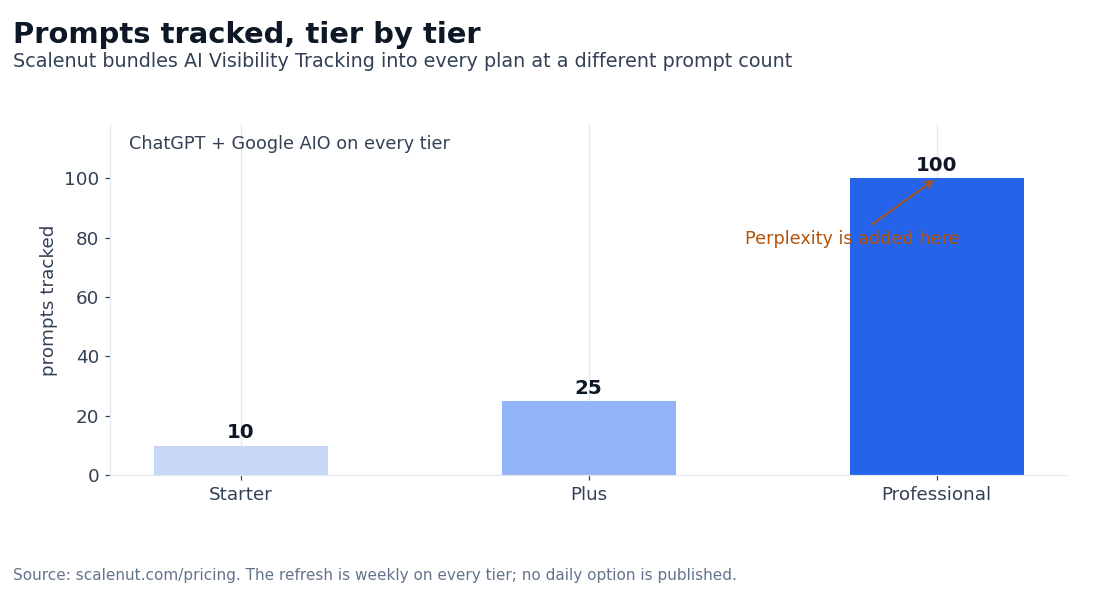
AI Search Visibility. Track how often your brand is cited in ChatGPT and Google AIO, with Perplexity added on Professional. The pricing page labels the refresh weekly on every tier. The prompts are tracked at the engine level, and you choose which ones you care about: 10 on Starter, 25 on Plus, 100 on Professional.
Cruise Mode and clusters
GEO Content Engine. The Cruise Mode + Keyword Clusters + Content Optimization suite, which is the original Scalenut product. Cruise Mode walks you from a seed keyword to a 2,000-word draft. Keyword clusters build topical clusters around a head term; content optimization scores your existing draft against the top SERP results and tells you what NLP terms to add.
Content audit
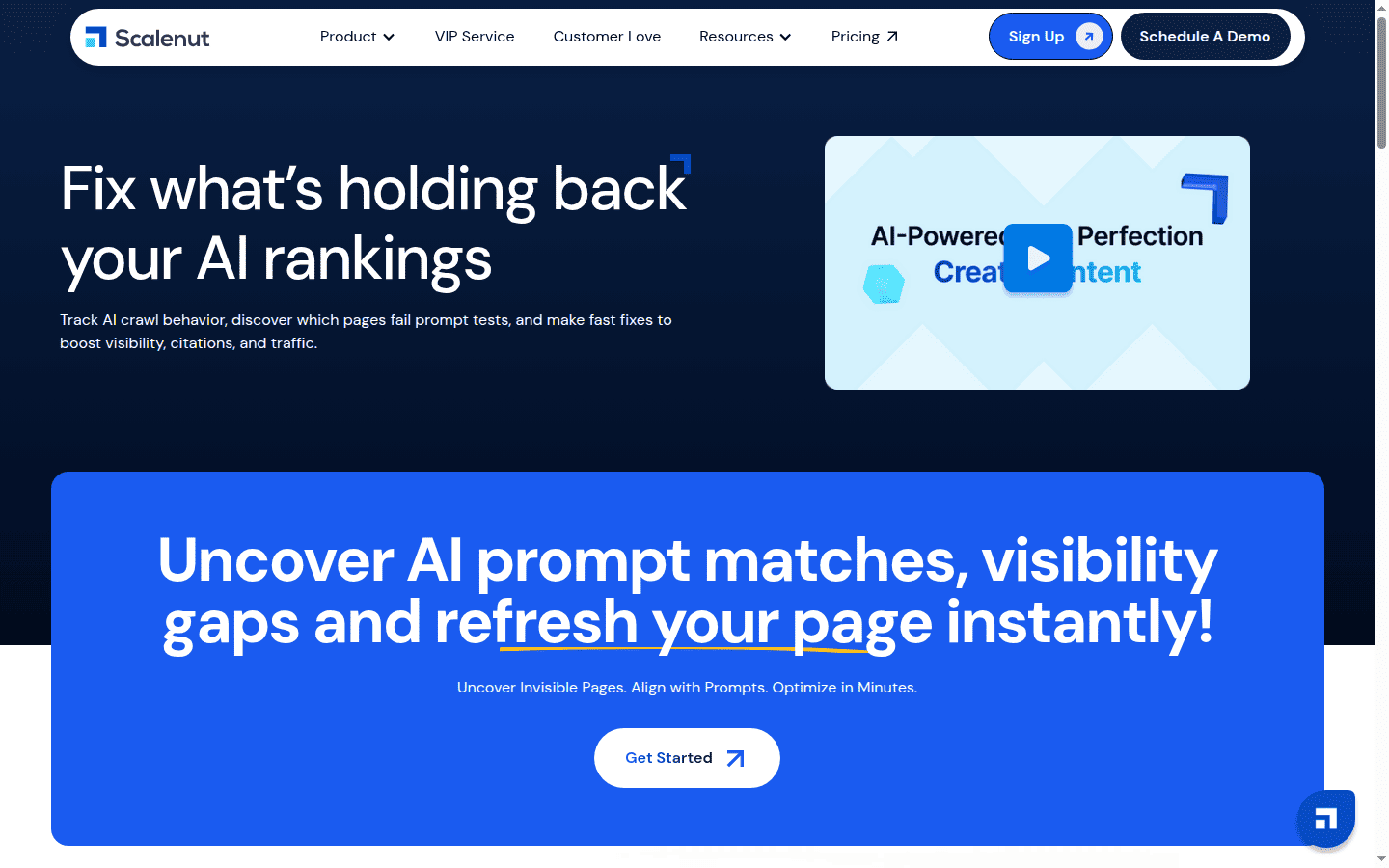
GEO Content Audit. A technical audit of your existing pages:
- on-page recommendations
- internal linking suggestions
- topic gaps
- cannibalization detection
Pages-per-month limit scales from 200 on Plus to 1,000 on Professional — both doubled while the 60% promo runs — with an OnPage Pro add-on that extends the limit further.
Add-ons
Backlinks Marketplace + Social Upreach. Add-ons for link building and social monitoring. Not core to the platform, but a useful differentiator for agencies who want one dashboard for content + links.
Two of the four parts carry the price
The four parts are not equal in weight. The first two — AI Search Visibility and GEO Content Engine — are the reason you would buy Scalenut in 2026. The third and fourth are the upsell.
The features page is where the pivot shows. GEO is the headline on it now, and Cruise Mode sits underneath as one of several tools rather than as the product.
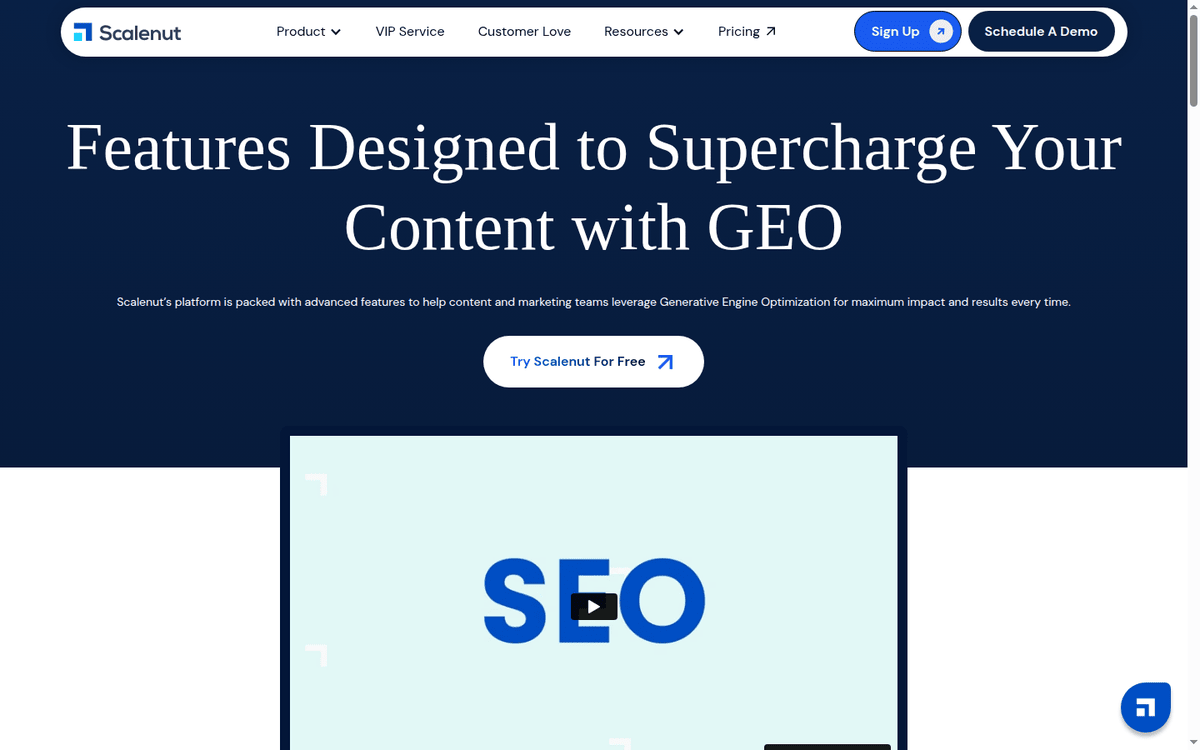
The pivot is now the framing on the vendor’s own overview page: AI Visibility Tracking sits beside Cruise Mode, the keyword-clustering engine and the on-page optimizer, and the whole set is sold as GEO. Write content that ranks in ChatGPT and Google AIO, not just in Google classic.
Scalenut pricing in 2026: monthly vs annual promo
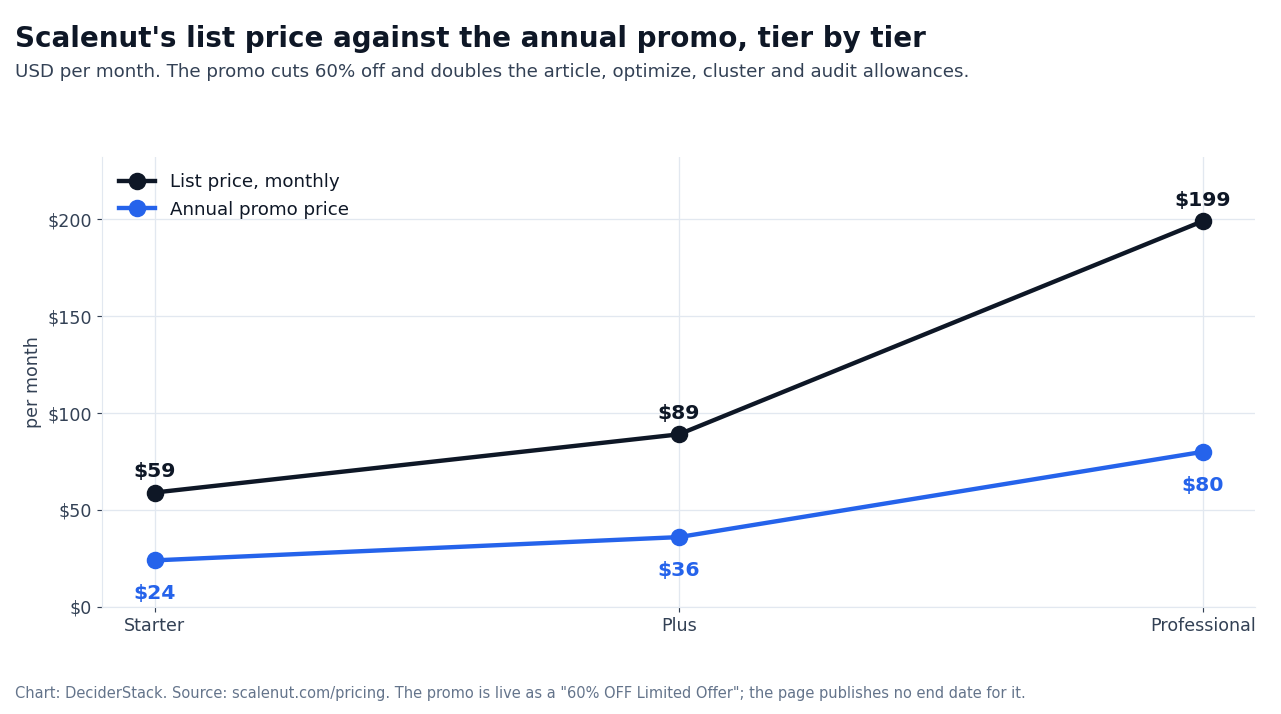
The pricing ladder is the part of Scalenut’s offer that is easiest to misunderstand. The headline numbers on the pricing page are the monthly prices; the annual promo prices (60% off, with doubled limits) are what you actually pay if you commit annually.
| Plan | Monthly USD | Annual promo USD/mo | Prompts tracked |
|---|---|---|---|
| Starter | $59 | $24 | 10 |
| Plus | $89 | $36 | 25 |
| Professional | $199 | $80 | 100 |
| VIP Service | Custom | — | Custom |
| Plan | Articles, optimize and clusters per month | Audit pages per month | Workspaces |
|---|---|---|---|
| Starter | 5, 10 on promo | — | 1 |
| Plus | 30, 60 on promo | 200, 400 on promo | 2 |
| Professional | 75, 150 on promo | 1,000, 2,000 on promo | Unlimited |
| VIP Service | Custom | Custom | Unlimited |
Engine coverage is ChatGPT and Google AIO on Starter and Plus, with Perplexity added on Professional.
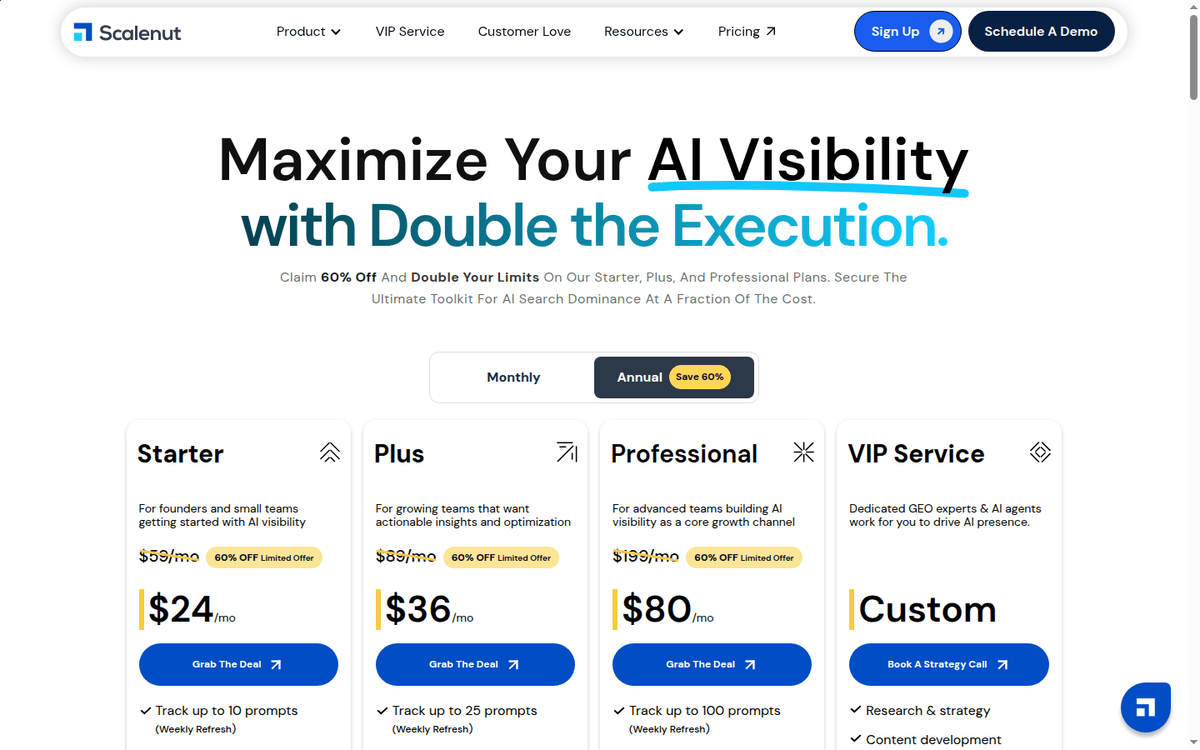
The annual promo doubles the article, optimize and cluster limits on every tier, and it doubles the audit allowance too. If you are deciding between Starter at $24 a month on the annual promo and Plus at $36, the doubling moves the Plus article limit from 30 to 60. That is the upgrade step that matters, not the prompt count.
The trial, and the ceiling nobody prices
The trial is 7 days and needs a sign-up. The page does not say whether a card is required at that step, so check it at checkout; the plan itself activates only when you choose to commit at the end of the window.
The allowance that bites first is usually the audit, not the articles.
A 2,000-page site takes two months of the Professional audit allowance at 1,000 pages a month, or ten months on Plus at 200. Run that spreadsheet before the promo price talks you onto the cheap tier.
The 60% promo is live on the pricing page as a “60% OFF Limited Offer” and the page publishes no end date. The FAQ still answers the discount questions under a Black Friday heading.
It says the discount runs for life: “The discounts will be applicable till you are subscribed to Scalenut.” So the honest read is a promo price that is contractual for as long as you keep the subscription — and if it is gone on the day you buy, the list rates are $59, $89 and $199 a month.
Cruise Mode: why content teams still open it first
Cruise Mode is the workflow that put Scalenut on the map in 2022–2023, and it is still the most useful single feature for a content team that ships long-form articles. The flow is keyword → SERP analysis → NLP terms → AI outline → 2,000-word draft → optimize.
The user reviews every step and can override the AI at each transition.
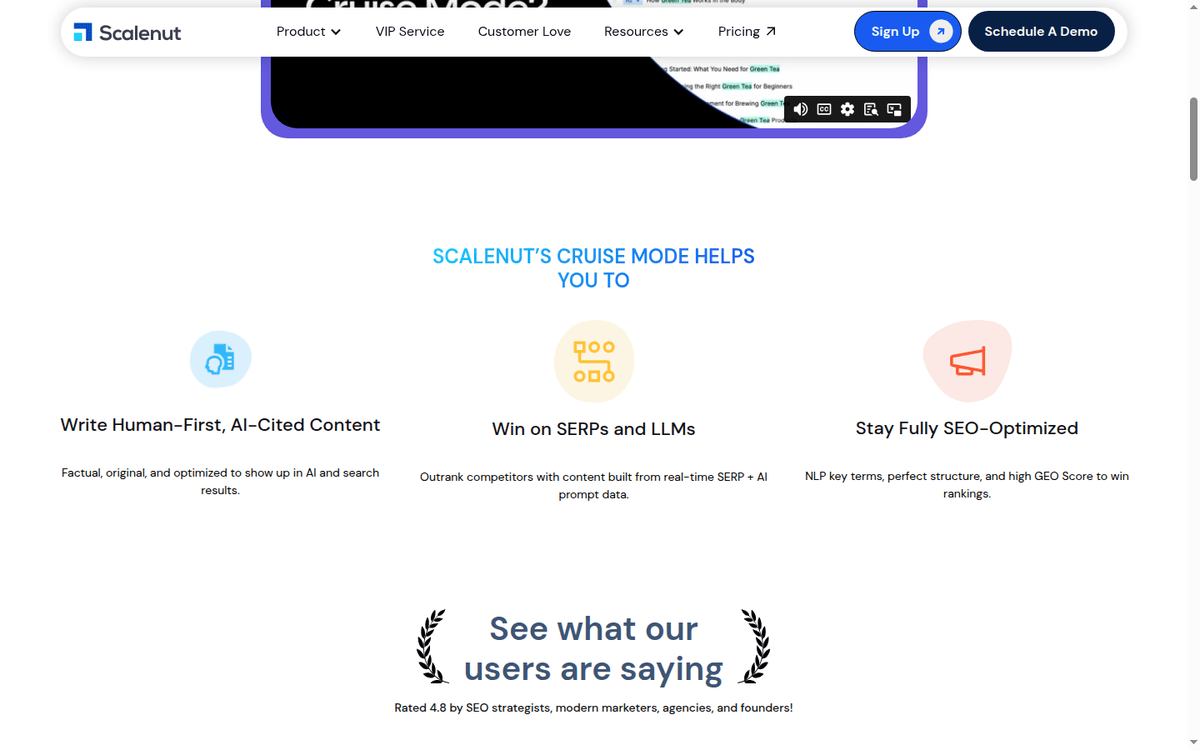
In practice, Cruise Mode produces a publishable draft in 30–45 minutes for an experienced user with a clear topic.
The bottleneck is not the AI generation speed — it is the SERP review step, where you decide which competitors to pull NLP terms from. A user who knows the SERP can complete the SERP review in 5 minutes; a user who is learning the SERP for the first time will spend 15.
The SERP review step is also where the draft’s ceiling is set. Pick two weak competitors and the NLP list comes out thin; pick six strong pages and the draft chases terms this domain cannot rank for. The default selection is a suggestion, not an instruction.
The output quality is competitive with other AI long-form writers (Jasper, Koala, Frase) for English-language B2B and SaaS content. Where the AI has no domain context to lean on — highly technical material — it is the weaker option. Affiliate content with clear topical authority in the SERP sits at the other end, and there Scalenut is genuinely competitive.
The 2,000-word output is a draft, not a publish-ready article. The typical editing pass to make it publish-ready is 30–60 minutes for a skilled editor; 2+ hours for a non-expert. Treat Cruise Mode as a draft accelerator, not a replacement for editing.
The GEO dashboard in practice
The 2026 flagship is AI Visibility Tracking. You set the prompts you care about (e.g. “best crm for saas,” “top project management tools 2026”), Scalenut queries ChatGPT, Google AIO and — on Professional — Perplexity on those prompts, refreshes weekly, and shows you how often your brand appears in the answer and what the answer says about you.
The dashboard shows brand mentions over time and ranks the citations by prompt. The data is sampled, not exhaustive — Scalenut does not query every prompt on every model on every refresh. The pricing page labels the refresh weekly on every tier; no daily option is published there.

Size the prompt allowance against your own catalog, because it is the number that separates the tiers. A single product page and its buyer questions fit inside ten prompts. A small cluster needs fifty, and a brand-level watch is what the top tier is for.
When ten prompts stop being enough
The honest assessment: AI Visibility Tracking is a useful product, but the prompts you track and the engines you query matter more than the dashboard.
Tracking 10 prompts on ChatGPT and Google AIO on Starter will give you directional data; tracking 100 prompts across three engines on Professional is closer to competitive intelligence. The jump from Starter to Professional on this dimension is the meaningful upgrade.
Weekly is the cadence on every tier — the pricing page publishes no daily option — so a launch-week spike is invisible unless it lands on the refresh day.
Plan the tracking window around that, or treat the dashboard as a trend line rather than a live feed.
Those three engines do different jobs. ChatGPT is the dominant consumer-facing AI engine for Q&A in 2026; Google AIO is the Google-search-engine-augmented-answer engine and matters for SEO-adjacent traffic; Perplexity is the citation-first engine and matters for technical/research content.
If your audience is on ChatGPT, the Starter and Plus tiers cover you; if you need Perplexity data, you need Professional.
Integrations, add-ons, and the agency angle
The integrations list is short and focused:
- Semrush
- WordPress
- Shopify
- Copyscape
- Semrush is the keyword-data upstream.
- WordPress and Shopify are the auto-publish targets.
- Copyscape is the plagiarism checker.
There is no Zapier connector on the pricing page and no public roadmap mentioning one, which limits the custom-workflow angle for power users.
The add-ons list is where Scalenut earns its keep for agencies.
- Backlinks Marketplace is a curated link-vendor directory with managed pricing.
- Social Upreach watches Reddit and Quora, with 20–40 keyword slots depending on tier. The pricing page lists 20 to 40 keywords, 5 to 10 subreddits and 3 to 6 competitors across the tiers.
- AI Link Manager is an internal-linking automation that runs alongside the audit — 200 pages a month on Plus and 1,000 on Professional.
- OnPage Pro is an extended-pages version of the audit.
For an agency running 5–10 client domains, the Professional tier’s unlimited workspaces plus the Backlinks Marketplace plus the Social Upreach add-on covers a meaningful slice of an SEO retainer workflow. For a single in-house content team, the Starter or Plus tier covers the content workflow without the agency overhead.
The auto-publish path into WordPress and Shopify is a meaningful workflow accelerator for content teams that ship 30+ articles/month. The integration is one-click setup with API keys, and the publishing step preserves formatting including the Content Score sidebar Scalenut adds.
Three jobs left to other tools
Where Scalenut stops, and what to use instead.
One editor, one model
No multi-engine AI writing in a single editor. Scalenut’s assistant generates content inside the Cruise Mode flow rather than in a playground where you switch between GPT-4, Claude and Gemini on the same prompt. Power users who want that flexibility will be happier in a tool like Jasper (brand voice plus multiple models) or in a plain ChatGPT-and-Claude workflow.
Referring domains stay outside the tool
No backlink-profile product that we could find. The Backlinks Marketplace on the pricing page is a curated link-vendor directory, and nothing in the vendor’s comparison reads referring domains. For backlink profile work — your referring domains, your competitors’, your lost links — you still need Ahrefs, Semrush or Majestic.
No rank-tracker screen
No first-party rank tracking at scale. Scalenut does show your AI Visibility Tracking data and your Content Score after optimization, but there is no traditional rank-tracker dashboard where you monitor 1,000 keywords across devices and geographies.
Rank tracking is not part of the subscription, so a dedicated tracker — AccuRanker, Ahrefs or Semrush — still sits outside it. Scalenut’s GEO dashboard is a complement to rank tracking, not a replacement.
The naming overlap between Surfer (“Surfy” AI assistant) and Scalenut (its own AI writing assistant) is a real point of confusion in the SERP. Check the domain before you credit a feature to either product; the two names are close enough to blur.
Scalenut vs Surfer SEO: when the choice is real
Surfer SEO and Scalenut overlap on:
- content optimization
- content score
- AI writing assistant
- AI visibility tracking
Both have pivoted toward GEO in 2026. In practice, three things decide it.
- The pricing unit. Surfer prices per month on yearly billing — 49 to 299, printed in the visitor’s own currency — and bills by documents, from 120 to unlimited. Scalenut prices in dollars and bills by articles plus optimize runs, 5 to 75 a month. One high-volume article a week favors Surfer’s unlimited-documents Pro plan at 182 a month; 30 articles a month favors Scalenut’s Plus plan at $89.
- AI visibility depth. Surfer’s AI Search Analytics is a focused product sold alongside the content tool at 82 a month on the yearly plan. Scalenut bundles AI Visibility Tracking into every tier at a different prompt count. AI visibility as the main use case favors Surfer; AI visibility as one feature among many is cheaper on Scalenut.
- Integrations. Surfer connects to Google Docs, WordPress and Jasper; Scalenut connects to WordPress, Shopify, Semrush and Copyscape. For a Shopify store owner, Scalenut is the only option in the pair. For a Google Docs writer, Surfer is.
The honest decision: Surfer is the better choice for content teams that write one big article at a time and want unlimited optimization.
Scalenut is the better choice for content teams that ship 10–30 articles per month and want ai visibility tracking bundled in. The pricing difference at the median workload is small enough that the integration list should be the tiebreaker.
Worth pricing the meters together if two content tools share your week:
- Scalenut bills articles
- Surfer bills documents
- Alli AI bills the site
- Murf AI bills characters of generated speech
The unit, not the feature list, is what the budget owner checks.
The short answer: who this is for
Scalenut in 2026 is a credible GEO-first content platform with a strong Cruise Mode workflow, a useful AI Visibility Tracking dashboard.
A pricing ladder that is hard to read because of the 60% annual promo. The honest assessment is that the annual promo is the real price, the monthly price is the not-yet-committed price. The right plan for a content team shipping 10–30 articles per month is the plus tier at $36/month annual (60 promo).
The case for Scalenut in 2026 is the bundled AI Visibility Tracking on every tier, the Cruise Mode workflow for keyword-to-draft speed, and the Backlinks Marketplace + Social Upreach add-ons for agency workflows.
The case against is the article-limit billing model (a 30-article team can blow through Plus on a single high-volume week) and the naming overlap with Surfer that confuses the SERP.
Three ways to land it:
- If you want one platform for content and GEO, the 7-day trial on Professional is the way in. The plan runs $80 a month on the annual promo, and the trial shows the full AI Visibility Tracking dashboard before you commit.
- If you write one big article per week and want unlimited optimization, Surfer is the better pick.
- If you write 30+ articles per month across multiple clients, the scalenut professional tier’s unlimited workspaces are the better pick.
Pricing, promos and GEO: frequently asked questions
How much does Scalenut cost in 2026?
Starter $59/month ($24 on the 60% annual promo), Plus $89 ($36 promo), Professional $199 ($80 promo). Custom VIP Service on request. Annual promo doubles article/audit limits and is the headline price on the official page.
Does Scalenut have a free trial?
Yes, 7 days, and the plan activates only when you choose to commit at the end of the window. The page does not state whether a credit card is required at sign-up.
What is Cruise Mode?
A guided keyword-to-draft workflow that walks you through:
- SERP analysis
- NLP term selection
- outline generation
- 2,000-word AI draft
The output is a publishable draft in 30–45 minutes for an experienced user.
What is GEO?
Generative Engine Optimization — writing content that ranks in ChatGPT, Google AIO, and Perplexity, not just in Google classic. Scalenut’s 2026 pivot is from “AI + SEO content” to “AI + GEO content.”
What AI engines does Scalenut track?
ChatGPT and Google AIO on every tier; Perplexity on Professional and above. The page labels the prompt refresh weekly across the tiers.
Does Scalenut integrate with WordPress?
Yes, with one-click setup via API keys. Auto-publish preserves the Content Score sidebar and internal links.
What is the difference between Scalenut and Surfer SEO?
Surfer bills by documents and prices its plans per month on yearly billing in your local currency; Scalenut bills by articles and prices in dollars. Surfer has a dedicated AI Search Analytics tier; Scalenut bundles AI Visibility Tracking into every tier at different prompt counts. Both have pivoted to GEO in 2026.
Can I cancel anytime?
Yes. You can upgrade or downgrade at any time and your data stays intact. No long-term contract on Starter/Plus/Professional.
How these figures were checked
Scalenut pricing Scalenut platform overview
How we put this together: the tier prices, the promo rates, the prompt counts, the article, cluster and audit allowances and the integration list come from scalenut.com/pricing, read in September 2026. We have not bought a paid Scalenut plan.
Disclosure: this article contains affiliate links. If you buy through them we may earn a commission at no extra cost to you. Commission never changes our scoring or the order of a ranking.