Annual billing is where the pricing page loses its footing. The yearly figure it publishes is twelve months of the monthly rate, not the two months free the badge promises, and two of the three self-serve tiers list no annual rate at all.
Most “community” platforms started life as course platforms, then bolted on discussions.
Mighty Networks is the other way around. The platform was built for paid memberships and creator-led communities first, then layered courses and events inside the same membership surface (mightynetworks.com, captured recently). That ordering changes what the platform is good at, and what it is not.
The pricing page lists four plans. Three at fixed monthly rates. One custom. The review sits in our SaaS and business tools section, with the rest of the operator stack. What the page does not show is the operational delta between a Launch community and a Growth community.
That’s what we pulled out from the plan details and the public migration context (mightynetworks.com/pricing, captured recently).
How the plans are laid out
Pricing lives at mightynetworks.com/pricing.
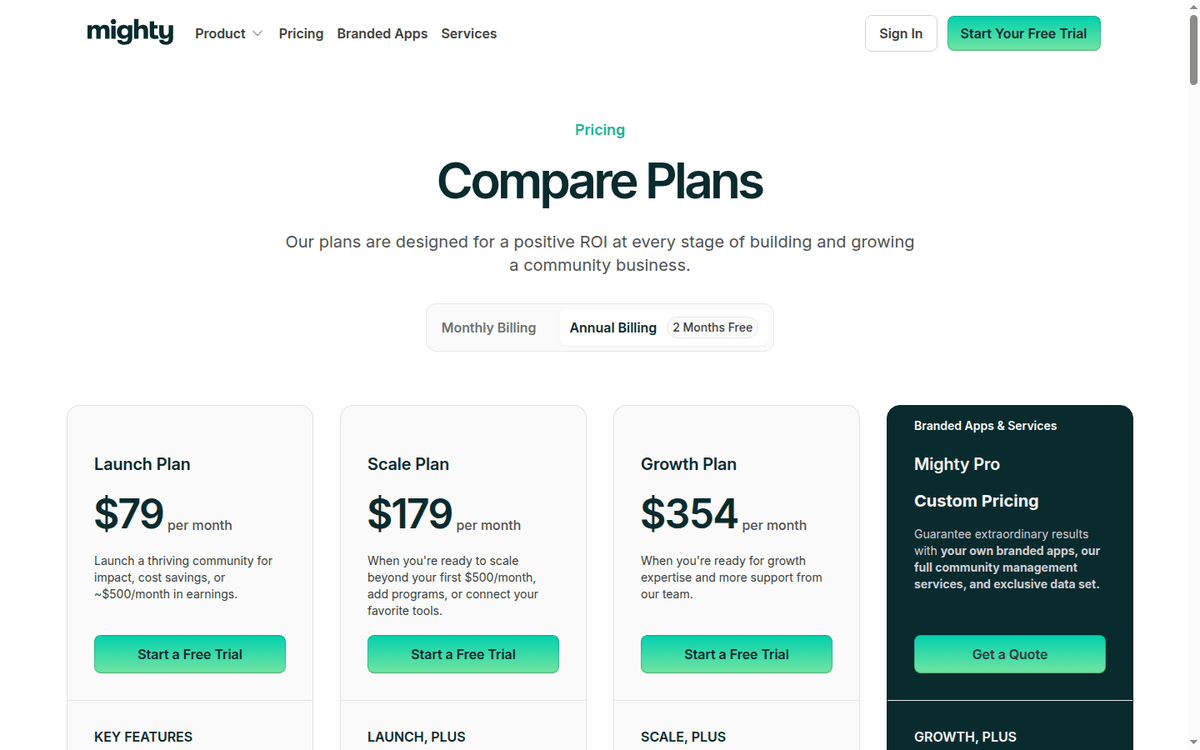
The hero block at the top of the page lays out the four plans with monthly figures:
- $79 Launch
- $179 Scale
- $354 Growth
- and “Custom Pricing” for Mighty Pro (mightynetworks.com/pricing, captured recently)
Below that is a comparison table covering General features, Spaces, Members, Plans, Engagement, Payments, and — relevant later in this review — Total Storage and transaction fees per plan. Below the table there is a “Custom Storage & Usage” section that gates the biggest plans.
The annual figure that does not add up
Annual billing is where the page stops being internally consistent.
The annual calculator quotes $950/year for Launch and the toggle is labeled “2 months free when you buy annually” — but $950 is twelve months at about $79.17, so at a $79 monthly rate the discount does not appear in the arithmetic.
Read it as a saving the page asserts without pricing: ask for the annual figure in writing before you commit to a year. Scale and Growth have no public annual rate at all; only Launch gets a yearly number.
We did not start a trial or call Mighty sales. The numbers below come from the public pricing page snapshot and the published comparison table.
If the plan card is all you compare on, the three self-serve tiers — Launch, Scale and Growth — leave two things off it: the annual calculator and a transaction fee.
- Launch — the entry tier: members are unlimited on every plan, and storage is the row a growing community feels first.
- Scale — the integration and automation layer arrives, and the transaction fee steps down for the first time.
- Growth — Expert Sessions, Priority Support and Migration Services start here, and it is the rung the vendor puts every trial on.
Apps and Mighty Co-Host ship on all three self-serve plans, and there is no permanent free tier on the page, so a community that lets the trial lapse stops.
Plan by plan, with the limits the cards leave out
| Plan | Monthly (USD) | Annual (USD) |
|---|---|---|
| Launch | $79 | $950 |
| Scale | $179 | Not published |
| Growth | $354 | Not published |
| Mighty Pro | Custom | Custom |
| Plan | Members | Total storage | Transaction fees |
|---|---|---|---|
| Launch | Unlimited | 200 GB | 2% |
| Scale | Unlimited | 500 GB | 1% |
| Growth | Unlimited | 1 TB | 0.5% |
A fourth column in the vendor’s comparison covers Mighty Pro and lists 4 TB of storage with the same 0.5% transaction fee. iOS, Android and the web all sit under one roof on every self-serve plan, and Mighty Co-Host is listed in the key features of all three.
We did not sign a Pro contract, request a Pro quote, or download the Branded Apps SDK. The “exclusive data set” claim and the “guarantee extraordinary results” line are vendor-published.
Launch, the tier most communities start on
Launch is the entry plan and the cheapest published rate at $79/mo. The plan targets creators running their first paid community, with enough room for courses and events. The platform’s positioning on this tier is community operations:
- members
- plans
- basic chat
- and Spaces (mightynetworks.com/pricing, captured recently)
The free trial is the hook here: a creator can run a paid challenge with no promise of more and see whether the platform holds the audience.
What the page publishes about it is oddly specific in one direction and silent in the other. The FAQ says every free trial of a Mighty Network runs on the Growth plan; no length is given anywhere on the page. Budget the trial as a Growth-plan evaluation rather than a sampler of the whole ladder.
What Launch does not include:
- Advanced integrations.
- Branded apps.
- Priority support.
- The migration services that come in at Growth.
If your community needs a Zapier-style automation layer on day one, you’ll bump into the ceiling quickly.
Scale, once you pass the first 500 a month
Scale at $179/mo is positioned for creators who’ve crossed their first $500/month in community revenue and want to integrate and automate more. The jump from Launch is roughly 2.3x price for the same headcount on the platform, which only makes sense if the additional integrations are pulling weight (mightynetworks.com/pricing, captured recently).
That math matters because the plan changes are not just about features — they shift the operational surface.
Scale adds the automation layer that lets your community tie into your CRM, your email tool, and your payment stack. For creators running a hybrid of community + course + paid newsletter, that’s where the math starts to favor Scale over Launch.
What the integration layer does not include is a general-purpose automation builder. If your flows run outside the community — a purchase synced into the CRM, a member tagged in the mailing list — Make is the tool we reviewed for that job. It stays a separate line on the bill.
The same AI Co-Host is available across Launch, Scale, and Growth. The headline capability of Co-Host is the Community Design™ workshop, where the AI walks you through a 30-day paid challenge structure. Scale does not add new AI features beyond what is on Launch; it adds the surrounding context the AI can integrate with.
Growth and the people cost
Growth at $354/mo is the first plan where the price reflects human service.
- Growth Expert Sessions — the highest-value addition for a community in transition.
- Priority support on the same plan, rather than as an add-on.
- Migration Services, which the vendor’s pricing page reserves for the Growth plan and above.
Migration Services is the meaningful addition for a specific buyer: existing Mighty customers moving from a lower tier, or operators migrating from another community platform. The page explicitly says “If you’re on Mighty Networks, we can help you on the Growth Plan and above” for the migration conversation.
The price ratio from Scale to Growth is roughly 2x, but the value proposition changes character — Growth isn’t a software upgrade, it’s a service contract for the cases where the platform’s standard tooling isn’t enough.
For a creator-community at steady state, Growth may be overkill; for a community in transition, it carries the real operational risk reduction.
Mighty Pro: when you need your own branded app
Mighty Pro is sales-led.
The published entry is “Custom Pricing” with three flagships: branded apps, full community management services, and the exclusive data set. The homepage positions this as “Guarantee extraordinary results with your own branded apps, our full community management services, and exclusive data set” (mightynetworks.com, captured recently).
The “guarantee extraordinary results” claim is vendor-published and is not a benchmarked KPI. Treat it as a sales framing. The actual Pro contract terms — pricing, deliverables, app-store ownership, SLA — were not quoted in this capture. A real engagement starts with a “Get a Quote” call to the Mighty team.
Branded apps are the structural difference
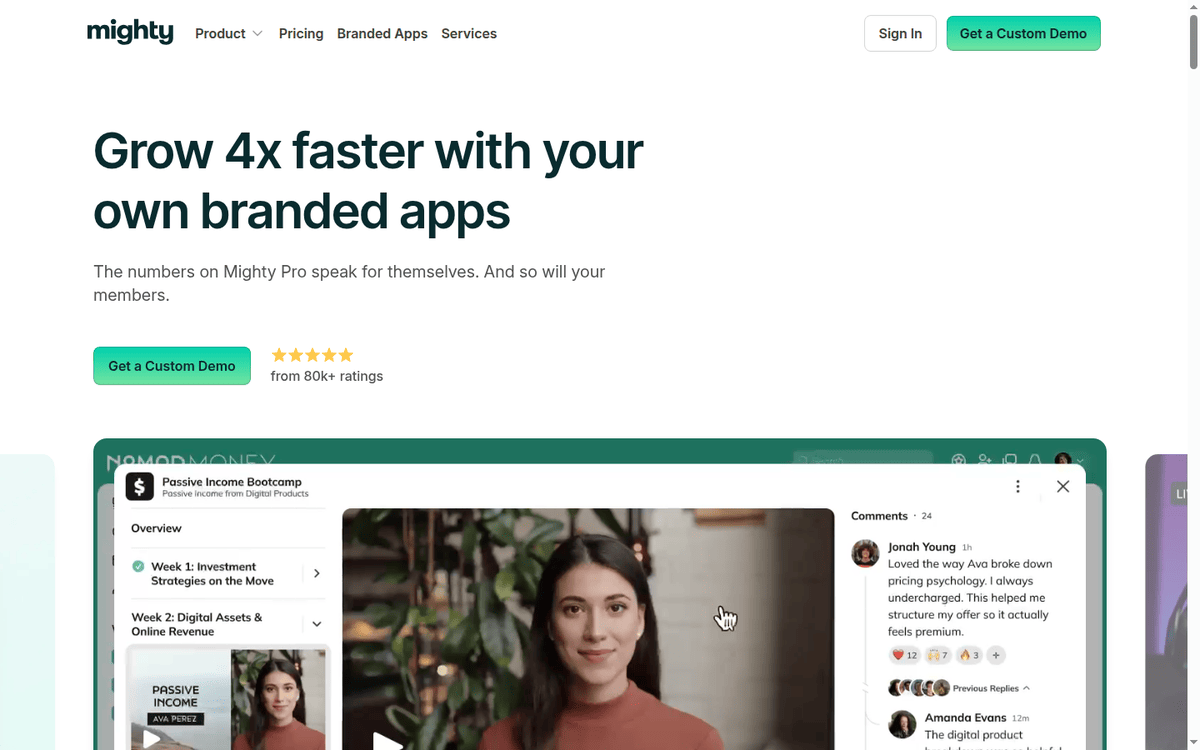
The interesting feature shift on Pro is the branded apps surface. Launch, Scale, and Growth all run on Mighty’s shared iOS, Android, and Web apps. Pro gives you your own branded apps in the stores. For a creator whose business is the brand identity — coaches, authors, cohort-based course operators — this is the structural difference.
The Pro page sells the branded-app surface and the services that come with it, and it does not print a price on any of them. That is the difference a quote request buys: your own app in the stores instead of Mighty’s shared one.
Building the app yourself is the other route, and it is a different budget: our Adalo review covers the no-code path to a store app, where you own the build and pay for it monthly. Mighty Pro trades that control for a managed surface.
AI Cohost in plain words
Mighty Co-Host is the AI layer across the self-serve plans. The published positioning is a workshop companion: it walks new operators through Community Design™ and helps set up the 30-day paid challenge structure. The AI is positioned as a setup tool, not a community manager (mightynetworks.com/pricing, captured recently).
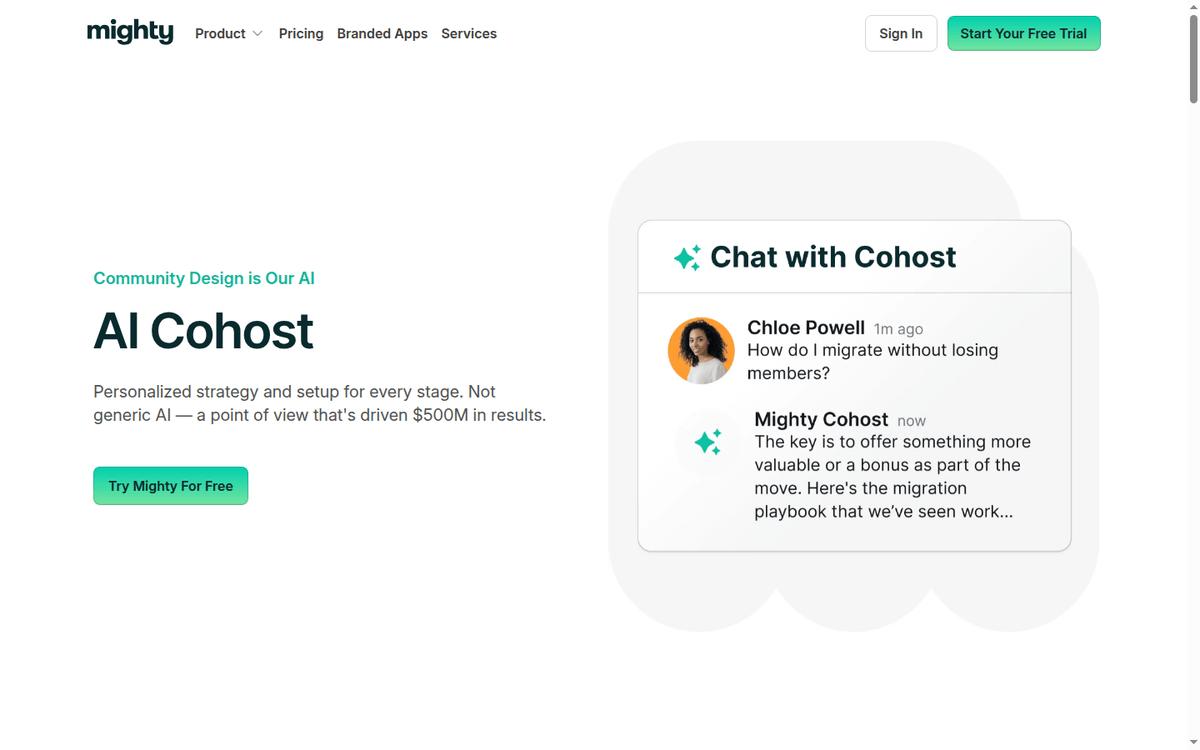
Co-Host is not a competitor to community chat assistants such as Tidio’s Lyro or Intercom Fin. The product is running in a different layer: instead of handling tickets and answering member questions, it’s used during the build phase of a community to suggest content, scheduling, and member flows.
We did not run Co-Host against a real community build. The summary above comes from the page descriptions, not from a measured engagement.
When Mighty Networks fits (and when it does not)
A good fit under four conditions.
- You’re a creator running a paid membership or community-led business.
- Your members consume content inside the community, not on external email or YouTube.
- You want iOS, Android, and Web under the same surface without building three apps yourself.
- You’re operating in the Launch-to-Scale stage and want a ladder with Migration Services at the top end.
The cases it does not fit
Probably not the right fit in four cases.
- You’re running pure course delivery with no community surface. Teachable or Kajabi may do the course half cheaper.
- You need full B2B-style CRM and ticketing depth. The platform is creator-first, not operator-first.
- Your community has compliance needs (HIPAA, FINRA, FERPA) that require custom data residency controls.
- You want to own the iOS and Android presence fully on day one. That’s the Pro tier, and the cost is sales-led.
Pricing details that aren’t obvious from the headline
Three things in the published pricing material that need a closer reading.
The trial runs on Growth
the trial runs on the Growth plan per the vendor’s FAQ, and the page publishes no length for it. Whichever tier you end up on, expect to choose deliberately at the end of the evaluation rather than drift into a paid plan.
Only Launch has an annual rate
the only annual number on the page is Launch at $950/year, and the page labels annual billing “2 months free”. Those two do not reconcile at a $79 monthly rate, so ask for the annual figure in writing before you commit to a year. Scale and Growth have no public annual rate at all.
The limits, tier by tier
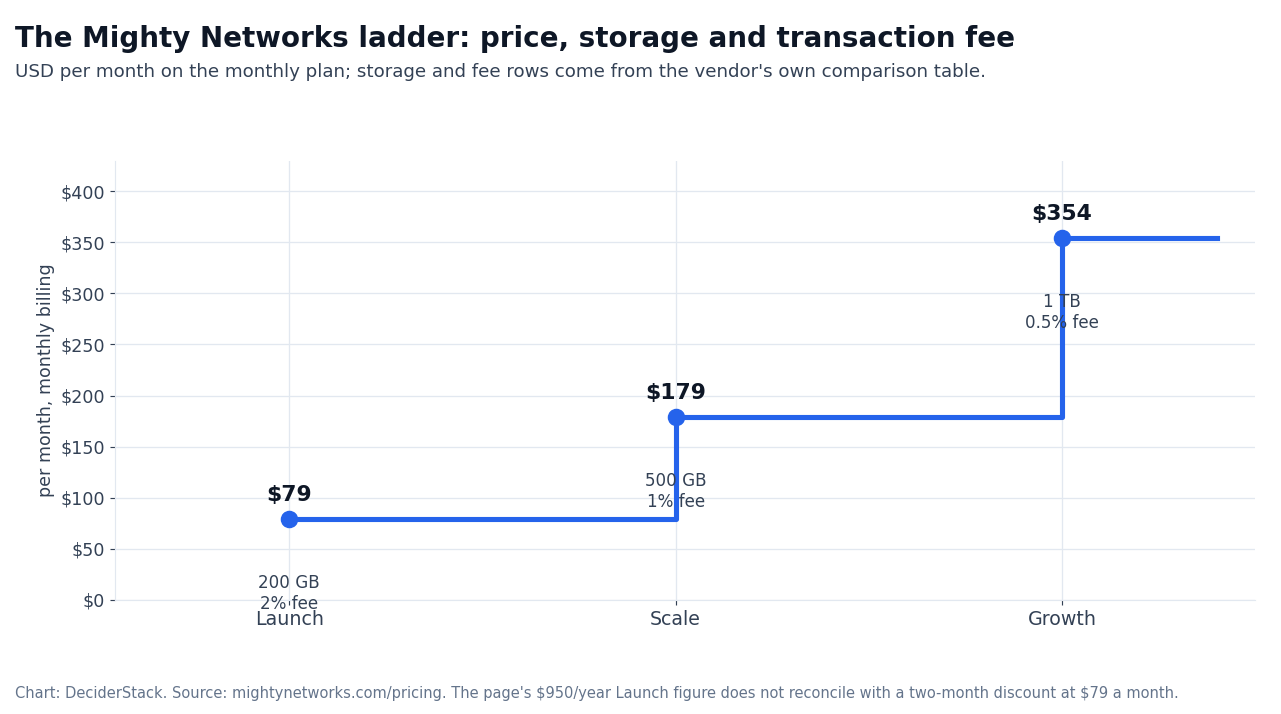
the limits that bind are in the comparison table rather than on the headline cards, and the headline cards are what most reviews quote. Members are unlimited on all three self-serve plans; storage runs 200 GB on Launch, 500 GB on Scale and 1 TB on Growth; transaction fees run 2%, 1% and 0.5%.
“Custom Storage & Usage” is a separate section of the page for plans that need more than that, and its thresholds are not enumerated without a sales conversation. If your community will pass 1 TB of stored media, ask for the number before you pay.
The Custom Storage & Usage thresholds were not enumerated in this capture. The pricing page exposes them as a section header but not as concrete numbers without an authenticated quote flow.
Run the fee next to the subscription
Run the transaction fee next to the subscription once. A community at $5,000 a month in membership revenue pays $100 of fee on Launch at 2% and $25 on Growth at 0.5%. That is $75 a month the step up cancels out before you count anything else.
Read the two rows together and the ladder stops looking linear. Storage triples while the fee that comes off membership revenue falls from 2% to 0.5% — which is why the Growth column keeps paying for itself as a community grows.
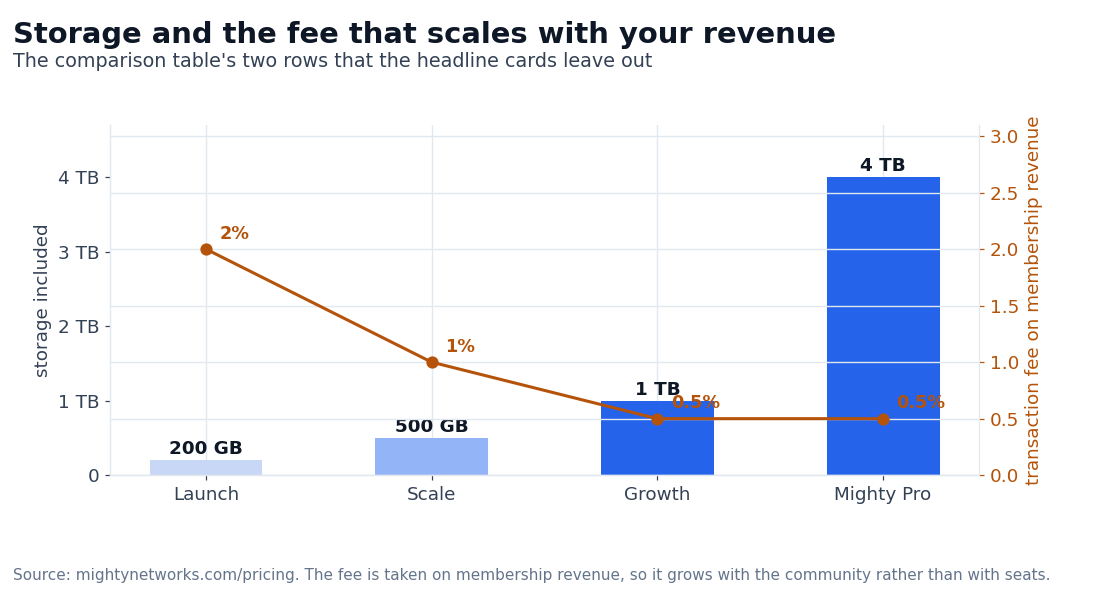
Two limits are worth writing down before the trial ends: storage, because 200 GB on Launch fills up quickly with video, and the transaction fee, because it scales with community revenue rather than with seats. Custom Storage & Usage is the only route past the first one.
The work this review did not do
This article did not start a paid plan, build a real community, or run a Pro sales conversation.
The plan comparisons above come from the public pricing page and the launch ordering. The vendor-published “$14,400/year average Launch revenue” claim is presented as a representative figure with no guarantee of results. Use it as a directional point, not a projection for your own business.
The trial, and the limits it does not lift
The trial signup CTA sits at the top of the pricing page, and the vendor’s own FAQ places every trial on the Growth plan — the tier the page already badges as where most communities land (mightynetworks.com/pricing, captured recently). That makes the trial a fair test of the mid-tier rather than a sampler of the whole ladder.
What happens after the trial is the practical question, and it is the one the pricing page answers least.
What the page does settle: there is no permanent free tier to fall back on, so a community on a lapsed trial stops. If you want to compare Launch against Scale before you commit, read the feature delta on paper first — the page does not describe a way to trial two self-serve tiers at once.
We did not run an actual trial-to-paid conversion in this capture. The pricing page documents the trial terms but does not publish post-trial behavior in detail. The exact surfaces available after lapse are not enumerated here.
Pricing math at each tier
The four plans sit at different positions on the creator-revenue ladder. Launch at $79/mo is the lowest published monthly and is sized for first $500/month communities. The amortized annual rate of $950/yr is the cheapest commit you can publish against the platform (mightynetworks.com/pricing, captured recently).
Scale at $179/mo covers the next stage — the moment your community revenue crosses the first $500/month, Scale’s integration surface starts paying for itself.
Growth at $354/mo is roughly 2x Scale, but the value proposition is the people-services layer: Expert Sessions, Priority Support, Migration Services. Mighty Pro at custom is the branded-app tier where Mighty starts behaving like an agency, not a SaaS.
The realistic progression
For most creator communities in the long tail, the realistic progression is Launch → Scale → Growth.
The Pro tier is a specific bet on the branded app surface that most creators won’t take. If you are evaluating Pro, your community economics already cover enterprise-tier pricing — that is the only tier where the conversation moves from price-per-month to price-per-engagement.
Plan limits, trials, and the storage fee — the FAQ
Does Mighty Networks have a free plan?
No permanent free tier. The platform runs a free trial that its own FAQ places on the Growth plan — the pricing page does not publish how long it lasts. When it ends you move to a paid plan; nothing on the page describes a free state you can stay in (mightynetworks.com/pricing, captured recently).
How is Mighty different from a course platform like Teachable?
Mighty puts the community surface first and the course surface inside it. Teachable puts the course first with optional add-on communities. For members whose primary value is the community, Mighty is the better fit; for pure course delivery, Teachable is usually cheaper.
Are there transaction fees on paid memberships?
It does. The pricing comparison lists transaction fees of 2% on Launch, 1% on Scale and 0.5% on Growth, with the same 0.5% against the Mighty Pro column (mightynetworks.com, captured recently).
What is Mighty Co-Host?
Co-Host is the AI companion that walks new operators through the Community Design™ workshop. It is bundled across the three self-serve plans and is positioned as a setup tool, not a member-facing chat assistant (mightynetworks.com/pricing, captured recently).
Can I migrate from another community platform?
Yes, and the Growth plan ships Migration Services. The page notes “If you’re on Mighty Networks, we can help you on the Growth Plan and above” — so cross-tier migration is part of the Growth bundle, not a separate purchase (mightynetworks.com/pricing, captured recently).
How do I get to Mighty Pro?
A “Get a Quote” call on the pricing page. The pricing page does not publish Pro pricing because the contract is built around branded apps, services, and data terms.
How we put this together: the tier prices, the storage and transaction-fee rows, the trial terms and the revenue calculator figures come from mightynetworks.com/pricing, read in September 2026. We have not started a paid Mighty Networks plan or had a sales conversation.
Disclosure: this article contains affiliate links. If you buy through them we may earn a commission at no extra cost to you. Commission never changes our scoring or the order of a ranking.