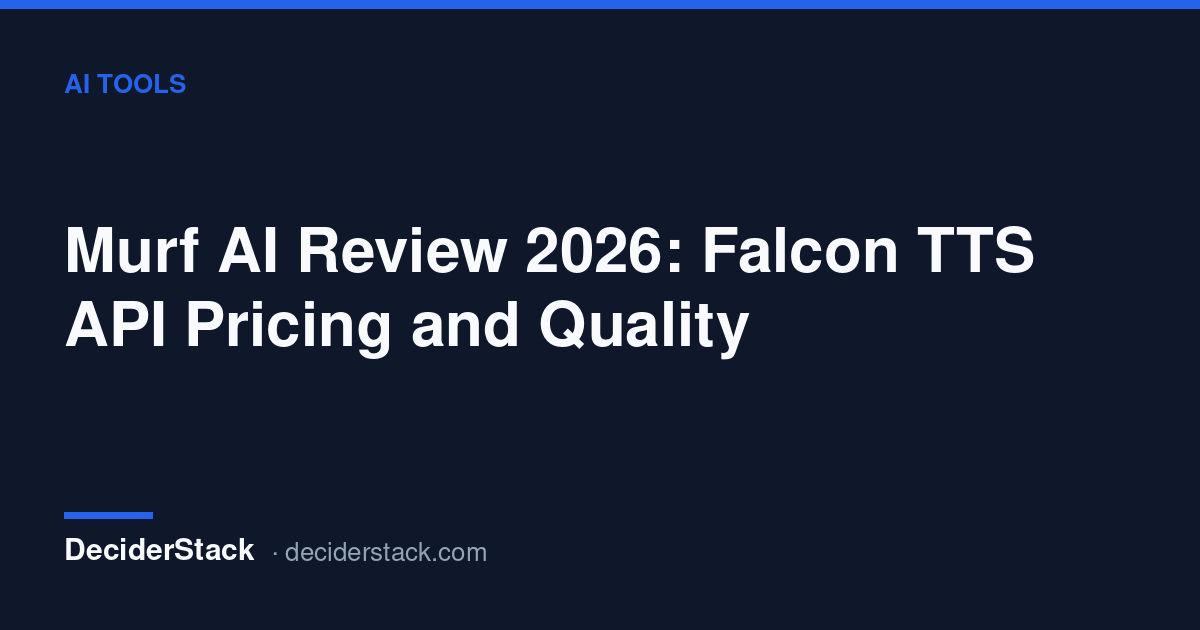
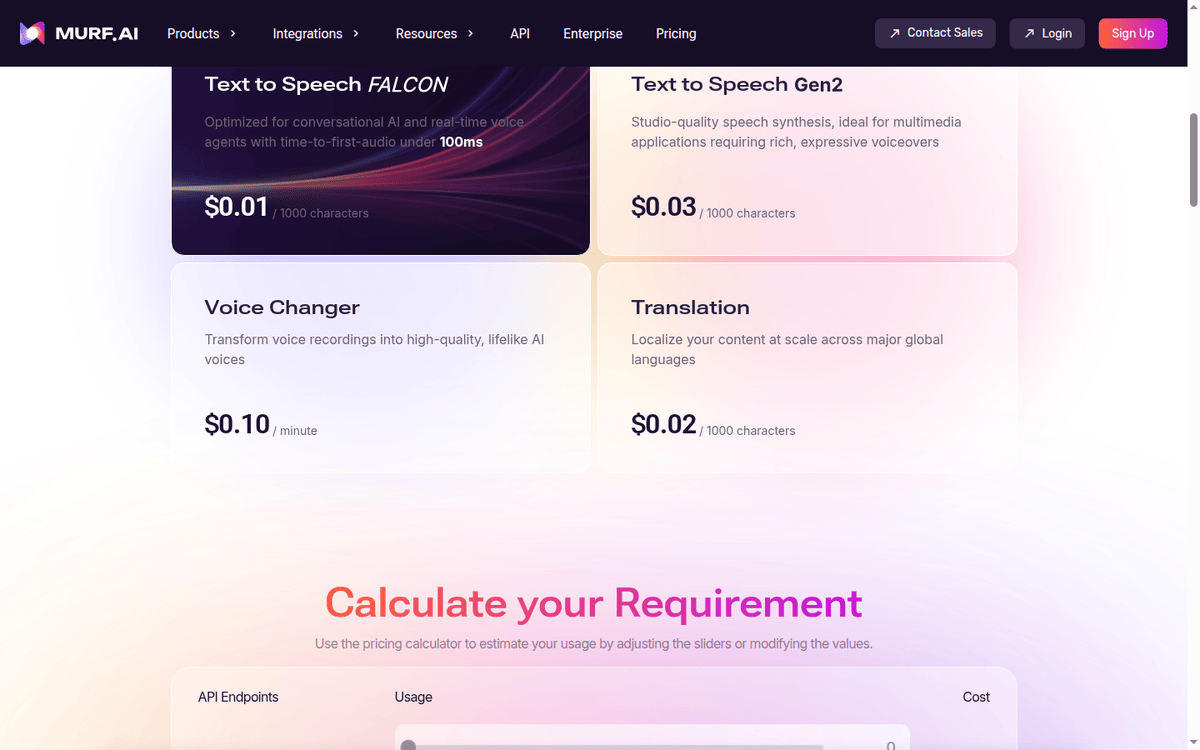
Murf bills by the character, not by the seat: $0.01 per 1,000 for Falcon, $0.03 for Gen-2, $0.02 for Translation, $0.10 a minute for Voice Changer.
Free tier: $10 of credit a month, 150+ voices in 35+ languages, 5 concurrent requests, no card.
Murf started in 2021 as a studio-style AI voiceover tool for content creators — pick a voice, paste a script, export an MP4. The product you hit today is two things at once. The legacy Studio still ships and is still the right tool for content creators who want a timeline editor and a library of stock voices.
The newer Murf is a TTS API with a Falcon model that does 55ms inference and a Voice Agents platform with pre-built agent templates for customer support, reservations, and sales. The two halves share the same 150+ voice library and the same SOC 2 Type II / ISO 27001 / GDPR / HIPAA compliance posture.
The pricing is now usage-based per 1,000 characters rather than per-seat subscription. That shift is what makes a 2026 review worth writing.
This review walks through both halves of Murf. It covers:
- the four-model API pricing ladder (Falcon / Gen-2 / Voice Changer / Translation)
- the Voice Agents platform
- the Studio product for content creators
- and the head-to-head with ElevenLabs and PlayHT that every TTS buyer runs in their first month
The dollar figures come from murf.ai/pricing, captured in September 2026 via Firecrawl. Anything that needs a paid account to verify — actual latency on a real conversational agent at peak traffic, the true resolve rate on a real voice bot — is marked as an estimate where it appears.
What ships in 2026
Murf ships three product surfaces in 2026, all on the same platform. The API is the developer surface:
- Falcon for conversational agents
- Gen-2 for studio-quality voiceovers
- Voice Changer for transforming existing recordings
- Translation for multilingual localization
Studio is the content-creator surface — a timeline editor with a stock-voice library, the same backend as the API but with a visual workflow. Voice Agents is the newest surface — conversational agents for customer support, reservations, and sales, with the same voice library and multilingual support behind them.
The platform publishes 150+ voices across 35+ languages and styles, and the free tier carries that library. Paid tiers unlock more voices and higher concurrency. The compliance posture is broad — SOC 2 Type II, ISO 27001, GDPR, and HIPAA — which is unusual for a TTS vendor.
That posture is one of the reasons the platform shows up in healthcare and enterprise deals. The customer list (300+ of the Fortune 2000 per the home page) includes:
- Salesforce
- Cisco
- Pfizer
- PepsiCo
- Oracle
- Netflix
- Michelin
- McKinsey
- Infosys
- Deloitte
- Baker Hughes
- and Accenture
HQ is Salt Lake City, Utah.
How the API surface fits together
The four models share the same authentication, the same voice library, and the same dashboard. Falcon is the latency-optimized endpoint — short-form conversational TTS where the end-to-end budget is tight. Gen-2 is the quality-optimized endpoint — long-form narration where the voice quality matters more than the response time.
Voice Changer operates on input audio rather than text, useful for transforming recorded voiceovers into a consistent brand voice. Translation is the localization endpoint — take a script in one language and emit it in another, with the TTS done in the target language.
The shared voice library means a brand voice defined for Falcon can also be used for Gen-2 and Translation. That is the practical reason to standardize on a single TTS vendor rather than splitting workloads — a single brand-voice definition travels across every endpoint.
Murf pricing in 2026: pay per 1,000 characters
Murf’s API pricing is usage-based, billed per 1,000 characters of input text. There is no per-seat subscription on the API side; you buy a credit bundle and the credits never expire. There is a free tier with $10 of credit every month, no credit card required.
| Model | Price | Per 1M chars | Use case |
|---|---|---|---|
| Falcon (TTS for agents) | $0.01 / 1k chars | $10 | Real-time conversational AI, voice agents, sub-100ms latency |
| Gen-2 (Studio TTS) | $0.03 / 1k chars | $30 | Multimedia voiceovers, expressive narration |
| Voice Changer | $0.10 / minute | — | Transform existing recordings into AI voices |
| Translation | $0.02 / 1k chars | $20 | Multilingual localization across major global languages |
Falcon is the headline for 2026. The published latency is 55ms model inference and 130ms end-to-end, which is in the same range as ElevenLabs’ Turbo v2 and PlayHT’s Play 3.0. At $10 per 1M characters it is materially cheaper than ElevenLabs’ Flash and Turbo rate of $0.05 per 1K characters, which is $50 per 1M.
The end-to-end latency on your own integration stack — network hop, TURN server time — is the part the pricing page cannot answer for you.
The free tier is real:
- 150+ voices in 35+ languages
- $10 of credit every month
- 5 concurrent requests
- 24/7 chat support
The 5-concurrent-request ceiling is the binding constraint for production voice-agent deployments — Enterprise raises the concurrency ceiling to a custom level.
Enterprise adds:
- data residency
- on-premise deployment
- enterprise-grade concurrency
- dedicated technical support
- professional voice cloning
- SLA assurance
- and a Master Service Agreement
Pricing is custom; the SLA line is what matters most to enterprise buyers.
The full pricing page is at murf.ai/pricing.
Studio and the content-creator path
The Studio product is still the right tool for the content-creator workflow. The Studio UI is a timeline editor:
- drop script chunks into a timeline
- assign a voice per chunk
- edit pacing and pronunciation inline
- export as MP4 or MP3
The voice library is the same one the API draws from, with extras locked behind paid tiers.
Canva add-on, Google Slides add-on, and Voice over Video are the integration entry points for the creator workflow.
The honest version on Studio in 2026: it is no longer the company’s growth bet. The Voice Agents platform and the Falcon API are where the marketing dollars and the engineering headcount have shifted. Studio will still ship and still work, but the conversational side is the lead product.
If you are a creator who only needs studio-quality voiceovers, Studio still does that job cleanly. If you are building a product that talks to users, the API is the surface to evaluate.
Voice Agents in 2026
The Voice Agents platform runs on Falcon. The product page positions it as industry-specific voice agents for customer support, reservations, and sales, built from the same voice library and language coverage as the API.
What the page does not publish is a builder walkthrough or a per-role tone matrix, so treat the agent templates as starting points and budget integration time of your own.
For conversational AI buyers, the relevant question is whether Falcon’s latency and quality hold up on real production traffic. The published numbers (55ms inference, 130ms end-to-end) are competitive with the ElevenLabs Turbo tier on paper. The test that matters is the latency under sustained load and on long conversations.
That test is workload-specific and cannot be checked without a paid integration.
Murf vs ElevenLabs in 2026
ElevenLabs is the default TTS vendor for developers in 2026 and the one Murf is most often compared against. The split is sharper than the marketing suggests.
ElevenLabs wins on voice quality and the realism of the multilingual voices. The ElevenLabs voice library is broader, the voice cloning is more flexible, and the community has been iterating on ElevenLabs voices for longer.
Murf wins on price at the conversational-agent tier (Falcon at $10 per 1M against ElevenLabs Flash and Turbo at $50 per 1M). Murf also wins on the enterprise compliance posture (SOC 2 Type II + HIPAA + ISO 27001) and on the pre-built Voice Agents platform.
For a developer building a single conversational product on a tight budget, ElevenLabs Turbo is the right default. For an enterprise deploying a customer-support voice agent across regulated markets, Murf Falcon + Voice Agents is the better fit.
The voice-quality gap between Murf and ElevenLabs is narrowing every release cycle. Falcon’s multilingual coverage and Falcon’s prosody on long-form Gen-2 narration have closed most of the gap as of late 2025.
The compliance posture plus the price advantage make Murf the pragmatic choice for enterprise buyers even where ElevenLabs’ voice realism is slightly ahead. The honest version: Murf is the platform you standardize on for enterprise voice agents. ElevenLabs is the platform you choose for premium consumer experiences where the voice quality is the product.
Murf vs PlayHT and WellSaid Labs
PlayHT and WellSaid Labs are the other TTS names that come up in buyer conversations. PlayHT is the closest competitor to ElevenLabs on the developer side; their Play 3.0 model targets the same conversational-agent workload.
WellSaid Labs is the higher-end studio voiceover vendor, with stronger voice cloning and a more curated voice library but a higher per-character price. The right choice depends on whether you need latency (Falcon / ElevenLabs Turbo / Play 3.0) or studio realism (Gen-2 / ElevenLabs Multilingual v2 / WellSaid Labs).
When Murf is the wrong tool
Three workloads where Murf is the wrong pick. First, on-device TTS. Murf is a cloud API; if your application needs to run without network access (a mobile app that must voice-prompt in flight mode, for example), look at Apple AVSpeechSynthesizer or Android TTS Engine instead. Second, ultra-low-cost at very high volume.
Falcon’s $10 per 1M is competitive but not the cheapest rate in the category; if cost dominates latency, price the hyperscaler TTS tiers against it before you commit. Third, voice cloning at hobbyist scale.
ElevenLabs’ voice cloning is more flexible for short-form experiments; Murf’s professional voice cloning is Enterprise-only.
The claims we cannot verify, and the tests you can run
Three classes of figures in this review depend on real workload measurement, and we could not benchmark them without a paid Enterprise account. They are listed below, and we recommend you test them on your own integration before you commit.
The first is the actual end-to-end latency on a production conversational agent. The published numbers (55ms inference, 130ms end-to-end) are on Murf’s reference stack; your stack will include network hop, TURN server time, and the latency added by your own agent logic. The second is the resolve rate on a real voice bot.
The Voice Agents platform ships pre-built agent templates, but the fit depends on the question pattern and the brand voice — a 30-day pilot is the right move before sizing the volume commitment. The third is the multilingual quality on your specific locale set.
Murf’s published 35+ language coverage includes the major markets, but the quality on the smaller languages varies and matters for non-English-first brands.
The unit economics in plain numbers
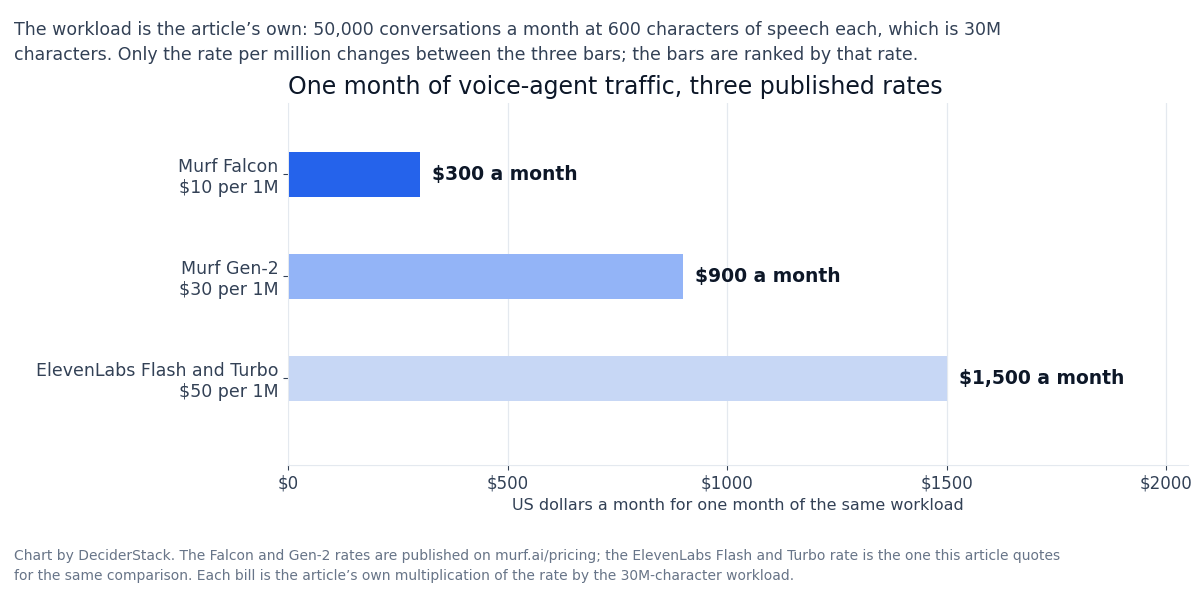
For a real workload, the math goes like this. A customer-support voice agent that handles 50,000 conversations per month, with an average of 600 characters of TTS output per conversation, runs 30M characters per month. On Falcon at $10 per 1M, that is $300 per month of TTS cost. On Gen-2 at $30 per 1M, that is $900.
On ElevenLabs Flash and Turbo at $50 per 1M, the same volume lands at $1,500. The TTS line item is rarely the binding cost on a conversational-agent deployment — the LLM tokens and the telephony usually are — but it is the easiest to forecast. For voice agents at conversational scale, Falcon’s $10/1M is the right price to model against.
FAQ: characters, voices, and licensing
Is Murf free?
Yes — the API has a free tier with $10 of credit every month, no credit card required. Studio has a free trial. Enterprise is custom-priced.
How much does Murf cost per 1,000 characters?
Falcon is $0.01 per 1k characters ($10 per 1M). Gen-2 is $0.03 per 1k ($30 per 1M). Translation is $0.02 per 1k ($20 per 1M). Voice Changer is $0.10 per minute of input audio. Credits never expire.
Is Murf better than ElevenLabs?
It depends on the workload. ElevenLabs wins on voice realism and the multilingual voice library. Murf wins on the conversational-agent price ($10/1M against $50/1M on ElevenLabs Flash and Turbo), the enterprise compliance posture (SOC 2 Type II + HIPAA + ISO 27001), and the pre-built Voice Agents platform.
Does Murf support voice cloning?
Professional voice cloning is available on Enterprise. The Studio tier does not include cloning for IP and consent reasons.
What languages are supported?
The pricing page publishes 150+ voices in 35+ languages and styles. The site’s language menu links 26 individual language pages:
- American English
- British English
- Australian
- German
- French
- Italian
- Spanish
- Russian
- Portuguese
- Arabic
- Hindi
- Tamil
- Chinese
- Japanese
- Korean
- Dutch
- Danish
- Finnish
- Norwegian
- Romanian
- Turkish
- Indonesian
- Cantonese
- Brazilian Portuguese
- Scottish
- and Indian English
Pages we pulled these figures from
The source data for this review is the Murf pricing page and the Murf product pages, captured in September 2026 via Firecrawl. Specific URLs follow.
- Murf AI pricing — API pricing models, free tier, Enterprise contact (captured September 2026).
- Murf AI Falcon TTS API — Falcon model latency and cost (captured September 2026).
- Murf AI text-to-speech — language list, voice library.
- Murf AI Voice Agents — pre-built personas, conversational positioning.
- Murf AI security — SOC 2 Type II, ISO 27001, GDPR, HIPAA.
How we put this together: per-character and per-minute API rates, the free-tier allowance, the voice and language counts and the compliance list come from murf.ai/pricing, quoted as displayed. We have not run a paid Murf Enterprise account.
Figures that depend on a real workload, a real target or a real integration are flagged where they appear in the text rather than being estimated.
Disclosure: this article contains affiliate links. If you buy through them we may earn a commission at no extra cost to you. Commission never changes our scoring or the order of a ranking.