One bill and one UI for the cold-email stack — the pitch, and the limit.
— the pricing model, in the words of this review
Saleshandy is the multichannel outbound platform for sales teams that want one bill and one UI for the cold-email stack. The case fits three shapes of buyer.
SDR or BDR team — running cold email at scale, with the verified B2B data, the sending surface and the warm-up tool in one place.
Founder doing your own outbound — skip the four-tool stack: a lead database, an email verification tool, a cold-email sender and an email warm-up tool.
Agency — outbound for multiple clients, under the seat-less pricing model.
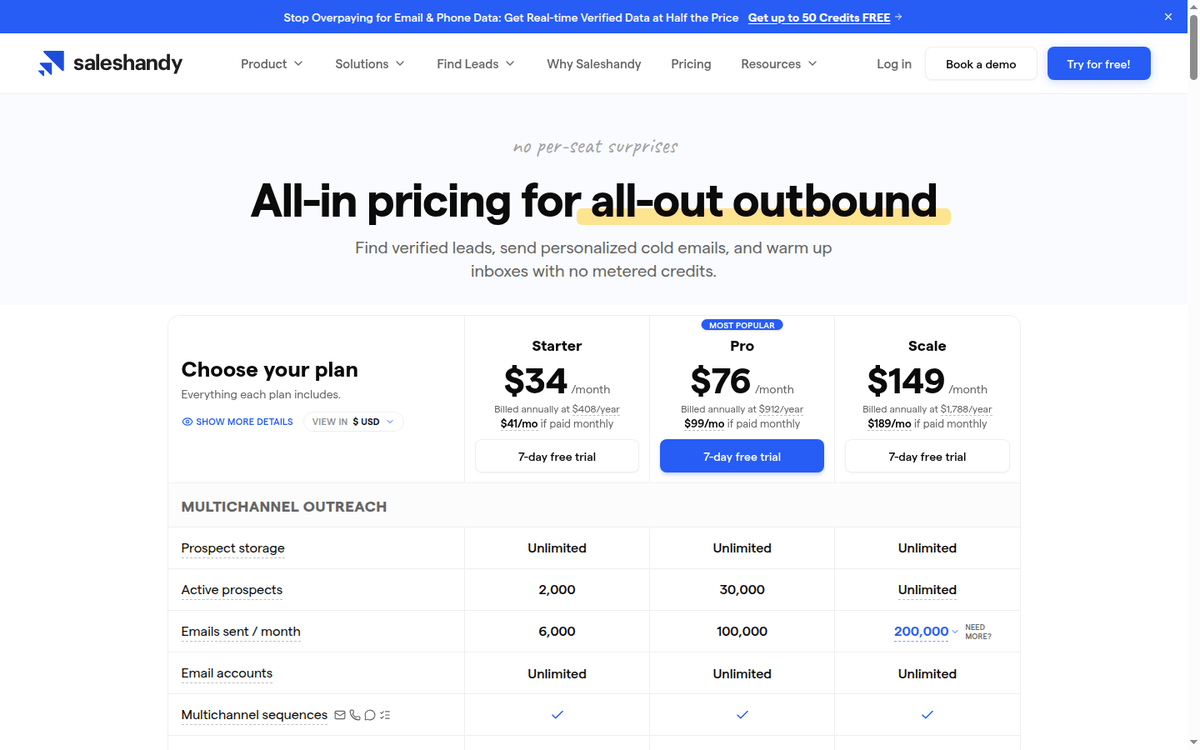
The bill — three published tiers, billed monthly or annually, with no per-seat charges on any tier.
The trial — a 7-day window on any paid tier, enough to evaluate the workflow on a real prospect list.
The lead-finder credit pool refreshes monthly on monthly billing and annually on annual billing.
4 bills and 4 UIs for one outbound workflow — a lead database, an email verification tool, a cold-email sender, and an email warm-up tool. Saleshandy is the platform built to replace that stack.
The pitch is the simplest in the cold-email category: verified B2B data, multichannel sequences (email, calls, LinkedIn, WhatsApp, tasks), and email-deliverability tooling on one bill, with no metered credits on the core sending feature.
The trade-off against the per-seat pricing model of competitors is straightforward. Saleshandy charges per platform, not per user. Adding a 10th SDR to the same account does not increase the bill. This is a real cost advantage for any team with more than 3–4 seats.
The Starter tier: solo founders and small teams
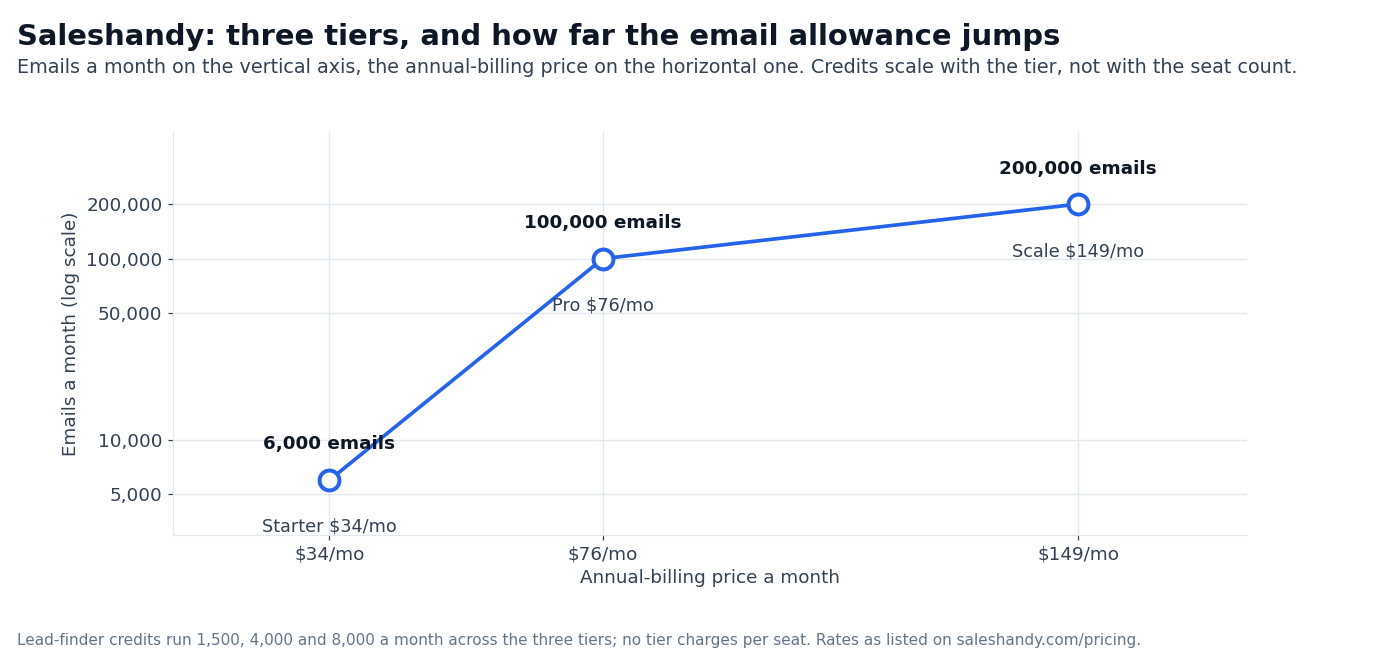
Starter at $34/mo (billed annually) is the entry point for solo founders and small sales teams. The published numbers are 2,000 active prospects at a time, 6,000 emails per month across all connected mailboxes, unlimited email accounts (no per-inbox fee), and 1,500 lead-finder credits per month.
The multichannel sequence surface, the sub-sequence trigger logic, and the B2B database (852M+ contacts, 42M+ companies) are all included.
The honest read on Starter is that it is enough for a solo founder or a small team running cold email at a steady cadence. The 6,000-emails-per-month cap is the constraint — at a typical 4-email sequence with a 30% open rate, you can run a roughly 1,500-prospect campaign per month. The 2,000 active-prospect cap matches that cadence.
The trade-off against Pro is the email volume and the lead-finder credits. Pro ships 100,000 emails per month and 4,000 lead-finder credits. If your outbound cadence is heavier than what Starter allows, the upgrade path is straightforward.
The Pro tier: the working tier for SDR teams
Pro at $76/mo (billed annually) is the working tier for SDR and BDR teams. The published numbers are 30,000 active prospects at a time, 100,000 emails per month, unlimited email accounts, and 4,000 lead-finder credits per month. The multichannel sequence surface, the sub-sequence logic, and the B2B database are all included.
The honest read on Pro is that it is the right tier for any team running a real outbound cadence. The 100,000-emails-per-month cap handles a 4-5 SDR team running daily cold email. The 4,000 lead-finder credits per month handle the prospect research that feeds the sequence.
The trade-off against Scale is the email volume and the lead-finder credits. Scale ships 200,000 emails per month and 8,000 lead-finder credits. If your team is running more than 4-5 SDRs or if your list research is the bottleneck, Scale is the upgrade path.
The Scale tier: high-volume senders and agencies
Scale at $149/mo (billed annually) is the tier for high-volume senders and agencies. The published numbers are unlimited active prospects, 200,000 emails per month (with an upgrade path to 300,000 and 600,000 on the same tier), unlimited email accounts, and 8,000 lead-finder credits per month.
Multichannel sequences, sub-sequence logic and the B2B database all come with the tier.
The honest read on Scale is that it is the right shape for an agency running outbound for multiple clients or for a sales team running 8-10+ SDRs. The unlimited active-prospect cap removes the practical ceiling on list size. The 200,000-emails-per-month cap handles most high-volume cadences; the upgrade path to 300,000 or 600,000 is a sales conversation.
The trade-off against Pro is the per-month cost ($149 vs $76 on annual billing). For a 4-SDR team, Pro is typically enough. For an agency with multiple clients, Scale is the right shape.
The lead-finder credit mechanic
The credit mechanic is the unit of work on the data side. One credit reveals a verified work email. Six credits reveal a verified phone number. The credit pool refreshes monthly on monthly billing or annually on annual billing. Unused credits do not roll over month to month on the monthly plans; on the annual plans, the full year’s credit allotment is deposited upfront.
The honest read on the credit mechanic is that it is straightforward for email-only outbound (1 credit per prospect) but expensive for phone-only outbound (6 credits per prospect). For a team that runs phone-heavy outbound, the per-prospect credit cost adds up fast.
The 8-provider waterfall is the differentiator on the data side. When you request a verified email, Saleshandy queries eight providers in sequence — Saleshandy, Prospeo, [RocketReach](/rocketreach-review/), Findymail, Enrich.so, Scalelist, then verifies through ZeroBounce and BounceBan — until one returns a match.
One credit covers the entire waterfall, not per provider. The unverified emails cost $0. The honest read is that the waterfall approach delivers higher match rates than any single-provider tool, at the cost of higher per-credit spend.
The multichannel sequence surface
The multichannel sequence is the workflow surface. You build a sequence that includes email steps, call tasks, LinkedIn tasks, WhatsApp messages, and manual tasks you assign to SDRs. The platform runs the sequence on the connected channels and tracks engagement (opens, clicks, replies, calls connected, LinkedIn accepts).
The sub-sequence logic is the deeper feature. You can trigger a follow-up sequence automatically based on how prospects respond — “if no reply after step 3, send the breakup email; if they clicked the link, send the calendar invite.” This is the workflow surface that distinguishes a real sales-engagement platform from a basic email sender.
The honest read is that the multichannel sequence surface is competent and well-priced for the segment. The trade-off against Apollo and Outreach is the depth of the conversation-intelligence and deal-management surface. Saleshandy is an outbound platform, not a full sales-engagement platform with conversation AI and pipeline analytics.
The email-deliverability tooling
The deliverability surface is the warm-up and sender-reputation tooling. You connect your mailbox, Saleshandy warms it up through a network of inboxes that engage with your emails (open, reply, mark important), and tracks the inbox placement score over time. The published promise is 95%+ inbox placement on warmed-up mailboxes.
The honest read is that the warm-up tool is competent for the price. The trade-off against dedicated warm-up tools (Warmbox, Lemwarm) is the price — the warm-up is included in the Saleshandy subscription, while the standalone tools charge $49-99/mo for the same surface.
The break-even is when you already have a Saleshandy subscription; if you do not, a dedicated warm-up tool is cheaper.
The free trial and entry point
The free trial is a 7-day window on any paid tier. The platform ships that window on the Starter, Pro, or Scale tier; at the end of the trial, you either activate the tier or drop off.
The trial is enough to evaluate the cold-email workflow and the lead-finder surface on a real prospect list. It is not enough to evaluate the deliverability surface on a real domain — warm-up takes 2–3 weeks to show measurable results, which is longer than the trial window.
The comparison angles: Apollo, Instantly, Lemlist, Smartlead
The honest head-to-head depends on the workload.
Against Apollo. Apollo is the closest peer in the cold-email platform category. Both ship verified B2B data, sending, and deliverability tooling. Apollo wins on the depth of the B2B database (Apollo’s database is larger and more frequently refreshed) and on the conversation-intelligence surface.
Saleshandy wins on the seat-less pricing model (Apollo charges per seat at higher tiers) and on the credit mechanic (1 credit covers the entire waterfall, not per provider). For a team that needs the largest possible B2B database, Apollo is the better fit. For a team with more than 3–4 seats that needs predictable per-platform pricing, Saleshandy is the better fit.
Against Instantly. Instantly is the cold-email sender focused on high-volume outreach. Instantly wins on the lower entry price and the unlimited email accounts on every tier.
Saleshandy wins on the lead-finder surface (Instantly does not have a comparable B2B database) and on the multichannel sequence surface (Instantly is email-only). For a team that needs the B2B data on the same platform as the sending, Saleshandy is the better fit. For a team that already has a data provider and only needs the sending, Instantly is the cheaper option.
Against Lemlist. Lemlist is the multichannel outbound platform with the deeper personalization surface (image personalization, video personalization, landing-page personalization). Lemlist wins on the personalization features. Saleshandy wins on the lead-finder surface and on the seat-less pricing.
For a team that needs the deep personalization features, Lemlist is the better fit. For a team that needs the B2B data on the same platform, Saleshandy is the better fit.
Against Smartlead. Smartlead is the cold-email sender focused on deliverability at scale. Smartlead wins on the deliverability surface (the warm-up tool is the deepest in the category). Saleshandy wins on the lead-finder surface and the multichannel sequence surface.
For a team that needs the deepest warm-up tool, Smartlead is the better fit. For a team that needs the all-in-one platform, Saleshandy is the better fit.
When Saleshandy is the wrong pick
Three workloads where the platform is not the right shape.
The first is a low-volume outbound workload. If you send one campaign a quarter, the $34/mo Starter tier is overkill. The right shape is a one-off lead list from a data provider, sent through your existing mailbox.
The second is a deep enterprise sales-engagement workload. Saleshandy is an outbound platform, not a sales-engagement platform with conversation AI, deal management, and pipeline forecasting. For that workload, Outreach, Salesloft, or HubSpot is the right shape.
The third is a phone-heavy outbound workload. The 6-credit-per-phone-number mechanic makes phone-only outbound expensive on Saleshandy. For a phone-heavy SDR team, a dedicated dialer (Aircall, JustCall, Orum) is the right primary, with Saleshandy as the email side.
What we could not verify
Three classes of figures in this review depend on real workload measurement that we could not benchmark without a paid Saleshandy account on a real outbound cadence. They are flagged and we recommend you test them on your own pipeline before committing.
The first is the actual reply rate on your real prospect list. The published deliverability numbers (95%+ inbox placement) are the platform’s claims; the real reply rate depends on your list quality, your copy, and your offer. The second is the bounce rate on your real domain.
The deliverability tooling helps, but the actual bounce rate depends on your domain reputation and your list hygiene. The third is the lead-finder match rate on your real ICP.
The 8-provider waterfall delivers higher match rates than single-provider tools, but the actual rate depends on the seniority and the geography of your target prospects.
FAQ
How much does Saleshandy cost per month?
Starter is $34/mo billed annually ($41/mo monthly). Pro is $76/mo billed annually ($99/mo monthly). Scale is $149/mo billed annually ($189/mo monthly). All three include the multichannel sequence surface and the B2B database. Lead-finder credits refresh monthly (1,500 on Starter, 4,000 on Pro, 8,000 on Scale).
Does Saleshandy have a free trial?
Yes. The free trial is a 7-day window on any paid tier. The trial is enough to evaluate the sending surface and the lead-finder surface on a real prospect list.
How does Saleshandy compare to Apollo?
Both are cold-email platforms with B2B data and sending. Apollo wins on the B2B database depth and the conversation-intelligence surface. Saleshandy wins on the seat-less pricing (no per-seat charges) and on the lead-finder credit mechanic (1 credit covers the entire waterfall).
Does Saleshandy include email warm-up?
Yes. The warm-up tool is included on every paid tier. The published promise is 95%+ inbox placement on warmed-up mailboxes. Warm-up takes 2–3 weeks to show measurable results.
How many lead-finder credits do I need per month?
One credit reveals a verified work email. Six credits reveal a verified phone number. For a 1,000-prospect cold-email campaign, you need roughly 1,000 credits on email-only and roughly 6,000 on phone-only. The Starter tier (1,500 credits) is enough for an email-only campaign of that size; the Pro tier (4,000) is the upgrade path for phone-only or larger lists.
Can I use Saleshandy for LinkedIn outreach?
Yes. The multichannel sequence surface supports LinkedIn tasks alongside email, calls, WhatsApp, and manual tasks. The platform tracks engagement (LinkedIn accepts, replies) and triggers sub-sequences based on the response.
Sources
- Saleshandy pricing — Starter, Pro, Scale tiers, credit mechanic, lead-finder waterfall (captured September 2026)
- Saleshandy homepage — product surface, customer logos (GoDaddy, Cloudflare, Gartner, Marsh, NetApp, Cloudtalk), trust badges (captured September 2026)
- Saleshandy email deliverability — warm-up tool, inbox placement tracking (captured September 2026)
How we put this together: the three tier prices on both billing cycles, the email allowances, the lead-finder credit pools, the active-prospect caps and the eight-provider waterfall come from saleshandy.com/pricing, quoted as displayed.
We have not run a cold-email campaign through Saleshandy, warmed a mailbox on the platform or measured a reply rate on a list of our own, so anything that depends on your sending domain and your list stays flagged where it appears.
Figures that depend on a real workload, a real target or a real integration are flagged where they appear in the text rather than being estimated.
Disclosure: this article contains affiliate links. If you buy through them we may earn a commission at no extra cost to you. Commission never changes our scoring or the order of a ranking.