A hybrid AI + live-agent receptionist service with years of Clutch and G2 ratings and the strongest published per-call billing model in the answering-service category.
Three AI Receptionist tiers, from a free plan that stays permanent to an enterprise line.
Human lines: Virtual Receptionist and Hybrid, at about half the human-first rate.
Integrations: Clio, Filevine, Lawmatics, MyCase and the legal stack, plus 7,000+ connections.
The gap: no published HIPAA BAA, and a Live Agent Network that is North America only.
Month-to-month with 30 days’ notice, and a small pilot before you commit — the per-call math depends on your call volume and escalation rate.
Smith.ai is the AI receptionist service that publishes a per-call billing model rather than a per-minute one.
What the published pricing actually looks like
The Smith.ai pricing page is built around three AI Receptionist tiers plus two human-in-the-loop lines. The headline metric is per-call cost, not per-minute — a structural choice that aligns the vendor’s incentives with the customer’s (“we want to minimize your call time, not maximize it”).
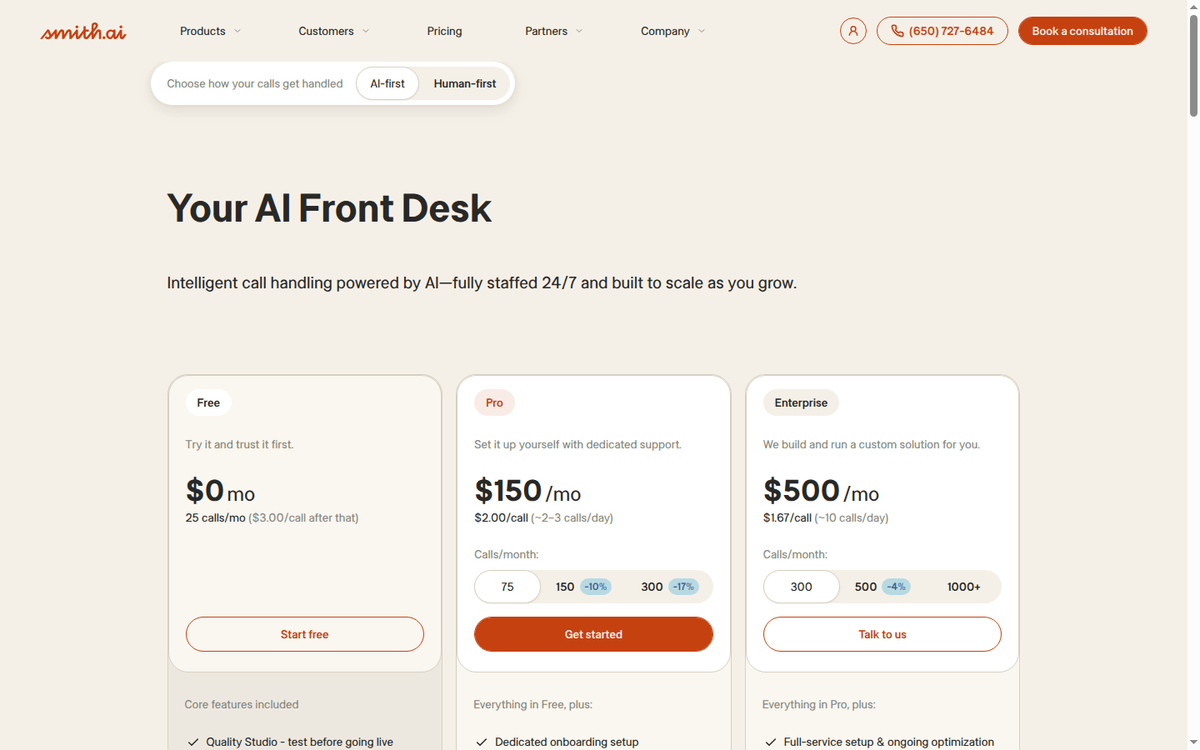
Every published tier includes 24/7 call answering, recording/transcription/summaries, lead qualification, AI scheduling, native integrations, and analytics; the higher tiers add dedicated onboarding, live phone/email/chat support, custom SMS branding, custom AI prompting, and a dedicated success manager.
The billing model is per call, not per minute. Smith.ai is explicit on the pricing page about why: per-minute services are incentivized to keep callers on the line longer, which is bad for the customer. Per-call billing aligns both sides around shorter, higher-quality calls.
For high-volume callers (law firms, home services, marketing agencies) this is the published structural differentiator versus Ruby Receptionist, AnswerConnect, and the legacy answering-service incumbents.
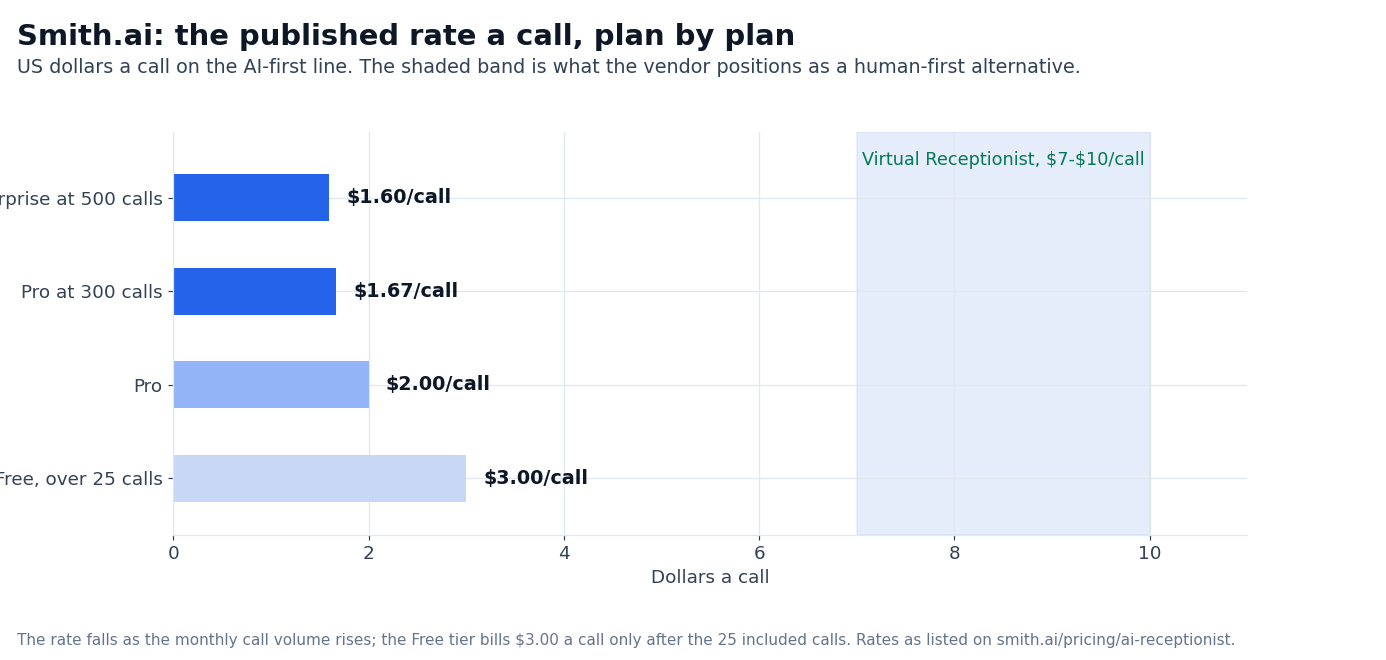
The Free tier is $0/mo with 25 included calls and $3.00/call overage. The Pro tier is $150/mo with 75 included calls at $2.00/call, 150 included calls at $1.80/call (10% off), or 300 included calls at $1.67/call (17% off). The Enterprise tier is $500/mo with 300 included calls at $1.67/call, 500 included calls at $1.60/call (4% off), or 1,000+ included calls at a custom rate.
| Tier | Monthly USD | Per-call rate | Included calls | Extra per call |
|---|---|---|---|---|
| Free | $0 | Free (up to 25) | 25 | $3.00 |
| Pro (75) | $150 | $2.00 | 75 | $2.50 |
| Pro (150) | $150 | $1.80 (10% off) | 150 | $2.30 |
| Pro (300) | $150 | $1.67 (17% off) | 300 | $2.17 |
| Enterprise (300) | $500 | $1.67 | 300 | $2.17 |
| Enterprise (500) | $500 | $1.60 (4% off) | 500 | $2.10 |
| Enterprise (1,000+) | $500 | Custom | 1,000+ | Custom |
| Virtual Receptionist (Human-first) | Quote | $7-$10/call | Quote | Quote |
| Hybrid (AI + Human) | Quote | About half the human-first rate | Quote | Quote |
The Pro-to-Enterprise step at 300 calls is the published price cliff: Pro 300 is $1.67/call, Enterprise 300 is also $1.67/call, but the Enterprise adds custom AI prompting, custom integrations, full-service setup, multi-location support, and a dedicated success manager.
The published crossover is at 300 calls — below 300 calls, Pro is cheaper; above 300 calls, the per-call rate drops further only on Enterprise.
For low-volume callers (under 25 calls/mo), Free is the published entry point. For 75-300 calls/mo, Pro is the cleanest published option. For 300+ calls/mo with custom AI prompting, Enterprise is the published default. For callers who refuse AI handling or whose escalation rate is high, the Virtual Receptionist or Hybrid line is the published alternative.
The Free tier, the trial, and what counts as a “real call”
The Free tier includes 25 real calls per month with no monthly fee. Every call answered by the AI receptionist counts toward the 25-call quota by default; spam calls from a published list of 20M+ known spammers are auto-filtered before the AI answers and do not count. Smith.ai publishes an allowance to remove up to 10% of monthly calls from the bill as spam calls that the AI did answer.
The Free tier is not a “free trial” — it is a published $0/mo plan that runs indefinitely.
The published positioning is “use it forever if your call volume stays under 25/month, or upgrade when it grows.” For solo practitioners, freelancers, and very-small businesses, this is the closest published thing to a permanent free plan in the answering-service category.
Test calls (calls you make to the AI to verify behavior) and simulated calls (calls the system generates internally for QA) do not count toward the 25-call quota. Simulated calls run at 50/month on Free, 150-600/month on Pro, and 600-2,000+/month on Enterprise.
Where the human escalation fits
The Hybrid line (priced at about half the human-first rate) and the Virtual Receptionist line ($7-$10/call) are the two human-in-the-loop alternatives:
- Hybrid — AI handles routine calls; live North-American agents handle complex calls. The Hybrid tier is the published default for law firms and home-services businesses that need a mix of AI efficiency and human nuance.
- Virtual Receptionist (Human-first) — Live North-American agents answer every call from the start; no AI handling. The published positioning is for callers who refuse AI handling, have a high escalation rate, or operate in regulated industries where the AI disclosure is a deal-breaker.
The Hybrid tier sits between the AI-only and human-first lines. The vendor’s hybrid page puts human-only service at $8–$10/call and says Hybrid halves that, so the published anchor is $4–$5/call — more than the AI-only Pro at $1.67-$2.00/call and less than the human-first Virtual Receptionist at $7-$10/call.
Calls the AI cannot handle are routed to the Live Agent Network on demand; the $3.00 published rate is the extra-call price on the Free tier once the 25 included calls are used up, not a fee for escalating to a person. The AI never claims to be human when the caller asks directly — the published policy is that bar rules and disclosure preferences are configurable per firm.
Spam policy, billing, and the published trial model
Spam handling is published in detail:
- 20M+ known spam numbers are auto-filtered before the AI answers.
- Customers can mark new spam numbers to auto-block future calls.
- Up to 10% of monthly calls can be removed from the bill as customer-marked spam.
The 10% spam-removal allowance is a published policy, not a marketing promise. Smith.ai is explicit that the customer has to actively mark spam calls; the system auto-filters only the 20M+ known-spammer list.
If your call volume includes a high fraction of spam that you do not actively mark, you can pay for spam calls. The published mitigation is “mark them when they come in.”
Billing is monthly, no long-term contract. Cancellation requires 30 days’ notice. The published payment methods are credit card; bank wire and invoiced billing are sales-gated on the Enterprise tier.
The published trial model on Smith.ai is the Free tier itself — 25 calls/mo with no recurring charge. There is no separate “free trial” CTA on the pricing page. The published positioning is “start free, upgrade when your call volume justifies it.”
Integrations, languages, and the published technical surface
Smith.ai publishes native integrations with Clio, Filevine, Lawmatics, MyCase, PracticePanther, Smokeball, Litify, and Rocket Matter — the major North-American legal-practice-management systems. Beyond the legal stack, the vendor publishes 7,000+ integrations via Zapier-style connections.
The published integration list is the strongest single argument for Smith.ai in the legal-practice category. If your CRM is Clio or MyCase, the native integration is published as a one-click setup.
If your CRM is something else (Salesforce, HubSpot, Pipedrive, a custom internal tool), the 7,000+ Zapier-style connections cover most of the common SaaS stacks.
The published languages are English and Spanish (bilingual by default). For law firms serving Spanish-speaking clients, the bilingual coverage is the published differentiator versus AI-only answering services that handle English only.
Compliance and the published audit trail
Smith.ai does not list SOC 2 or GDPR attestations on the pages we checked, and we could not confirm them elsewhere on the public site. For most North-American SMB legal and professional-services buyers that is a question for the sales call rather than a blocker.
For enterprise procurement (healthcare, financial services with regulatory audit requirements), verify the certifications against your own requirements before you sign.
Smith.ai does not publish a HIPAA BAA on the public pricing page, and the pricing pages we checked carry no SOC 2 or GDPR badges either. A practice that handles PHI has to negotiate the BAA separately, through the sales team. This is the published gap in the otherwise-strong compliance posture.
Call data is encrypted and stored within the dashboard; call recordings are deleted after three months. The published data-retention window is shorter than most legacy answering services.
Who Smith.ai fits in 2026
Three personas fit cleanly into the published Smith.ai offer, and three should compare with alternatives.
Best fit: solo practitioners and very-small businesses that need a permanent free plan. The Free tier (25 calls/mo, $0/mo) is the published default for freelancers, solo lawyers, consultants, and very-small teams. If your call volume stays under 25/month indefinitely, the published plan is permanent.
Best fit: 2-10 person law firms and home-services businesses that need a hybrid AI + human model. The Hybrid tier is the fit for law firms and home-services teams whose call mix is mostly AI-handleable with a human tail. The native integrations with Clio, Filevine, Lawmatics, and MyCase make the legal vertical a published sweet spot.
Best fit: customers who want per-call billing instead of per-minute. The published billing model is per-call, not per-minute. If your buyer is a procurement team that wants transparent per-call accounting rather than minute-based math, Smith.ai is the published structural differentiator.
Worth shopping elsewhere: enterprise procurement teams that need HIPAA BAA, FedRAMP, or PCI-DSS on the contract. Smith.ai does not publish HIPAA BAA on the public pricing page. For healthcare and regulated industries, verify with sales.
Worth shopping elsewhere: customers who want a pure-AI experience with no human escalation. Smith.ai’s published positioning is hybrid-first; if you want a pure-AI answering service with no live-agent fallback, a different vendor may be a better fit.
Worth shopping elsewhere: customers outside North America. The Live Agent Network is North American; if your customers are in Europe, Asia, or Latin America, the published language coverage (English, Spanish) and the published agent network coverage may not fit your market.
FAQ
Is Smith.ai a real answering service?
Yes. Smith.ai has handled 25M+ calls across 5,000+ businesses over 11+ years, with 500+ North-American live agents. The company publishes Clutch 4.8, G2 4.9, Capterra 4.8, and Trustpilot 4.2 ratings. Pricing is published on the official pricing page.
How much does Smith.ai cost?
From $0/mo Free (25 calls/mo) to $500/mo Enterprise at $1.60-$1.67/call. The Pro tier is $150/mo at $1.67-$2.00/call. Hybrid (AI + human) is positioned at about half the human-first rate; Virtual Receptionist (human-first) is $7-$10/call.
Does Smith.ai offer a free trial?
The Free tier at $0/mo with 25 calls/mo is the published permanent free plan. There is no separate “free trial” CTA — the published positioning is “start free, upgrade when your call volume grows.”
How much does Smith.ai charge per call?
Per-call rates run from $3.00/call on the Free overage to $1.60/call on the Enterprise 500-call tier. The Hybrid tier is positioned at about half the human-first rate; the Virtual Receptionist tier is $7-$10/call. Billing is per-call, not per-minute.
Does Smith.ai use AI or live agents?
Both. The AI Receptionist handles routine calls (lead qualification, appointment booking, intake capture); calls the AI cannot handle are routed to the Live Agent Network on demand. Extra calls on the Free tier are billed at $3.00 each once the 25 included calls are used.
What languages does Smith.ai support?
English and Spanish (bilingual by default). The Live Agent Network is North American. For non-English / non-Spanish markets, the published coverage is limited.
Does Smith.ai integrate with Clio?
Yes — Clio is a published native integration, along with Filevine, Lawmatics, MyCase, PracticePanther, Smokeball, Litify, and Rocket Matter. The published 7,000+ integrations cover most common SaaS stacks via Zapier-style connections.
What is the cancellation policy?
Month-to-month with 30 days’ notice. No published long-term contract. The Free tier can be downgraded or closed at any time.
How does Smith.ai handle spam?
20M+ known spammers are auto-filtered before the AI answers. Customers can mark new spam numbers to auto-block future calls. Calls the customer marks as spam can take up to 10% off the monthly bill.
Does Smith.ai have a HIPAA BAA?
Not published on the public pricing page. For healthcare practices handling PHI, the BAA must be negotiated separately with the sales team.
What is the contract term?
Month-to-month. 30 days’ notice to cancel. No published annual commit discount.
Does Smith.ai publish a SOC 2 attestation?
Not on the pages we checked. The pricing pages we reviewed carry no SOC 2 or GDPR badges, so treat the attestation as a question for the vendor rather than a published fact.
Sources
Smith.ai pricing page Smith.ai homepage Smith.ai integrations
How we put this together: the three AI Receptionist prices, the per-call rate at each call volume, the human-first and hybrid positioning, the spam-removal allowance and the extra-call pricing come from smith.ai/pricing/ai-receptionist, quoted as displayed.
We have not put a real phone line through Smith.ai, measured an escalation rate on real calls or tested the integrations, so anything that depends on your own call mix stays flagged where it appears.
Figures that depend on a real workload, a real target or a real integration are flagged where they appear in the text rather than being estimated.
Disclosure: this article contains affiliate links. If you buy through them we may earn a commission at no extra cost to you. Commission never changes our scoring or the order of a ranking.