SOAX is the residential proxy provider most teams overlook in 2026 — and the one that publishes the most unusual pricing structure in the category.
The model is five tiers on top of credit-based per-GB billing. Per-GB cost depends on which geo tier you target.
Tier-1 geos (US, EU and similar high-cost markets) cost more than Tier-3 geos (Philippines and similar low-cost markets).
The published plan structure, tier by tier:
- Sandbox is the only published plan with no monthly fee.
- Builder is the published entry point for paid plans.
- Enterprise adds dedicated IP pools and the locked-in lowest per-GB rates.
- The credit allowance and the seat count scale with the plan.
The result is a published pricing model that looks like a flat-fee SaaS on the outside and behaves like a usage-priced proxy on the inside.
Real-world success rate depends on the target you scrape. Run a small pilot before you commit.
Why the SOAX pricing model looks different
The SOAX pricing page is structured around five tiers, each with a monthly subscription fee, a credit allowance, a per-GB rate that varies by geo tier, a seat count, a proxy-package count, and a credit rollover window.
The credit unit is “1 credit ≈ $1 of usage” — which makes the math feel familiar, but the per-GB rate is set by the geo tier rather than by the credit price, so a credit spent on Tier-1 traffic costs you more GB than a credit spent on Tier-3 traffic.
The credit system looks like a flat-rate SaaS but is actually a usage-priced proxy with a minimum monthly commit on paid plans.
The Sandbox at $0/mo looks free, but per-GB rates are still Tier-1 $5.00, Tier-2 $4.00, Tier-3 $2.00 — top-up credits are purchased at those rates before they can be used. Read the per-GB math before you assume Sandbox is enough for a real pilot.
The geo tier system is the published differentiator that nobody else in the residential category matches. SOAX defines three geo tiers:
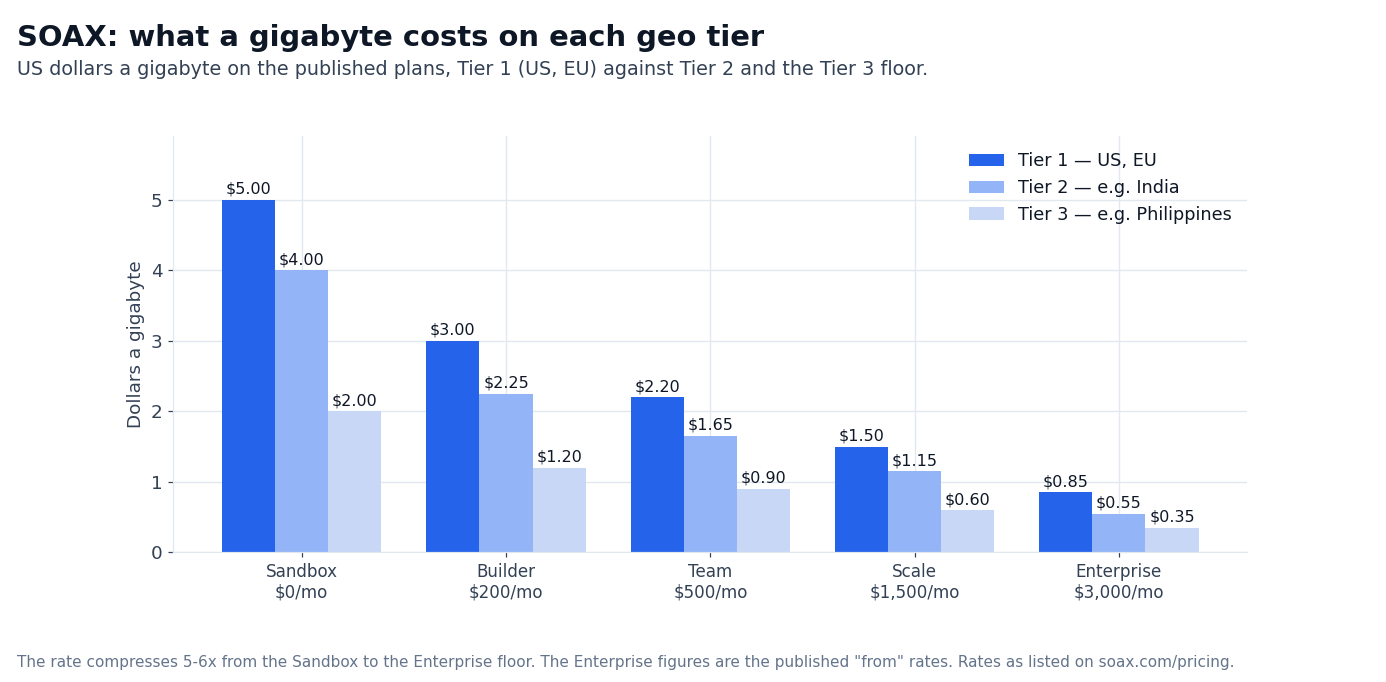
- Tier 1 — highest rates (US, EU, similar high-cost markets): $5.00/GB on Sandbox, down to $0.85/GB on Enterprise.
- Tier 2 — lower rates (e.g. India): $4.00/GB on Sandbox, down to $0.55/GB on Enterprise.
- Tier 3 — lowest rates (e.g. Philippines): $2.00/GB on Sandbox, down to $0.35/GB on Enterprise.
The published per-GB rate compresses by 5-6x from Sandbox to Enterprise. For workloads that target only Tier-3 geos (price intelligence from emerging markets, ad verification in lower-cost countries, geo-distributed content testing), the SOAX pricing math at Enterprise is the cheapest published rate in the category.
For workloads that target US/EU Tier-1 geos, SOAX is mid-pack versus bright data and smartproxy.
The five tiers in detail
The published tier structure on the pricing page is built around monthly subscription fees that scale with usage and team size. The credit system gives each tier an “included credits” allowance that maps to a per-GB quantity depending on the geo mix.
Credits roll over for 60 days (annual Enterprise moves to a 365-day rollover), so unused credits are not lost at the end of the billing cycle.
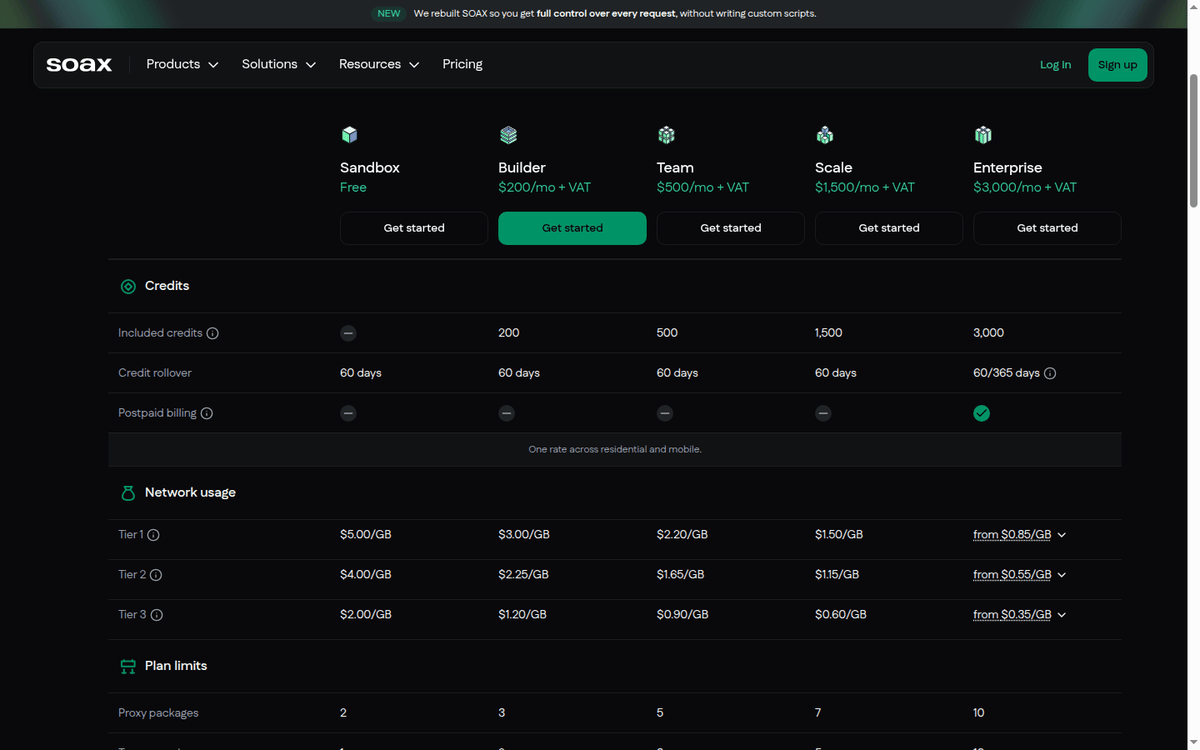
| Plan | Monthly USD | Included credits | Credit rollover | Tier-1 /GB | Tier-2 /GB | Tier-3 /GB | Proxy packages | Seats |
|---|---|---|---|---|---|---|---|---|
| Sandbox | $0 | none (top-up at tier rates) | 60 days | $5.00 | $4.00 | $2.00 | 2 | 1 |
| Builder | $200 | 200 | 60 days | $3.00 | $2.25 | $1.20 | 3 | 2 |
| Team | $500 | 500 | 60 days | $2.20 | $1.65 | $0.90 | 5 | 3 |
| Scale | $1,500 | 1,500 | 60 days | $1.50 | $1.15 | $0.60 | 7 | 5 |
| Enterprise | $3,000 | 3,000 | 60/365 | from $0.85 | from $0.55 | from $0.35 | 10 | 10 |
The Builder tier is the published entry point for paid plans — Sandbox is the only $0/mo option. Builder adds 24/7 support over the Sandbox. Team adds a larger credit allowance and more seats.
Scale adds ASN and ZIP targeting and a 5-seat allowance. Enterprise adds dedicated IP pools, a customer success manager, and the locked-in lowest per-GB rates.
The published per-GB math on the Sandbox is the closest thing to a free trial in the residential category — pay-as-you-go at the tier rate with no subscription fee and no minimum commitment.
Sandbox gives you the same Tier-1/Tier-2/Tier-3 per-GB rates as the paid plans, and you only pay for what you actually use. If your workload is US-only, budget for Tier-1 at $5.00/GB; for emerging-markets work, Tier-3 at $2.00/GB is the cheapest published Sandbox rate.
The 60-day credit rollover (365 days on annual Enterprise) is a softer form of refund protection than IPRoyal’s “no expiry” PAYG model. If you stop using your Sandbox for two months, you do not lose the credits. If you stop using your Builder for six months, you do.
Pool, locations, targeting, and what the geo tiers actually cover
SOAX does not publish a single “pool size” headline figure the way bright data (400M+) or smartproxy/decodo (115M+) does. The published positioning is “residential + mobile” with city-level targeting, and ASN and ZIP targeting on Scale+.
The geo-tier system is the published way to think about pool composition: Tier-1 has fewer IPs at higher cost, Tier-3 has more IPs at lower cost.
SOAX does not publish a single “pool size” headline the way bright data (400M+) or smartproxy/decodo (115M+) does.
If your workload needs a published pool-size number for a procurement document, SOAX is harder to cite than its competitors. The geo-tier system is the published answer; the pool composition is the workload-specific answer.
The published geo coverage is “global” with the tier system as the pricing signal. For workloads that target a specific country (US-only ad verification, EU-only price intelligence), the relevant question is whether that country is in Tier-1 (high-cost), Tier-2 (mid-cost), or Tier-3 (low-cost).
SOAX publishes the tier classification on the pricing page for the most common targets.
Session types are rotating and sticky, with sticky session length published in the dashboard documentation rather than on the pricing page. The sticky window is therefore something to measure on your own pilot, not a figure you can read off the page.
Support, billing, and what Enterprise adds
Support tiers are published and clear:
- Sandbox — basic support (email/community).
- Builder / Team — 24/7 support.
- Scale — 24/7 support on the standard SLA.
- Enterprise — 24/7 support, a premium SLA, and a dedicated Customer Success Manager.
Billing is monthly by default; Enterprise supports annual commits (12-month minimum) with locked-in lowest per-GB rates, billed in advance. Postpaid billing appears on the pricing page as its own line, reserved for approved business accounts rather than enabled on the self-serve tiers.
Postpaid billing is published as its own line, not advertised, and not enabled on the self-serve tiers. If your buyer is a procurement team that works on invoices rather than prepaid card billing, talk to sales.
Payment methods are credit card and bank wire (sales-gated for Enterprise). Crypto, Alipay, and PayPal are not advertised on the pricing page, which differs from smartproxy/decodo and IPRoyal.
What SOAX fits in 2026
Three personas fit cleanly into the published offer, and three should compare with alternatives.
Best fit: geo-distributed ad verification teams that need Tier-3 coverage at the cheapest published rate. The Sandbox at $0/mo and the Enterprise at $3,000/mo ($0.35/GB Tier-3 floor) bracket the use case that no competitor matches on price.
If your workload is global ad verification with a heavy emerging-markets mix, the Enterprise tier is the cheapest published option.
Best fit: small teams that need a multi-seat structure with included credits. The Team tier ($500/mo, 3 seats, 500 credits) is the cleanest mid-market option in the published category for a 2-3 person scraping team that needs seat-based billing.
Best fit: workloads that need a real free trial in published form. The Sandbox tier is $0/mo with no subscription fee, no included credits, and no minimum commit — you buy top-up credits at the published tier rates and burn through them.
For teams evaluating proxies for a single deliverable, this is a low-risk published entry point.
Worth shopping elsewhere: enterprise procurement teams that need a published pool-size number for security questionnaires. The vendor does not publish a single pool-size figure the way bright data or smartproxy does.
Worth shopping elsewhere: customers targeting only US/EU Tier-1 geos at scale. The Tier-1 published rates ($5.00/GB Sandbox, $1.50/GB Scale, $0.85/GB Enterprise floor) are mid-pack versus bright data and smartproxy.
If your workload is Tier-1-only at scale, compare with smartproxy/decodo or bright data before you commit.
Worth shopping elsewhere: workloads that need mobile proxy coverage as a separate product. The published pricing bundles residential + mobile, but does not publish mobile-only pricing. If you need a mobile-only comparison, bright data or oxylabs is the easier citation.
The bottom line
SOAX in 2026 is what it has been since the geo-tier system landed: a residential proxy vendor with the cheapest published Tier-3 rates in the category and a credit-based pricing model that wraps per-GB math in a SaaS-shaped subscription.
The Sandbox at $0/mo is the cleanest published free-trial equivalent in the residential category.
The case for the vendor in 2026 is the geo-tier system. At $0.35/GB on Tier-3 Enterprise, the platform wins workloads that need emerging-markets IP coverage at the cheapest published rate. The Sandbox at $0/mo with no subscription fee and no minimum commit wins workloads that need a low-risk published entry point.
The case against is the absence of a published pool-size headline and the mid-pack published Tier-1 rates versus bright data and smartproxy.
If your workload is global ad verification with a heavy emerging-markets mix or a small team that needs a seat-based billing structure with included credits, this is the strongest published option in the category.
If your workload is Tier-1-only at scale or enterprise procurement with a published audit trail, compare with smartproxy/decodo, bright data, or oxylabs before you commit.
FAQ
Is SOAX a real proxy provider?
Yes. SOAX is a residential and mobile proxy vendor with a published geo-tier pricing structure on the official site.
The Sandbox tier is the $0 entry point and is functionally equivalent to a free trial. Pricing is published and verifiable.
How much does the vendor’s residential proxy cost?
The published per-GB math depends on the geo tier and the subscription tier. Tier-1 (US, EU) ranges from $5.00/GB on Sandbox to $0.85/GB on Enterprise. Tier-3 (Philippines and similar) ranges from $2.00/GB on Sandbox to $0.35/GB on Enterprise.
The Sandbox is $0/mo with no subscription fee — you buy top-up credits at the published tier rates to use the service.
Does the vendor offer a free trial?
The Sandbox tier is $0/mo with no subscription fee and no included credits. You buy top-up credits at the published tier rates (Tier-1 $5.00/GB, Tier-2 $4.00/GB, Tier-3 $2.00/GB) and burn through them. Credits roll over for 60 days.
The official pricing-page FAQ explicitly states “no free trial” — Sandbox is the no-commitment option, not a time-boxed trial.
What is the IP pool size?
SOAX does not publish a single pool-size headline figure the way bright data (400M+) or smartproxy (115M+) does.
The geo-tier system is the published way to think about pool composition. For a published pool-size number for procurement documents, bright data or oxylabs is the easier citation.
What geo tiers does SOAX support?
Three: Tier-1 (US, EU, high-cost geos), Tier-2 (e.g. India, mid-cost), and Tier-3 (e.g. Philippines, low-cost). Each tier has its own per-GB rate at every subscription tier. The pricing page lists the most common country classifications per tier.
What is the sticky session length?
SOAX publishes rotating and sticky sessions but does not list the sticky window length on the pricing page. Treat the sticky window as a feature to verify on your pilot rather than as a published number.
How does SOAX compare to Bright Data on price?
At the bottom of the published ladder, SOAX Enterprise is $0.85/GB on Tier-1 and $0.35/GB on Tier-3.
Bright Data does not publish a directly comparable per-GB rate, so the honest comparison is product-shaped: SOAX is the cheaper published entry on Tier-3, while Bright Data has the wider product catalog (Web Unlocker, mobile, ISP, datacenter) and the larger published residential pool.
How does SOAX compare to Smartproxy?
On Tier-1, SOAX Enterprise ($0.85/GB) is cheaper than Smartproxy/Decodo PAYG ($4.00/GB) and 1 TB Enterprise ($2.00/GB).
On Tier-3, SOAX Enterprise ($0.35/GB) is the cheapest published rate. Smartproxy has the simpler per-GB pricing model (no geo tier system) and the strongest self-serve trial flow.
What payment methods are accepted?
Credit card on the published tiers; bank wire (sales-gated) for Enterprise annual commits. Crypto, Alipay, and PayPal are not advertised on the pricing page.
Does SOAX have a SOC 2 attestation?
SOC 2 and ISO 27001 are not advertised on the pricing page. For published compliance attestations, oxylabs is the strongest reference in the residential category.
Sources
SOAX pricing SOAX residential proxy product
How we put this together: the five plan prices, the included credit allowance, the credit rollover and the per-gigabyte rate on all three geo tiers come from soax.com/pricing, quoted as displayed, with the residential product framing read from soax.com/residential-proxies.
We have not bought bandwidth from SOAX, run a crawl through its pool or measured a success rate on our own targets, so anything that depends on the workload you point at it stays flagged as unverified in this review.
Figures that depend on a real workload, a real target or a real integration are flagged where they appear in the text rather than being estimated.
Disclosure: this article contains affiliate links. If you buy through them we may earn a commission at no extra cost to you. Commission never changes our scoring or the order of a ranking.