Per GB
Residential bandwidth, and the browser bandwidth Scraping Browser meters in GB.
Per IP
ISP and Datacenter IPs, billed per IP and per month.
Per unit
Web Unlocker, SERP API and Web Scraper API, billed in successful requests or delivered records.
Mixing the units in one bill is normal; the cheaper the unit, the higher the monthly commitment.
What Bright Data actually sells in 2026
The vendor organizes the catalog around two stacks. The proxy stack covers Residential (rotating home IPs across 195 countries), ISP (static datacenter IPs registered as residential), Datacenter (cheap shared IPs), and Mobile (3G/4G/5G carrier IPs).
The scraping stack wraps those networks into managed products: Web Scraper API for pre-built extractors, Web Unlocker for protected targets, Scraping Browser for Puppeteer and Playwright, SERP API for search engines, and Scraper Studio for the no-code case. Datasets and Bright Insights sit alongside as paid-data products.
The reason the catalog matters more than it does at competitors: every product has a different unit of billing. Residential meters bandwidth in GB (counting request and response headers). ISP and Datacenter meter IPs per month. Web Unlocker and SERP meter successful requests.
Scraping Browser meters GB of browser bandwidth with a 5K-credit allowance. Mixing them in one bill is the normal case for any team running more than one workload, and the only way to compare Bright Data to a competitor is product-by-product, not as a single bill.
The pool itself is large. Bright Data publishes a figure of 400M+ residential IPs refreshed monthly, alongside city, state, ZIP, and ASN targeting on the same endpoint — targeting metadata does not add to the price.
Targeting is part of why the catalog is more interesting for data teams than the residential-only vendors. Bright Data separates session control (how long an IP sticks), geo targeting (country / state / city / ZIP / ASN), and proxy type (residential, ISP, mobile, datacenter) as orthogonal knobs. A team scraping U.S.
ZIP-level retail pages can request residential + U.S. + ZIP 94110 + sticky session 30 minutes on the same endpoint, with no extra fee for any of those dimensions. Most competitors charge for city targeting as an add-on and treat ASN as enterprise-only.
The pricing model in one breath
Three metrics, one rule: the cheaper the unit, the higher the monthly commitment.
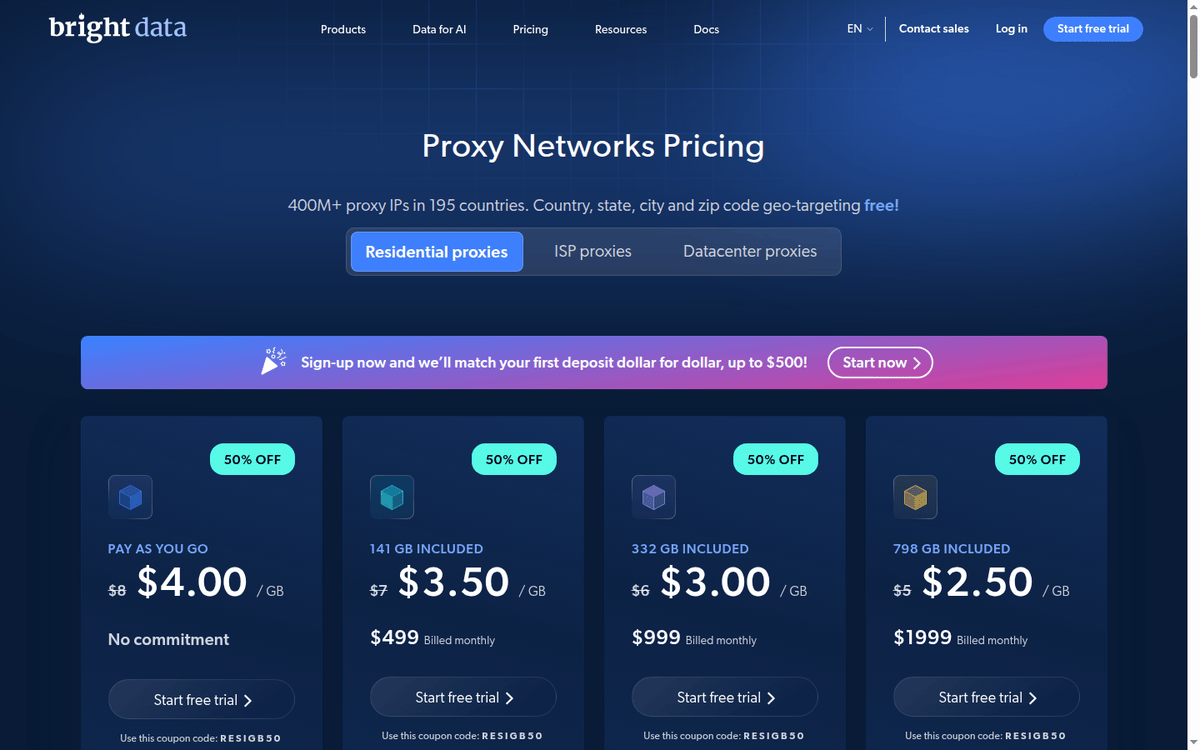
- Residential bandwidth: $4/GB PAYG → $3.50/GB Starter ($499/mo, 141 GB) → $3.00/GB Growth ($999/mo, 332 GB) → $2.50/GB Business ($1,999/mo, 798 GB). Enterprise at >1,000 GB is custom with a 99.99% uptime SLA.
- ISP IPs: $1.80/IP PAYG → $1.45/IP at 100 IPs ($145/mo) → $1.40/IP at 500 IPs ($700/mo) → $1.30/IP at 1,000 IPs ($1,300/mo).
- Datacenter IPs: $1.40/IP PAYG → $1.00/IP at 100 ($100/mo) → $0.95/IP at 500 ($475/mo) → $0.90/IP at 1,000 ($900/mo).
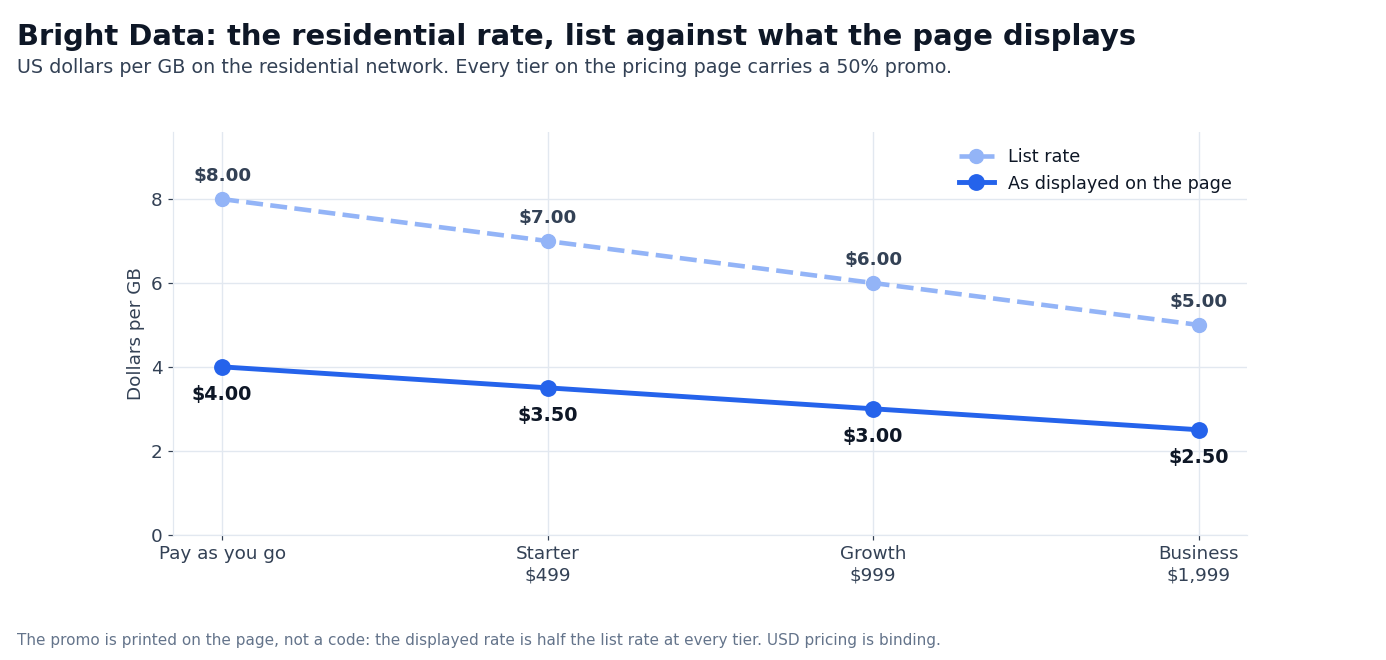
These are the rates as displayed: every residential tier on that page carries a 50% promo, and the list prices are $8/GB pay-as-you-go and $7, $6 and $5 per GB on Starter, Growth and Business. USD pricing is binding. The promo code appears on the residential pricing page itself, so it is not a hidden marketing gimmick.
A 25% promo code (APIS25) applies to most Web Scraper API plans for the first three months. A first-deposit match up to $500 is available on most products — useful for new accounts running a one-off job.
The free tier nobody talks about
Every API product on the Bright Data side ships with a 5,000-unit free tier and no credit card required. That covers:
- Web Scraper API: 5,000 successfully delivered records per month, pay only for successful delivery, expert support included.
- Web Unlocker: 5,000 successful requests per month, CAPTCHA solving, JS rendering, browser fingerprinting, automatic retries, 99.99% uptime.
- SERP API: 5,000 successful SERP requests per month across 195 countries, with city-level targeting.
- Scraper Studio: 5,000 page-load operations per month, three scrapers maximum, 100 records per scraper, exports in JSON, NDJSON, CSV, or Excel.
- Scraping Browser: 5,000 credits per month with 1 GB of browser bandwidth included, limited concurrency on the free plan.
The product pages describe this as “expert support, no card needed.” For evaluation, that is the cheapest possible path on the market — 5,000 records through Web Unlocker is enough to validate a target, and there is no auto-recharge risk on the free tier.
What the residential plan costs at three usage tiers
The published tiers line up like this:
| Plan | Monthly | GB included | Effective $/GB | Notes |
|---|---|---|---|---|
| PAYG | $0 | none | $4.00 | No commitment, pay per GB; promo listed on page |
| Starter | $499 | 141 | $3.50 | 50% off promo listed on page |
| Growth | $999 | 332 | $3.00 | 50% off promo listed on page |
| Business | $1,999 | 798 | $2.50 | 50% off promo listed on page |
| Enterprise | custom | >1,000 | custom | 99.99% uptime SLA |
A few ways the math lands in practice:
- A team running 200 GB a month lands in the Starter band: $499 plus overage at the same $3.50/GB rate (or PAYG-equivalent $4 if they do not want to commit). The overage bill is roughly $700–$800.
- A 500 GB workload crosses into Growth territory: $999 flat, versus roughly $2,000 on PAYG. The tier pays for itself before the second invoice.
- A 1,500 GB workload is Business-or-better. At Business the math is $1,999 for 798 GB plus overage at $2.50/GB for the remaining 702 GB, so roughly $3,754 total. Enterprise pricing almost always beats this above 1,500 GB.
These figures assume US-headquartered billing in USD and ignore VAT. Bright Data notes that “local-currency display [is] indicative only” — the USD price is binding.
The API side: Web Unlocker, SERP, Scraper Studio
Bright Data’s API stack is positioned for teams that want managed unblocking rather than rolling their own proxy rotation.
Web Unlocker is the simplest sell. You POST a URL, Bright Data routes through the right proxy pool, solves CAPTCHAs, renders JavaScript, rotates user agents, and returns the rendered page. Failed requests still consume bandwidth — only “successful delivery” is free.
Free tier is 5,000 requests per month, then PAYG with spend limits and unlimited concurrency, then Scale at 383,000 requests with discounted per-1K pricing, then Enterprise above 500K.
The architecture under Web Unlocker is what makes it different from a simple proxy rotator. Bright Data maintains its own pool of browser fingerprints, rotating TLS fingerprints (JA3/JA4), HTTP/2 frame orderings, and canvas hashes per request.
What justifies the per-1K pricing on the Scale tier is the detection work the vendor runs internally — and the alternative of buying 75 credits per protected request on ScrapingBee Stealth makes that math concrete.
The cost math flips depending on the target: a site with a 30% block rate on raw residential is roughly the same on Web Unlocker Scale as on ScrapingBee Stealth, but Web Unlocker Scale removes the per-call credit math from your code path entirely.
SERP API covers 195 countries at the city level — the vendor’s pricing page says every country on Earth. Same plan structure as Web Unlocker: 5K free, PAYG, Scale at 380K requests, Enterprise above.
Scraper Studio is the no-code path. Five thousand page-load operations free per month with three scrapers and a 100-record cap each, then PAYG per 1K loads, then Scale at 383,000 loads, then Enterprise. Result definition: the first page render counts as one result, and each click, scroll, or load adds to the count.
Delivery targets include API, webhook, S3, GCS, Pub/Sub, Azure, and SFTP.
Scraping Browser is a managed Puppeteer/Playwright/Selenium-compatible browser with built-in proxies and unlocking. Free: 5K credits and 1 GB. PAYG: unlimited sessions. Scale: 71 GB at discounted pricing, unlimited browsers. The “headful” architecture (a GUI browser, not a headless one) makes detection harder for anti-bot systems.
Compatibility with Puppeteer, Playwright, and Selenium is explicit on the pricing page.
Where the bill actually grows
Three friction points show up in the published constraints and in the field notes from teams running at scale.
KYC on Residential and Mobile. Identity verification is required before Residential or Mobile traffic will route through your account. The published note is “compliance call + ID verification,” and the implication is that a same-day signup-and-scrape workflow does not work.
Datacenter and ISP traffic do not require KYC, so teams that can route their workload through datacenter IPs avoid the step.
Auto-suspend at 100% of balance. Bright Data’s billing model auto-suspends the account when balance hits zero and recommends auto-recharge. There is no grace period; a billing-cycle overrun results in a stopped account until the recharge lands.
For teams running 24/7 pipelines, the mitigation is either auto-recharge (with a hard cap) or pre-paid balance with alerts.
Failed Web Unlocker requests still consume bandwidth. The “free” 5,000-unit tier on Web Unlocker only counts successful delivery; failed attempts still use the proxy + compute budget. A target with a high block rate will burn through free units without producing useful output.
The published warning is direct: “failed records are not charged” — meaning the bill is success-only — but the proxy and compute on failed attempts are not free in the underlying sense.
A related pricing-architecture note: all API plans ship with unlimited concurrency. There is no per-thread surcharge, which is unusual — most competitors cap concurrency on cheaper tiers.
Bright Data vs ScrapingBee vs Smartproxy
The honest comparison narrows quickly once you isolate the workload.
| Workload | Bright Data wins | ScrapingBee wins | Smartproxy wins |
|---|---|---|---|
| One-off scrape < 100K pages | Web Unlocker free tier (5K/mo, no card) | Flat credit pricing (1 credit/req simple) | Mid-market residential pool, simpler UX |
| Heavy residential proxy, mixed geo | 400M+ IP pool, city/ZIP/ASN targeting | Premium proxy is 10–25 credits/req, expensive at scale | Residential pay-as-you-go at lower entry price |
| Hard targets (Cloudflare, DataDome, PerimeterX) | Scraping Browser + Web Unlocker (built-in) | Stealth proxy at 75 credits/req — pays only on protected calls | No native unlocking layer |
| Long-running Playwright/Puppeteer | Scraping Browser (managed) | Limited Playwright story | Pure proxy — bring your own browser |
| Static ISP / datacenter IPs | ISP pool from $1.30/IP, datacenter from $0.90/IP | Not core to offering | Smartproxy ISP comparable, datacenter weaker |
ScrapingBee’s edge is flat credit pricing — you know exactly what a request costs before you call it (1 to 75 credits depending on target and proxy tier). Bright Data’s edge is integration: when you need a residential proxy, a managed unlocker, and a headful browser in one stack, the catalog is unified.
When Bright Data is the right choice — and when it isn’t
Bright Data is the right choice if you have at least two of these three needs at once: a large rotating residential pool, managed unblocking for hard targets, and a managed browser. The catalog depth is the moat. If you only need one of the three, a focused competitor will usually beat it on price or simplicity.
It is the wrong choice if any of the following applies:
- You cannot complete KYC (Residential and Mobile require it).
- Your workload is bursty and unpredictable — auto-suspend at 100% balance is a hard cliff, and PAYG pricing is the most expensive tier.
- You need to predict per-request cost precisely — most API pricing is set via login, not published, which makes cost forecasting rough.
- Your team is small, and your traffic is below 100K requests per month. The free tiers will cover evaluation, but at production scale the $499 Starter commitment becomes the floor.
For a small team scraping public web pages under 10K requests a day, ScrapingBee or Browse AI will be cheaper and easier.
For a team running millions of mixed-quality requests across residential, ISP, and protected targets, Bright Data’s unified catalog is hard to replace.
What we did not verify
We did not run a live Residential account through KYC in this review — KYC is described from the vendor’s published constraints, not from a hands-on signup. We did not test the first-deposit match up to $500 — the offer is listed on the pricing page, but the redemption mechanics are set via account login and were not exercised.
Pricing for Web Scraper API Scale and Web Unlocker Scale is “slider-set” and was not benchmarked at a specific record count. The 50% residential promo and the APIS25 three-month discount were verified as listed on the public pricing pages; whether your account is eligible for them at sign-up depends on the channel you came through.
All product prices in this article are taken from the Bright Data public pricing pages, as captured in our research file.
Sources used in this article:
- Bright Data pricing overview
- Residential proxy pricing
- Web Scraper API pricing
- Web Unlocker pricing
- SERP API pricing
- Scraper Studio pricing
- Scraping Browser pricing
FAQ
Does Bright Data have a free tier?
Yes. Web Scraper API, Web Unlocker, SERP API, and Scraper Studio each give 5,000 units per month with no credit card. Scraping Browser gives 5,000 credits plus 1 GB of bandwidth. The free tier is enough for evaluation but not for production.
What is the cheapest paid plan?
PAYG residential bandwidth at $4/GB with no commitment, or PAYG ISP IPs at $1.80/IP. PAYG rates are higher than committed tiers but require no monthly spend.
Is KYC required?
Yes for Residential and Mobile networks. Datacenter and ISP traffic does not require identity verification.
What happens if my balance runs out?
The account auto-suspends at 100% of the prepaid balance. Auto-recharge is recommended for uninterrupted traffic; a stopped account does not retry on its own.
Can I use Bright Data for SERP scraping?
Yes. The SERP API covers 195 countries at the city level, with 5,000 free requests per month.
Does the price differ by country?
Pricing is USD-binding. Local-currency display on the site is indicative and is not the contracted rate.
How we put this together: the residential pay-as-you-go rate, the three committed tiers, the promo as it is printed on the page, the ISP and datacenter per-IP rates and the free-tier unit counts come from the four pricing pages on brightdata.com, quoted as displayed, with the comparison figures read from scrapingbee.com, smartproxy.com and browserless.io.
We have not run a crawl through the residential network or the Web Unlocker, so anything that depends on your own target mix stays flagged where it appears.
Figures that depend on a real workload, a real target or a real integration are flagged where they appear in the text rather than being estimated.
Disclosure: this article contains affiliate links. If you buy through them we may earn a commission at no extra cost to you. Commission never changes our scoring or the order of a ranking.