GMV Polar prices by the brand’s annual gross merchandise value, so the bill steps by GMV band, not by seats or tracked events.
Unlimited users every plan in the published ladder includes them, so the marketing team’s headcount never changes the bill.
Core Plan Business Intelligence, Klaviyo Audiences, Advertising Signals and a dedicated Snowflake warehouse in one subscription.
Snowflake the brand holds the keys to its own warehouse, so ad-hoc SQL runs without going through the Polar UI.
Add-on modules Incrementality Testing, the SQL and enrichment bundle and Email Marketer are where a real bill grows past the subscription.
Analytics tools for Shopify D2C brands split into two camps. The lightweight ones — Triple Whale, Lifetimely, ThoughtMetric — give you a dashboard of CAC, ROAS, and a few attribution windows at a flat monthly price.
The warehouse-native ones — Polar Analytics, Northbeam — give you your own Snowflake database and a semantic layer, with pricing that scales with your annual gross merchandise value. Polar sits firmly in the second camp.
The interesting question in 2026 is not whether the warehouse-native approach is better (it is, past a certain GMV), but where exactly the crossover happens — and what the second-tier add-on modules do to a real bill (polaranalytics.com, captured recently).
Why GMV-based pricing is the central decision
Most BI tools price by seats or by tracked events. Polar prices by the brand’s annual gross merchandise value, which is the closest thing to a “size of business” metric for a Shopify D2C brand.
The published pricing ladder is anchored at $720/mo for the Core Plan under $5M annual GMV, then steps up at every GMV threshold (polaranalytics.com, captured recently).
The math implication is simple. Add ten people to your account and the bill does not move. Cross a GMV threshold and the bill steps up, often by roughly $300/mo per $1-2M of incremental GMV past the $5M line.
For a fast-growing brand, the GMV-based pricing is more predictable than seat-based or event-based pricing — the bill grows in proportion to the business, not in proportion to the analytics team’s hiring or to a noisy traffic spike.
For a brand whose growth has stalled, the same pricing model is the friction. A $5M brand that drops to $3M annual GMV does not get a refund. A $15M brand that has a slow quarter does not get a discount on the next quarter. The pricing is anchored to the trailing annual figure, not to the current run rate.
The trade is real: predictability in one direction, rigidity in the other.
The user model is the other half of the central decision. Every plan in the published ladder includes unlimited users. A 50-person marketing team using the same Polar workspace pays the same as a 5-person team.
For agencies managing multiple client workspaces, the GMV model means each workspace is priced by that client’s revenue, not by the agency’s headcount touching it.
The contract structure is also worth understanding. Polar bills annually with a roughly 17% discount versus monthly billing, similar to most B2B SaaS in this tier. The discount applies to the Core Plan subscription; add-on modules are not always covered by the same discount.
The published pricing page does not call out add-on discounts explicitly, which means a brand negotiating a Custom plan should ask whether the add-on modules carry the same annual-discount structure or whether they are quoted at list price on top.
At the $10M+ GMV tier, the add-on pricing structure can swing the total bill by 10-20% depending on the negotiation.
What the Core Plan actually bundles
The Core Plan is the bundle most brands evaluate first.
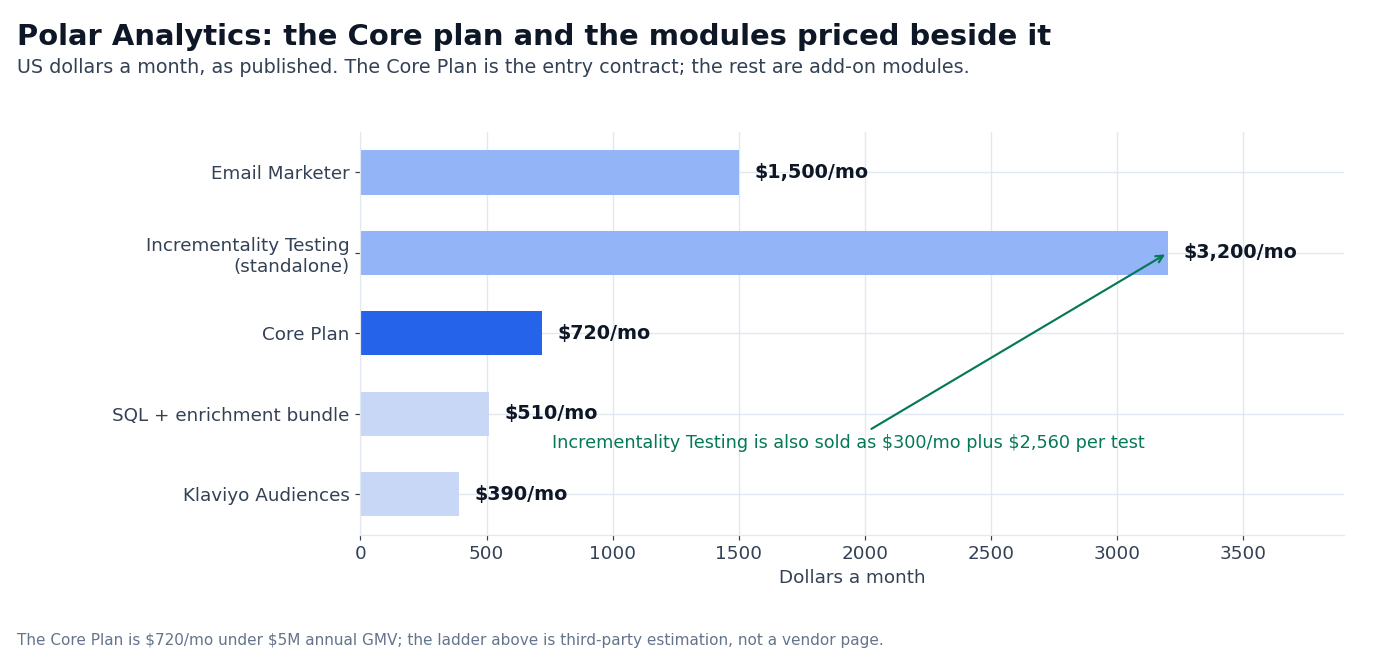
It combines four modules — Business Intelligence, Klaviyo Audiences, Advertising Signals, and a dedicated Snowflake warehouse — into a single subscription at $720/mo under $5M annual GMV (eightx.co, captured recently).
| Module | What it covers |
|---|---|
| Business Intelligence | Dashboard library, custom reports, multitouch attribution, Ask Polar AI, goal tracking, alerts |
| Klaviyo Audiences | Identifies missed abandonment events, re-engagement audiences, Klaviyo sync |
| Advertising Signals | Cross-channel ad signals, attribution enrichment |
| Dedicated Snowflake warehouse | Customer holds the keys; 40+ connectors + Polar Pixel with attribution |
| Customer Success Manager | Dedicated CSM as part of the bundle |
| First-party Pixel | Server-side and browser-side attribution with Lifetime ID |
| Unlimited users | No per-seat charge on top |
The bundle is broad enough that a brand can run the BI, the Klaviyo audiences, and the ad signals from a single dashboard, with all the underlying data sitting in a Snowflake warehouse that the brand owns.
That ownership matters for two reasons: the brand can run ad-hoc SQL against the warehouse without going through Polar’s UI, and the warehouse can be used for non-Polar analytics work (custom models, machine-learning pipelines, finance reporting).
The four words on the pricing page that do the most damage to a budget are “SQL access,” “intraday refresh,” “demographic enrichment,” and “incrementality testing.” Each of these is an add-on, not a universal inclusion. The first three are bundled in the SQL/enrichment module at ~$510/mo.
The fourth is the biggest line item on the platform.
The add-on modules that move the bill
Three modules account for most of the variation in real Polar bills past the Core Plan subscription.
Klaviyo Audiences at $390/mo. This module is part of the Core Plan bundle, but it is also sold as a standalone subscription for brands that already have a Polar BI tier and want the audience features without upgrading.
The module identifies missed abandonment events (events that Klaviyo’s tracking cannot capture), creates re-engagement audiences, and syncs the audiences back to Klaviyo for activation. For a brand spending on paid social with a Klaviyo stack, this module pays for itself quickly if the missed-event rate is non-trivial.
Incrementality Testing (Causal Lift) at ~$3,200/mo standalone, or ~$300/mo + $2,560 per test. Causal Lift runs holdout lift tests across Meta, Google, TikTok, and TV to measure incremental impact of paid media. The standalone price is the most expensive single line item in the Polar catalog.
The bundled structure (a base fee plus per-test pricing) is closer to a custom-engagement model than to a SaaS subscription.
Sources disagree on which structure is current — one independent tracker lists $3,200/mo as a standalone product, another cites $300/mo + $2,560 per test (eightx.co, captured recently). The published Polar pricing page does not specify the structure clearly.
The honest read is that the Incrementality line is the single biggest swing factor in a Polar bill.
SQL / enrichment bundle at ~$510/mo. Demographic enrichment, SQL access, and Google Sheets connectors in a single add-on. For brands that have an analyst on the team, this module is the difference between “BI tool with a UI” and “warehouse you can actually query.” For brands without an analyst, the module is a sunk cost.
Email Marketer at ~$1,500/mo (on the vendor’s pricing page that $1,500 card is labeled “Polar Headless MCP”; the Email Marketer name comes from a third-party tracker). Polar AI for email, automated email reporting, segmentation workflows. The module is positioned as a Polaris-built alternative to a dedicated email tool.
For brands already on Klaviyo, the module is harder to justify.
True TCO at three GMV tiers
The Core Plan subscription is the starting point. The full bill is the Core Plan plus whatever add-on modules the team actually uses. Three realistic profiles from independent analyst work show how the math lands (eightx.co, captured recently):
| Profile | Core Plan | Klaviyo Audiences | Incrementality | SQL bundle | Total |
|---|---|---|---|---|---|
| Starter ($1M GMV, BI only) | ~$350 | $0 | $0 | $0 | ~$350 |
| Growth ($5M GMV, Core Plan) | $720 | $0 | $0 | $0 | $720 |
| Growth + activation ($5M, Core + Klaviyo) | $720 | $390 | $0 | $0 | $1,110 |
| Mid-market ($10M GMV, Core Plan) | $1,660 | $0 | $0 | $0 | $1,660 |
| Mid-market + incrementality ($10M) | $1,660 | $0 | $3,200 | $0 | $4,860 |
| Full stack ($10M, Core + all add-ons) | $1,660 | $390 | $3,200 | $510 | $5,760 |
The full-stack line is the one that surprises most operators. A $10M brand running the full Polar stack pays roughly $5,760/mo, or about $69,000/year before the annual discount. That is real money, and it is almost entirely driven by one decision: whether to run Incrementality Testing inside Polar.
Annual billing saves roughly 17%. The discount applies to the Core Plan subscription; add-on modules are not always covered by the same discount, and the published pricing does not call out add-on discounts explicitly.
How Polar compares to Triple Whale and Northbeam
The three-way comparison is the one operators ask about most, because each platform has a structural advantage at a different GMV band.
| Annual GMV | Polar | Triple Whale | Northbeam |
|---|---|---|---|
| $1M | ~$400 | ~$300 | ~$1,500 |
| $5M | $720 | ~$900 | ~$1,500 |
| $10M | ~$1,660 | ~$2,728 | ~$2,000 |
| $20M | ~$2,200 | ~$3,500 | ~$2,500 |
The crossover below ~$2M GMV is the first decision point. Triple Whale’s free tier and $219/mo entry make it the cheapest of the three at low revenue.
Triple Whale also has a richer pre-built dashboard for the most common D2C metrics (CAC, MER, blended ROAS), which matters for early-stage brands that do not have an analyst to build custom dashboards.
The crossover at $5-10M GMV is the second decision point. Polar’s GMV-based pricing pulls ahead of Triple Whale at this band, and the bundled Snowflake warehouse starts to matter for brands that have outgrown a flat-fee dashboard but have not yet hired a data team.
Northbeam’s quote-based pricing tends to land in the same band as Polar, with Northbeam’s edge being its multitouch attribution model and Polar’s edge being the bundled warehouse and the lower entry price at low GMV.
The crossover at $20M+ GMV is the third decision point. Northbeam’s enterprise positioning becomes more relevant — the custom quote structure and the dedicated support model are designed for brands at this scale.
Polar’s Core Plan price steps up sharply here ($2,770/mo at $20-25M, $7,970/mo at $75-100M), but the add-on module structure is more flexible than Northbeam’s bundled enterprise pricing.
Sources: Polar Analytics comparison page, PricingSaaS live tracker, Saras Analytics review, Conjura pricing breakdown (eightx.co, captured recently).
Higher-tier Triple Whale and Polar values are vendor-provided or third-party estimates; a direct quote against your actual GMV is the only way to lock the real numbers.
When Polar Analytics fits (and when it does not)
A good fit when:
- You run a Shopify D2C brand at $5M+ annual GMV, where the warehouse-native model starts to pay for itself. – You have or plan to hire a data analyst who can query the Snowflake warehouse directly. – You want a single subscription that bundles BI, Klaviyo audiences, advertising signals, and the underlying warehouse.
- You run paid media at scale and need Incrementality Testing across Meta, Google, TikTok, and TV. – You operate an agency model where each client workspace is priced by that client’s revenue.
Probably not the right fit when:
- You are under $1M GMV. A $720/mo Core Plan is a heavy line item at low revenue, and Triple Whale’s free tier or Lifetimely at $79/mo covers the basics. – You do not have an analyst on the team. The Snowflake warehouse is the differentiator only if someone on the team can query it.
- You run a single-channel brand with no Klaviyo stack. The Klaviyo Audiences module is one of the bundle’s biggest value drivers, and it is wasted if you are not on Klaviyo. – You need a flat-fee subscription with no GMV step-ups. Polar’s pricing rewards growth and penalizes flat-or-declining revenue.
What we did not verify
This article did not book a Polar demo, request a GMV-tier quote, or run the platform against a real Shopify store. The published Core Plan price ($720/mo under $5M GMV) comes from the vendor’s own pricing page and is corroborated by independent trackers.
The GMV-tier prices above $5M ($1,020/mo at $5-7M, $1,660/mo at $10-15M, $2,770/mo at $20-25M, $7,970/mo at $75-100M) are third-party estimates from Conjura — a competitor — and should be treated as directional anchors, not as published rates.
The Incrementality Testing pricing structure (~$3,200/mo standalone vs ~$300/mo + $2,560 per test) is ambiguous across sources; both versions appear in independent trackers.
The comparison table against Triple Whale and Northbeam is positioned from public marketing material and third-party reviews, not from feature-by-feature benchmarking.
The 4.9-star operator rating (116 reviews on the Shopify App Store) is vendor-listed; the same listing quotes the Core Plan from $750/mo against the $720/mo on the vendor’s own page, a discrepancy we could not resolve.
FAQ
Does Polar Analytics publish pricing?
Partially. The pricing page lists the Core Plan at $720/mo under $5M annual GMV and the Custom Plan at “Contact us.” Specific GMV-tier prices above $5M are not published; third-party trackers (Conjura, PricingSaaS) cite estimated ranges.
Confirm with a Polar demo quote (polaranalytics.com, captured recently).
How is Polar Analytics different from Triple Whale?
Polar is warehouse-native — every plan includes a dedicated Snowflake database the brand owns. Triple Whale is a flat-fee dashboard with a pre-built metrics library.
Polar’s edge is at $5M+ GMV and for brands with an analyst on the team; Triple Whale’s edge is at sub-$2M GMV and for brands without an analyst.
What does Incrementality Testing cost?
Incrementality Testing (Causal Lift) runs holdout lift tests across Meta, Google, TikTok, and TV. The published price is ambiguous — sources cite ~$3,200/mo as a standalone product and ~$300/mo + $2,560 per test as a bundled structure.
The line item is the single biggest swing factor in a real Polar bill (eightx.co, captured recently).
Does Polar Analytics offer a free trial?
Yes. The trial is 14 days with self-serve setup, and there is a demo environment where you can explore with your own data without a long-term commitment.
Is Polar Analytics worth the cost for sub-$1M brands?
Usually not. A $720/mo Core Plan is a heavy line item at low revenue, and lighter tools (Triple Whale’s free tier, Lifetimely at $79/mo, ThoughtMetric at $99/mo) cover the basics. Polar earns its price once a brand has enough channels and volume to justify a dedicated warehouse.
Which integrations are bundled in the platform?
The vendor lists 40+ connectors, including Shopify, Amazon, retail channels, Klaviyo, Meta, Google, TikTok, and the major ad platforms.
The first-party Polar Pixel covers both browser-side and server-side attribution, and the dedicated Snowflake warehouse means a brand can also pull data from non-Polar sources into the same warehouse.
How we put this together: the Core Plan price, the Klaviyo Audiences, Incrementality Testing, SQL/enrichment and Email Marketer module prices, the GMV-band table and the operator rating come from polaranalytics.com/pricing, quoted as displayed, with the higher GMV-tier ranges read from third-party trackers on conjura.com and pricingsaas.com and marked as estimates rather than vendor figures.
We have not run a Polar pilot on a live store, negotiated a contract or measured the attribution windows, so anything that depends on your own catalog stays flagged where it appears.
Figures that depend on a real workload, a real target or a real integration are flagged where they appear in the text rather than being estimated.
Disclosure: this article contains affiliate links. If you buy through them we may earn a commission at no extra cost to you. Commission never changes our scoring or the order of a ranking.