Customer success software sits in a strange middle layer of the SaaS stack. It is not a CRM, not a ticketing tool, not a marketing automation — but it pulls signals from all three to flag which accounts are about to leave. ChurnZero is one of the better-known dedicated CS platforms.
There is no public rate card. Every call to action on the site books a demo.
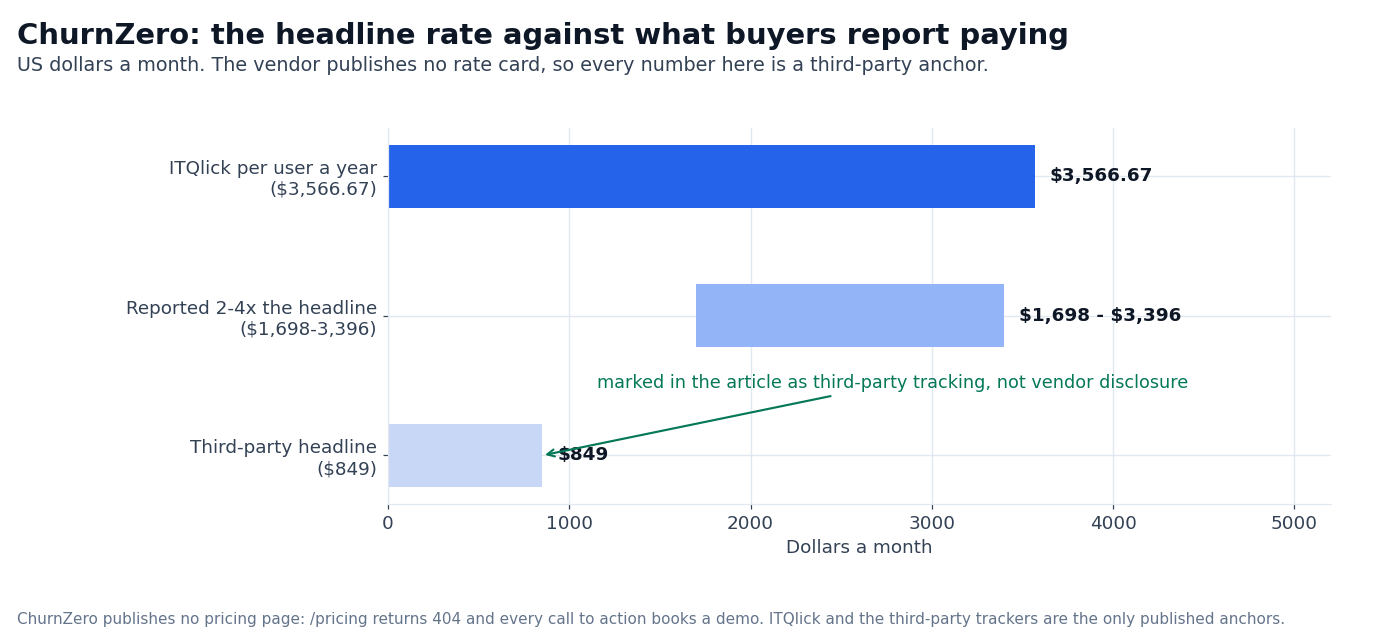
The headline rate and the per-user annual anchor come from third-party tracking, not from ChurnZero.
The interesting story in 2026 is not the feature list, which is solid and well-marketed, but the gap between the published entry rate and the contract a real buyer signs (churnzero.com, captured recently).
How the platform is sold
The pricing page does not exist on churnzero.com. There is no rate card, no “From $X/mo” line, no plan list. Every CTA on the marketing site — homepage, hero, footer, library pages — routes to “Book a Demo” or “Request a Demo” (churnzero.com, captured recently).
That funnel is on purpose: the contract is built around CSM seat count, customer-account volume tier, and the integration footprint.
What we know from third-party tracking rather than vendor disclosure: the headline entry rate is around $849/month, and the real number buyers see tends to land at 2-4x that once the conversation covers CSM seats, customer-count tiers, and implementation.
ITQlick anchors a typical commitment at $3,566.67 per user/year after add-ons (itqlick.com, captured recently).
We did not book a demo, get a quote, or talk to sales. The $849/month and $3,566.67 per user/year figures come from third-party pricing trackers, not from the vendor directly. Real deals for B2B SaaS contracts in this category vary widely by industry, ARR under management, and term length.
Treat the numbers as directional anchors, not quotes.
What the AI Agents layer actually does
The 2026 marketing push is the AI Agents layer. The vendor’s framing is that these are purpose-built embedded agents, not generic LLM hooks. The claim is that they “act” rather than “analyze or advise” (churnzero.com, captured recently). What that means in operational terms:
- The Engagement AI agent monitors product usage signals and triggers in-app or email outreach to at-risk accounts.
- The Sentiment AI agent watches responses (NPS, CSAT, in-app replies) and routes negative signals to the assigned CSM.
- The Renewal AI agent builds forecast models for upcoming renewals based on usage, support ticket volume, and exec sponsorship signals.
We did not run the platform against a real book of business. The AI capabilities described above come from the homepage and product pages, not from a measured deployment.
The “purpose-built, embedded Agents that don’t just analyze or advise — they act” framing is vendor positioning; the precise scope of autonomous action versus CSM approval steps is not published as a contract term.
In a regulated environment — financial services, healthcare, education — the autonomous-action framing is worth pressure-testing in the contract, because the difference between “suggests an action” and “fires an action without human approval” is a meaningful compliance boundary.
How the customer health score gets built
Health scoring is the central data product. The published description is that the platform combines product usage, support volume, NPS, and exec sponsorship signals into a per-account composite score, then lets CSMs define the thresholds that turn a score into a risk band.
The exact weighting is configurable, which is the right design for a CS team that knows its own customer shape — a usage-heavy B2B SaaS weights product events very differently from a services-heavy subscription business.
The score lives in two places: as a column on the CSM account view, and as a trigger that fires plays. A drop below threshold is the most common trigger event.
The interesting design choice is that score events can fire both automated plays and human-CSM tasks from the same trigger — so a single drop can produce an in-app message to the customer, a Slack alert to the assigned CSM, and a renewal-stage update in the pipeline view.
The trigger-and-task composition is the part most worth pressure-testing in a pilot: it is the cleanest way to find out whether your CS org prefers one alert per signal or a single rollup when the day is done.
The platform’s reporting surfaces expose the score distribution across the portfolio, which is where the “13x increase in CSM account coverage” claim on the homepage comes from.
The math works roughly like this: a CSM who used to manually triage 30 accounts per quarter can pick from a flagged list of 200, then run plays against the flagged subset.
Whether that 13x claim is real depends on how clean the underlying usage data is — if the signals are noisy, the flagged list has more false positives, and the CSM ends up doing the same triage with extra steps.
A useful pre-pilot test is to ask the vendor for a sample scoring model against a synthetic account portfolio and see how stable the risk bands are across a couple of months of simulated data.
What the platform ships
| Surface | What it does |
|---|---|
| AI and AI Agents | Embedded agents that automate engagement, sentiment, and renewal signals |
| Customer health scoring | Combine product usage, support, NPS, and exec signals into per-account scores |
| Customer journeys | Multi-step lifecycle plays triggered by score or stage changes |
| Plays and automation | Build custom rules that fire on health-score drops, milestone dates, or product events |
| In-app communications | Send in-app messages, tooltips, and tours without engineering work |
| Renewal forecasting | Pipeline for renewals with risk-weighted probability and stage movement |
| Surveys | NPS, CES, CSAT with response capture and routing |
| Reporting | Dashboards for portfolio health, CSM coverage, and revenue retention |
The platform targets SaaS and subscription businesses with enough customer-account volume to justify dedicated CSM headcount.
The logo wall on the homepage reads as mid-market B2B SaaS — myshop manager, iContact, Cision, Cin7, ComplianceQuest, HackerRank, Untappd, Fiscal Note, Spins, Smoothwall, ABBYY, GoCanvas, Sibme, FreeWill (churnzero.com, captured recently).
The mid-market positioning matters for the comparison: enterprise-heavy peers (Gainsight, in particular) start at a higher entry price and assume a more bespoke CS org chart.
Where the hidden costs land
Three places where the contract grows past the headline sticker.
First, CSM seats. The license model is per-CSM-seat for the platform’s users, not per-customer-account under management. A team of 10 CSMs at the average third-party seat rate drives the per-year cost into the high five figures quickly. If your CS org doubles in a year, the platform line item scales with it.
Second, customer-count tiers. The contract brackets the number of customer accounts you can manage under the platform. The entry tier covers a few thousand accounts. Once a customer portfolio crosses into tens of thousands of accounts, the tier moves and the unit price changes.
The threshold itself is not published — it’s part of the conversation with sales, not a public ladder.
Third, implementation and integrations. The integration library is broad — Salesforce, HubSpot, Slack, Stripe, Recurly, Chargebee, Maxio, Snowflake, BigQuery, NetSuite, Zendesk, Intercom, Mixpanel, ServiceNow, Jira Service Management. Wiring the platform into a real stack is implementation work.
Premium support and dedicated CSMs are typically sold as add-ons that drive the total above sticker. The integration count is a marketing asset but not a cost — each integration is a project, and the projects add up.
None of the specific tier thresholds — customer-account counts, seat tiers, integration fees — are published. The structure of the contract came out of third-party pricing write-ups, not from the vendor’s own documentation. If your business is large enough that the tier brackets matter, get them in writing before signing.
Where the contract surprises hit
Beyond the published line items, three operational frictions show up once the contract is signed.
Implementation timeline is the first. The integration library is broad, but each integration is a project. A realistic Salesforce plus HubSpot plus Snowflake plus Stripe integration build tends to run six to ten weeks with a dedicated admin, depending on data shape.
The vendor sells implementation as a professional services engagement, which is an additional line item on top of the license.
The second friction is the seat-vs-account mismatch. The license is per CSM seat, but the tier is per customer-account under management. If your CS team grows faster than the customer base, you pay for seats you do not fully use.
If your customer base grows faster than the CS team, you hit the account tier before you hire enough CSMs to justify the next license bracket. Both shapes are normal — the published ladder is structured to make both transitions a sales conversation, not a self-service upgrade.
The third friction is data retention and export. The platform stores usage signals, health scores, and play history in a proprietary format. Exporting the data into a separate warehouse for analysis is not a one-click operation; it tends to require either a Snowflake or BigQuery connector or a scheduled API pull.
Buyers with an existing data warehouse strategy should plan the export path before signing, not after. The Snowflake and BigQuery connectors are listed on the integration page, but the cost of running them continuously is not published.
None of these are deal-breakers — they are the same frictions that show up on every mid-market CS platform. The reason they matter for ChurnZero specifically is that the contract structure hides them: a buyer who only looks at the headline rate card has to discover each of them in turn during implementation.
A useful pre-signing move is to ask the vendor to put the seat tier, account tier, and implementation services estimate in writing, even if the final numbers move.
Comparison: ChurnZero versus the alternatives
Three SaaS-CS platforms sit in similar territory. Gainsight is the enterprise incumbent, with deeper enterprise CRM integration and a higher entry price. Vitally is the modern SMB-CS platform with a faster onboarding curve.
Catalyst is the closest peer on AI-driven plays and customer journeys, with a different pricing model (per-account, not per-seat).
The structural position is mid-market B2B SaaS, with a feature depth that competes with Gainsight but at a price that competes with Vitally and Catalyst. The headline number is closer to Vitally; the feature depth is closer to Gainsight; the AI Agents layer is closer to Catalyst.
If you have a small CS team and a few thousand accounts, the platform is likely more than you need. If you have a large CS team and a portfolio of tens of thousands of accounts, the tier structure is the relevant middle option.
The peer comparison above is positioned from public marketing material, not from feature-by-feature benchmarking. Treat it as orientation, not a head-to-head matrix.
A short pilot against your own book of business is the only way to test the AI Agents framing in your environment — the marketing copy is consistent across all three competitors, and the difference tends to show up in the data shape after a quarter of real usage.
When the platform fits (and when it does not)
A good fit when:
- You run a B2B SaaS or subscription business with a dedicated customer success team. – You have enough customer-account volume to justify tiered per-seat pricing. – Your retention story is anchored in product-usage signals and account-stage plays.
- You want a CS platform with a published AI Agents layer rather than a bolt-on GPT.
Probably not the right fit when:
- You’re a pre-CS-stage company. Without a CS team, the platform has no users. – Your customer book is hundreds, not thousands. Per-seat pricing scales poorly at low volume. – You need a CRM. The tool integrates with Salesforce and HubSpot; it does not replace them.
- You run a consumer or transactional product. The signal layer assumes a named-account model.
What we did not verify
This article did not book a demo, request a quote, or run the platform against a real book of business. The pricing figures come from third-party trackers, not vendor disclosure. The AI Agents framing comes from the homepage and product pages, not from a measured deployment.
The peer comparisons are positioned from public marketing material, not from feature-by-feature benchmarking.
The 65% reduction in onboarding time, 13x increase in CSM coverage, and 21% increase in gross revenue retention figures on the homepage are vendor-published self-reported metrics. Treat them as marketing claims, not as benchmarks for your own business.
A realistic way to evaluate them is to ask the vendor for a customer reference in your ARR band, then run the same onboarding exercise the reference customer ran, with the same seat count.
FAQ
Does the platform publish pricing?
No. The pricing is sales-led. The headline entry rate is around $849/month by third-party tracking, and real commitments land at 2-4x that once CSM seats, customer count tiers, and implementation are added.
How does the AI Agents layer differ from a ChatGPT plugin?
The vendor positions its agents as purpose-built, embedded, and able to act — meaning they trigger plays, send messages, and route signals without manual approval at every step. The published framing is autonomy, not advice.
The contract terms around that autonomy are not published; ask sales for the exact approval-step policy.
Which integrations ship out of the box?
The homepage lists 48+ integration logos including Salesforce, HubSpot, Slack, Microsoft Teams, Stripe, Recurly, Chargebee, Maxio, Zendesk, Intercom, Mixpanel, Snowflake, BigQuery, NetSuite, and others.
The full integration footprint is broader than the logo wall — the partner directory lists additional connectors for niche billing and ops systems.
Is the AI capability extra cost?
The AI Agents layer is positioned as part of the core platform. The headline third-party pricing does not call out a separate AI surcharge, but contract structure varies by deal — ask sales to confirm whether the AI Agents are bundled or an additional line item.
Does the platform replace Salesforce?
No. It integrates with Salesforce and HubSpot; it does not replace them. The platform is the customer-success layer on top of a CRM, not a CRM itself.
What is the contract length?
Annual subscription, sales-led. Multi-year and quarterly terms are negotiable but are not published defaults.
How we put this together: the AI Agents description, the customer-health scoring inputs, the integration list and the self-reported metrics come from churnzero.com and churnzero.com/features, quoted as displayed.
The pricing anchors are third-party: churnzero.com publishes no rate card, so the headline rate and the per-user figure come from ITQlick and the pricing trackers rather than from the vendor.
Figures that depend on a real workload, a real target or a real integration are flagged where they appear in the text rather than being estimated.
Disclosure: this article contains affiliate links. If you buy through them we may earn a commission at no extra cost to you. Commission never changes our scoring or the order of a ranking.