Data Credits versus Actions, two currencies that burn differently.
— the credit model, in the words of this review
50,000 rows, three providers cascading through Apollo, then Hunter, then Prospeo before each row is marked enriched — run the Clay waterfall once against a list that size and you understand what the platform is actually selling. It is not a contact database.
It is a credit-powered orchestration layer that treats enrichment as a programming problem, not a SaaS menu. Clay lets you route every row through the cheapest provider that returns a hit, fail-over to the next provider when it does not, and never overpay for the rows that were already answered by the first call.
This is the version a RevOps lead, growth engineer, or sales-ops buyer reads before committing to a data platform.
Where it fits — RevOps, growth and sales-ops teams running enrichment as a routing problem, where the cheapest provider that returns a hit fills the row.
Where it does not — Buyers who want a contact database: the value is the waterfall, not the rows behind it.
On every plan — Two credit pools — Data Credits for third-party data, Actions for the work Clay itself does — plus the waterfall across 150+ providers.
Where the cost lands — Which pool you run out of first: run out of Data Credits and the enrichment stops, run out of Actions and the workflow engine stops.
The credit economics: two currencies, two burn rates
Clay does not bill per seat, per record, or per provider. It bills in two credit pools that map to two different activities. This is the most-confused part of the pricing for first-time buyers, and it is also where the most real cost-of-mistake happens.
Data Credits are spent when you buy data from one of the 150+ providers in the Clay marketplace. Finding an email costs some number of credits. Finding a phone number costs more. Pulling a firmographic record from a vendor like Apollo, Clearbit, or Datagma costs more again.
Data Credits are the price of the third-party data itself, with Clay acting as the routing layer that negotiates volume discounts with the providers and passes them through. The published rate starts at $0.05 per credit and gets cheaper as your monthly credit volume scales. Data Credits roll over.
On Launch and Growth plans, unused credits accumulate up to 2x your monthly credit amount (a 10,000-credit plan banks up to 20,000). On Free, there is no rollover. Enterprise plans have custom rollover.
Actions are spent when Clay itself does work on a row. Each row you push through the platform, each enrichment step, each Claygent AI research call, each HTTP API call to an external system, each AI-formula run — all of those consume Actions.
Actions are billed at the per-action rate, which the vendor publishes as starting below $0.01 each and decreasing as you commit to higher Action tiers within a plan. Actions do not roll over. Unused Actions at the end of the month are gone.
The reason the two-currency model matters is that the cost-of-mistake pattern is asymmetric. Running out of Data Credits mid-month means you cannot enrich new rows, but you can pause and resume next month.
Running out of Actions means you cannot use Clay at all — the workflow engine cannot run, Claygent cannot fire, and outbound sequencer stops pushing. A buyer who budgets only for Data Credits and ignores the Action math discovers this in week three.
The four published tiers: Free, Launch, Growth, Enterprise
The plan ladder in 2026 is structured around both credit pools. Each plan names a base Action volume and a base Data Credit allotment. Within a plan, you can buy more Actions or more Data Credits a la carte, or step up to a higher Action tier.
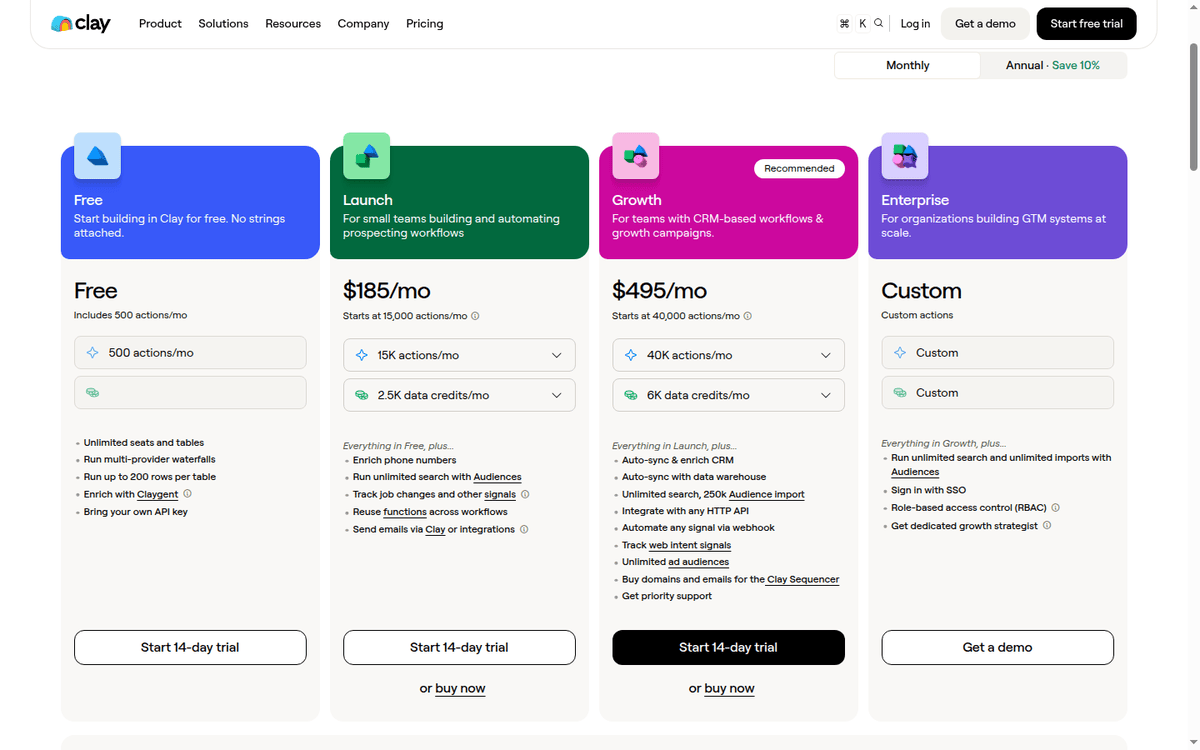
Free is the no-credit-card trial surface. It includes 500 Actions per month, 100 Data Credits per month, 1,200 Data Credits per year total, and up to 200 rows per tab. Multi-provider waterfalls, Claygent AI enrichment, and the Clay Sequencer for email are included. Tables and users per workspace are unlimited.
The free plan does not include phone number enrichment. Free is the right surface for evaluating Clay with a 500-row pilot list. It is not a real production plan.
Launch (starts at $185/mo) is the first production plan. It starts at 15,000 Actions per month and the published Action tier ladder runs 15k ($60/mo), 40k ($150/mo), 60k ($200/mo), 100k ($290/mo), 200k ($540/mo).
Data Credits scale similarly: 30k/yr ($113/mo), 72k/yr ($261/mo), 120k/yr ($414/mo), 240k/yr ($792/mo), 600k/yr ($1,913/mo). Phone number enrichment is included. Rollover up to one month’s credits (15% of annual).
Growth (starts at $495/mo) is the team plan. It starts at 40,000 Actions per month with the Action tier ladder at 40k ($205/mo), 60k ($290/mo), 100k ($450/mo), 200k ($850/mo). Data Credits run 72k/yr ($261/mo), 120k/yr ($413/mo), 240k/yr ($792/mo), 600k/yr ($1,913/mo).
CRM auto-sync and enrichment, HTTP API integrations, webhook automation, and web intent signals are added on top of Launch. Same credit rollover rules.
Enterprise is custom-priced with an annual commitment. The published ceiling is custom Action and Data Credit volumes, unlimited rollover, custom security and infrastructure terms, and the full Growth feature set. Enterprise is the right tier for GTM teams running Clay as core revenue infrastructure.
The important pricing detail that does not always show up in the headline plan table: each plan within Launch and Growth has its own sub-ladder. You pick your Action tier (15k, 40k, 60k, 100k, 200k) and your Data Credit tier (30k, 72k, 120k, 240k, 600k annually) separately. They bill together as a plan total.
The waterfall story: why Clay is not Apollo or ZoomInfo
Apollo and ZoomInfo sell you a contact database. Clay sells you the orchestration layer that decides which provider to ask, in what order, and when to stop asking.
The waterfall mechanic is the technical answer to a problem every GTM team has: provider A covers 60% of your emails, provider B adds 25% of the rows provider A missed, provider C fills another 10%, and the last 5% are unreachable. Apollo or ZoomInfo would charge you full price for the 60% provider A already covered.
Clay charges you for the providers that actually filled the missing rows.
The published provider count is 150+. Real-world usage clusters around the dozen that have the deepest coverage: Apollo, Hunter, Prospeo, Datagma, Clearbit, Dropcontact, Snov.io, [RocketReach](/rocketreach-review/), and a handful of intent and signal providers. The waterfall is configured per-column.
You pick the providers, the order, the stop condition (e.g., stop when a valid email is found, or keep going until two providers agree), and Clay runs it across your list.
For a buyer comparing Clay to a flat-rate database, the cost math is roughly: a flat-rate database at $10,000/year plus an enrichment tool at $5,000/year runs $15,000/year for a single-database workflow.
Clay at the Launch plan with the 60k Action tier and 72k Data Credit tier runs roughly $461/month or $5,532/year, with access to all providers. The waterfall means Clay typically returns 90%+ fill rate on a B2B list at a lower effective cost than a flat database.
Test on your own list shape before committing, because the answer depends on the industry, the seniority of titles, and the geography of your prospects.
Claygent, MCP for reps, and the AI piece
The newest layer on Clay is the AI agent surface. Claygent is the per-row research agent — point it at a company URL and ask it to find the engineering org size, the funding stage, or the product launch date, and it scrapes and parses. Account Agents extend the same idea across a list.
The Agent plugin (CLI/API) lets you run Clay inside a coding agent. MCP for reps puts Clay data inside the AI tools your sales team already uses (Claude, Cursor, ChatGPT).
The credit economics on Claygent: each Claygent run consumes Actions based on the depth of the research. A simple “find the CEO’s name” call might consume 5–10 Actions. A complex “summarize the latest 5 product launches and score ICP fit” call might consume 50–100. The action cost is the gating mechanism.
A team that defaults to Claygent for every column will burn through the Action tier quickly.
For 2026, the MCP piece is the most strategically interesting. The Model Context Protocol is the emerging standard for AI agents to access data tools. Clay is one of the first GTM platforms to ship a native MCP server.
The use case is concrete: a sales rep working in Claude Desktop or Cursor can ask “find me 20 VP of Sales at Series B SaaS companies in Texas” and the answer comes back populated with verified Clay data, not hallucinated guesses. The MCP story is the reason some teams are switching to Clay from older GTM stacks.
Cost scenarios: what real workloads cost
The published pricing table is the ceiling. The real question is what specific list sizes and workflow shapes cost in 2026. Three worked examples using the published rates, all flagged where they appear because your mileage will vary.
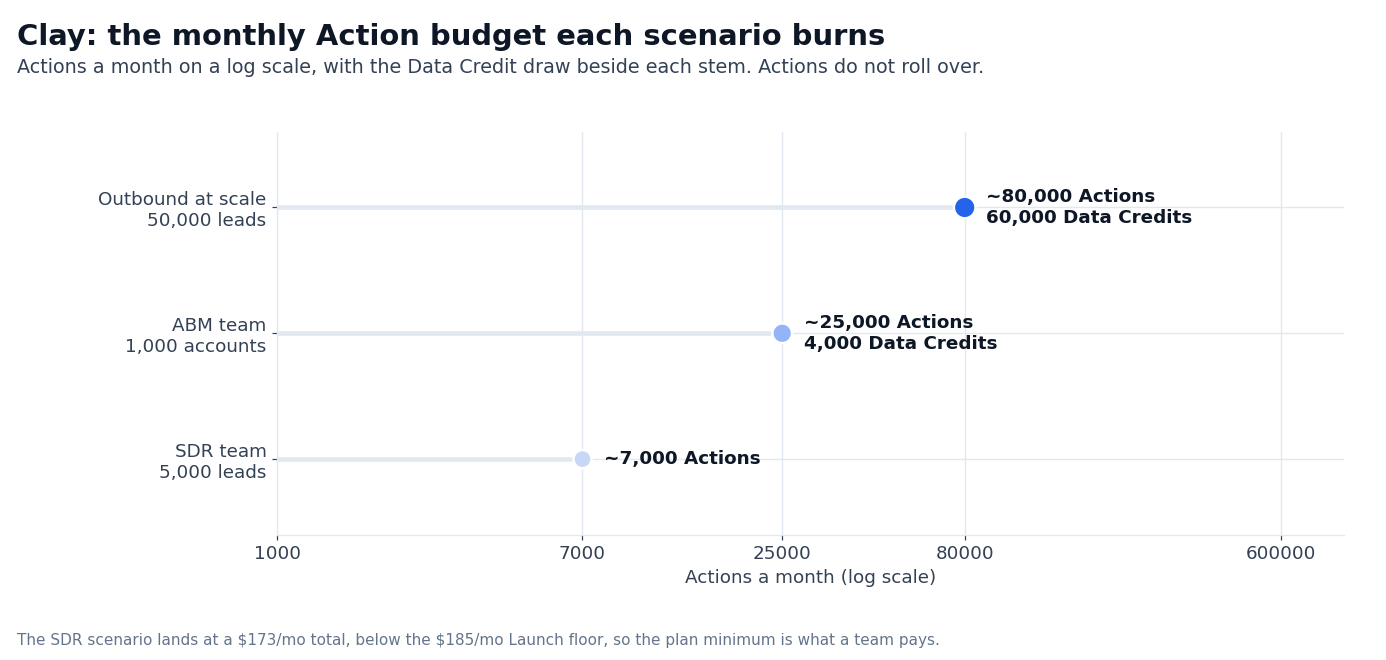
Scenario 1: SDR team, 5,000 leads/month, email-only. Build a waterfall of three providers (Hunter → Apollo → Datagma) for work email. Skip phone. Use Clay Sequencer for outbound, no Claygent. Estimated Actions: ~7,000 (one per row plus workflow overhead).
Estimated Data Credits: ~5,500 (three providers per row at average 1.8 lookups each, at roughly 1 credit per lookup on the cheap providers). Plan: Launch at the 15k Action tier with the 30k/yr Data Credit tier.
Monthly cost: $113/mo for credits plus $60/mo for Actions, total ~$173/mo — below the $185/mo Launch minimum, so the plan floor is what you actually pay. The free plan would cover it if you stay under 100 credits/month, which this scenario does not.
Scenario 2: ABM team, 1,000 target accounts/month with Claygent enrichment. For each account, run Claygent to score ICP fit from the company website, plus waterfall for the contact data. Estimated Actions: ~25,000 (heavy Claygent use). Estimated Data Credits: ~4,000 (smaller list, heavier providers).
Plan: Growth at the 40k Action tier with the 72k/yr Data Credit tier. Monthly cost: $261/mo for credits plus $205/mo for Actions, total ~$466/mo. That is at the low end of the published $495/mo starting price.
Scenario 3: Outbound at scale, 50,000 leads/month with phone enrichment. Heavy waterfall with phone numbers (six providers), Claygent for ICP scoring, plus HTTP API calls to your CRM. Estimated Actions: ~80,000. Estimated Data Credits: ~60,000 (phone numbers are more expensive per credit than emails, and the waterfall runs further).
Plan: Growth at the 100k Action tier with the 240k/yr Data Credit tier. Monthly cost: $792/mo for credits plus $450/mo for Actions, total ~$1,242/mo. Enterprise is the right conversation at this volume because of the credit rollover customization.
The pattern across the three: email-only SDR use cases cost under $200/mo on Launch. ABM with AI enrichment costs $400-$500/mo on Growth. Outbound at scale with phone data crosses $1,000/mo and pushes toward Enterprise.
When Clay is the wrong pick
Three buyer profiles where Clay is not the right platform in 2026.
First, teams that want a flat contact database, not orchestration. If your sales process is “give me 5,000 names from a database, I will email them through Outreach,” Apollo or ZoomInfo is the simpler, cheaper tool. Clay is overkill.
The waterfall, the AI agents, and the credit system only pay off if you actually want to build workflows, run multi-step enrichment, and orchestrate.
Second, teams without engineering or RevOps capacity. Clay has a low-code UI, but the power features (HTTP API calls, webhook automation, custom formulas, Claygent at scale) require either a growth engineer or a RevOps hire.
A two-person sales team with no technical operator will hit a ceiling around month two when the workflows get complex enough that the UI is no longer sufficient.
Third, teams whose prospect lists are too small to amortize the credit cost. Clay’s pricing assumes you are running thousands of rows through it. A team that needs 200 leads per month gets the same $185/mo Launch minimum and burns a tiny fraction of the included credits.
Apollo’s free tier or Hunter’s free tier is the better answer at that volume.
How Clay compares to Apollo, ZoomInfo, and other GTM data platforms
A short comparison is worth doing here. The question a RevOps lead asks first is usually “should we be on Clay, Apollo, or ZoomInfo?”
| Dimension | Clay | Apollo | ZoomInfo | Hunter |
|---|---|---|---|---|
| Pricing model | Credit (Data Credits + Actions) | Per-seat + credit | Per-seat + tiered | Per-lookup + tier |
| Provider count | 150+ marketplace | Own data + few integrations | Own data | Own data |
| Waterfall | Native | Not supported | Not supported | Not supported |
| AI agents | Claygent, MCP for reps | Limited | Limited | Not native |
| Workflow engine | Native (Functions, AI formulas) | Sequences only | Limited | Not supported |
| Free tier | Yes (limited) | Yes (limited credits) | No | Yes (50 credits/mo) |
| Phone enrichment | Yes (paid) | Yes | Yes | No |
| Roll-over credits | Yes (Launch/Growth) | No | No | Yes |
The honest comparison: Apollo is the right pick if you want a flat-rate contact database with built-in sequences and don’t need a workflow engine. ZoomInfo is the right pick for enterprise teams who need the deepest firmographic data and the largest sales organization buying power. Hunter is the right pick if you only need email lookup.
Clay is the right pick when you need to run multi-step enrichment workflows, want access to multiple providers behind one credit pool, and have the technical operator capacity to build the workflows.
The honest version on Clay
The 2026 version of Clay is the most-capable GTM data platform for teams that want to build workflows rather than buy a database. The four-tier pricing is transparent. The Data Credits roll over and get cheaper with scale. The waterfall mechanic is genuinely different from anything Apollo or ZoomInfo offer.
The MCP story is a real differentiator that other platforms have not caught up to.
The honest version is on the learning curve. Clay is a platform, not a tool. The first week is the setup phase. The first month is figuring out which providers to put in your waterfall and how to score ICP fit. The second month is when the workflows start returning real pipeline.
A team that buys Clay expecting Apollo-grade simplicity will be frustrated for the first 60 days. A team that buys Clay expecting a programmable data layer is the right fit.
The second honest version is on credit cost-at-scale. The published Data Credit rates start at $0.05 and scale down. In practice, the real cost per enriched record depends on the providers in your waterfall, the depth of the enrichment, and how aggressive your Claygent usage is.
The cost scenarios above are realistic but they are not promises. Test on your own list before committing to a Growth or Enterprise plan.
The third honest version is on phone data. Phone enrichment is the most expensive line item in the credit system. A team that wants direct dials through Clay will spend more than a team doing email-only outbound, often by a factor of two or three.
The phone waterfall needs more providers (six or more) to hit acceptable fill rates, and each provider charges more credits per lookup than the equivalent email provider.
What we couldn’t verify
Three classes of figures in this review depend on a real Clay account we did not run for this piece. They are flagged where they appear, and we recommend you validate them on your own prospect list before committing to a Growth or Enterprise plan.
The first is the actual fill rate on a specific waterfall configuration. The waterfall mechanic is designed to hit 90%+ fill rates, but the actual rate depends on the providers, the seniority of titles, the geography, and the industry of your prospects. Run a 1,000-row pilot before signing.
The second is the actual Claygent cost per ICP score. The published Action rates are ceiling-level guidance. The real Claygent cost depends on the depth of the research, the size of the websites, and the complexity of the prompt. Benchmark on your own scoring rubric before scaling Claygent across the full list.
The third is the actual credit rollover behavior at the end of a quarter. The published rule is “up to 2x your monthly credit amount” on Launch and Growth. The actual rollover amount is visible in the dashboard and depends on your consumption pattern.
Track it for two billing cycles before budgeting on the assumption that rollover will fund a slow month.
FAQ
How much does Clay cost per month?
The published pricing starts at $0 for the Free plan (500 Actions/mo, 100 Data Credits/mo), starts at $185/mo for Launch (15,000 Actions/mo base), and starts at $495/mo for Growth (40,000 Actions/mo base). Enterprise is custom.
Within Launch and Growth, you pick your Action tier and Data Credit tier independently, which means the real plan total depends on the mix. Most production teams land between $200/mo and $1,500/mo.
What is the difference between Data Credits and Actions?
Data Credits buy third-party data from the 150+ providers in the Clay marketplace (Apollo, Hunter, Datagma, etc.). Data Credits roll over and get cheaper as you scale. Actions cover the work Clay itself does — row orchestration, Claygent AI research, HTTP API calls, workflow runs. Actions do not roll over.
A buyer who plans only on Data Credits and ignores Action math gets caught by this in week three.
Does Clay replace Apollo or ZoomInfo?
It depends on what you need. If you want a flat contact database with sequences, Apollo or ZoomInfo is simpler and cheaper. If you want to run multi-step enrichment workflows, want access to multiple providers behind one credit pool, and want to build programmable workflows, Clay replaces both.
Most teams use Clay alongside Apollo or ZoomInfo initially, then migrate their workflows to Clay as the workflows mature.
What is the waterfall feature?
Waterfall is Clay’s mechanic for routing each row through multiple providers in a defined order until the data is found. If the first provider supplies the email, Clay stops and bills for one provider lookup. If provider A misses, Clay falls through to provider B, then C, until a valid answer is returned or the configured stop condition is hit.
The waterfall is what makes Clay’s effective cost-per-enriched-record lower than flat-rate databases.
Does Clay have a free plan?
Yes. The Free plan includes 500 Actions per month, 100 Data Credits per month, 1,200 Data Credits per year total, and up to 200 rows per tab. Multi-provider waterfalls, Claygent enrichment, and the Clay Sequencer for email are included. Phone number enrichment is not included.
Free is the right surface for evaluating Clay with a pilot list; it is not a production plan.
What is Claygent and what does it cost?
Claygent is Clay’s per-row AI research agent. Point it at a company URL and ask it to score ICP fit, summarize product launches, or extract specific facts from the website. Claygent runs consume Actions based on the depth of the research. A simple fact-lookup call might consume 5–10 Actions.
A complex multi-fact research call might consume 50–100 Actions. There is no separate Claygent credit; it is billed through the Action pool.
Sources
- Clay pricing — the four-tier pricing (Free, Launch, Growth, Enterprise), Data Credit and Action sub-ladders, rollover rules, the $5B valuation reference
- Clay homepage — the company overview, 150+ provider count, Claygent, MCP for reps, the orchestration positioning
- Claygent and Account Agents — the agent surface, plus the waterfall mechanic framing and the orchestration/execution descriptions
How we put this together: the Free, Launch and Growth prices, the Action and Data Credit rates, the rollover rules and the 150+ provider count come from clay.com/pricing and clay.com, quoted as displayed.
The three cost scenarios are worked here from those published rates and are estimates, not quotes; we have not run a Clay waterfall at scale or benchmarked Claygent, so anything that depends on your own list stays flagged where it appears.
Figures that depend on a real workload, a real target or a real integration are flagged where they appear in the text rather than being estimated.
Disclosure: this article contains affiliate links. If you buy through them we may earn a commission at no extra cost to you. Commission never changes our scoring or the order of a ranking.