Crypto APIs in 2026: more credits per dollar and more chains, against a thinner support and SDK story.
Coverage — 15+ chains under one roof, from Bitcoin and Ethereum to the long tail of XRP, Tezos and Kaspa.
Credits — a monthly credit allocation on every tier, and a credit model that is easier to forecast than a compute unit that varies by chain and method.
Compliance — AML/KYT screening bundled from Starter and above, where Alchemy and Infura make you bolt it on.
Wallets — HD wallet generation included, so you do not build the wallet layer yourself.
Support — email only, and the Starter plan lists a 72-hour support response.
It fits a multi-chain product — an exchange, a wallet or a fintech app — where predictable per-credit pricing and AML/KYT come in one API contract.
Crypto APIs is the blockchain infrastructure platform most teams have not heard of until they need a second opinion on Alchemy’s pricing or Infura’s rate limits.
The product is a nodes-as-a-service + market data + wallets + AML/KYT combo, with the same shape as Alchemy and QuickNode but a different pricing philosophy. More monthly credits per dollar, slower support tier, and a generous free plan that lets you build something real before paying.
By 2026 it covers 15+ chains (Bitcoin, Ethereum, Solana, Polygon, Arbitrum, Optimism, BNB, Tron, XRP, and more), ships HD wallet generation, and is the only mid-tier provider that bundles AML/KYT compliance with the API at the Starter plan.
This review is built around a single test question: for a developer building a non-trivial crypto product (exchange, wallet, custody, fintech), does Crypto APIs cover the same ground as Alchemy at a price that doesn’t punish you as you scale? The dollar figures come from cryptoapis.io/pricing captured via Firecrawl in September 2026.
The trade-off vs Alchemy is support tier and ecosystem maturity.
What Crypto APIs ships in 2026
The platform is six product lines under one roof.
First, Nodes-as-a-Service. Hosted full nodes for Bitcoin, Ethereum, Litecoin, Bitcoin Cash, Dash, Dogecoin, Zcash, Solana, Polygon, Arbitrum, Optimism, BNB Smart Chain, Tron, Ethereum Classic, XRP Ledger, Tezos, Avalanche, Base and Kaspa. You don’t run the node — you query it via REST or WebSocket.
The alternative is running your own node (hardware, bandwidth, monitoring, disk failures) or using a competitor like Alchemy, Infura, QuickNode, or Moralis.
Second, Market Data API. Real-time prices, OHLCV candles, exchange rates, market cap data. Comparable to CoinGecko or CoinMarketCap APIs, but bundled with the node access on the same account.
Third, Wallet / Transaction API. HD wallet generation (BIP32/39/44), address history, transaction creation and signing. The HD wallet API is the differentiator vs Alchemy — Alchemy ships the node access but you build your own wallet layer or pay extra for it.
Fourth, Webhooks (Blockchain Events). Real-time push notifications on blockchain events — new blocks, transactions, address activity. The Scale plan and above ship unlimited blockchain events. The Starter plan ships 1 event on Free, unlimited on Starter.
Fifth, AML / KYT (Know Your Transaction). Built-in AML/KYT screening on addresses and transactions. Screening flags the addresses and transactions that hit those lists, and the response carries the category — sanctioned, stolen, darknet, mixer, scam. This is the compliance layer that fintech apps need to satisfy regulators.
Bundled at Starter and above.
Sixth, x402 Payment Protocol. A micropayments protocol for paid APIs. Useful if you are building a paid API that needs to accept crypto payments per request.
The AML/KYT bundling is the practical differentiator. Alchemy and Infura don’t ship AML at the standard plan tiers — you bolt it on via separate providers (Chainalysis, Elliptic, TRM Labs) at $0.005-$0.05 per API call. Crypto APIs bundles it. For a fintech app that needs AML on every transaction, that math alone justifies the platform.
Crypto APIs pricing in 2026
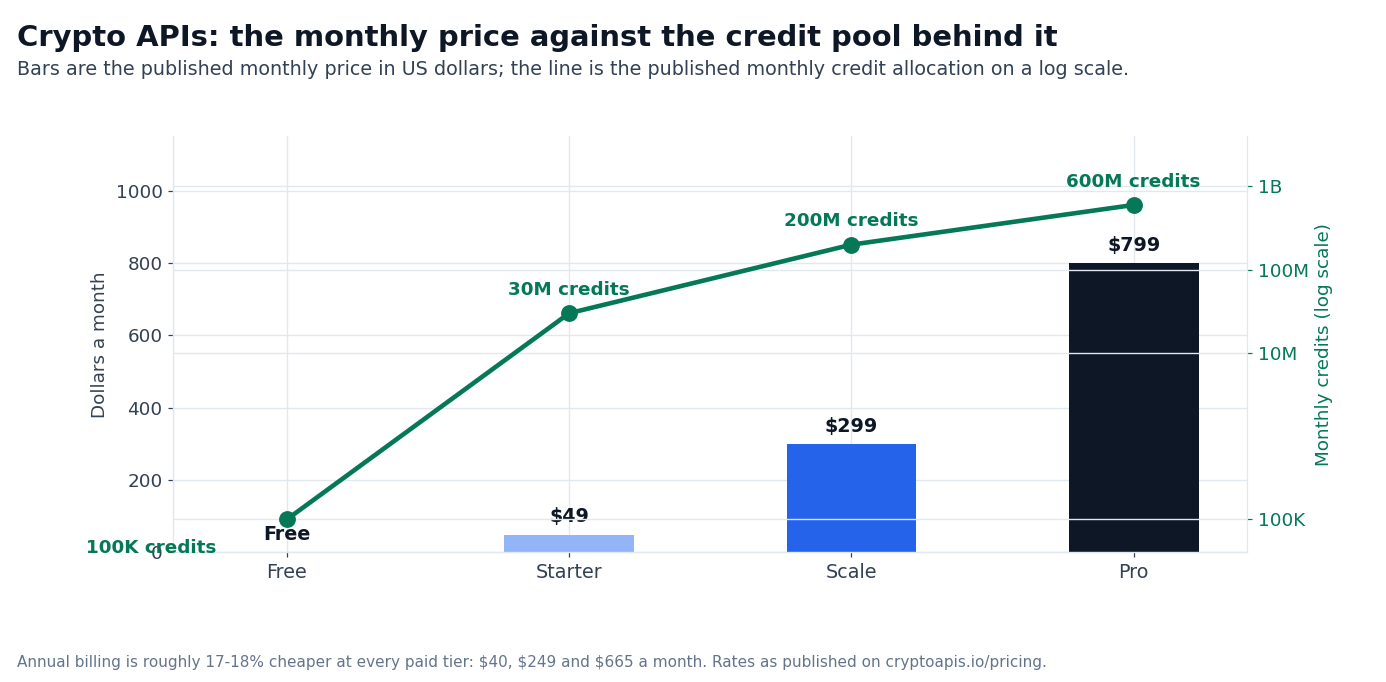
The pricing ladder is the cleanest in the multi-chain blockchain API market. Four paid tiers (Starter, Scale, Pro, Enterprise) plus Free, billed monthly or annually (annual saves roughly 17-18% depending on tier).
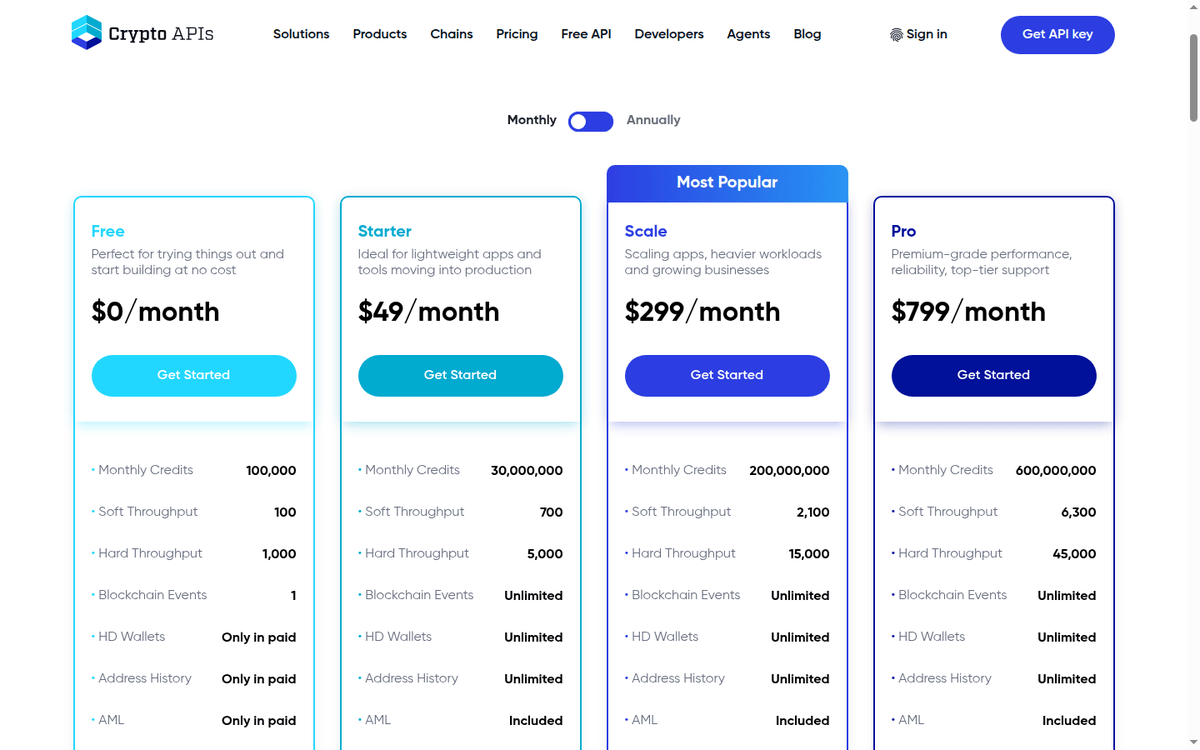
| Plan | Monthly USD | Annual USD/mo | Monthly credits | Soft throughput | Hard throughput | Blockchain events | AML |
|---|---|---|---|---|---|---|---|
| Free | 0 | 0 | 100,000 | 100 | 1,000 | 1 | — |
| Starter | 49 | 40 | 30,000,000 | 700 | 5,000 | Unlimited | Included |
| Scale (Most Popular) | 299 | 249 | 200,000,000 | 2,100 | 15,000 | Unlimited | Included |
| Pro | 799 | 665 | 600,000,000 | 6,300 | 45,000 | Unlimited | Included |
| Enterprise | Custom | — | Custom | Custom | Custom | Custom | Included |
The annual pricing saves real money — roughly 17-18% at every paid tier. Starter at $40/mo annual is $480/yr against $588/yr monthly. Scale at $249/mo is $2,988/yr against $3,588/yr, and Pro at $665/mo is $7,980/yr against $9,588/yr.
The vendor’s own save badges read $98, $598 and $1,598, which track those differences closely without matching them exactly.
“Scale” is the plan name, not “Growth.” Confusing because the most popular plan in the industry is usually called “Growth” or “Pro.” Crypto APIs uses “Scale” because the platform’s target persona is the team that has outgrown the Starter tier — they need to scale. The plan name matches the use case.
Additional credits on the Starter plan run at $1 for every 291,545 additional credits. On the Scale plan the overage is more efficient. On Pro and Enterprise, custom overage agreements.
The Free plan is unusually generous: 100K monthly credits, 100 soft throughput, 1K hard throughput, 1 blockchain event, no credit card required. You can build a non-trivial prototype on Free without paying. The hard limit is the 1 blockchain event — anything that needs real-time event monitoring needs Starter at minimum.
The multi-chain coverage story
Crypto APIs covers 15+ chains. The question for most builders is “which chains do I actually need?”
Bitcoin + Ethereum covers 70%+ of the crypto market. Adding Solana, Polygon, and BNB Smart Chain covers 90%+.
The full list (Solana, Polygon, Arbitrum, Optimism, BNB Smart Chain, Tron, Ethereum Classic, XRP Ledger, Tezos, Avalanche, Base, Kaspa, Litecoin, Bitcoin Cash, Dash, Dogecoin, Zcash) covers the long tail of chains that fintech apps and exchanges typically need.
The coverage gap vs Alchemy is on Ethereum Layer 2 ecosystem depth — Alchemy’s Arbitrum, Optimism, Base, zkSync, Polygon zkEVM coverage is deeper. Where the product is an L2-native DeFi app, Alchemy is the right answer. On a multi-chain wallet, exchange, or fintech app, Crypto APIs covers what you need.
The Ethereum Classic support is the unusual one — Crypto APIs is one of the few providers that ships ETC nodes out of the box. When ETC is a requirement (rare, but some compliance use cases), Crypto APIs is the obvious choice.
Crypto APIs vs Alchemy, Infura, and QuickNode in 2026
The comparison question for any Crypto APIs review is “why not Alchemy?” The honest answer is: Alchemy has better developer experience (better docs, better SDKs, faster support), Crypto APIs has better pricing economics and broader chain coverage.
| Axis | Crypto APIs (Scale) | Alchemy (Growth) | Infura (Developer) | QuickNode (Build) |
|---|---|---|---|---|
| Monthly USD | $249/mo annual | ≈$142 | $50 | $49 |
| Monthly credits / compute | 200M | Variable by chain | Variable by method | Variable by method |
| Chains covered | 15+ | 15+ | 10+ | 30+ |
| HD wallet API | Yes | No (build your own) | No | Limited |
| AML/KYT bundled | Yes (Starter+) | No | No | No |
| Soft throughput | 2,100 | Variable | Variable | Variable |
| Webhook events | Unlimited | Pay per event | Pay per event | Pay per event |
| Support tier | Email + Discord | Email + Discord | ||
| Best fit | Multi-chain builders at scale | Ethereum + L2 deep work | Ethereum + IPFS | Multi-chain hobbyist |
The rule for 2026: if you are building an Ethereum-heavy or L2-heavy product and want the best developer experience, Alchemy is the right answer. If you are building a multi-chain product (exchange, wallet, fintech) and want predictable per-credit pricing with AML/KYT included, Crypto APIs is the right answer.
If your workload is hobbyist or testnet, Infura’s free tier or QuickNode’s free tier is enough.
The pricing comparison gets fuzzy because Alchemy and Infura charge by compute unit which varies by chain and method (ETH mainnet reads cost more than Polygon reads). Crypto APIs charges by credit which is more predictable. For high-volume apps with mixed read/write patterns, Crypto APIs’s credit model is easier to forecast.
What we couldn’t verify (and what to test yourself)
Three things on this review are flagged where they appear because they need your real workload to measure:
- Actual throughput on Production. The advertised 2,100 soft / 15,000 hard throughput on Scale is what you get under ideal conditions. Your actual throughput depends on chain load (Ethereum mainnet reads during peak NFT mints slow down), endpoint mix (writes cost more than reads), and your retry policy. Test on your real traffic pattern before you choose between Scale and Pro.
- Latency to your nearest node cluster. Crypto APIs operates multiple regions but the routing depends on your account setup. Test from your production region to see the actual latency. For a latency-sensitive product (trading bot, real-time pricing), <100ms is the target.
- Support response time on Starter. The Starter plan lists 72-hour support response. Real response time depends on the issue severity and your account history. Critical issues on production typically get faster escalation; routine config questions wait.
For all three, the practical path is the same: build a real prototype on Free (100K credits is enough for a small test), measure the throughput and latency on your workload, then decide if Scale at $299/mo is the right tier.
Crypto APIs vs CoinGecko and CoinMarketCap
When market data is what you need (prices, OHLCV, market cap, exchange rates), the alternative is the CoinGecko or CoinMarketCap API. The comparison question is straightforward.
Crypto APIs Market Data is bundled with the node access — you get it on every plan from Free to Enterprise. CoinGecko’s free tier is a Demo plan with a capped rate limit and no commercial use. CoinMarketCap’s free tier ships 15,000 credits a month — roughly 500 a day — at 50 requests per minute.
Both have paid tiers that are similar in cost to Crypto APIs Scale.
The differentiator is the bundling. If you need both nodes (for transaction building) and market data (for pricing) in one API contract, Crypto APIs is simpler. If you need market data only, CoinGecko or CoinMarketCap’s free tiers are enough.
For a product that needs market data AND on-chain transaction building (DEX, wallet, exchange), Crypto APIs is the simpler choice — one API contract, one bill, one support relationship. The trade-off is that Crypto APIs’s market data is less deep than CoinGecko’s (fewer chains, less granular historical data).
For a serious historical analytics product, CoinGecko Pro is still the right answer.
When Crypto APIs is the wrong tool
The platform has honest limits that matter for some use cases.
If you are building an Ethereum L2-only product (Arbitrum, Optimism, Base, zkSync), Alchemy’s L2 depth and SDK quality are better. Crypto APIs covers the L2 chains but the documentation and SDKs are thinner on L2-specific features.
A serious analytics platform that needs historical market data going back 5+ years across 1,000+ tokens is better served by CoinGecko Pro. Crypto APIs Market Data covers the major coins but the historical depth is shallower.
Where the requirement is subgraph indexing (Graph Protocol, The Graph), neither Alchemy nor Crypto APIs ships it — you need a separate provider (The Graph, Goldsky).
If your team is small (1-3 developers) and you don’t need the multi-chain breadth, Infura’s free tier is enough for Ethereum-only development at no cost.
If you need real-time MEV protection or validator-level data (private mempools, validator slashing data), neither Crypto APIs nor Alchemy covers that — you need a specialist like Flashbots or bloXroute.
FAQ
Is Crypto APIs worth it in 2026?
For multi-chain builders (exchange, wallet, fintech, custody) who need predictable per-credit pricing with AML/KYT bundled, yes. For Ethereum + L2-only products where SDK quality matters more than pricing, Alchemy is the right answer.
How much does Crypto APIs cost per month?
Free for 100K credits/month. Starter $49/mo ($40/mo annual) for 30M credits. Scale $299/mo ($249/mo annual) for 200M credits — this is the most popular tier. Pro $799/mo ($665/mo annual) for 600M credits. Enterprise is custom.
Can you use Crypto APIs for free?
Yes. The Free plan ships 100K monthly credits, 100 soft throughput, 1K hard throughput, and 1 blockchain event. No credit card required. The hard limit is the 1 blockchain event — for real-time event monitoring you need Starter.
What’s the cheapest Crypto APIs paid plan?
Starter at $49/mo (or $40/mo annual) with 30M monthly credits and unlimited blockchain events. HD wallets, AML/KYT, and address history all included.
Does Crypto APIs replace Alchemy?
For multi-chain builders needing broader chain coverage and predictable per-credit pricing, mostly yes. For Ethereum + L2-only products where SDK quality and developer experience matter most, Alchemy is still the right answer.
Is Crypto APIs better than Infura?
For multi-chain coverage (vs Ethereum + IPFS only on Infura) and per-credit pricing, yes. For pure Ethereum development, Infura’s free tier and Ethereum-focused tooling are simpler.
What chains does Crypto APIs support?
Bitcoin, Ethereum, Litecoin, Bitcoin Cash, Dash, Dogecoin, Zcash, Solana, Polygon, Arbitrum, Optimism, BNB Smart Chain, Tron, Ethereum Classic, XRP Ledger, Tezos, Avalanche, Base and Kaspa — 19 networks on the vendor’s support page.
Does Crypto APIs include AML compliance?
Yes. AML/KYT (Know Your Transaction) screening is bundled at Starter ($49/mo) and above. Flagged addresses (sanctioned, stolen, darknet, mixer, scam) come back in the API response. The competitor alternatives (Chainalysis, Elliptic, TRM Labs) charge $0.005-$0.05 per API call separately.
Sources
- Crypto APIs pricing — plan tiers, credit allocations, chain coverage
- Crypto APIs free crypto API — Free plan documentation
- Alchemy pricing — comparison data for Alchemy section
- Infura pricing — comparison data for Infura section
- QuickNode pricing — comparison data for QuickNode section
How we put this together: the four tier prices on both billing cycles, the credit and throughput allocations, the AML/KYT and HD wallet coverage and the supported-network list come from cryptoapis.io/pricing and cryptoapis.io, quoted as displayed, with the Alchemy, Infura and QuickNode comparison figures read from their own pricing pages.
We have not run a production workload against the API, so throughput, latency and support response stay flagged where they appear.
Figures that depend on a real workload, a real target or a real integration are flagged where they appear in the text rather than being estimated.
Disclosure: this article contains affiliate links. If you buy through them we may earn a commission at no extra cost to you. Commission never changes our scoring or the order of a ranking.