Hyros sells one thing: the gap between the platform-reported numbers and the bank account, closed on Hyros’ terms.
- What it catches — the sales Meta, Google, TikTok and YouTube report as conversions they did not cause.
- What it runs on — AI Swarm Tracking, the AIR agent for ecommerce and an LLM/MCP interface, on one plan with no add-ons.
- How it is priced — the entry band is the only published figure; the bands above it are set in the sales call.
Four business models — ecommerce, SaaS, info-education and B2B calls — run on the same plan structure.
20-50% of the sales the ad platforms report as conversions they did not cause is the gap this product exists to close. If you have spent any time in the world of paid ecommerce ads and felt that the platform-reported numbers do not match what is in the bank account, you have probably heard of the platform.
Founded by Alex Becker and now used by Tony Robbins, Russell Brunson (ClickFunnels), Alex Hormozi, Whop, and Playboy, it is the ad-tracking product whose pitch is the simplest in the category. It catches the 20-50% of sales that Meta, Google, TikTok, and YouTube report as conversions they did not cause.
It then optimizes the ad-platform AIs against the real sales data, and CPA drops. Tony Robbins’ ad team has cited a 43% lift in ad spend against the same platform mix. Luxury Bazaar cited “a measurably better return on every ad dollar.”
The product in 2026
The platform runs three products under one roof. The first is AI Swarm Tracking, the attribution engine. The premise is rooted in a measurable problem. Ad-platform reporting under-attributes the human signal. Meta reports a sale that actually started from an email click that came from a YouTube ad that Google reported.
The brand ends up scaling the wrong platform and starving the right one. AI Swarm Tracking stitches the events together across ad platforms, CRM, checkout, and lifecycle data and rebuilds the attribution model on Hyros’ terms.
The second product is AIR (AI Remarketing), an AI agent for ecommerce stores. AIR recognizes returning visitors from existing customer data, learns what they are interested in, and reaches out via email and SMS with a 1-to-1 customized message.
Per Hyros’ published Shopify data, AIR delivers a 3-5% average revenue lift for Shopify stores on top of the existing funnel — measurable on weekly traffic, not on vibes.
The third product is Hyros MCP, an LLM interface (Claude, or any MCP-compliant model). The interface lets a brand write a prompt that returns a custom attribution model, an LTV dashboard, an ad-cut recommendation, or a new feature inside the Hyros app.
This is the most differentiated feature Hyros ships in 2026 — a competitor that exposes every metric through a queryable LLM endpoint. The use case for direct-response advertisers is the LLM audit. “Based on Hyros swarm data, which ads should we cut and which should we scale based on LTV?” gets an answer in seconds.
The LLM can apply the change to Meta and Google directly.
The platform covers four business models with explicit positioning. E-commerce (one-click Shopify install, generic ecom track for stores on any platform). SaaS (trials, subscriptions, upgrades). Info-education (courses, coaching, webinars). B2B calls (booked calls and closed deals).
Each business model has its own case-study gallery and tracking logic. Setup is custom per business model and includes an assigned analyst.
The pricing reality: one plan, stepped tiers, mostly behind sales
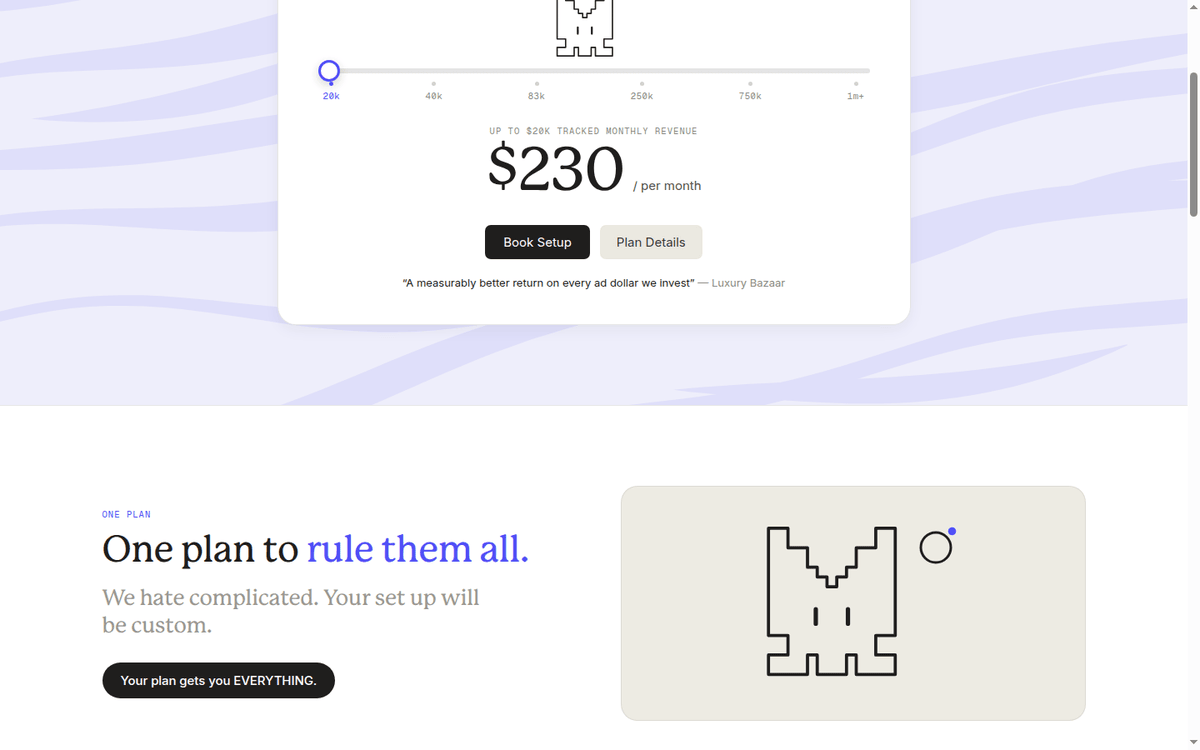
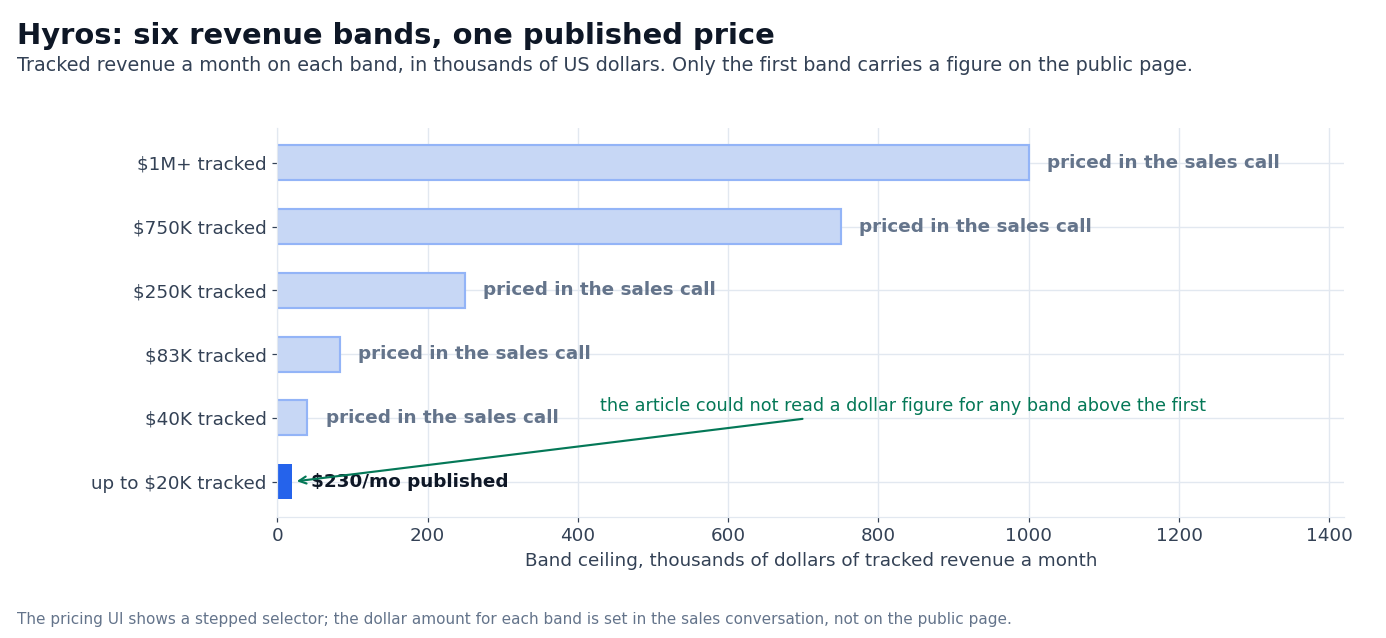
Hyros runs one plan structure. The pricing page shows a stepped selector with six bands: up to $20K, $40K, $83K, $250K, $750K and $1M+ in tracked monthly revenue. Each band has its own dollar amount. Only the first is published on the public page.
| Tracked monthly revenue | Monthly price | Notes |
|---|---|---|
| Up to $20K | $230/mo | The only published price point; the entry band for solo and small-business direct-response advertisers |
| Up to $40K | — | Band exists in the UI selector; the dollar figure is set in the sales call |
| Up to $83K | — | Same; the seven-figure paid-media brand |
| Up to $250K | — | Same; “HYROS Guarantee” tier per typical cases |
| Up to $750K | — | Same; enterprise ecommerce and info-education |
| $1M+ tracked / mo | — | Same; custom contract |
The five cells above the entry band are blank because the dollar figure is set in the sales conversation, not on the public pricing page. Ask Hyros sales for the per-tier price before you model the spend.
The “tracked monthly revenue” is the metric Hyros uses to size the tier. That is the total revenue the platform is going to attribute through the swarm data integration — not your gross ad spend and not your total business revenue. A Shopify store with $200K/year in sales, all attributed, would generally land in the $20K tracked/mo band.
A saas firm with $1M ARR and concentrated trial conversions that go through Hyros would land in the $83K tracked/mo band.
What every tier gets, regardless of the dollar step:
- Full setup team and assigned analyst
- Full tracking across ad platforms, CRM, checkout, lifecycle
- AI Swarm Data attribution model
- AIR (AI agent for ecommerce) — Shopify and generic
- All integrations across stores, funnels, CRMs, schedulers, email and checkouts
- LLM / Claude MCP interface
- Weekly training (live sessions)
- “Your ads grow, or you don’t pay” guarantee
Per the public pricing page, “We guarantee better ad ROI — if you’re not satisfied, you don’t pay.” In practice, that is described as a 90-day window with measurable lift and an opt-out at the end if performance did not move, though the window itself is a contract term rather than a published one.
The exact guarantee math (lift threshold, measurement window, refund mechanics) is in the contract, not the public page.
Enterprise plans — the $250K tracked/mo band and above — add what procurement teams at larger companies usually need: SSO, detailed audit logs, custom security reviews and flexible billing terms. SOC 2 is the standard for every plan.
Where the published pricing stops and the sales conversation starts
The exact dollar amount for every band above $20K is in the sales conversation, not the public pricing page. The volume-band discount mechanic at $40K or $83K tracked/mo and the contract terms for enterprise plans are negotiated, not listed.
The setup-time claim (15 minutes for most businesses) is from the published FAQ; real-world setup on a Shopify store with five ad platforms usually runs longer.
AI Swarm Tracking: the actual attribution layer
AI Swarm Tracking is Hyros’ first product and the part that wins the head-to-head with Triple Whale for direct-response advertisers who care about LTV, not just ROAS.
The premise is rooted in a measurable problem. Ad-platform reporting under-attributes the human signal. A sale that began with a YouTube ad, moved through an email click and closed in the inbox gets credited to Meta. The brand ends up scaling the wrong platform and starving the right one.
The “Customer Journey Hijacking” page on Hyros goes through the math on the gap: 20-50% of “untracked” sales per the platform, which is the gap the swarm data closes.
The implementation story is the second thing the platform sells. AI Swarm Data is fed back into Meta and Google as conversion signal. The ad-platform AI then re-bids on the real signal — the right customer, the right intent, the right LTV.
This is what Tony Robbins’ ad team means when they say “we scaled ad spend by 43%.” The platforms got the right signal; the money followed.
For a brand already running paid ads, the relevant question is the attribution accuracy math. The published Hyros case studies show shifts in attributed revenue from a 10% lift to a 60% lift depending on the catalog. The mean is in the 15-30% range based on the case studies on hyros.com/results.
Real lift depends on the brand’s existing attribution setup. Brands coming from Google Analytics 4 standard see the largest lift; brands already running on a server-side attribution stack (Triple Whale, Northbeam) see smaller lifts because the gap is already smaller.
AIR: the AI agent layer
AIR (AI Remarketing) is the second product. AIR runs the four-step “Recognize, Learn, Reach Out, Interact” loop on top of AI Swarm Data. Recognize: AIR uses the customer data Hyros already has to identify visitors without a customer record. Learn: AIR watches what those visitors do on the site and figures out what they care about.
Reach Out: AIR sends a personalized email or SMS to convert before they leave. Interact: AIR continues the conversation post-purchase.
The published KPI from Hyros is a 3-5% revenue lift for Shopify stores that turn AIR on, on top of the existing funnel. AIR also lifts the AI Swarm Tracking call cases — the platform tracks the AIR-attributed sales back into the attribution model, and the ad-platform AI then optimizes against the AIR-attributed customers.
The honest read is that AIR is the closest thing direct-response ecommerce has to an autonomous AI agent product. The catch is that AIR is built for the email/SMS lifecycle; it does not replace a full ad-personalization stack (Dynamic Yield, Monetate) and it does not build a creative asset the way an AdCreative.ai does.
AIR’s job is to recognize the visitor and reach out — the personalization is in the channel, not in the on-site experience.
For Shopify-brand use cases, AIR is the obvious reason to upgrade from a Triple Whale or Northbeam stack that does not include an agent product. For B2B use cases (SaaS, info-ed), AIR is not the right tool — the agent is built for ecommerce conversion, not demo booking.
The MCP and Claude integration
The third product is the most novel and the easiest to miss. The platform exposes its entire swarm data layer via MCP (Model Context Protocol).
The practical consequence is that a brand can use Claude (or any compliant LLM) to query Hyros data, generate custom attribution models, build dashboards, and write new features inside the Hyros app.
The use case the team demos publicly: “based on Hyros swarm data, which ads should we cut and which should we scale based on LTV?” The LLM returns a list with three actions — Scale, Cut, Best LTV — and asks if the user wants to apply. Apply pushes the change to Meta and Google.
That is the end of the manual ad-cut decision for direct-response advertisers who already run Hyros.
The MCP layer is also the integration surface. A brand that needs a custom attribution model for a specific business case (say, a multi-brand Shopify Plus store with different customer segments per brand) can prompt the LLM to build it. The Hyros API documentation goes through the available endpoints.
The LLM is not building the entire backend; it is composing features out of the Hyros primitives (attribution data, AI recommendations, ad-platform sync, LTV) and pushing them into the Hyros app.
For enterprise procurement teams, the MCP surface is a separate consideration. The MCP server exposes account data, attribution events, and ad-platform recommendations; the data governance story is part of the Enterprise contract. SOC 2 is the floor; SSO and audit logs are the additions.
The MCP data governance surface is negotiated as part of the Enterprise contract and should be reviewed with your security team before signing.
When it’s the right pick
Three workloads where the platform is the strongest available option. First, direct-response ecommerce on Shopify or any platform running Meta and TikTok as primary acquisition. The integration set is one-click for Shopify, the attribution math is direct-to-ROI, and AIR is the autonomous agent product.
Second, info-education and high-ticket coaching running webinars and sales calls. The “B2B Calls” track in Hyros tracks every call outcome and LTV by ad set, and the customer logos in the space (Tony Robbins, ClickFunnels, Whop, Jay Shetty) set the procurement reference.
Third, performance marketing agencies running client accounts at scale. The agency partner program is structured around lifetime commission (40% per the landing page), and the platform’s white-label reporting capability makes it the central nervous system for an agency stack.
For these workloads, the guarantee is the deal-closer: the platform refunds if ad ROI does not move in the measurement window. That moves the procurement math from “trust me” to “prove it.”
When it’s the wrong pick
Three workloads where the platform is not the best fit. First, B2B SaaS brands running content-led growth. The platform is built for direct-response with a measurable ad-attribution loop.
A content-led SaaS brand runs paid ads as a supplement, not the primary channel, and the platform’s high-touch setup model does not match the way those brands scale. Second, brands under $20K/month tracked revenue.
At $230/mo, the math works, but the setup-process overhead is heavier than the math would suggest — a smaller brand will not use the analyst hours. Third, brands that want a fully transparent pricing page for procurement. The five tier steps past $20K tracked/mo are in the sales conversation, not the public page.
Procurement teams that need a published per-tier dollar amount for vendor evaluation will need a 4-6 week sales cycle and the contract-level figure to land the budget.
The alternatives, briefly
| Vendor | Differentiator | Best for | Watch out for |
|---|---|---|---|
| Hyros | AI Swarm + AIR + MCP, guarantee | Direct-response ecommerce, info-education, B2B calls | Pricing past $20K is sales-call; high-touch setup |
| Triple Whale | Easier UI, the “first dashboard” for Shopify | Shopify merchants who want fast install + clean dashboard | Less depth in B2B calls, less agent surface |
| Northbeam | Most accurate attribution for Shopify + paid social | Larger Shopify brands that need cross-channel accuracy | No agent; higher price band |
| Rockerbox | Enterprise cross-channel attribution | Multi-channel brands at $50M+ revenue | Most expensive; heavyweight implementation |
| Wicked Reports | Long-attribution windows for info-education | Info-ed brands with long LTV curves | Smaller user community |
| Attribution (attributionapp.com) | Lightweight cross-channel dashboard | Smaller brands who want a cheaper alternative | Less depth; no agent; no MCP |
The honest comparison in 2026: Triple Whale is the better on-ramp if your brand is Shopify-only and you want to ship in a day. Northbeam is the better pick if your Shopify brand is crossing $5M revenue and you want the most accurate attribution. Rockerbox is the right answer if you are a $50M+ multi-channel business.
Hyros is the right pick if you run direct-response ads as a primary channel and you want both attribution and an autonomous agent, with a guarantee that the math works. The MCP layer is the most differentiated feature in the comparison — none of the competitors expose the data layer to an LLM in the same way.
The honest version on Hyros
The 2026 release is the strongest version of the platform we have seen. The MCP integration, the AIR agent product, and the SOC 2 + SSO + audit-log procurement surface mature the platform beyond the early-stage pitch that Alex Becker started with.
The customer list — Tony Robbins, ClickFunnels, Whop, Alex Hormozi, Playboy — justifies the marketing.
The honest version: the “or you don’t pay” guarantee is a real sales motion but it is not a money-back guarantee in the usual sense. The contract terms on the guarantee window, the lift threshold, and the refund mechanics are negotiated per account.
Buyers who evaluate Hyros as “guaranteed to 10x my ads or I pay nothing” are misreading the contract. The honest version is “we measure against your pre-Hyros baseline and refund if the lift is below the threshold in the measurement window.” That distinction matters for procurement.
It matters for any brand that signs on marketing claims alone.
The second honest version is on the setup. The 15-minute claim in the FAQ is for one-click Shopify stores with zero edge cases. Real-world setup on a multi-platform brand with custom checkout, an ESP, an SMS vendor, and three ad platforms runs longer, and the assigned analyst is part of why the setup fee is built into the tier price.
The math is reasonable; the marketing is shorter than reality.
What we couldn’t verify (and what to test yourself)
Three classes of figures in this review depend on a real Hyros account. They are flagged where they appear, and we recommend you validate them on your own.
The first is the actual dollar amount for each band above $20K tracked/mo. The pricing UI shows six bands; the dollar amount is set in the sales conversation. A prospect evaluating Hyros needs the contract-level figure to size the budget. The second is the actual attribution lift on your catalog.
The published case studies (Tony Robbins, Luxury Bazaar, Whop) show the range, but every catalog is different. The mean lift is in the 15-30% range, but the range goes as high as 60% in the published cases — the math depends on the gap between your current attribution and the real attribution.
The third is the AIR revenue lift on your store. The published Shopify stat is a 3-5% average across all enabled stores, but the lift varies by traffic shape and catalog mix. Run a 30-day AIR pilot before committing to a 12-month contract.
FAQ
Is Hyros better than Triple Whale?
For Shopify brands running direct-response on Meta and TikTok, Hyros is the more complete platform. Triple Whale is the faster install and the cheaper entry tier. Hyros wins on attribution depth, the AIR agent product, and the MCP layer. Triple Whale wins on UI simplicity and Shopify-native dashboard ergonomics.
Both have SOC 2 and 1-click Shopify install.
How much does Hyros cost per month?
Hyros’ published starting tier is $230/mo for up to $20,000 in tracked monthly revenue. Five more bands run above it — $40K, $83K, $250K, $750K and $1M+ tracked/mo — but the dollar amount for each is set in the sales call. Enterprise plans add SSO and detailed audit logs.
Does Hyros work without a Shopify store?
Yes. The platform works with any ecom platform through integrations (WooCommerce, BigCommerce, Magento, custom checkouts). It works with SaaS subscriptions through CRM and checkout integrations. With info-education businesses through webinar and checkout integrations. With B2B call-based businesses through call-tracking integrations.
Shopify gets the one-click install. Everything else is a guided setup with the analyst team.
Is the Hyros guarantee a money-back guarantee?
It is a performance guarantee; the measurement window is described as 90 days, and the contract terms — lift threshold, window, refund mechanics — are negotiated per account.
Buyers should treat it as “we measure the lift against your pre-Hyros baseline; if it does not move, you do not pay for the period.” That is a meaningful guarantee but not a marketing-money-back guarantee.
Can Hyros replace Google Analytics?
No. Hyros is an ad-attribution platform; Google Analytics is a website analytics platform. Most Hyros customers run GA4 in parallel. Hyros pushes its conversion data back into GA4 via integration, and the platform is designed to plug into an existing analytics stack, not replace it.
The Claude MCP server is what lets a brand pull Hyros data into a different reporting tool — that is the closest Hyros gets to “replacing GA” for a procurement conversation.
What is the Hyros MCP?
MCP is Model Context Protocol. Hyros exposes its swarm data and ad-platform sync through an MCP server, so a Claude (or any compliant LLM) can query the data and push changes to the ad platforms. The use case is the LLM audit.
“Based on Hyros swarm data, which ads should we cut and which should we scale based on LTV?” — the LLM returns a list and can apply the change to Meta and Google.
Does Hyros work for B2B SaaS?
It depends on the growth model. SaaS brands running paid ads as the primary acquisition channel (free-trial funnels, demo funnels) can use Hyros for the attribution and the AIR agent is not relevant. SaaS brands running content-led growth do not need Hyros — the platform is built for direct-response, not for content.
Sources
- Hyros home — platform positioning, customer logos, MCP demo, AIR product (captured September 2026)
- Hyros pricing / FAQ — the one-plan tier ladder, $230 entry, FAQ on guarantee, integrations, SOC 2 (captured September 2026)
- Hyros AI Tracking — AI Swarm Data overview, business-model selectors (captured September 2026)
- Hyros AIR — AI Remarketing product, Recognize → Learn → Reach Out → Interact loop (captured September 2026)
- Hyros results — case studies with $5B+ ad spend tracked, 5,000+ brands (captured September 2026)
- Hyros docs — LLM interface and integration list (captured September 2026)
- Hyros vs Triple Whale — vendor-published head-to-head (referenced from pricing/FAQ)
How we put this together: the $230/mo entry band, the six-band selector, the integration categories and the SOC 2 surface come from hyros.com/pricing-ai-tracking and hyros.com, quoted as displayed.
Every band above the first is priced in the sales conversation and is not published; we have not run an attribution pilot or negotiated a contract, so anything that depends on your own catalog stays flagged where it appears.
Figures that depend on a real workload, a real target or a real integration are flagged where they appear in the text rather than being estimated.
Disclosure: this article contains affiliate links. If you buy through them we may earn a commission at no extra cost to you. Commission never changes our scoring or the order of a ranking.