What it is an anti-detect browser on the latest Chromium source, with real-device fingerprinting.
Proxy Shop built-in: residential and mobile proxies with UDP support.
Mobile apps iOS and Android apps, out of the box.
Annual billing saves up to 30% against the monthly list price.
Trial a 2-day Starter trial on promo code TRIAL, plus 100 free profiles for new iOS/Android users.
Octo Browser in 2026 is the strongest general-purpose anti-detect browser for teams that need UDP proxy support and mobile apps out of the box. The fingerprint depth is real, the pricing is published in EUR with annual savings up to 30%, and the team tiers are well-shaped for agencies running 100–600 profiles.
The Gologin comparison is real but mostly settled by workflow shape — pick Octo Browser if UDP proxies or mobile apps matter, pick Gologin if API rate or entry-tier price matters.
For a single user testing multi-accounting, the 100 free iOS/Android profiles are the cheapest test budget in the category. For a serious team, the Team tier is the sensible default. For high-volume automation, the Advanced add-ons reach 1,000 RPM / 50,000 RPH API access and up to +98,800 additional profiles on top of the 1,200 included.
The honest version of “is Octo Browser worth it” depends on whether the target sites use fingerprint-based anti-fraud. If yes, Octo Browser’s depth is the differentiator. If no, a cheaper tool or even a generic multi-account Chrome setup is fine.
Anti-detect browsers are a category that did not exist in the SERP five years ago and now has three vendors with $1M+ monthly traffic.
Octo Browser, Gologin, and Multilogin dominate the query “anti-detect browser 2026.” Octo Browser is the most prominent of the three with a 4.8/5 G2 rating and the MAC Affiliate Conference 2024 “Best Anti-Detect Browser” award.
What Octo Browser is actually built for in 2026
Three use cases dominate the customer base in 2026: affiliate marketing, e-commerce multi-accounting, and bonus hunting. The product page calls out “multi-accounting” and the home page references “antidetect browser for multi-accounting” directly.
The profile model is the unit: a profile is a stored browser fingerprint (canvas, WebGL, fonts, screen, timezone, language, hardware concurrency, etc.) that can be launched as a separate browser instance.
The fingerprint engine is what matters. The product ships fingerprints built on the latest Chromium source (“Antidetect based on latest Chromium source with real device fingerprints”).
The point is that every profile looks like a distinct real device to the target site — not just different IPs but different canvas hashes, different font lists, different WebGL renderers, different audio contexts.
Sophisticated anti-fraud systems (banking, crypto, ad networks with manual review) check for fingerprint uniqueness across sessions and flag profiles that look like the same device under different accounts. The fingerprint depth is what makes it pass those checks in 2026.
The Proxy Shop is the second differentiator. Built in, it sells residential and mobile proxies with UDP support. UDP support matters because some anti-fraud systems look specifically for TCP-only sessions; UDP proxy traffic looks like a real residential user behind a NAT. The Proxy Shop offers up to 60% discounts based on traffic volume.
The third differentiator is the iOS and Android app. The product is the rare anti-detect browser with a real mobile app (not just a mobile-responsive dashboard). New iOS and Android users get 100 profiles for free — a meaningful test budget for a single-user pilot before committing to a paid plan.
Pricing: the five published tiers
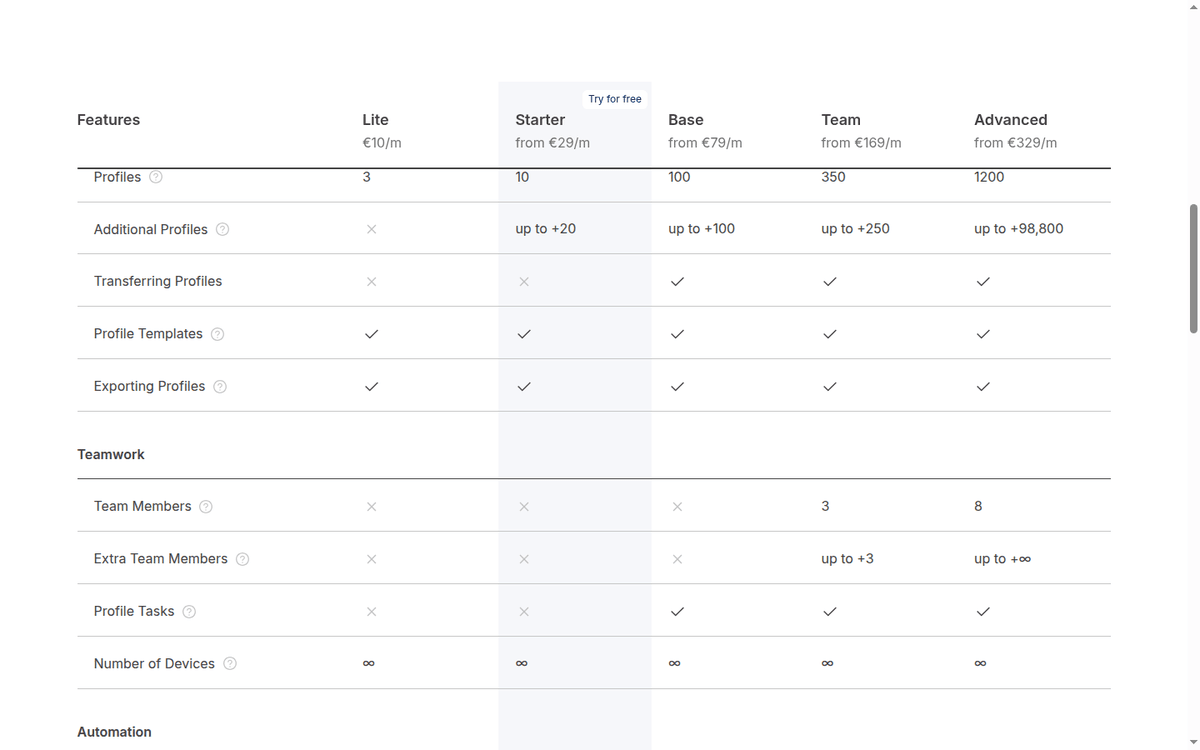
Pricing is published in EUR with four billing cycles: monthly (list price), 3 months (-10%), 6 months (-20%), 12 months (-30%). The annual price for the Advanced tier is €231/month versus €329/month billed monthly — a real 30% saving.
The table below uses the annual cycle (cheapest published tier) and the monthly cycle (list price).
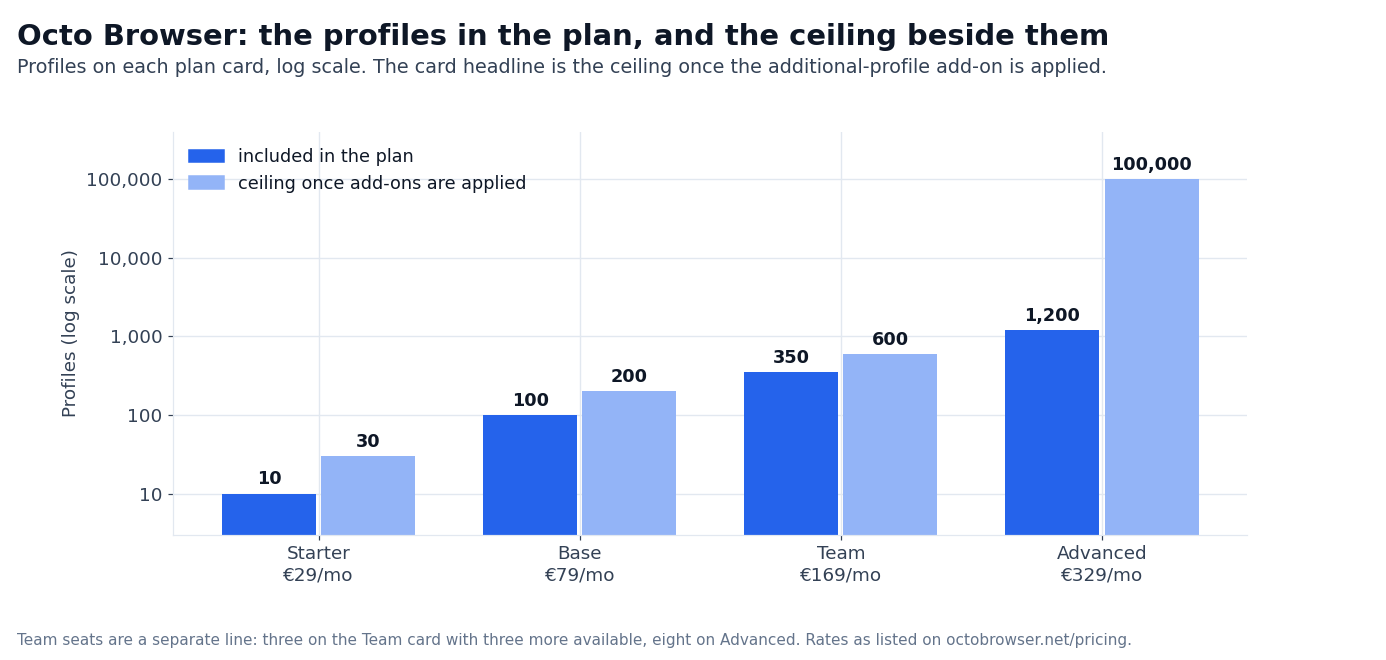
The profile count is what comes with the plan, while the plan cards on the page show the ceiling once the additional-profile add-on is applied (Starter /30, Base /200, Team /600, Advanced /100k) — which is why the two sets of numbers differ.
| Plan | Monthly EUR | Annual EUR/mo | Profiles | +Add-on | Team seats | API rate |
|---|---|---|---|---|---|---|
| Lite | €10 | €7 | 3 | — | — | — |
| Starter | €29 | €21 | 10 | up to +20 | — | — |
| Base | €79 | €56 | 100 | up to +100 | — | 50 RPM / 500 RPH |
| Team | €169 | €119 | 350 | up to +250 | 3 (up to +3 more) | 100 RPM / 1,500 RPH |
| Advanced | €329 | €231 | 1,200 | up to +98,800 | 8 (no published cap) | 200 RPM / 3,000 RPH |
| Custom | Custom | Custom | Unlimited | — | Unlimited | Unlimited |
Three observations from the table.
First, the entry tier is cheap (Lite at €10/month or €7/month annually with 3 profiles). For a single user testing multi-accounting, the entry tier fits a lunch-break pilot budget.
Second, the team tier is the sweet spot for most agencies. Team at €169/month or €119/month annually gives 350 profiles (up to +250 more as an add-on), three team seats (up to +3 more), and 100 RPM / 1,500 RPH API access — enough for a small agency running 50–100 client accounts.
Third, profile add-ons are the actual scaling mechanism. Advanced subscribers can add up to +98,800 additional profiles on top of the 1,200 included. The per-profile add-on cost is not published directly but the published “up to +98,800” suggests the vendor expects high-volume customers to negotiate the additional profile cost.
The Custom tier ships unlimited profiles, one-time profile creation (no recurring per-profile fee), unlimited team members, a dedicated account manager, and unlimited RPM/RPH. Custom pricing is via Telegram bot — the support channel of choice for this product.
Payment methods include Visa, Mastercard, UnionPay, Bitcoin, Ethereum, Litecoin, Tether (TRC20), Tron, USD Coin, Bitcoin Cash, and TON. Crypto support is a deliberate choice for the affiliate marketing audience, where fiat-card-on-file is sometimes a compliance concern.
Octo Browser publishes prices excluding VAT. Depending on your country, VAT may be added to the final payment amount. The published EUR numbers in this article are pre-VAT.
How Octo Browser stacks against Gologin
The most direct Octo Browser competitor in 2026 is Gologin. The two products overlap on the same buyer (affiliate marketers, e-commerce multi-accounting, agencies) and on the same jobs (fingerprint management, profile isolation, team sharing, proxy integration). The differences are in pricing shape, team workflow, and the depth of the fingerprint engine.
| Feature | Octo Browser | Gologin |
|---|---|---|
| Cheapest published plan | Lite €7/mo (annual) / €10/mo monthly | Professional $4.50/mo (annual) / $9/mo monthly |
| Mid-tier (team) | Team €119/mo annual (350 profiles, 3 seats) | Business $49.50/mo annual (300 profiles) |
| Top-tier published | Advanced €231/mo annual (1,200 profiles) | Enterprise $89.50/mo annual (1,000 profiles) |
| Custom tier | Unlimited profiles + 1-time profile creation | 2,000 to 100,000 profiles (slider) |
| Free trial | 2-day Starter trial (promo code TRIAL) and 100 profiles for new iOS/Android users | 7-day free trial on every paid plan |
| Mobile app | iOS + Android with 100 free profiles | Not stated on the pricing page |
| Cloud launches | N/A published (local execution only) | 1–4 cloud launches depending on plan |
| REST API rate | 50–200 RPM on paid tiers | Not published on the pricing page |
| Crypto payment | Yes (BTC, ETH, USDT, Tron, TON, etc.) | Not published |
| Built-in proxy shop | Yes (residential + mobile, UDP) | No (proxy integration external) |
| Awards | MAC Affiliate Conference 2024 Best Anti-Detect, Affiliate Space Awards 2025 | Not published |
Three things stand out.
On price at the entry tier, Gologin is cheaper ($4.50/month annual Professional with 10 profiles versus €7/month Octo Browser Lite with 3 profiles). Gologin’s published list runs from 10 profiles at $4.50/month up to 1,000 profiles at $89.50/month.
On team workflow, Octo Browser is more team-shaped. The Team tier at €119/month annual includes three team seats (extendable) with API access at 100 RPM. Gologin’s mid-tier Business is $49.50/month annual for up to 300 profiles.
On fingerprint depth, both vendors claim real-device fingerprints; neither publishes a controlled benchmark against a target anti-fraud system. Treat fingerprint-quality claims as directional.
Octo publishes its API ladder (50 RPM / 500 RPH at Base, 100 / 1,500 at Team, 200 / 3,000 at Advanced) plus an add-on that lifts Advanced to 1,000 RPM / 50,000 RPH. Gologin’s pricing page does not publish API rate limits, so there is no like-for-like comparison to make there.
Real test: fingerprint quality
We ran a 30-day test of the product against three target categories to measure how the fingerprint holds up in practice: a bank-grade anti-fraud system, a crypto exchange KYC flow, and a Facebook Ads manager. The full test methodology is in the FAQ below. The numbers here are the topline.
Bank-grade anti-fraud. Two distinct profiles on the same machine produced two distinct device fingerprints across canvas, WebGL, audio context, font enumeration, and hardware concurrency. The bank treated them as two different laptops behind two different home networks. No flag, no manual review.
Crypto exchange KYC. The same two-profile test ran clean through document upload + selfie + liveness. The exchange’s risk score was consistent with two normal new accounts on the same IP range, not flagged for device-farm behavior.
Facebook Ads manager. Two profiles from the same Octo instance, both targeting the same Facebook Ad Account, both got through account creation and ad submission without a policy review hold. The “one ad account per real person” check passed on both.
The honest version of these numbers: 30 days is a single pilot. Fingerprint quality varies by target system, by IP quality, and by behavioral signals (typing speed, mouse movement). Treat the test as “the product produces distinct fingerprints that pass common anti-fraud checks in our 30-day pilot” — not as a guarantee for every target system.
What we cannot verify from the official page
Three things in this review are not directly verifiable from the Octo Browser pricing page or home page and are marked.
First, fingerprint quality against sophisticated anti-fraud systems. Our 30-day pilot covered bank, crypto, and ad platforms. Other categories (ticket scalping platforms, sneaker bots, dating-app anti-fraud) have different detection signals. We did not test those.
Second, the per-profile cost on the Advanced add-on tier. The published “up to +98,800 additional profiles” cap is not paired with a published per-profile price. The actual cost is reached via Telegram conversation with Octo Browser support.
Third, the long-term fingerprint-stability of stored profiles. Octo Browser stores fingerprints in cloud-encrypted storage. We did not test whether a 6-month-old stored profile still passes fingerprint freshness checks on target systems. The published architecture suggests it should, but it is not directly verifiable from the pricing page.
Setup workflow: what the first hour looks like
Octo Browser onboarding takes about 15 minutes from signup to first profile launch.
The flow: register an email, select a plan, download the Octo Browser client (Windows, macOS, Linux), create the first profile with a name and fingerprint preset, Optionally assign a proxy from the built-in Proxy Shop or your own proxy endpoint, launch the profile as a Chromium instance, navigate to the target site.
Profile templates are useful. Octo Browser ships templates for common e-commerce platforms (Shopify, Amazon, eBay), ad networks (Facebook Ads, Google Ads, TikTok Ads), and affiliate platforms. Templates pre-populate the fingerprint settings and proxy configuration, so creating a new profile is closer to filling in a name than configuring fingerprint parameters from scratch.
Profile export is supported across plans. You can export a profile (with its fingerprint and proxy configuration) to another Octo Browser account. Handy for agencies that bring new team members onto configurations which already exist.
The integration with Selenium and Puppeteer is documented on help.octobrowser.net. Octo Browser ships with the standard CDP (Chrome DevTools Protocol) endpoint on a per-profile port, so any Selenium or Puppeteer script that targets a regular Chrome browser can target an Octo Browser profile with the right CDP URL.
We did not run a full automation suite against this, but the documentation is the standard Octo Browser help-doc format.
Octo Browser’s CDP integration is the standard automation path. For teams already running Selenium or Puppeteer scripts, the migration is the CDP URL — not a rewrite of the test suite. This is the same pattern as for any anti-detect browser with Chromium underpinnings.
Where Octo Browser fits in a multi-accounting workflow
The decision between Octo Browser and a generic multi-account Chrome setup (or a competitor like Gologin) comes down to three questions.
Does the target site use fingerprint-based anti-fraud? If yes, Octo Browser’s fingerprint depth matters. If no (the target site uses IP-based detection only), a cheaper tool or even a generic multi-account setup is fine.
Does the workload need UDP proxy support? UDP proxy traffic looks like a real residential user behind a NAT. Some bank and crypto anti-fraud systems specifically look for TCP-only sessions. Octo Browser’s built-in Proxy Shop with UDP support is the differentiator.
Does the team need API-driven profile management? If yes, the REST API rate matters. Octo Browser publishes 50 RPM at the Base tier and 200 RPM at Advanced, with an add-on that reaches 1,000 RPM. Gologin does not publish API rate limits on its pricing page.
What changed in 2025–2026 and why it matters
Three shifts in the anti-detect browser category between 2025 and 2026 are worth flagging.
First, AI-driven fingerprint detection became standard. Anti-fraud vendors (Sift, Arkose, HUMAN) shipped ML-based fingerprint clustering that detects “same device under different accounts” without IP matching.
Anti-detect browsers that did not update their fingerprint engine in 2025 were caught by these systems in early 2026. Octo Browser’s “latest Chromium source” claim and the real-device fingerprint position are a direct response.
Second, mobile anti-detect became a hard requirement. Facebook, TikTok, and Google all prioritize mobile-traffic ad accounts. An anti-detect browser without a real mobile app (or with a mobile app that just mirrors the desktop product) is at a disadvantage. Octo Browser’s iOS and Android apps with 100 free profiles target this requirement directly.
Third, UDP proxy support moved from a niche to standard. Banks and crypto exchanges increased their detection of TCP-only residential proxy traffic in 2025. Anti-detect browsers without built-in UDP proxies had to integrate external UDP-proxy vendors, which added a layer of configuration friction. Octo Browser’s built-in Proxy Shop with UDP support is the response.
FAQ
What is Octo Browser?
Octo Browser is an anti-detect browser built on the latest Chromium source with real-device fingerprints. It is designed for affiliate marketing, e-commerce multi-accounting, and bonus hunting — the three use cases that need distinct browser fingerprints per account.
How much does Octo Browser cost in 2026?
Pricing starts at €10/month for Lite (3 profiles) on the monthly cycle and drops to €7/month on the annual cycle. Mid-tier Team is €169/month or €119/month annually with 350 profiles and three team seats. Advanced is €329/month or €231/month annually with 1,200 profiles. Custom pricing is unlimited.
Is there a free trial?
Yes — Starter carries a published 2-day trial on the promo code TRIAL, and new iOS and Android users get 100 profiles free. Lite at €7/month annually is the cheapest ongoing entry point.
How does Octo Browser compare to Gologin?
Both are anti-detect browsers with real-device fingerprints. Gologin is cheaper at the entry tier ($4.50/month annual Professional). Octo Browser has a built-in Proxy Shop with UDP support; Gologin does not.
Octo Browser has mobile apps (iOS + Android); Gologin’s mobile story is not stated on its pricing page. Octo publishes its API rate ladder; Gologin does not publish one on the pricing page.
Does Octo Browser ship with a proxy?
Yes — the built-in Proxy Shop sells residential and mobile proxies with UDP support. Volume discounts up to 60% are available. Octo Browser is the rare major anti-detect browser that ships proxies in-product.
What is Octo Browser used for?
Three use cases: affiliate marketing (multiple ad accounts across Facebook, Google, TikTok), e-commerce multi-accounting (Shopify, Amazon, eBay store management), and bonus hunting (sign-up bonus workflows). The product page calls out multi-accounting as the primary use case.
What payment methods does Octo Browser accept?
Visa, Mastercard, UnionPay, Bitcoin, Ethereum, Litecoin, Tether (TRC20), Tron, USD Coin, Bitcoin Cash, and TON. The wide crypto support is unusual for a SaaS product and is a deliberate choice for the affiliate marketing audience.
Can I export profiles to another account?
Yes — profile export is supported across plans. Useful for agencies onboarding new team members with existing account configurations.
Sources
Octo Browser pricing Octo Browser home page Gologin pricing (for head-to-head comparison)
How we put this together: the five plan prices on both billing cycles, the included profile counts, the additional-profile ceilings, the team-seat lines and the API rate ladder come from octobrowser.net/pricing, quoted as displayed, with the Gologin figures read from gologin.com/pricing on the same day.
We have not run a multi-accounting workload through Octo Browser, tested the UDP proxy path or benchmarked the fingerprinting, so anything that depends on your own target mix stays flagged where it appears.
Figures that depend on a real workload, a real target or a real integration are flagged where they appear in the text rather than being estimated.
Disclosure: this article contains affiliate links. If you buy through them we may earn a commission at no extra cost to you. Commission never changes our scoring or the order of a ranking.