Editors Storyblok’s visual editor overlays on any frontend, and AI content generation and translations are on every tier rather than sold as a separate product.
Developers A headless content API on a component-based schema, plus an MCP server that works inside the space through the Management API.
The bill Seats, traffic, API requests and AI credits sit on separate lines of one grid, and the add-on price of each one is published on the page.
Storyblok is an Austrian headless CMS (storyblok.com) that sells one product rather than a suite, and what you are buying is capacity rather than seats. You can go live on it free and pay only for the features you switch on, and the Starter space stays free rather than expiring as a trial.
What Storyblok actually sells
Storyblok pitches three things at once: a visual editor for non-technical editors, a headless content API for developers, and an AI content layer.
Per the home page (storyblok.com), the product is “the CMS for Confidence”, and the customers listed include Disney, Netflix, Oatly, Marc O’Polo, Renault, Adidas and Virgin Media O2.
The platform is one product under the hood: a content backend with a component-based schema, a visual editor that overlays on any frontend, an image CDN, and an AI toolkit. The pricing page sells no separate Forms or Commerce SKU: everything is counted on the same grid.
The unusual parts:
- 45-day free trial of the second-highest plan. Most headless CMS vendors give 14 days. Storyblok lets you run on Growth Plus for 45 days, then pick the plan you actually want.
- A real free tier. Starter is free forever, not a trial. It has hard caps on traffic, seats and AI credits, but the visual editor and the headless API both work.
- Storyblok Agents. The pricing page lists “Storyblok Agents” as a feature on Growth and Growth Plus, which is the vendor’s branding for agentic content workflows.
- An MCP server. Storyblok ships a documented Model Context Protocol server, which lets an MCP client such as Claude, Cursor or a custom agent work inside a Storyblok space with auth. It exposes the Management API only, so published content is not readable through the Content Delivery API.
The model assumes two distinct user types: editors working in the visual editor, and developers integrating the API. The Growth plan tops out at “5 seats (up to 10)”, and seats are not the same meter as API requests — the grid counts them on separate lines.
Plans and pricing — the full table
All numbers below come from the storyblok.com/pricing page, which opens with the vendor’s own promise: “Free to go live. Then pay for the features you want.” Annual billing saves one month versus monthly billing on Growth and Growth Plus.
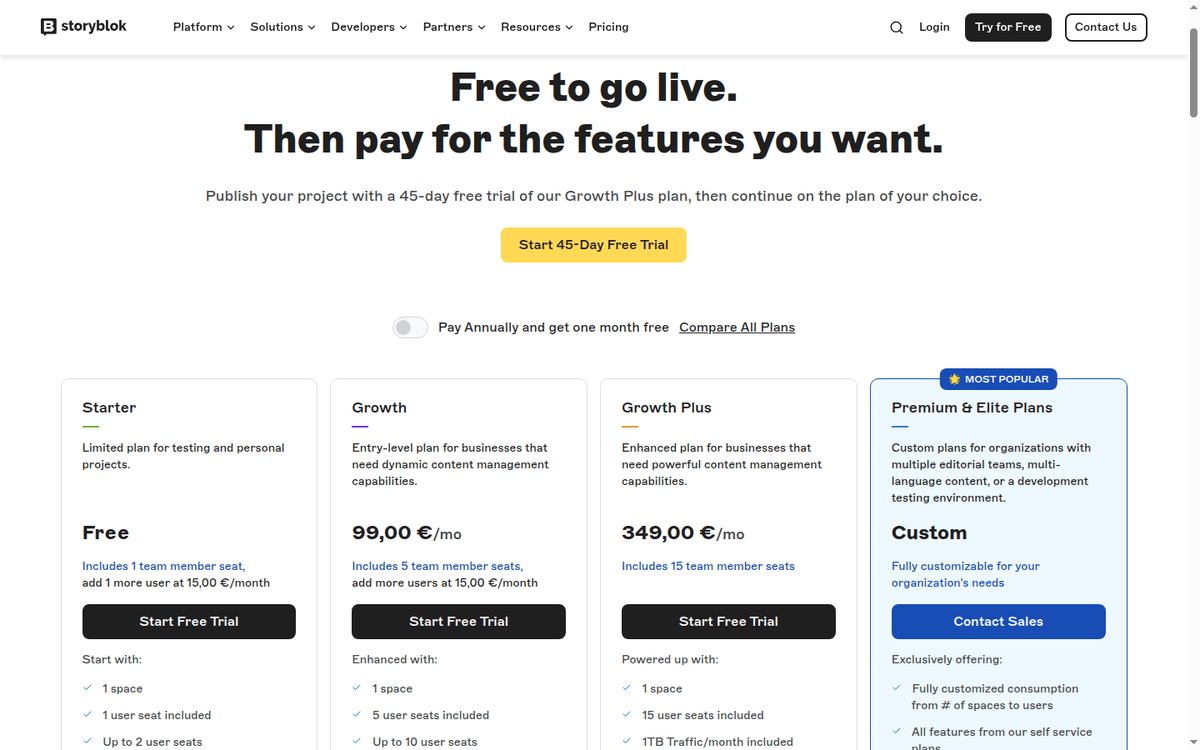
The grid itself is published once, in one set of figures — what changes by country is the currency symbol, which is the first trap on this page.
| Plan | Monthly EUR (monthly billing) | Monthly EUR (annual billing) | Seats | Traffic | API requests | Locales | AI credits | SLA |
|---|---|---|---|---|---|---|---|---|
| Starter | Free | Free | 1 (up to 2) | 100 GB | 100k | 2 | 25k | None |
| Growth | €99.00 | €90.75 | 5 (up to 10) | 400 GB (up to 1 TB) | 1M (up to 5M) | 2 (up to unlimited) | 100k (up to 500k) | 97% uptime |
| Growth Plus | €349.00 | €319.91 | 15 | 1 TB | 4M | 10 | 200k | 97% uptime |
| Premium | Custom | Custom | Unlimited | Unlimited | Unlimited | Unlimited | Unlimited | 99.9% |
| Elite | Custom | Custom | Unlimited | Unlimited | Unlimited | Unlimited | Unlimited | 99.99% |
Three things the table does not show.
The numbers in parentheses are add-on ceilings, not new tiers. Growth at €90.75/mo buys 5 seats, 400 GB traffic, 1M API requests, 2 locales and 100k AI credits. The vendor sells seat, traffic, request, locale and credit add-ons that lift those caps, and the page publishes the price of each one — that list sits in the section on add-ons below.
“Storyblok Agents” arrives on Growth and stays through Premium. Starter does not list Storyblok Agents in its feature set. The pricing page does not define what counts as an Agent or how it consumes AI credits.
45-day trial, not 14-day. Every new account starts on Growth Plus and gets 45 days to evaluate before being asked to choose a plan. The clock is tied to the space rather than the signup form: the vendor’s FAQ says “every space comes with a 45-day free trial”.
What the AI credits actually unlock
Storyblok’s pricing page carries an AI credit line on every tier. Three things are worth knowing about it.
AI credits are a monthly allowance. Starter gives 25k credits, Growth gives 100k (with an add-on path to 500k), Growth Plus gives 200k, and Premium and Elite are unlimited by quote. The grid labels the line “AI Credits (Monthly)”; what happens to unused credits at the end of a cycle is not spelled out on the page.
AI features are spread across several lines of the grid. Storyblok Agents are listed from Growth up. AI Content Generation and AI Translations are checked on every tier, including Starter, and AI Alt Text starts at Growth.
The Image Optimization Service is on all five tiers as well, though the page does not file it under AI. The credit cost per action is not published — there is no per-action rate card on the pricing page.
The limits are pooled per space, not per locale. A Starter space includes 2 locales, and its traffic and request allowances are shared across both rather than counted twice.
The honest answer on AI credit math: the vendor publishes no per-action rate card, so the allowance cannot be sized against a publishing volume from the page alone. What the page does give you is the expansion price, which means an allowance can be topped up mid-cycle instead of forcing a jump to the next tier.
Add-ons, billing model, and the EUR/USD trap
Storyblok’s pricing page is short. Three details on it matter more than the headline rate.
The headline price is monthly billing. Growth at €99/mo is the monthly billing rate. Annual billing brings it to €90.75/mo, which is about 8% less. Growth Plus shows the same shape: €349/mo or €319.91/mo annually.
One grid, two currency symbols. The rate cards render from a single set of figures; a script in the page then swaps the symbol by country. Visitors from the US, Canada and a few other countries read USD, everyone else reads EUR.
The numbers behind both are identical, and so is the annual discount. There is no separate US price list to hunt for and nothing to convert.
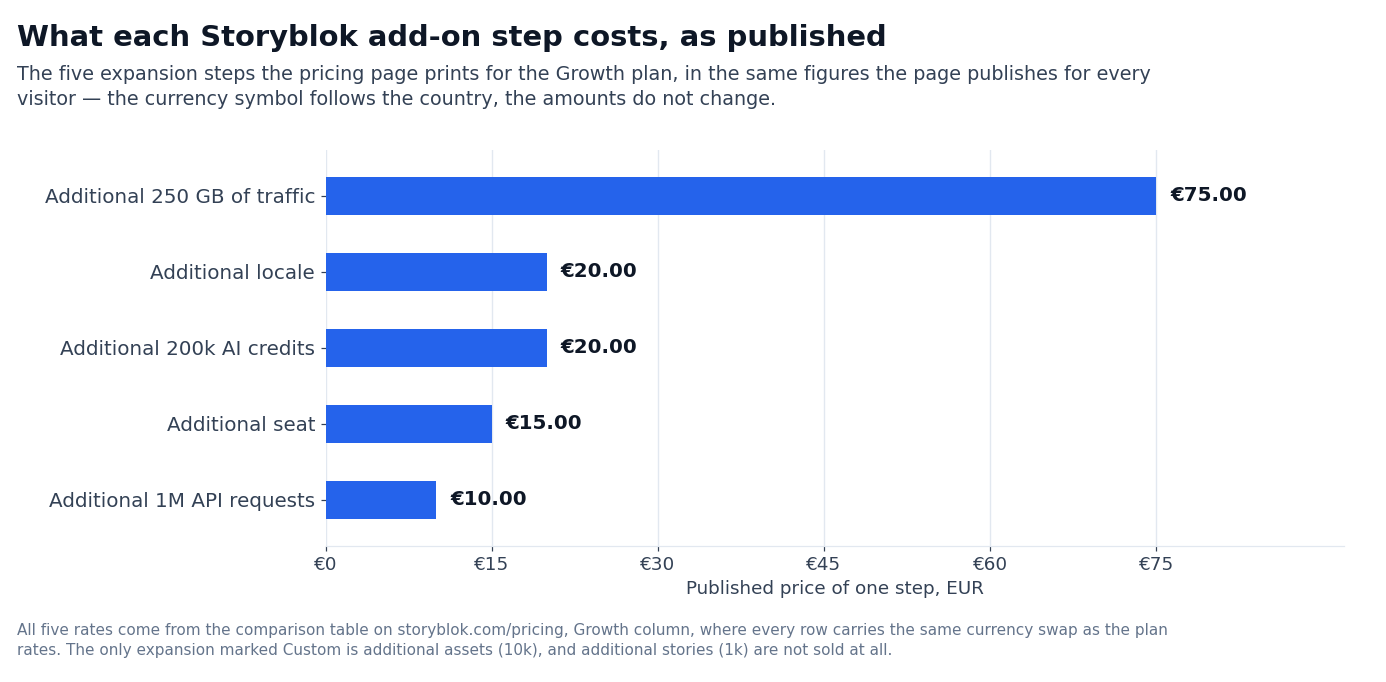
The add-on prices are on the page. Growth can be expanded to 10 seats, 1 TB traffic, 5M API requests, unlimited locales and 500k AI credits. The comparison table publishes what each step costs on that plan:
- an additional seat — €15.00.
- an additional 1M API requests — €10.00.
- an additional locale — €20.00.
- an additional 250 GB of traffic — €75.00.
- an additional 200k AI credits — €20.00.
Every one of those rows carries the same currency swap as the plan rates. The only expansion marked Custom instead of printed is additional assets (10k); additional stories (1k) are not sold at all. The Growth card still links a downloadable fact sheet for the configurable plan behind those rates.
No transaction-fee line anywhere on the page. Storyblok is a CMS rather than a commerce platform, and commerce runs through integrations — Shopify is the one the grid lists against Growth and up. Nothing on the pricing page bills a percentage of your sales.
Compliance, hosting, and data residency
Storyblok is a European company headquartered in Linz, Austria, with engineering presence in multiple EU countries. The default hosting region is AWS Frankfurt (eu-central-1); the vendor’s FAQ adds North America (US and Canada) and Australia as supported locations customers can choose between.
Choosing one is a paid line on the grid — “Preferred Data Centers” — priced on Premium and included on Elite. Three compliance points worth flagging.
GDPR is the baseline, not the differentiator. As an EU company, Storyblok is GDPR-native. The DPA is published and customers can sign it without sales involvement, and data processing happens inside the EU by default.
The uptime SLA arrives at Growth and climbs from there. Starter has no SLA at all — the page promises nothing for downtime. Growth and Growth Plus publish 97%, Premium 99.9% and Elite 99.99%.
The certifications live outside the self-service grid. The pricing page lists neither SOC 2 nor ISO 27001 on Starter, Growth or Growth Plus, and the Security Audit line is checked only on Elite.
The vendor does claim ISO 27001 for its products and operations on its own security pages, and the Trust Center ties SOC 2 to the AWS infrastructure underneath. Neither has a self-service route.
Storyblok also publishes a status page and an uptime history API for monitoring; the FAQ points at uptime.storyblok.com, and status.storyblok.com redirects there.
Comparison with the main alternatives
Storyblok sits in a headless CMS market with Contentful, Sanity, Strapi, Builder.io, Hygraph, Prismic, Directus, and open-source options like KeystoneJS.
The differentiators that come up most often are the visual editor, the AI credit model, the published free tier, and the EU data residency baseline.
| Tool | Published pricing grid | Free tier | Visual editor | Headless API | EU hosting | AI features | Best-fit signal |
|---|---|---|---|---|---|---|---|
| Storyblok | Yes (one grid, EUR or USD symbol) | Yes (Starter, hard caps) | Yes, included on every plan | Yes (REST + GraphQL) | Default | AI credits per tier; Storyblok Agents on Growth+ | Mid-market editorial teams with developers |
| Contentful | No (sales-quoted) | Yes (Free and Lite) | Contentful Studio (Enterprise) | Yes (REST + GraphQL) | Optional | AI Actions inside Enterprise quotas | Large enterprises with procurement |
| Sanity | Yes (Free $0, $15 per seat/month) | Yes (20 seats, 2 datasets) | Sanity Studio, customizable | Yes (GROQ + GraphQL) | Optional | AI Assist included in Growth | Teams that want a customizable studio |
| Strapi | Yes (self-hosted = free; cloud = paid) | Yes (self-hosted, MIT) | No built-in editor (third-party only) | Yes (REST + GraphQL) | Self-host = any | Plugin ecosystem | Engineering-first teams that want OSS |
| Hygraph | Yes (Hobby free, $199) | Yes (Hobby, free forever) | Yes (paid tier) | Yes (GraphQL) | Optional | Limited | Federated GraphQL use cases |
| Prismic | Yes (per month and per repository) | Yes (limited) | Yes (Slice Machine) | Yes (REST + GraphQL) | Optional | Limited | Marketing teams running multi-brand |
| Builder.io | Yes (published tiers) | Yes (limited) | Yes (drag-and-drop) | Yes (REST + GraphQL) | Optional | Built-in AI | Teams that need a visual page builder |
| Directus | Yes (self-hosted free; cloud paid) | Yes (self-hosted) | No (admin UI, not editor) | Yes (REST + GraphQL) | Self-host = any | None on the published tiers | Engineering teams wrapping SQL |
Contentful is the closest competitor for mid-market and enterprise, but Contentful quotes its plans rather than publishing them and folds AI Actions into enterprise quotas instead of selling them separately. Sanity has the more flexible studio and a free tier generous enough to develop on, with consumption add-ons on top of a per-seat rate.
Strapi wins on openness (MIT-licensed self-hosted option) and loses on visual editor polish.
Who Storyblok is for
Three profiles fit Storyblok well in practice.
- Mid-market editorial teams shipping content across multiple channels. Growth buys 5 seats and the allowances in the table above. That is enough for a marketing team of 3–5 editors publishing to a marketing site, a blog and a small storefront. The 97% uptime SLA matches what most marketing sites need.
- EU companies that need EU data residency by default. Storyblok is hosted on AWS Frankfurt out of the box, so EU residency is not a paid extra on the self-service tiers. Choosing a different region, or buying into the enterprise compliance pack, is where the gate appears.
- Developer teams building agent-driven content workflows. Storyblok’s MCP server and Storyblok Agents make it one of the few headless CMS vendors that can be driven directly by an LLM agent. The Agents line starts at Growth; the MCP server is documented without a tier of its own. This is the angle that fits teams already running Claude, Cursor or custom agent stacks.
Who should look elsewhere
Storyblok is not the right pick in a few clear cases.
- Heavy enterprise procurement with SOC 2 requirements. On Storyblok the security audit and the compliance pack are an enterprise conversation. If you need a vendor that puts SOC 2 on the self-service plans, Sanity publishes SOC 2 Type 2 on every tier, including its free one.
- Multi-brand portfolios with many spaces. Growth includes 1 space; Premium and Elite are unlimited. If you run 5+ brands and want per-brand billing, Builder.io and Prismic handle that pattern more directly.
- Engineering-first teams that want full source control. Storyblok is a SaaS with a managed backend and publishes no self-hosted distribution. Strapi (MIT-licensed self-hosted) and Directus are the right fit if you need to own the database.
- Pure headless API without an editor experience. With no editors and just an API to serve, a hosted Postgres with Hasura or a thin Sanity Studio is cheaper than any paid Storyblok plan.
Pricing policy details that matter
A handful of small-print points change real cost.
- Annual billing saves roughly 8% versus monthly billing on Growth and Growth Plus.
- The published add-on rates cover seats, traffic, API requests, locales and AI credits; anything marked Custom on the grid goes through the fact sheet or a sales conversation.
- The 45-day trial runs on Growth Plus, so you can build, integrate and ship to staging before picking a plan.
- There is no public refund window: annual plans bill annually, and mid-cycle downgrades take effect at renewal.
- Premium and Elite are sales-quoted — the published grid is only Starter, Growth and Growth Plus.
What each plan is worth
Storyblok publishes its lower tiers instead of quoting them, as Sanity, Strapi, Builder.io, Directus, Prismic and Hygraph do too — only Enterprise hides behind a call. It also gives away a real free tier and documents an MCP server for agent-driven content workflows. Growth is the entry point for any team of more than one editor.
Growth Plus is the right step once traffic, AI credits or locales start to bite: at that level the base allowances cover most mid-market workloads without an add-on.
The real caveat is how quickly the ceilings arrive, not what the expansions cost. The page publishes both the ceilings on Growth and the per-unit rate for each step, so a bigger plan can be priced in advance.
What cannot be priced in advance is how fast an editorial team burns AI credits, because no per-action rate card is published; watch the allowance for a month before you commit to that tier.
For mid-market editorial teams with developers, EU data residency and an interest in agent-driven workflows, the published rates put Storyblok on the shortlist in 2026. For pure enterprise procurement with SOC 2 below the custom tier, for engineering-first teams that need self-hosted, or for multi-brand portfolios with many spaces, look elsewhere.
The site serves one set of figures and swaps the currency symbol by country, so the USD rates are the same numbers (storyblok.com/pricing).
FAQ
How much does Storyblok cost in 2026?
Storyblok publishes three tiers with a price: Starter is free, Growth is €99/mo (€90.75/mo annual), Growth Plus is €349/mo (€319.91/mo annual), and Premium and Elite are sales-quoted.
Does Storyblok have a free plan?
Yes. Starter is a permanent free tier, not a trial. It includes 1 seat (up to 2), 100 GB traffic, 100k API requests, 2 locales and 25k AI credits. Storyblok Agents are not available on Starter; they arrive on Growth.
What is a Storyblok Agent?
Storyblok Agents are the vendor’s branding for agentic content workflows — automated or AI-driven actions that operate on Storyblok content. The feature is included on Growth, Growth Plus, Premium and Elite. Starter does not include Storyblok Agents. The pricing page does not publish how many AI credits a single Agent action consumes.
How long is the Storyblok free trial?
New accounts get a 45-day free trial of Growth Plus, not the usual 14 days. The vendor’s FAQ frames the clock per space — “every space comes with a 45-day free trial” — rather than tying it to the signup form.
What is the Storyblok MCP server?
Storyblok ships a documented Model Context Protocol server, which lets an MCP client such as Claude or Cursor work inside a Storyblok space. The server exposes the Management API only, so it cannot read published content through the Content Delivery API, and the documentation does not bind it to a tier.
Does Storyblok charge transaction fees?
No, and there is no transaction-fee line on the pricing page at all. Storyblok is a CMS rather than a commerce platform: payments and checkout are handled by integrated backends, with Shopify the one the grid lists from Growth up.
Is Storyblok SOC 2 compliant?
Not on the self-service grid. The pricing page lists neither SOC 2 nor ISO 27001 on Starter, Growth or Growth Plus, and the Security Audit line is checked only on Elite. The vendor does claim ISO 27001 on its security pages, and the Trust Center ties SOC 2 to the AWS infrastructure it runs on.
Where is Storyblok hosted?
The default region is AWS Frankfurt (eu-central-1), and the vendor’s FAQ lists North America (US and Canada) and Australia as the other supported locations customers choose between. On the grid that choice is the “Preferred Data Centers” line, priced on Premium and included on Elite; staying in the EU costs nothing extra.
How do Storyblok AI credits work?
AI credits are a monthly allowance; the grid labels the line “AI Credits (Monthly)”. They cover the editor’s AI features plus Storyblok Agents on Growth and up. Starter gets 25k, Growth 100k (up to 500k via add-on), Growth Plus 200k, and Premium and Elite are unlimited by quote. What happens to unused credits is not stated.
Can Storyblok handle invoice billing and procurement?
Yes on Premium and Elite. Growth and Growth Plus are card-only on the published pricing page; invoice and purchase order handling require Enterprise engagement.
How we put this together: the plan cards and both billing options, the per-tier seats, traffic, API request, locale and AI credit allowances, the published add-on rates, the uptime SLA, the currency-symbol swap in the page script, the MCP documentation, the vendor trust pages and the competitor rows, quoted as displayed. We have not run a paid Storyblok account.
Figures that depend on a real workload, a real target or a real integration are flagged where they appear in the text rather than being estimated.
Disclosure: this article contains affiliate links. If you buy through them we may earn a commission at no extra cost to you. Commission never changes our scoring or the order of a ranking.