The corpus the vendor’s own index of academic papers and clinical trials, not the open web.
What comes out research reports and tables with inline citations rather than a chat answer.
The bill seats on two published rates, one shared usage pool, and screening caps that climb with the tier.
Free stops at the agent’s allowance, custom extraction, the systematic review workflow and the API.
What decides the fit here is the pricing model rather than the feature list. The free card is a standing plan rather than a trial, seats are not discounted by volume, and the ceiling on the agent is what most upgrades come down to.
What Elicit actually sells
Elicit pitches itself as “AI for scientific research” and lists six surfaces on its home page: Research Agent, Search, Research Reports, Systematic Literature Review, Library, and Routines. The platform is one product rather than a bundle: the tiers differ by how much usage they carry and which workflows they unlock, not by which product you get.
What separates it from a generic LLM chat tool is the corpus it searches, the artifacts it produces, and the workflow it automates.
It searches a curated scientific corpus, not the open web. The corpus covers more than 138 million academic papers and 545,000 clinical trials. The home page adds that more data sources are coming soon. Search uses semantic matching rather than keyword match, so you do not need exact vocabulary to find relevant papers.
It produces cited artifacts. Every Research Report includes inline citations and a structured source list. The platform can also generate tables, figures, bioinformatics analyses, calculations and slides, all with citation tracking back to the underlying papers. This is the part that separates Elicit from ChatGPT with a search plugin.
It runs a PRISMA-grade systematic review workflow. PRISMA is the standard for systematic reviews in evidence-based research. Elicit ships a dedicated screening workflow that automates the title/abstract screening stage of a systematic review and supports PRISMA-grade extraction accuracy on Enterprise.
The published user count is “trusted by over 5 million researchers.” That number sits at the top of the home page; Elicit does not break it down by paid vs free.
Plans and pricing — the full table
All numbers below come from the elicit.com/pricing page. The published grid is in USD per user, and the page carries two switches: Monthly or Yearly billing, and an Industry or Academic price list.
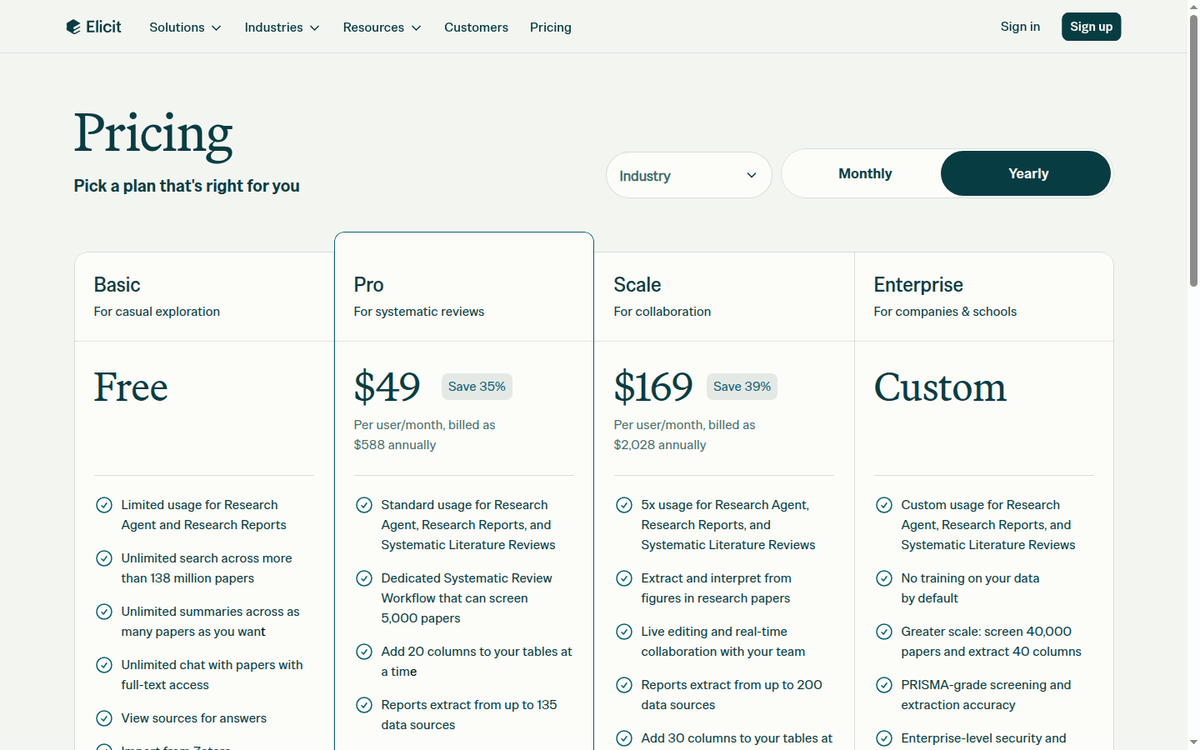
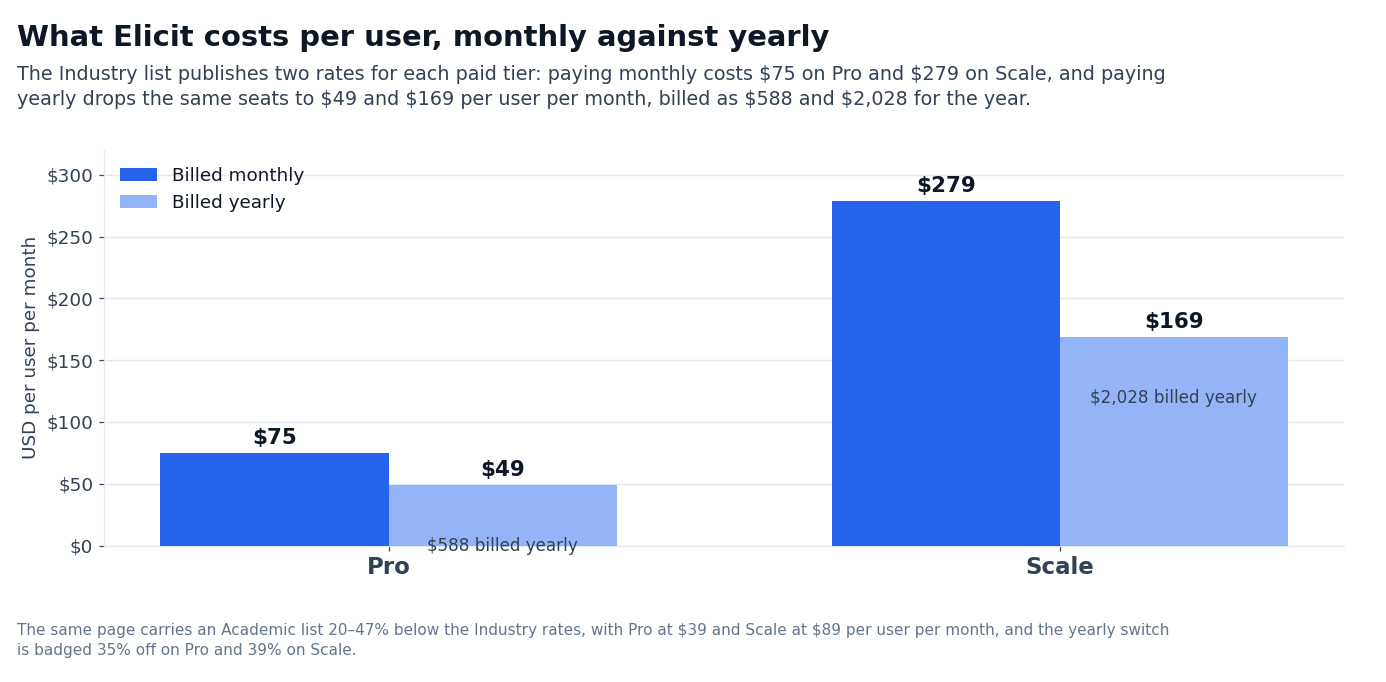
On the Industry list, monthly billing runs $75 on Pro and $279 on Scale, and the yearly rates are $49 and $169 per user per month, billed as $588 and $2,028 a year. Enterprise is quoted either way.
| Plan | Monthly rate | Yearly rate (per user/month) | Annual total per user | Research Agent usage | Reports extraction sources | Paper screening cap | Columns per table | Custom extraction | API access | Team features |
|---|---|---|---|---|---|---|---|---|---|---|
| Basic (Free) | $0 | $0 | $0 | Limited | Limited | Limited | Limited | Not available | Not available | Not available |
| Pro | $75 | $49 | $588 | Standard | Up to 135 | 5,000 | 20 | Yes | Yes | Not included |
| Scale | $279 | $169 | $2,028 | 5x Pro | Up to 200 | 20,000 | 30 | Yes | Yes | Real-time collaboration, admin panel, usage tracking, seat management |
| Enterprise | Custom | Custom | Custom | Custom | Custom | 40,000 | 40 | Yes | Unlimited | SSO/SAML, 2FA, single-tenancy, dedicated CSM, custom templates |
The second grid behind the Industry/Academic switch is worth knowing about. Academic rates run 20–47% below the Industry ones: Pro drops to $39 and Scale to $89 per user per month, and the list carries a Plus tier at $11 that the Industry list does not have.
The grid carries the rates; what decides the bill sits outside it.
The rate is per user, and the yearly switch is the cheaper one. $49/user/month on yearly billing is $588/year per seat, so a team of five on Pro pays $2,940/year. The same team on monthly billing pays $75 per seat, or $4,500/year. No volume discount is published for bigger teams; Enterprise is where those are negotiated.
Free is free for a reason. The Basic card lists unlimited search and unlimited summaries across 138M+ papers, unlimited chat with papers, source viewing and Zotero import. The paid tiers then deepen the AI Research Agent and Research Reports past their “limited usage” allowance and add the systematic review workflow, custom extractions and API access.
API access starts at Pro, not Free. Free does not include API access. Pro gives API access, and Scale and Enterprise raise the number of results one request can return; the 100-requests-per-minute burst limit is the same on every plan. Enterprise is the only tier with “Unlimited API access” published.
What the AI Research Agent actually does
The AI Research Agent is the feature that drives most of the upgrade decisions on Elicit. It is positioned for “high-stakes decisions and rigorous research workflows” rather than for the casual search the free plan covers.
What it actually does once you start it is where the plan limits bite.
It runs multi-step research autonomously. You describe a research question; the agent searches the corpus, filters for relevance, extracts data points, and produces a structured report with citations. The agent can also iterate: ask follow-up questions, add columns, change extraction templates, and re-run on a different slice of papers. This is not a single-shot generation step.
Usage is one monthly pool, not a per-action credit count. Elicit publishes multipliers rather than a token allowance: Pro gets “standard usage,” Scale gets “5x Pro,” Enterprise is custom, and the pool is shared across every feature the plan has.
Consumption per task is not published; Account Settings shows the usage for the workspace. Unused usage does not roll over, and the pool refreshes on the subscription date.
Reports extract from up to 135 data sources on Pro, 200 on Scale, custom on Enterprise. The page publishes the numbers without defining whether they count per report or per workspace, so treat them as ceilings rather than as an allowance. What is clear is the direction: Scale raises the figure Pro carries, and Enterprise quotes a custom one.
The honest answer on the upgrade decision: the AI Research Agent on Pro is useful for individual researchers running one or two literature reviews per month. Teams running systematic reviews at scale, with multiple researchers collaborating on the same extraction table, need Scale or Enterprise.
Free vs paid — what actually changes
The pricing page makes the free vs paid split very clear. What separates the two cards is a set of usage allowances, workflows and capabilities.
- Research Agent usage. Free has limited agent usage; Pro has standard usage; Scale has 5x Pro.
- Research Reports. Free has limited report generation; Pro unlocks deep customization: which papers, what information, what format.
- Systematic Review Workflow. Free does not include the dedicated PRISMA workflow; Pro includes it with a 5,000-paper screening cap; Scale raises that to 20,000 papers, and Enterprise screens 40,000 and extracts 40 columns.
- Custom extraction. Free does not support custom extractions from uploaded papers; Pro unlocks it.
- API access. Free has no API; Pro and above include API access.
- Routines. The legacy alerts were retired in September 2026 and replaced by Routines, which the vendor lists for Pro, Scale and Enterprise; the free plan has neither.
The Basic card also lists what comes with the plan:
- search across 138M+ papers
- unlimited summaries
- unlimited chat with papers
- source viewing
- Zotero import
- semantic search
Those are the foundation; the paid cards list what they add on top rather than repeating them.
Comparison with the main alternatives
Elicit sits in a market with Consensus, SciSpace, Scite, Research Rabbit, Litmaps, and Scholarcy. The differentiators that come up most often are corpus size, the systematic review workflow, and the per-user pricing model.
| Tool | Corpus coverage | Free tier | Published pricing | Systematic review workflow | API access | Best-fit signal |
|---|---|---|---|---|---|---|
| Elicit | 138M+ papers, 545k clinical trials | Yes (free plan, limited agent) | $49/user/mo Pro and $169 Scale on yearly billing; $75 and $279 monthly | Yes (dedicated workflow, PRISMA on Enterprise) | Pro+ | Individual researchers and small research teams running literature reviews |
| Consensus | 250M+ papers | Yes (10 Pro messages, 3 Deep reviews a month) | $12/user/mo Pro; Team $20/seat | Limited (Deep reviews, no dedicated workflow) | Included in Pro (500 uses/mo) | Quick yes/no scientific consensus checks |
| SciSpace | 280M+ papers | Yes (sign-up only, no published free tier) | Premium $12–20/user/mo, Advanced $70–90, Max $160–200; no Pro tier | Yes (Systematic Research included in Premium) | Not published | Literature search + AI writing assist |
| Scite | 1.6B+ citations, 300M+ scholarly sources | No free tier (7-day trial) | Basic $12/user/mo yearly ($20 monthly), Pro $40 yearly | Limited | Paid | Citation context classification |
| Research Rabbit | 310M+ papers | Yes (Free Forever) | Free; ResearchRabbit+ $10/mo annual | Not published | Not published | Visual literature mapping, free tier strong |
| Litmaps | 270M+ papers | Free (limited) | $10/mo, $120/year; Team separate | No | Limited | Visual citation maps, free tier strong |
| Scholarcy | Not published | Yes (10 summaries, 1/day) | €8.99/month; institutional | No | Not published | Article summarization and extraction |
Consensus and SciSpace publish lower per-seat prices than Elicit at the entry tier. Scite is built around citation context rather than full-text extraction. Research Rabbit and Litmaps both keep a free tier for visual literature mapping, and Research Rabbit now sells a paid one on top; either is a useful complement to Elicit rather than a direct competitor.
Scholarcy is a summarization tool with a different focus.
Who Elicit is for
In practice the fit comes down to how often a literature review lands on your desk.
- PhD students and postdocs running individual literature reviews. Pro at $588/year per seat is the right step once the AI Research Agent and Research Reports become part of the weekly workflow. The free tier covers the “I just need to find a few papers” use case; Pro covers “I need to extract data from 50 papers into a structured table.”
- Systematic review teams. Scale at $2,028/year per seat is the practical starting point for any team running more than one systematic review per quarter. The dedicated PRISMA workflow, real-time collaboration and admin panel with usage tracking are the features that make the jump from Pro to Scale worth it.
- Research labs with custom extraction needs. Pro unlocks custom extraction from uploaded papers. Scale raises the column and source ceiling. Enterprise unlocks PRISMA-grade extraction accuracy, SSO/SAML, single-tenancy deployments and custom data sources — the configuration most pharma, biotech and academic medical centers actually need.
Who should look elsewhere
Elicit is not the right pick in a few clear cases.
- Quick consensus checks. If you mostly need a yes/no answer to “what does the literature say about X,” Consensus at $12/user/mo is cheaper and faster. Elicit is overkill for that use case.
- Citation context analysis. Scite’s Smart Citations (1.6B+) are a different product. Use Scite when you need to know whether a paper is supported or contradicted, not when you need to extract structured data.
- Visual literature mapping. Litmaps and Research Rabbit both keep a free tier and produce visual citation maps that Elicit does not. Use them as complements, or as alternatives if mapping is your primary use.
- Heavy institutional procurement. Elicit Enterprise is the right tier for pharma and academic medical centers; pricing is custom. The pricing page lists neither SOC 2 nor HIPAA on the self-service tiers, so a procurement team has to raise compliance with the vendor directly.
- Non-academic use cases. Elicit is built for scientific research. For general knowledge work, ChatGPT, Claude and Perplexity cover most needs at lower cost.
Pricing policy details that matter
A handful of small-print points change real cost.
- Two billing switches, not one. Pro and Scale are published twice: $75 and $279 per user per month on monthly billing, or $49 and $169 per user per month billed yearly as $588 and $2,028. The yearly switch is badged 35% off on Pro and 39% on Scale.
- No volume discount, but a second grid. Per-seat pricing is the same at 2 seats as at 50 seats, and the discounts on the page are by audience rather than by volume. The Academic list runs 20–47% below Industry, with Pro at $39 and Scale at $89.
- No public refund window. Canceling stops the next renewal rather than refunding the current term; mid-cycle downgrades take effect at renewal.
- The free plan is not framed as a trial. Basic is listed as a standing plan with its own limits rather than with a countdown, though the page makes no promise about how long it stays free — the card’s button reads “Try for free.”
- Usage caps reset per cycle, and they can be topped up. The monthly pool refreshes on the subscription date and unused usage does not roll over. When it runs out, Pro and Scale can switch on extra usage, billed in $100 increments against a monthly spend limit you set, and on Scale an extra seat raises the limit.
- Custom extraction is gated to Pro and above. Free does not allow custom data extraction from uploaded papers.
Is it worth the price at each tier
Elicit is one of the few AI research assistants that publishes a real price grid across all tiers, keeps a free plan with unlimited search across 138M+ papers, and ships a dedicated systematic review workflow. Pro at $49/user/month on yearly billing ($588/year per seat) is the right step once the AI Research Agent becomes part of the regular workflow.
Scale at $169/user/month on yearly billing ($2,028/year per seat) is the practical starting point for any team running systematic reviews at scale. It adds 5x usage, real-time collaboration, and an admin panel with usage tracking and seat management.
The caveat is the caps rather than the billing. Both switches are published, so the yearly-versus-monthly decision is a straight 35% or 39% saving. There is no volume discount below Enterprise: a team of five on Pro pays $2,940/year on yearly billing or $4,500/year on monthly.
What deserves a closer read is the usage pool, which stops the agent mid-cycle unless extra usage is switched on. The screening ceilings decide a tier too: 5,000 papers on Pro against 20,000 on Scale.
For individual researchers and small research teams running literature reviews, Elicit is one of the better-priced AI research assistants in 2026. For quick consensus checks, citation context analysis, or visual mapping, the alternatives are cheaper and faster.
FAQ
How much does Elicit cost in 2026?
Elicit has four tiers in USD per user. Basic is free; Pro is $49/user/month on yearly billing ($588/year per seat) or $75 billed monthly; Scale is $169/user/month on yearly billing ($2,028/year per seat) or $279 billed monthly. Enterprise is custom (elicit.com/pricing).
Does Elicit have a free plan?
Yes. Basic is a standing free plan rather than a trial, and it includes unlimited search across 138M+ papers, unlimited summaries, unlimited chat with papers, source viewing and Zotero import. The AI Research Agent and Research Reports are limited on Basic rather than closed.
What is the AI Research Agent?
The AI Research Agent is Elicit’s autonomous research workflow. You describe a research question; the agent searches the corpus, filters for relevance, extracts data points, and produces a structured report with inline citations. The agent can iterate — ask follow-up questions, add columns, change extraction templates, re-run on a different slice of papers.
How does Elicit handle systematic reviews?
Elicit ships a dedicated systematic review workflow that automates the title/abstract screening stage. Pro supports up to 5,000 papers in a single review; Scale raises the cap to 20,000; Enterprise supports 40,000 papers, 40 extraction columns and PRISMA-grade accuracy.
Does Elicit have API access?
API access starts at Pro and is included on Pro, Scale and Enterprise. Enterprise is the only tier with “Unlimited API access” published.
How do Elicit usage caps work?
Elicit publishes usage multipliers rather than token counts. Pro has “standard usage” shared across the AI Research Agent and Research Reports; Scale has 5x Pro; Enterprise is custom. There is no per-task figure published, and Account Settings shows the workspace total. When the pool runs out, Pro and Scale can switch on extra usage billed in $100 increments.
Can Elicit handle team collaboration?
Pro does not include real-time collaboration. Scale includes live editing, real-time collaboration, an admin panel with usage tracking, and seat management. Enterprise adds SSO/SAML, 2FA, single-tenancy and other custom deployments, domain verification and a dedicated customer success team.
Is Elicit SOC 2 compliant?
The pricing page does not list SOC 2 or HIPAA compliance on Pro or Scale, and nothing on the grid describes a compliance pack. An institutional buyer has to raise it with the vendor directly.
Can Elicit extract data from figures in papers?
Yes, on Scale and above. Pro does not include figure extraction; Scale supports “extract and interpret from figures in research papers” and raises the column ceiling to 30 per table. Enterprise supports 40 columns.
Does Elicit integrate with Zotero?
Yes. Zotero import is listed on the free Basic card. The integration is built into the search and chat workflows, so imported references can be searched, summarized and cited like papers from the rest of the corpus.
How we put this together: the plan cards and both billing switches, the Industry and Academic price lists, the per-tier usage multipliers, screening caps, column and data-source ceilings, the extra-usage billing steps, the API limits, the help center articles and the vendor trust pages, quoted as displayed. We have not run a paid Elicit account.
Figures that depend on a real workload, a real target or a real integration are flagged where they appear in the text rather than being estimated.
Disclosure: this article contains affiliate links. If you buy through them we may earn a commission at no extra cost to you. Commission never changes our scoring or the order of a ranking.