RocketReach is a B2B contact and lead-intelligence platform with a published free tier and the whole price ladder printed on one page.
It is one of four tools in the mid-market sales-intelligence space — the others being ZoomInfo, Apollo and Lusha — and one of the few that lets you try the database without putting in a credit card.
The free tier is real — a handful of lookups, no card — and the individual ladder publishes both billing cycles, monthly and annual.
The vendor puts the user count at 26M+ and counts 95% of the S&P 500 as customers; the same company’s pricing page says “over 30 million”, so treat the total as approximate.
What RocketReach actually sells
RocketReach is a contact and lead-intelligence platform. The product surface splits into four layers:
- Search — 700M professional profiles searchable by name, title, company, location and industry, with 50+ advanced filters.
- Contact reveal — work and personal email addresses plus phone numbers, verified on demand.
- Intent and enrichment — technographics, news signals and intent data layered on top of the contact record.
- Activation — Messages (an email outreach tool with AI writer), Autopilot (prospecting workflows), a browser extension and a Contact Data API (rocketreach.co, captured recently).
The search filters are where RocketReach positions itself against Apollo. The published list includes job title, seniority, function, company size, industry, location, education, skills, and technographic attributes.
The combination of intent data, technographics and contact data in one product is the differentiator — Apollo has contact data and basic firmographics; ZoomInfo has stronger intent data but prices by demo; Lusha is contact-first with no intent data.
The integrations list is solid for a mid-market tool: Salesforce, HubSpot, Compose, and most ATSs. The Contact Data API exposes 4.5B records for programmatic enrichment, which is the entry point for engineering teams that want to wire RocketReach into their own stack.
How the pricing ladder breaks down
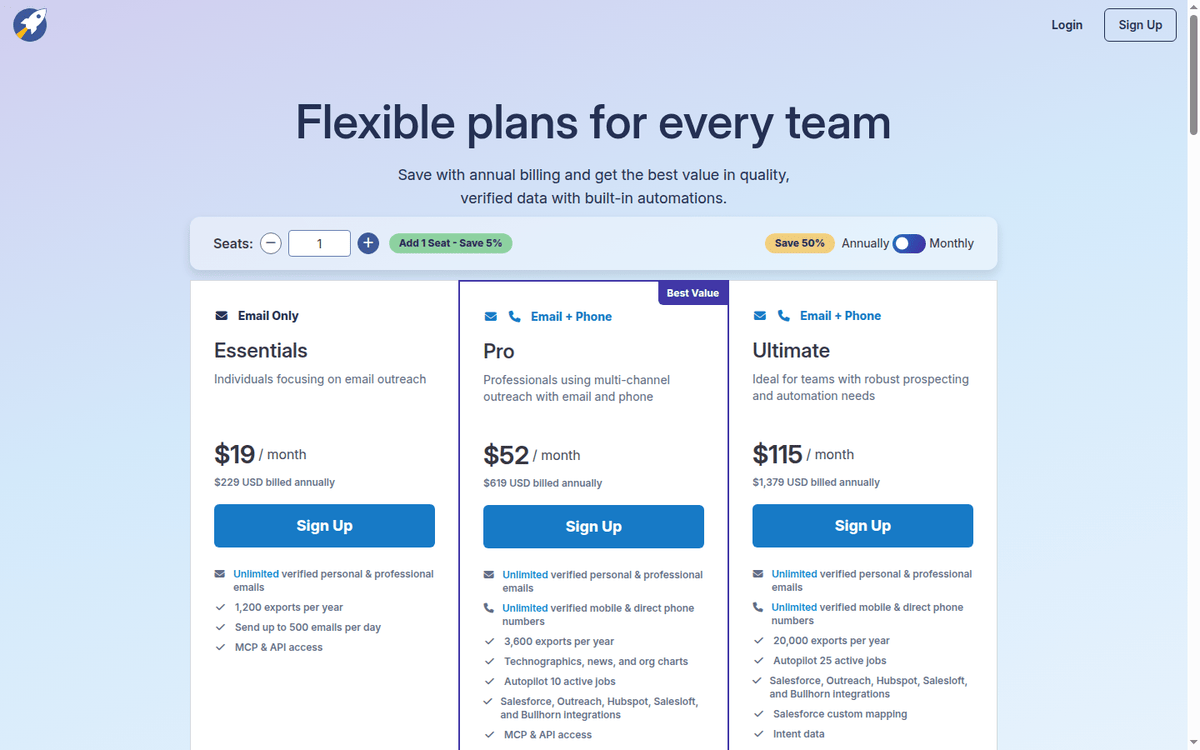
The pricing page lists four published tiers — Free, Essentials, Pro and Ultimate — plus a custom team line:
| Plan | Price | Billing | Limits |
|---|---|---|---|
| Free | $0 | Free, no card | 5 lookups, partial portfolio view, search of professional profiles, limited email/phone reveal |
| Essentials | $19/mo ($229/yr) | Monthly or annual | Entry tier of the published ladder |
| Pro | $52/mo ($619/yr) | Monthly or annual | Technographics, news and org charts; CSV/CRM export, browser extension, advanced filters |
| Ultimate | $115/mo ($1,379/yr) | Monthly or annual | Adds intent data |
| Custom / Team | From $6,000/yr | Annual | Pooled credits, company exports, dedicated account manager, higher API limits, Salesforce/HubSpot/Compose integrations, Contact Data API |
The Free tier is the entry point. Five lookups are enough to verify a specific candidate or build a small test list — they are not enough to run a real outbound campaign, but they are enough to decide whether the data quality is good enough to pay for (rocketreach.co/pricing, captured recently).
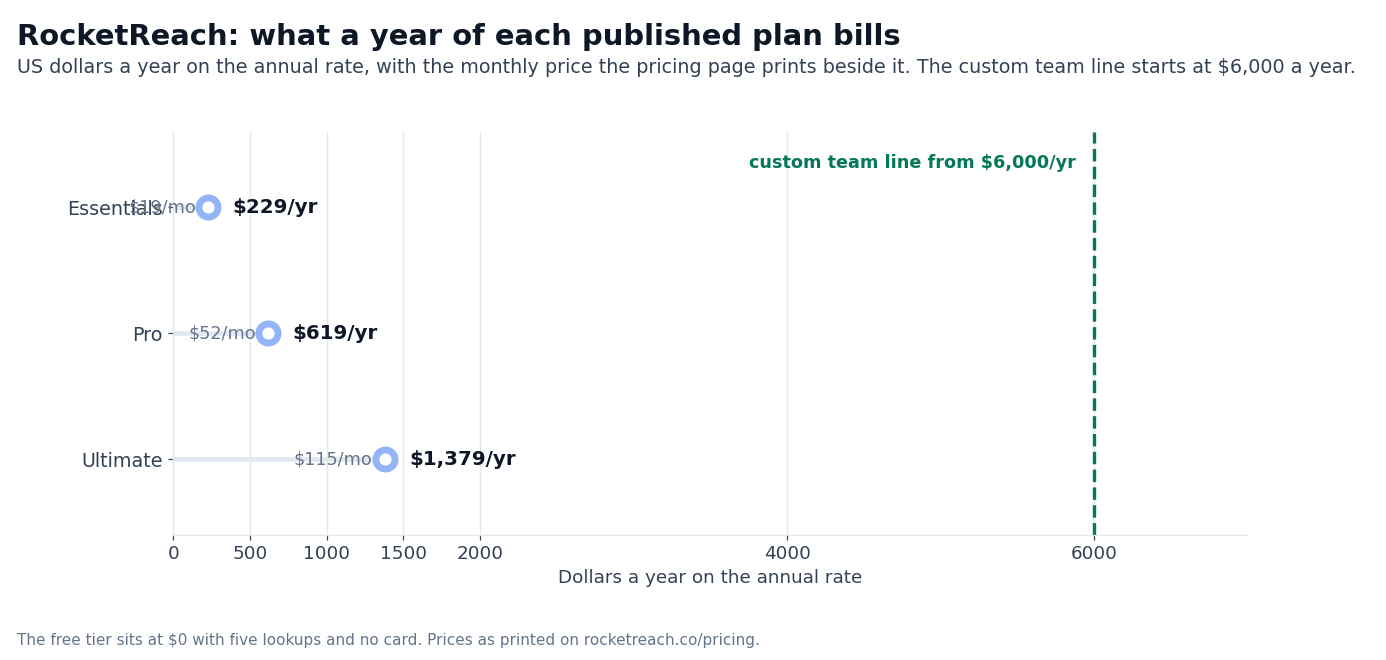
The individual ladder is fully published: Essentials at $19 a month or $229 billed yearly, Pro at $52 or $619, and Ultimate at $115 or $1,379. The custom team line is quoted from $6,000 a year.
The trial mechanic is “no trial” — you upgrade directly from the free tier once you decide to. There is no formal refund policy on the public pricing page.
What the data-accuracy claim actually means
RocketReach publishes 98% accuracy on emails verified on demand and in real time. The check happens when a contact is revealed, not at upload time.
The implication is that an email address may be flagged as unverified in the free tier but become verified once you upgrade and re-query it.
This is a meaningful design choice. Other tools in the space — Apollo, Lusha — verify emails at reveal time too, so the timing is not unique to RocketReach.
What the vendor publishes is a single figure, 98% accuracy on verified emails; no independent benchmark and no personal-email split is published alongside it.
What the vendor does not publish:
- The size of the personal-email versus work-email mix behind the 98% figure.
- A bounce-rate benchmark independent of vendor testing.
- The cadence of re-verification — RocketReach claims “real-time” but does not publish a re-verification schedule for stale records.
For a team running 10K-100K outbound emails per month, the data-quality difference between RocketReach and a cheaper tool is meaningful — 5% more bounces is 500-5,000 more dead emails per campaign. For a solo founder running 1K emails per month, the difference is harder to measure.
How RocketReach compares to the alternatives
| Tool | Entry price | Free tier | Data scope | Differentiator |
|---|---|---|---|---|
| RocketReach | Free $0; Essentials $19/mo; team plans from $6K/yr | 5 lookups, no card | 700M profiles, 60M companies | Intent data + technographics + AI outreach in one |
| Apollo | Free tier, paid plans by level | A free tier with credits | Not published on the pricing page | Larger free tier, all-in-one outbound |
| ZoomInfo | Demo-led | A trial is offered | Not published on the pricing page | Intent data + sales engagement, enterprise-grade |
| Lusha | Free tier; paid plans from $37.45/mo | 40 credits a month | The vendor’s own B2B profile base | Extension-first, simpler pricing |
| Clearbit | On request | A limited free tier | Firmographic and contact enrichment | Best enrichment API, Reveal for visitors |
| Seamless.AI | Sign up free; pricing on request | A free sign-up | The vendor’s own contact base | Real-time search, lighter data |
RocketReach sits in the middle of the pack on price (cheaper than ZoomInfo, more expensive than Apollo and Lusha) and the middle on data scope (smaller than Apollo, larger than Lusha). Its edge is the combination of intent data, technographics, AI outreach, and contact data API in a single product — most competitors split these into separate tools.
For a sales team of one to five, the individual plans are a small commitment, but the custom team line quoted from $6,000 a year is on the high side. Apollo’s entry tier covers a similar feature set for a solo rep.
For a team of 10+ running coordinated outbound, the pooled credits and dedicated account manager justify the RocketReach price.
What RocketReach is good at and where it falls short
Where it wins:
- Free tier with no card. Five lookups are real and let you verify data quality before paying.
- Intent data + technographics + contact data in one tool. Apollo has the first two only at higher tiers; Lusha has none of the intent layer.
- Real-time email verification. The vendor publishes 98% accuracy at reveal time, checked on demand.
- Browser extension. Works on LinkedIn, company sites, and GitHub; one of the more reliable extensions in the category.
- Contact Data API. 4.5B records is the largest published API surface in the mid-market category.
Where it falls short:
- The team line is the expensive one. The custom plans start at $6,000 a year, above the threshold where a small team can comfortably experiment, while the individual plans start far lower.
- Custom tier is enterprise-priced. Apollo’s entry tier lets a small team try a comparable database with a much smaller commitment.
- No published independent accuracy benchmark. All accuracy numbers come from the vendor; there is no third-party audit comparable to the data-quality reports ZoomInfo publishes.
Who RocketReach is for
A real fit when:
- Your sales team is five or more reps running coordinated outbound.
- You need intent data and technographics layered on contact data in a single tool.
- You have an engineering team that wants to wire contact data into an internal pipeline (the Contact Data API is the strongest in the mid-market).
- You want to check the data quality yourself first — the no-card free tier is the easiest entry point in the category.
Probably not the right fit when:
- You are a solo founder running less than 1K outbound emails per month (Apollo’s entry tier is a better fit).
- You need transparent pricing without signup — Lusha publishes its full pricing card.
- Your use case is account-level firmographic enrichment only (Clearbit is purpose-built for this).
- You are an enterprise team running $50K+/year on sales intelligence — at that price point, ZoomInfo is the standard.
FAQ
Is RocketReach really free?
Yes — the free tier includes 5 lookups with no credit card and no expiration. It is enough to verify a candidate or build a small test list. It is not enough for a sustained outbound campaign.
How much does RocketReach cost?
The public pricing page lists four tiers: Free $0, Essentials $19/mo ($229 billed yearly), Pro $52/mo ($619 billed yearly) and Ultimate $115/mo ($1,379 billed yearly), plus a custom team line quoted from $6,000/year.
How accurate is RocketReach data?
The vendor publishes 98% accuracy on verified emails, checked on demand and in real time. Independent audits are not published.
How does RocketReach compare to ZoomInfo?
ZoomInfo prices by demo, has stronger intent data, and integrates with a larger sales-engagement stack. RocketReach is mid-market (individual plans from $19/mo), has contact, intent, technographics and AI outreach in one product, and lets you try before you buy.
ZoomInfo is the better fit for enterprise sales teams; RocketReach is the better fit for mid-market teams that want a single integrated tool.
Can I cancel anytime?
Yes. Per the published FAQ on the pricing page, you can cancel anytime through your accounts page. Since you prepay monthly or annually, cancellation takes effect the following term, and you retain access for the full prepaid period.
Sources
- RocketReach homepage — captured recently
- RocketReach pricing page — captured recently
How we put this together: the Essentials, Pro and Ultimate monthly and annual prices, the custom team floor, the free-tier allowance and the accuracy claim come from rocketreach.co/pricing, quoted as displayed, with the competitor entries read from apollo.io/pricing, lusha.com/pricing, zoominfo.com/pricing, clearbit.com/pricing and seamless.ai/pricing.
Where a rival publishes no figure, the table says so rather than carrying an estimate.
We have not bought a plan, run a campaign through the API or benchmarked the fill rate on our own list, so anything that depends on your target list stays flagged where it appears.
Figures that depend on a real workload, a real target or a real integration are flagged where they appear in the text rather than being estimated.
Disclosure: this article contains affiliate links. If you buy through them we may earn a commission at no extra cost to you. Commission never changes our scoring or the order of a ranking.