We offer a range of customizable packages.
— Tawkify’s published position on pricing, tawkify.com
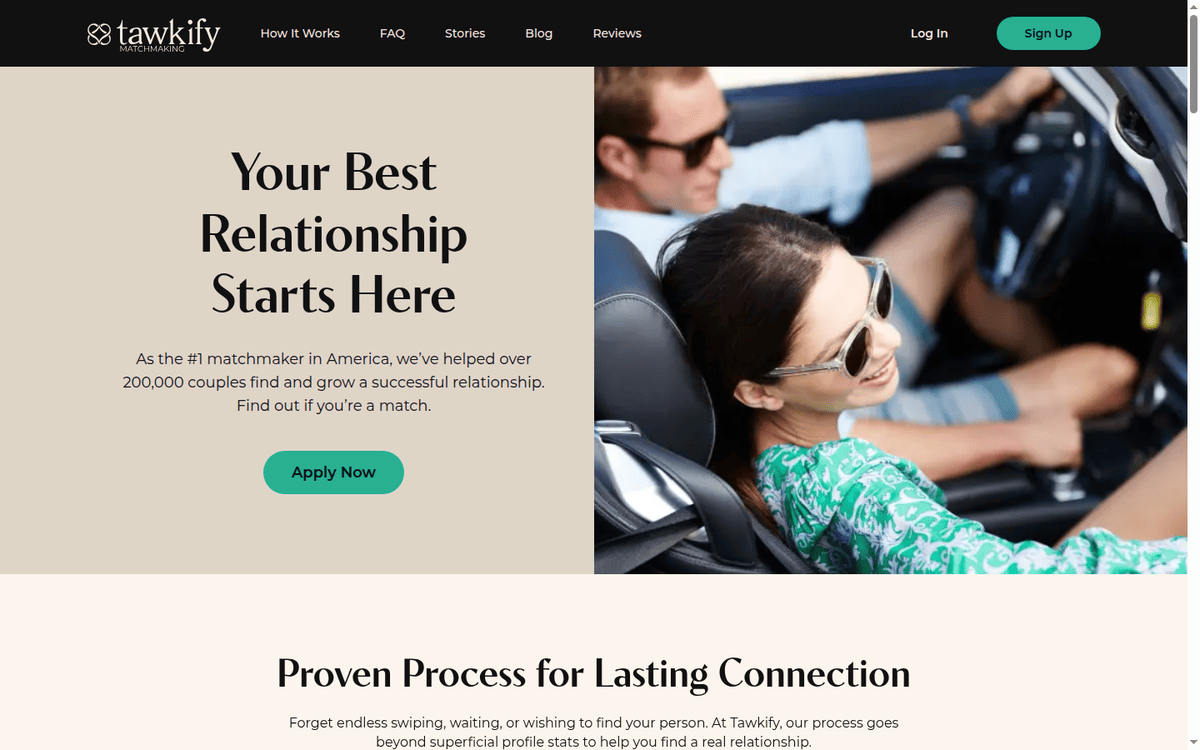
Tawkify is one of the few matchmaking services in the US that publishes its process, its screening standards, and the names of the people doing the matching — but does not publish a price.
The service is positioned against dating apps — the vendor claims 6.5x more effective than dating apps, citing a PEW Research Center 2023 reference — and against traditional offline matchmaking services such as Selective Search, Kelleher International and MacLeod’s.
Trustpilot sits at 4.6/5 on the homepage widget, and there is no free trial — the entry point is a one-minute eligibility survey.
What Tawkify actually sells
Tawkify is a matchmaking service, not a dating app. The distinction matters: there is no swipe feed, no algorithm to game, no in-app messaging.
A human matchmaker reads your intake, pulls from a private candidate pool, screens every potential match — criminal record check and video interview — and then plans the date itself: venue, activity, timing. After the date, the matchmaker collects your feedback and refines the criteria for the next round.
The 2026 product surface is built around five process steps: meet your dedicated matchmaker, tell them what you are looking for, let them vet and video-screen matches, attend the custom-planned dates and feed back after each one.
A coaching layer — optional in Client, included in Member and Premier — runs in parallel, plus access to private events and relationship-tips content (tawkify.com/how-it-works, captured recently).
Three roles work your case: a Client Experience Specialist who makes first contact and recommends the package; a Matchmaker who works 1:1, hand-selects from the 3M+ pool, plans the dates and gathers feedback; and Relationship Support for tools, resources and advice, with optional 1:1 coaching on top.
The trust layer is unusually explicit for this category. Tawkify publishes a 100% criminal-record-screening and video-screening standard for every match, alongside a confidential profile (your information is not exposed to other candidates).
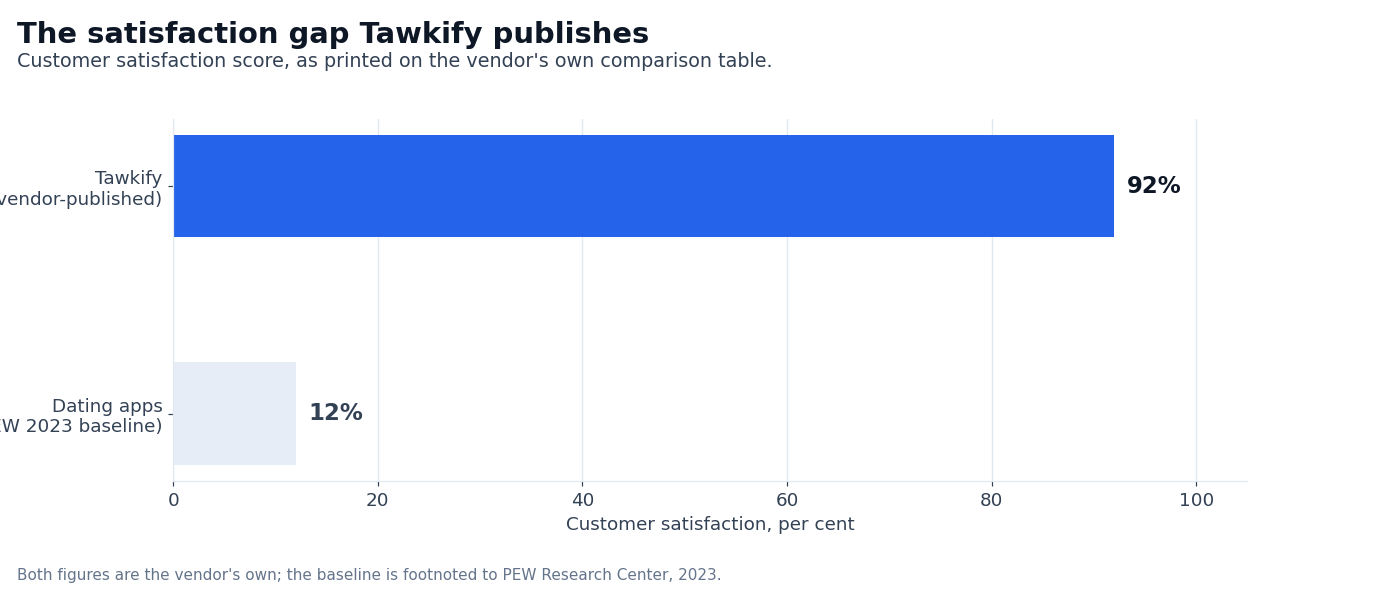
The vendor’s published satisfaction claim is 92%+ on customer-satisfaction score, compared to a 12% dating-app baseline cited from PEW Research Center 2023.
How the three service tiers differ
The published comparison table on the how-it-works page breaks down the differences:
| Tawkify Services | Client | Member | Premier Client |
|---|---|---|---|
| Video screening of all matches | Yes | Yes | Yes |
| One city search location | Yes | — | — |
| Curated in-person or video dates with every match | Yes | Yes | Yes |
| Criminal record screenings for every match | Yes | Yes | Yes |
| Relationship tips and event invites | Yes | Yes | Yes |
| Custom planned dates | Yes | Yes | Yes |
| Multiple search locations | — | Yes | Yes |
| Dedicated matchmaker | — | Yes | Yes |
| Certified relationship coaching | optional purchase | Yes | Yes |
| Unlimited search locations | — | — | Yes |
| Expanded search criteria | — | — | Yes |
| Second date planning | — | — | Yes |
The tier ladder is straightforward. Client is the entry tier: one metro area, curated dates, screening, custom planning. Member adds multiple cities and the dedicated matchmaker plus built-in coaching. Premier Client adds unlimited geography, expanded criteria, and second-date planning (tawkify.com, captured recently).
What the table does not show is the package-length variable. Tawkify sells multi-month engagements rather than monthly subscriptions and describes them as “a range of customizable packages”; the page publishes neither the number of months nor the number of introductions a package carries.
The vendor positions Premier as the longest engagement with the most introductions.
What the screening process actually looks like
The screening is the part Tawkify spends the most pages defending, and rightly so. Every candidate — both the client and the potential matches — goes through the same gate:
- 1-minute eligibility survey at tawkify.com/w/requestcall.
- Intake call with a Client Experience Specialist (about an hour).
- Background check and identity verification on the client.
- Profile is added to the internal pool (private; not exposed to other candidates).
- When a potential match is identified, the candidate goes through Tawkify’s 100% criminal-record screening and a video interview before the introduction is made.
The screening standard is the single largest competitive moat Tawkify has against dating apps, where the vendor cites the PEW reference it publishes for the “looking for something casual” baseline. Whether the screening is worth the premium over apps depends entirely on what you are optimizing for — time-to-second-date or time-to-marriage.
What Tawkify does not publish
Three things matter for a real cost comparison, and Tawkify does not publish any of them:
- Per-package pricing. Tawkify’s published position is that pricing is “quoted after onboarding.” The 1-minute survey is the entry point; the actual quote comes after the intake call. Third-party coverage of Tawkify suggests package prices vary from roughly $2,000 to $6,000+ depending on tier, market, and length, but no authoritative source publishes the actual current pricing grid.
- Length of engagement. Packages are multi-month, but the specific number of months and number of introductions per package are not on the public pricing page.
- Refund and cancellation policy. Tawkify’s published terms are visible only after signup. The homepage widget does not link to a refund-policy page.
This is normal for the matchmaking category — Selective Search, Kelleher, and other high-end matchmakers all price by quote. But it is meaningfully different from dating-app pricing, where everything is on a single pricing card.
How Tawkify compares to dating apps and traditional matchmakers
| Service type | Pricing model | Screening | Time investment |
|---|---|---|---|
| Tawkify Client | Multi-month package, private quote | Criminal record + video on every match | 1 onboarding call, ~1 date/month |
| Tawkify Member | Multi-month package, private quote | Same | Same, plus multiple cities |
| Tawkify Premier | Multi-month package, private quote | Same | Same, plus unlimited cities and expanded criteria |
| Selective Search | Multi-month package, private quote | In-person interview + reference checks | Higher time investment than Tawkify |
| Kelleher International | Multi-month package, private quote | In-person interview + reference checks | Higher time investment than Tawkify |
| Hinge Preferred | App subscription | None | Low time investment, high swipe volume |
| The League | App subscription | LinkedIn-based admission | Medium time investment |
| Bumble Premium | App subscription | Photo verification only | Low time investment |
The positioning is clear: Tawkify is for someone who has decided that dating apps are not producing the result and wants a human-filtered, human-executed alternative. The premium over apps is large: a multi-thousand-dollar package against an app subscription that costs a few tens of dollars a month.
The premium over traditional offline matchmakers is usually smaller, and the time commitment is usually lighter.
Who Tawkify is for
A real fit when:
- You have spent six to twelve months on Hinge, Bumble, or The League and the matches are not converting to relationships.
- You are willing to pay a multi-thousand-dollar package for human-vetted introductions.
- Your dating market is one to three specific metros (e.g., NYC and LA), not “anywhere I can travel.”
- You value the screening standard — the criminal record and video check is the most rigorous in the consumer matchmaking category.
Probably not the right fit when:
- You are under 30 and the dating-app pool still has plenty of viable candidates for your criteria.
- Your schedule cannot accommodate one curated date every three to four weeks.
- Your dating market is unusually specific — a narrow professional niche, an unusual religion, a rare age gap — and Tawkify’s 3M pool may not have enough matching candidates.
- You are unwilling to commit to a multi-month package without knowing the exact price first.
FAQ
How much does Tawkify cost?
Tawkify does not publish prices. The entry point is a 1-minute eligibility survey at tawkify.com/w/requestcall; pricing is quoted after that. Third-party coverage suggests Client packages run from roughly $2,000 to $6,000+ depending on tier, market, and length, but the vendor does not publish a current pricing grid.
Is Tawkify better than Hinge or Bumble?
Different model. Hinge and Bumble are swipe apps with no screening; you filter the volume yourself. Tawkify is a human-curated service with criminal-record and video screening on every match. The 6.5x success-rate claim Tawkify publishes compares to a PEW Research 2023 baseline for dating apps, not against a specific competitor.
How long does a Tawkify engagement last?
Packages are multi-month, and the vendor does not publish how many months a tier commits you to. The number of introductions per package varies by tier and metro area.
Can I get a refund if it doesn’t work?
Tawkify publishes terms only after signup. The published language emphasizes a refund review process; the specifics are not on the public pricing page.
Will my profile be public?
No. Tawkify’s published standard is a confidential profile — your information is not exposed to other candidates in the pool. Matches are introduced via the matchmaker, not via a public feed.
Sources
- Tawkify homepage — captured recently
- Tawkify how-it-works page (Client/Member/Premier comparison) — captured recently
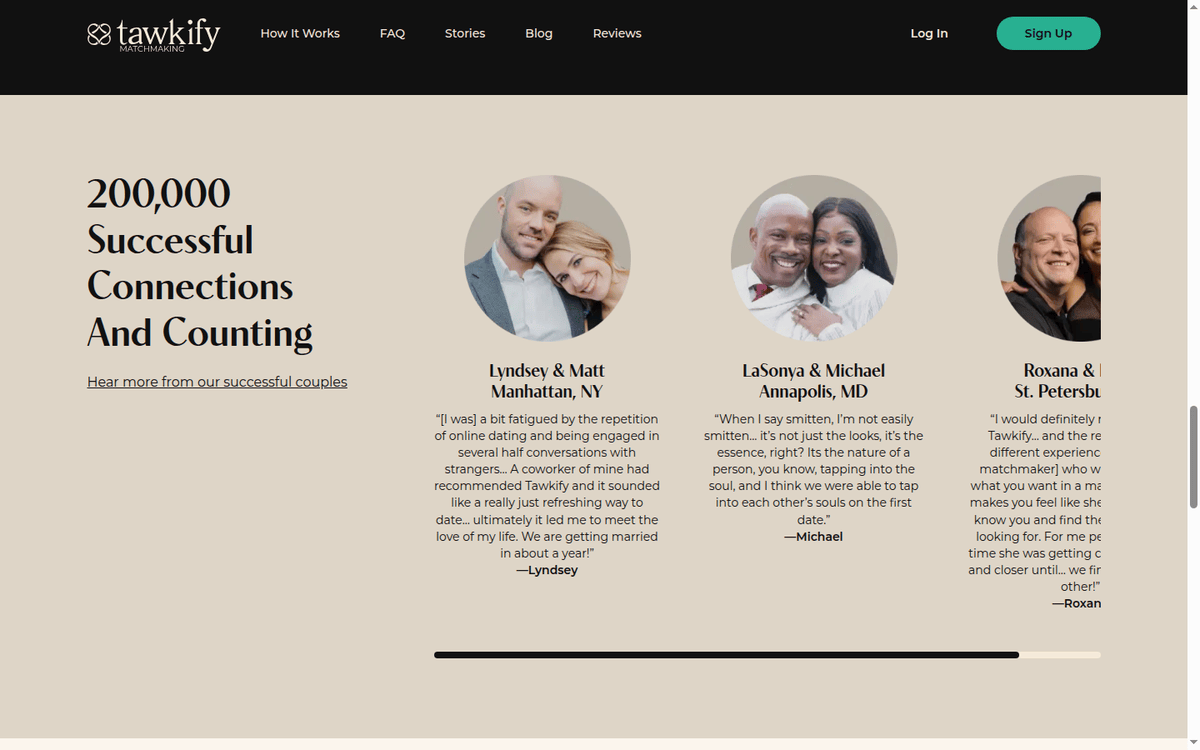
How we put this together: the three tier names, the screening standard, the tier feature table and the published results — 200,000 couples, the 3M+ candidate pool, the 92%+ satisfaction claim and the 6.5x figure — come from tawkify.com and tawkify.com/how-it-works, quoted as displayed and attributed to the vendor wherever they appear.
No price is published anywhere on either page: the intake survey is the entry point and the quote follows a call.
We have not bought a package, gone through the screening or measured a match rate, so the third-party price ranges in the text stay labeled as third-party.
Figures that depend on a real workload, a real target or a real integration are flagged where they appear in the text rather than being estimated.
Disclosure: this article contains affiliate links. If you buy through them we may earn a commission at no extra cost to you. Commission never changes our scoring or the order of a ranking.