- Three plans sit on the lifetime model — Standard, Pro+ and Enterprise — and only Standard is a true one-time purchase.
- Pro+ and Ultimate carry a renewal from year two, which the lifetime label does not spell out.
- ThriveCart takes no cut of your sales; the payment processor still does.
- The refund window is short, and the free trial only exists on the monthly plans.
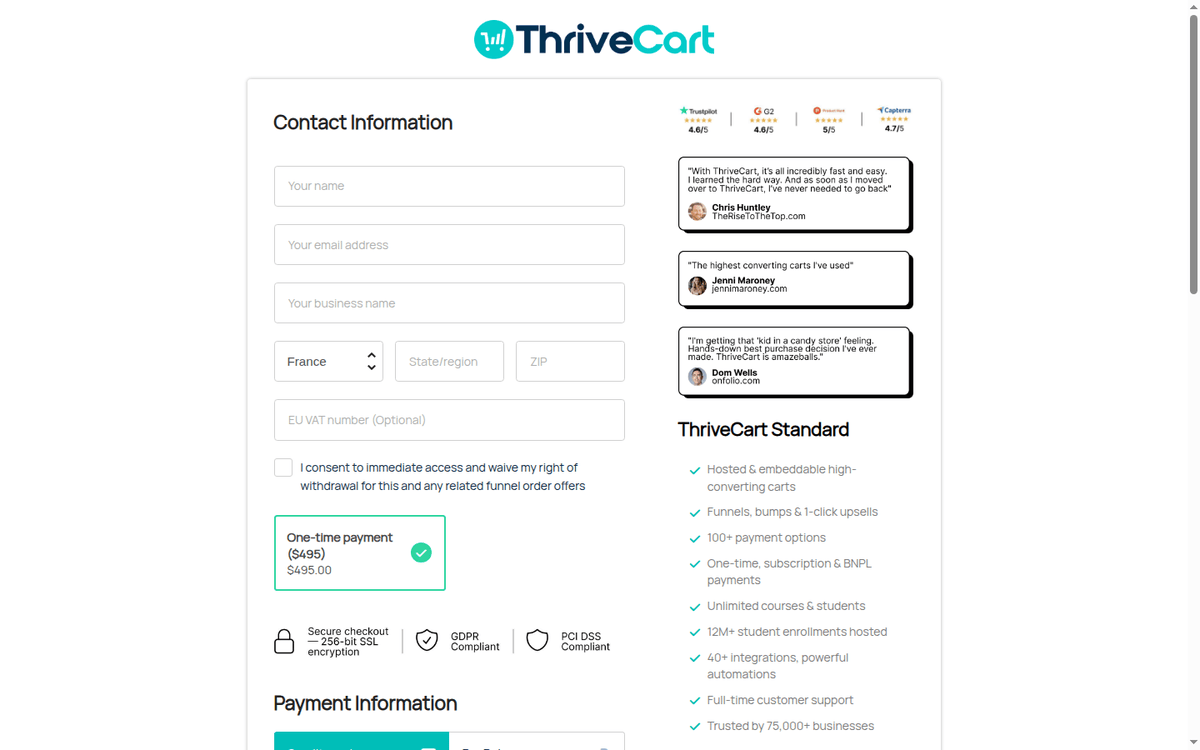
ThriveCart built its reputation on a lifetime license. From roughly 2017 through mid-2026, a one-time payment bought you access to the checkout and funnel stack — no monthly bill, no usage meter.
That pitch was the reason ThriveCart ended up behind tens of thousands of course funnels and creator businesses.
The company added monthly plans in 2026, the first time in its history. Both pricing models still coexist on the public pricing page, which is the source of most buyer confusion right now.
What ThriveCart actually sells
ThriveCart is a checkout and funnel platform. You build a product, plug in a payment processor, and ThriveCart handles the cart, the bumps, the upsells, the downsells, the affiliate payouts and the tax math.
It is positioned against three distinct categories that often get conflated:
- pure cart builders: SamCart, Payhip;
- all-in-one course platforms: Kajabi, Kartra, Teachable;
- funnel builders: ClickFunnels, GoHighLevel.
ThriveCart sits in the middle of those three — stronger on checkout economics than Kajabi, weaker on hosted courses than Teachable, and not as full-funnel as ClickFunnels.
The 2026 product surface splits into four areas. The checkout engine — modal, single-page and multistep layouts with branded customization — is the core. Funnels add bumps, one-click upsells and downsells, prorated payments and access rules.
Subscriptions handle trials, renewals, upgrades and cancellations on autopilot. Affiliates run with automated revenue splits, payouts and JV contracts. Everything is built around Stripe and PayPal as the payment rails, with 100+ direct integrations on top (thrivecart.com, captured recently).
The ThriveCart Academy (course and community hosting) sits inside every plan at a tier-appropriate level. Standard comes with the Starter Academy plan at up to 2,000 community members, 100 GB of video storage and 1080p HD streaming; Pro+ adds Growth Academy at up to 10,000 members, 500 GB and custom domains.
Scale Academy — unlimited members, unlimited communities, 4K streaming and white-label branding — is listed against Enterprise, not against a lifetime tier.
How the lifetime pricing ladder breaks down
The lifetime ladder, priced from the checkouts where the vendor publishes a number:
| Plan | Upfront | Renewal | Headline features |
|---|---|---|---|
| Standard | $495 one-time | None | Customized checkout, unlimited products, 1 bump, 1-click upsells/downsells, A/B testing, abandon cart recovery, Learn, 100+ countries, 100+ integrations |
| Pro+ | $790 year 1 | $295/year from year 2 | Adds multiple bumps, crypto payments, tax-inclusive pricing, affiliate center, JV contracts, custom domains, BI reporting, multi-user permissions |
| Ultimate | $985 year 1 | $295/year from year 2 | Adds the Learn+ course features: bundles, student import, advanced course rules, course analytics |
| Enterprise | Custom | Negotiated | Volume-based processing rates, unlimited team seats, multi-brand/marketplace support, custom API, headless for platforms, SLAs |
The pattern that catches first-time buyers is that only Standard is truly one-time. Pro+ and Ultimate are nominally “lifetime” in marketing copy, but the help docs and the third-party pricing guides both tie them to an annual renewal from year 2.
Anyone pricing out a three-year comparison needs to include that $295/year line item for Pro+ or Ultimate (revenuegeeks.com, captured recently).
Over three years, the math is roughly: Standard $495, Pro+ $790 + 2×$295 = $1,380, Ultimate $985 + 2×$295 = $1,575. Standard is the cheapest path if you only need the cart stack. Pro+ is the break-even if affiliates, dunning, or BI reporting matter. Ultimate only pays off if Learn+ features are central to your course model from day one.
The monthly layer added in 2026
ThriveCart added monthly subscription pricing for the first time in 2026, ending roughly seven years of lifetime-only sales. As reported on third-party comparison sites:
| Plan | Monthly billing | Annual billing |
|---|---|---|
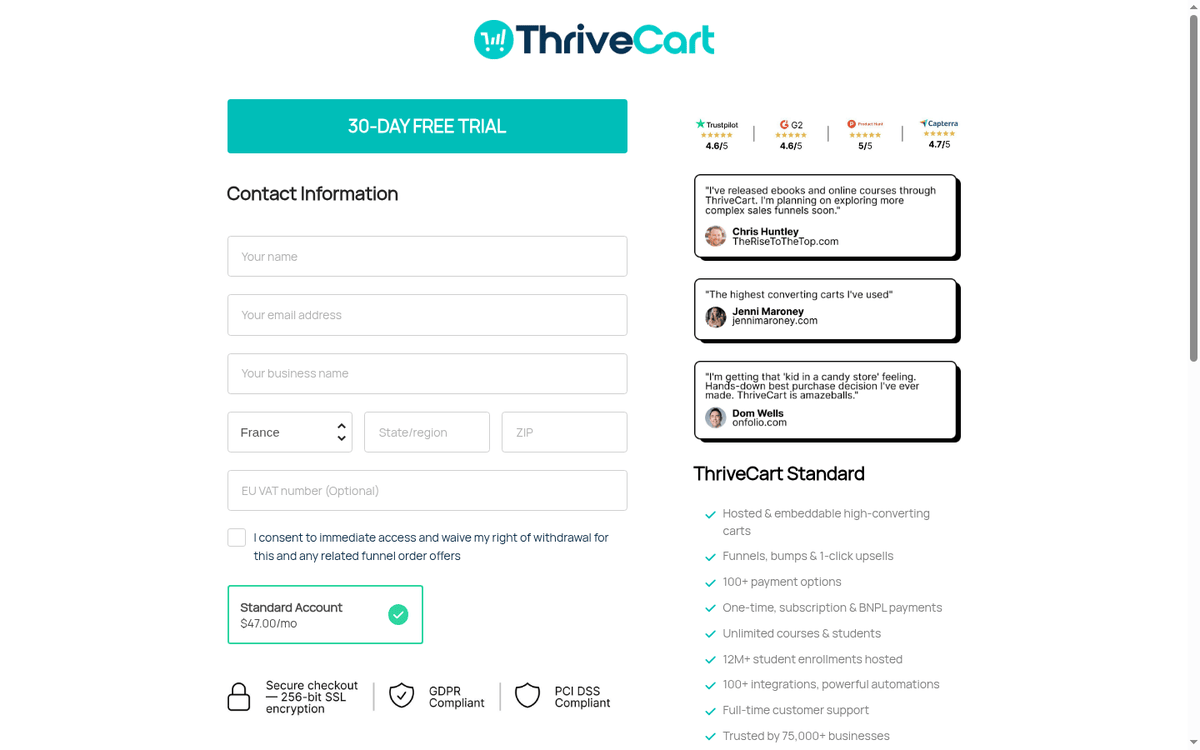
| Standard | $47/mo | $37/mo (annual commitment) |
| Pro+ | $87/mo | $67/mo (annual commitment) |
These prices are also visible in the vendor’s own checkouts — the homepage CTA currently reads “Start Your 30-Day Free Trial” pointing at a Standard monthly plan.
The live grid now lists three plans — Standard, Pro+ and Enterprise — with no numbers printed on it, so a buyer who wants a lifetime figure has to click through to the cart to see it (ruzuku.com, captured recently).
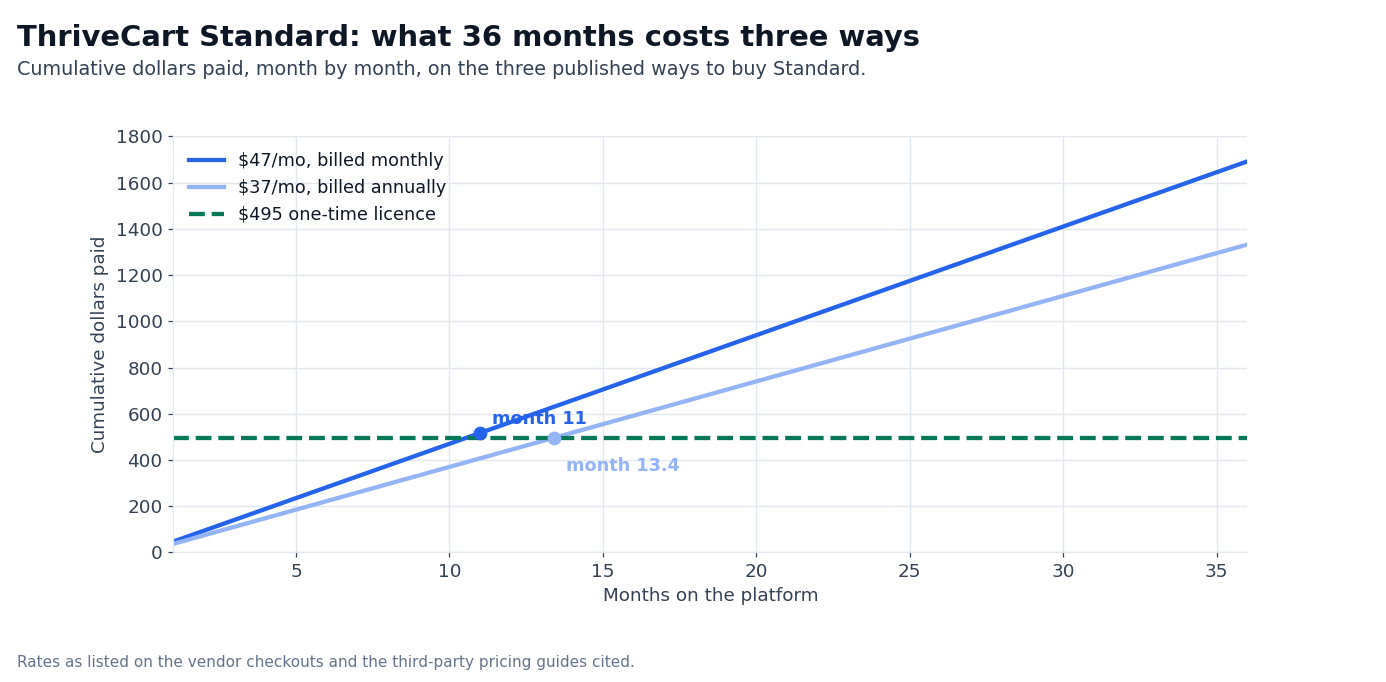
For a one-year horizon, Standard monthly ($444-$564/yr) is now slightly more expensive than Standard lifetime ($495 one-time). The crossover is at month 11 for monthly-billed Standard and month 13.4 for annual-billed Standard.
For Pro+, monthly ($804-$1,044/yr) overtakes the lifetime Pro+ ($790 year 1) at month 12 of monthly billing; the lifetime Pro+ renewal ($295/yr) makes the lifetime tier cheaper again from year 2 onwards.
The point of the monthly layer is to lower the upfront commitment for new sellers who do not yet trust the platform enough to pay $495-$985 on a credit card. For sellers with predictable revenue, the lifetime tier is still meaningfully cheaper over any horizon longer than 11 months.
What the feature gap between Standard and Pro+ actually means
Standard already covers the core cart stack. The reason Pro+ exists is the affiliate center — automated payouts, JV contracts, revenue splits — plus the operational layer of multiple bumps instead of one, crypto payments, tax-inclusive pricing, custom domains and BI reporting.
For a single creator selling one product, Standard is enough. For a multi-product operation with affiliates, dunning and reporting needs, Pro+ is the floor.
Three Pro+ features that move the bill in practice:
- Multiple order bumps. Standard limits you to one bump per funnel. Pro+ adds several. ThriveCart’s published benchmark puts average-order-value lift at 30% with a second bump.
- Affiliate center. This is the dealbreaker for affiliate-heavy funnels. Without Pro+, you cannot run automated payouts or JV contracts inside ThriveCart.
- Subscription dunning and analytics. Standard handles subscriptions on autopilot, but does not surface failed-payment recovery or per-funnel subscription comparisons. Pro+ does.
Ultimate is a smaller step than the Standard → Pro+ gap. The only meaningful difference is Learn+: bundles, student import, advanced course rules and course analytics. If your business is mostly checkout plus affiliates, Ultimate is hard to justify over Pro+.
What ThriveCart charges and does not charge
The “0% fees on sales” badge on the pricing cards refers to ThriveCart’s own fee, not the payment-processor fee. Stripe and PayPal charge their normal rates on every transaction ThriveCart processes; ThriveCart takes nothing on top.
That is a real advantage over platforms that fold their own per-transaction cut into the sale price — the fee then lands on top of the processor’s rate instead of beside it.
ThriveCart’s own fee is zero. The full sale amount minus processor fees minus any affiliate splits lands in your account.
Where the real costs hide is the renewal. A buyer who pays $985 for Ultimate expecting a one-time purchase gets a $295 invoice in year 2. The official terms allow a 7-day refund window from the original purchase date — longer than that, the deal is done.
When ThriveCart is the right call
A real fit when you are a course creator, info seller or digital product operator with a clear product line and predictable volume. The platform fits sellers who run one main funnel with bumps and one-click upsells.
It also fits sellers who either run an affiliate program — in which case Pro+ is mandatory — or are happy with the Standard cart stack plus a separate affiliate tool.
Members running a membership-heavy course platform will find ThriveCart Academy functional but not best-in-class compared to Teachable or Kajabi.
The wrong fit for hosted course platforms with deep community features (Kajabi, Thinkific), for sellers who need landing-page building beyond checkout pages (ClickFunnels, GoHighLevel), or for businesses whose entire model depends on a free trial of the platform itself (ThriveCart’s monthly free trial exists, but the lifetime plans do not refund after 7 days).
How ThriveCart compares on price
| Tool | Lifetime / one-time | Annual entry | Notes |
|---|---|---|---|
| ThriveCart Standard | $495 | $444-$564 (monthly plans) | 0% ThriveCart fee; Stripe/PayPal rates apply |
| ThriveCart Pro+ | $790 + $295/yr | $804-$1,044 | Adds affiliates, dunning, BI reporting |
| SamCart | — | CORE from $79/mo | Advertises no added fees on SamPay |
| ClickFunnels | — | Launch $97/mo, or $81/mo on yearly billing | Funnel builder, weaker checkout economics |
ThriveCart wins on lifetime math for sellers who stay past 11 months. It loses on hosted course depth (Kajabi, Thinkific) and on funnel-page visual control (ClickFunnels). The right comparison depends on which feature you actually use.
FAQ
Is ThriveCart really a one-time payment?
For Standard, yes. For Pro+ and Ultimate, the upfront is one-time, but there is an annual renewal ($295/year from year 2). The “lifetime” label in marketing copy is shorthand for “lifetime of the product, with annual maintenance fees on the advanced tiers.”
Does ThriveCart have a free trial?
Yes — a 30-day free trial is offered on the monthly plans via the homepage CTA. The lifetime plans do not have a public free trial; the official buyer-protection layer is a 7-day refund window per the published terms.
What does 0% fees on sales actually mean?
ThriveCart charges 0% on top of your sales. Stripe, PayPal, and other processors still charge their normal rates. The 0% badge is real, but it does not eliminate payment-processing fees.
Can I host courses inside ThriveCart?
Yes — every plan includes ThriveCart Academy at a tier-appropriate level. Standard comes with Starter — 2,000 community members, 100 GB video storage, 1080p HD; Pro+ adds Growth — 10,000 members, 500 GB, custom domains. Scale — unlimited members, 4K streaming, white-label — is listed against Enterprise.
What is the refund policy?
Refund requests must be submitted within 7 days of original purchase per official terms. After 7 days, no refunds.
Sources
- ThriveCart pricing (official homepage) — captured recently
- RevenueGeeks ThriveCart pricing breakdown — captured recently
- Ruzuku ThriveCart pricing comparison (monthly plans added in 2026) — captured recently
How we put this together: the Standard and Pro+ lifetime prices, the monthly rates and the 30-day trial come from the vendor’s own checkout pages, quoted as displayed, with the Ultimate figure, the 7-day refund window and the annual-billing comparison read from the third-party guides the article names and marked as such in the text.
The live pricing grid publishes no numbers at all, so where a figure comes from a checkout or a third party the article says so.
We have not bought a license, run a funnel through the cart or tested the Academy tiers, so anything that depends on your own volume stays flagged where it appears.
Figures that depend on a real workload, a real target or a real integration are flagged where they appear in the text rather than being estimated.
Disclosure: this article contains affiliate links. If you buy through them we may earn a commission at no extra cost to you. Commission never changes our scoring or the order of a ranking.