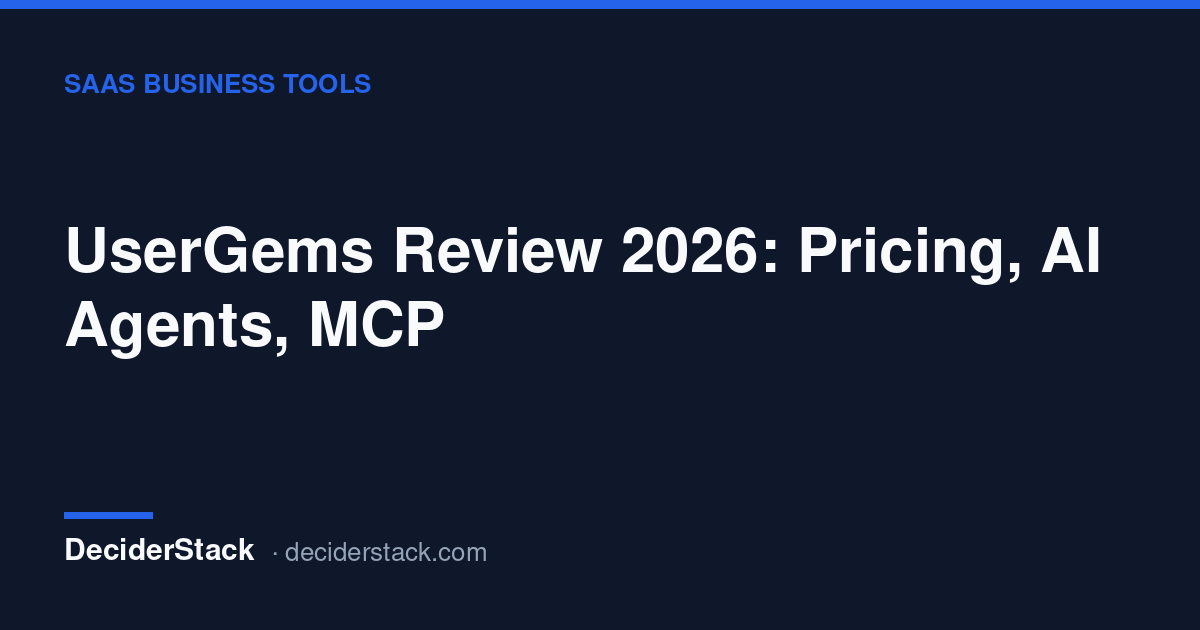
Results guaranteed — Money back if you don’t get ROI in closed-won revenue.
— the guarantee as published on usergems.com/pricing
UserGems is an AI-driven outbound and ABM platform that mines past customers, churned accounts, and stalled deals from your CRM to surface new leads. The published pricing is unusual: three annual tiers, all of which include the same feature set and unlimited users.
Tiers three, billed annually
Features the same on all three
Users unlimited
What changes credit volume and TAM coverage
Guarantee money back if the platform does not produce closed-won ROI
The tiers differ in credit volume and TAM coverage, not in feature gating. UserGems also publishes a money-back guarantee: if the platform does not produce ROI in closed-won revenue, the contract is refundable. We read the pricing page, the homepage, and the published credit math to map what each tier actually buys.
The three published tiers, in one table
The pricing page publishes three annual tiers with the same feature set. Numbers are USD (usergems.com/pricing).
| Tier | Annual price | Credits | Data actions | AI actions | TAM coverage | Users |
|---|---|---|---|---|---|---|
| Core | $40,000/yr | 4,000,000 | 40K | 400K | 2–4K accounts | Unlimited |
| Advanced | $75,000/yr | 10,000,000 | 100K | 1M | 4–10K accounts | Unlimited |
| Elite | $150,000/yr | 25,000,000 | 250K | 2.5M | 10K+ accounts | Unlimited |
Three things matter beyond the headline price:
- Features do not gate by tier. Every published tier includes the same thirteen features — the only thing that changes between Core, Advanced, and Elite is credits and TAM. This is unusual in the ABM / outbound category, where most vendors lock features behind tier.
- Credits are a blended budget. Each credit converts to either a data action or an AI action. Core’s 4M credits = 40K data actions OR 400K AI actions; you cannot do 40K data actions AND 400K AI actions with the same credit pool.
- TAM is a coverage number, not a hard cap. The pricing page describes TAM coverage as a sizing range per tier — Core covers 2–4K accounts, Elite covers 10K+. Actual coverage depends on the segment definitions in your CRM.
The pricing page does not document what happens when credits run out mid-cycle. Overage, rollover, and top-up pricing are sales-led.
How the credit math breaks down in practice
UserGems publishes two credit consumption modes — data actions and AI actions — with a 10:1 ratio. A data action is a CRM record touch: creating, enriching, scoring. An AI action is a model-driven operation — writing personalized copy, generating research summaries, classifying intent.
The published credit math, restated:
| Tier | Credits | Data actions | AI actions | Effective cost per data action | Effective cost per AI action |
|---|---|---|---|---|---|
| Core | 4,000,000 | 40K | 400K | $1.00 | $0.10 |
| Advanced | 10,000,000 | 100K | 1M | $0.75 | $0.075 |
| Elite | 25,000,000 | 250K | 2.5M | $0.60 | $0.06 |
The per-action cost drops at each tier. Elite is the most efficient on a per-action basis. The pricing page does not document what happens when you mix data and AI actions in the same period — the published framing is “X data actions OR Y AI actions,” not a ratio.
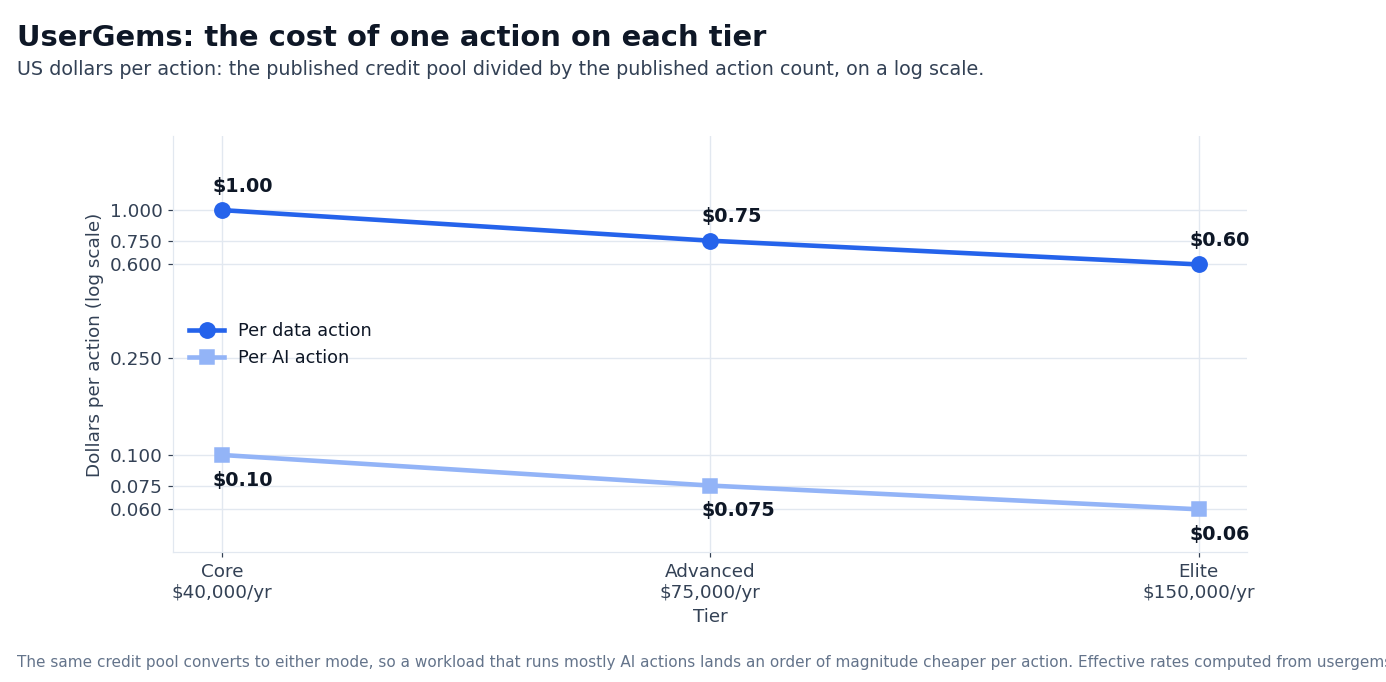
For a workload that runs mostly data actions (CRM enrichment, scoring), Core at $1.00/data action is the entry math. For a workload that runs mostly AI actions (writing personalized outbound copy at scale), Elite at $0.06/AI action is the published efficiency floor.
What is not published:
- The mix ratio. The pricing page treats it as “OR” rather than “AND.”
- Whether unused credits roll over.
- The overage rate above the published credit allocation.
- Whether the AI Co-pilot Chrome Extension consumes credits or is included separately.
What the feature table actually checks
The pricing page publishes a feature table where every row is checked across Core, Advanced, and Elite. Ten of the rows are (usergems.com/pricing):
- Build List (create & enrich) — generate a target account list from your CRM signals.
- Account & Contact Scoring — score accounts and contacts based on fit and intent signals.
- Automated Campaigns — trigger outbound sequences from scored signals.
- Writing Agent — AI-generated personalized copy for outbound.
- Research Agent — AI-generated account and contact research.
- AI Co-pilot Chrome Extension — browser extension for prospecting workflows.
- Reporting & Analytics — campaign performance and pipeline reporting.
- UserGems MCP — MCP server for connecting UserGems to other AI workflows.
- Ad Audience Sync — push scored audiences to ad platforms.
- Calendar Capture — capture meetings from connected calendars.
The table carries three more rows beyond those ten — Contact-level Intent & Web Deanonymization, Buying Stages and CRM Hygiene — all checked across every tier.
The MCP server is the published technical differentiator: it lets you wire UserGems signals into Claude, Cursor, or any other MCP-aware agent. The pricing page lists MCP as in-plan on every tier, which means it is not a feature you unlock by upgrading.
The Writing Agent and Research Agent are the AI-driven workflow primitives. They consume credits against the published budget. We did not benchmark the Writing Agent’s output quality against a human SDR; the published pricing does not promise a quality bar.
The money-back guarantee, in plain language
The pricing page leads with the line “Results guaranteed — Money back if you don’t get ROI in closed-won revenue” (usergems.com/pricing). The phrasing is on the landing copy and is repeated in the section heading.
The published language:
- The guarantee covers closed-won revenue.
- ROI is the metric, not “we tried it for a quarter.”
- The refund path is implicit — pricing does not enumerate the claim procedure, time window, or evidence required.
What is not published:
- The contract length before the guarantee can be claimed (30 days? One quarter? Year one?).
- Whether the guarantee applies to all three tiers or only specific ones.
- Whether the refund is pro-rated or full.
- The dispute or evidence procedure if UserGems believes ROI was achieved.
For a procurement team evaluating UserGems, the guarantee is the strongest published signal of confidence in the product. The fine print of how the guarantee is operationalized is part of the sales-led conversation, not the public pricing page.
How UserGems compares to 6sense, Demandbase, ZoomInfo, and Apollo
UserGems sits in the ABM / outbound category. The published positioning is “AI Command Center for Outbound and ABM” (usergems.com/) — the framing is an agentic workflow that learns from your CRM, not a pure data vendor.
| Tool | Primary positioning | Pricing model | Where it fits |
|---|---|---|---|
| UserGems | AI-driven outbound + ABM from CRM signals | Published $40K–$150K/yr | B2B teams that want AI agents on top of their own data |
| 6sense | Account intent + firmographic + ads | Sales-led annual contract | Enterprise ABM with multi-channel orchestration |
| Demandbase | ABM platform with advertising | Sales-led annual contract | Enterprises that want ads + intent in one contract |
| ZoomInfo | B2B contact and company data + intent | Sales-led with seat pricing | Sales teams that need direct dials + emails |
| Apollo | B2B database + outbound sequences | Freemium + paid tiers | SMBs that need contacts + sequencing at low cost |
UserGems’ published differentiation is the “past-customer / past-pipeline signal” model. The platform mines your CRM for people who moved jobs, accounts that churned, deals that stalled, and surfaces those as new leads. The AI agents (Writing, Research) compose outbound from those signals.
MCP support means the same signals are accessible to other AI workflows you run.
For a B2B sales team that already has 6sense for ads and ZoomInfo for contacts, UserGems is positioned as the missing layer that turns your own CRM history into a prospecting source.
UserGems vs Champify
The closest competitor in the category is Champify. It also starts from first-party relationships and sells job-change tracking instead of a purchased contact database, so the published pricing is where the two diverge most.
Champify publishes three plan cards (champify.io/pricing):
- Core — starting at $2,000/month. 15,000+ monitored contacts, the Salesforce package, unlimited users, a dedicated CSM.
- Pro — $3,000/month. 40,000+ contacts, InsiderAI nurture, 2,000+ accounts, custom playbooks.
- Enterprise — $6,000/month. 150,000+ contacts, 5,000+ accounts, CRM Clean for contact databases above 200,000 records.
The page also leads with a $500,000 ROI guarantee offered to all customers.
The entry cards measure different things, so a price-only comparison misleads. Champify’s Core counts 15,000 monitored contacts. UserGems’ Core counts 4,000,000 credits and a TAM of 2,000–4,000 accounts.
A team with a small but high-value book of past customers can start on Champify’s $2,000/month card and stay there. A team that plans to run the Writing and Research agents at volume spends UserGems credits as soon as the agents touch accounts.
The other published difference is what drives the bill. Champify prices monitored volume, so a small book of past customers is not penalized for being small. UserGems prices the credit pool and the coverage range, which rewards volume.
If both products do the job, the deciding question is what you are buying: contact and account monitoring from Champify, or the agent layer and MCP surface from UserGems.
UserGems vs Clay
Both Clay and UserGems sell to go-to-market teams and both price in credits. They start from opposite ends of the data problem. Clay is an orchestration layer that routes rows through a marketplace of third-party data providers and runs AI research over them. UserGems starts from the accounts the company already knows.
The published entry points sit far apart (clay.com/pricing):
- Free — 100 data credits and 500 actions a month, enough to test a waterfall on a small list.
- Launch — from $54/month billed annually ($60 monthly), 2,500 data credits and 15,000 actions a month.
- Growth — from $185/month billed annually ($205 monthly), and adds CRM sync, HTTP API calls, webhooks, and web intent signals.
- Enterprise — custom quote.
Clay sources its signals from the open web rather than from your CRM history: its Launch tier tracks job changes, promotions, new hires and company news, but the “past customer changed jobs” motion UserGems sells reads the records you already own, not a third-party feed.
What Clay adds is breadth: hundreds of providers, AI research agents, and a native MCP server — the same MCP surface UserGems now publishes.
For a team whose blocker is filling a list with verified emails and phone numbers, Clay‘s Launch card at $54/month billed annually sits far below UserGems’ $40,000/year Core. For a team whose blocker is knowing which past customers to chase, the cheaper tool does not answer the question.
UserGems alternatives: Champify, Clay, and the contact databases
A published Core entry of $40,000 a year puts UserGems out of reach for teams that want the motion without the contract. The alternatives fall into four groups.
- Champify — the closest like-for-like. First-party job-change tracking, from $2,000/month (champify.io/pricing). Pick it when you want the same motion with less software around it.
- Clay — the cheap front end of the same job. From $54/month billed annually, with hundreds of data providers and AI research agents, but no CRM-signal sourcing (clay.com/pricing). Pick it when your list needs filling more than your past customers need chasing.
- ZoomInfo and Apollo — the contact-database route. ZoomInfo sells seat-based enterprise contracts; Apollo sells a freemium database with sequencing. Pick either when direct dials and emails are the bottleneck, not CRM history.
- 6sense and Demandbase — enterprise ABM with advertising inside the contract. Pick them when the outbound motion has to include paid channels.
None of these is a drop-in replacement for the whole product. The credit pool, the MCP server, the money-back guarantee, and the agents that write from your own signals are UserGems’ published package, and the alternatives either price those pieces separately or do not publish them at all.
What we did not verify
The pricing page is the source for every number in this review. Items we did not confirm hands-on:
- The credit mix ratio when data and AI actions are used in the same period.
- Whether unused credits roll over across billing cycles.
- The contract length before the money-back guarantee can be claimed.
- The SOC 2 / GDPR posture and where customer data is stored.
- The Writing Agent’s quality on a sample outbound workload.
- The exact CRM integrations beyond the standard Salesforce/HubSpot sync.
What the CRM-signal model actually surfaces
UserGems’ differentiation from the rest of the ABM / outbound category is the signal source. The platform does not start with a third-party B2B database. It starts with your own CRM history (usergems.com/). The signal families the pricing page and the marketing site describe:
- Past customers. Accounts that bought from you previously and have moved jobs or changed employer. They are now warm prospects at a new company, with a known affinity for your product.
- Closed-lost deals. Accounts that stalled or were lost in earlier cycles. Re-introducing them with new messaging or a new product feature is a different motion from cold outbound.
- Stalled opportunities. Open deals that have gone quiet. Resurfacing them with a fresh signal is the next-best action for an SDR.
- Account changes. Companies that have grown, hired new leadership, or shifted tech stacks in the period since the last touch.
The AI agents — Writing and Research — compose outbound copy and account briefs from these signals. The MCP server exposes the same signals to other AI workflows. The combination is what makes UserGems feel closer to an agentic platform than to a B2B database.
For a B2B team whose CRM has three or more years of customer and deal history, the signal pool is rich enough for the published credit math to make sense. For a team whose CRM is younger than that, the per-action cost at Core ($1.00/data action) is harder to justify without enough signal to act on.
Who UserGems is for
Three profiles fit UserGems cleanly:
- B2B sales teams with a substantial CRM history. Core at $40K/yr is the published entry tier for teams with 2–4K accounts of TAM and a CRM full of past customers and stalled deals.
- B2B sales teams running outbound + ABM at scale. Advanced at $75K/yr covers 4–10K accounts and a million AI actions per year, which fits a team running personalized outbound at volume.
- Enterprise sales orgs with 10K+ target accounts. Elite at $150K/yr is the published tier for portfolio-scale ABM with credit headroom.
Three profiles should pass:
- SMB sales teams without CRM history. UserGems’ signal model needs a CRM full of past customers and stalled deals. A new CRM with little history will not surface enough signal to justify Core at $40K/yr.
- Sales teams that need contacts and dials. UserGems is positioned on CRM-signal-driven outbound. ZoomInfo or Apollo are the published options when direct contact data is the bottleneck.
- Teams that need an ABM platform with ads. 6sense and Demandbase bundle ads with intent. UserGems publishes Ad Audience Sync but the pricing page does not bundle ad spend.
Is UserGems worth the price tag? For a B2B sales team with a substantial CRM history, Core at $40K/yr is the published entry tier with a money-back guarantee. The credit math at $0.10/AI action and $1.00/data action is the published efficiency at Core. Advanced at $75K/yr drops the per-action cost.
Elite at $150K/yr is the published efficiency floor at $0.06/AI action.
FAQ
How much does UserGems cost?
Three published annual tiers: Core $40,000, Advanced $75,000, Elite $150,000. Enterprise is contact sales. All three tiers include the same feature set; the tiers differ in credits and TAM coverage (usergems.com/pricing).
Are there cheaper alternatives to UserGems?
On published prices, yes. Champify’s entry card starts at $2,000/month and Clay’s at $54/month billed annually, against UserGems’ $40,000/year Core. They answer different questions: Champify tracks first-party relationships, Clay fills lists from third-party providers.
Neither publishes the agent layer that UserGems includes on every tier.
Is there a free trial?
No. The published path is a sales-led POC. The pricing page also publishes a money-back guarantee on closed-won revenue ROI.
What is the money-back guarantee?
“Results guaranteed — Money back if you don’t get ROI in closed-won revenue.” Published on the pricing page. The fine print of the claim procedure is part of the sales conversation, not the public page.
What is the difference between Core, Advanced, and Elite?
Credits and TAM coverage. Core: 4M credits, 2–4K accounts. Advanced: 10M credits, 4–10K accounts. Elite: 25M credits, 10K+ accounts. Every other feature — Build List, Account Scoring, Writing Agent, Research Agent, MCP, Ad Audience Sync, Calendar Capture — is included on every tier.
What are data actions and AI actions?
Data actions are CRM record touches (creating, enriching, scoring). AI actions are model-driven operations (Writing Agent, Research Agent). The pricing page frames them as “OR” — 4M credits on Core = 40K data actions OR 400K AI actions, not both.
Does UserGems integrate with Salesforce?
Yes. The pricing page describes standard CRM sync with Salesforce and HubSpot. Specific integration depth is not documented on the public pricing page.
What is UserGems MCP?
A Model Context Protocol server that exposes UserGems signals to MCP-aware agents (Claude, Cursor, others). Included on every published tier.
How does UserGems compare to 6sense and Apollo?
UserGems is positioned on CRM-signal-driven outbound and ABM, with AI agents that write from your own data. 6sense is enterprise ABM with ads and orchestration. Apollo is contacts + sequencing at SMB price points. UserGems sits between them on both positioning and price.
Is UserGems SOC 2 compliant?
The pricing page does not publish a SOC 2 badge or compliance line. Compliance posture is part of the sales conversation.
Can I pay monthly instead of annually?
The pricing page publishes annual pricing. Monthly billing is not published. UserGems is sales-led for billing terms.
Sources
- UserGems pricing: https://usergems.com/pricing (captured 2026-09)
- UserGems home: https://usergems.com/ (captured 2026-09)
- Champify pricing: https://www.champify.io/pricing
- Clay pricing: https://www.clay.com/pricing
How we put this together: the three annual prices, the credit pools, the action ratios, the TAM ranges and the money-back guarantee come from usergems.com/pricing, quoted as displayed, with the Champify and Clay comparison figures read from champify.io/pricing and clay.com/pricing.
We have not run a POC, wired the MCP server into an agent or benchmarked the Writing Agent, so the operational numbers need a pilot of your own.
Figures that depend on a real workload, a real target or a real integration are flagged where they appear in the text rather than being estimated.
Disclosure: this article contains affiliate links. If you buy through them we may earn a commission at no extra cost to you. Commission never changes our scoring or the order of a ranking.