Lift AI runs on top of an existing B2B website and scores anonymous visitors in real time. The score is a buyer-intent probability — a number between zero and one that says how likely a given visitor is to convert, based on behavior patterns Lift AI has learned across its customer base.
Role buyer-intent scoring for anonymous visitors on an existing B2B site
Score a probability between zero and one that a visitor will convert
Entry Essentials — one integration, single website
Visitor cap 20,000 visitors a month on every published tier
Add-on Account Reveal, per website, with its own cap
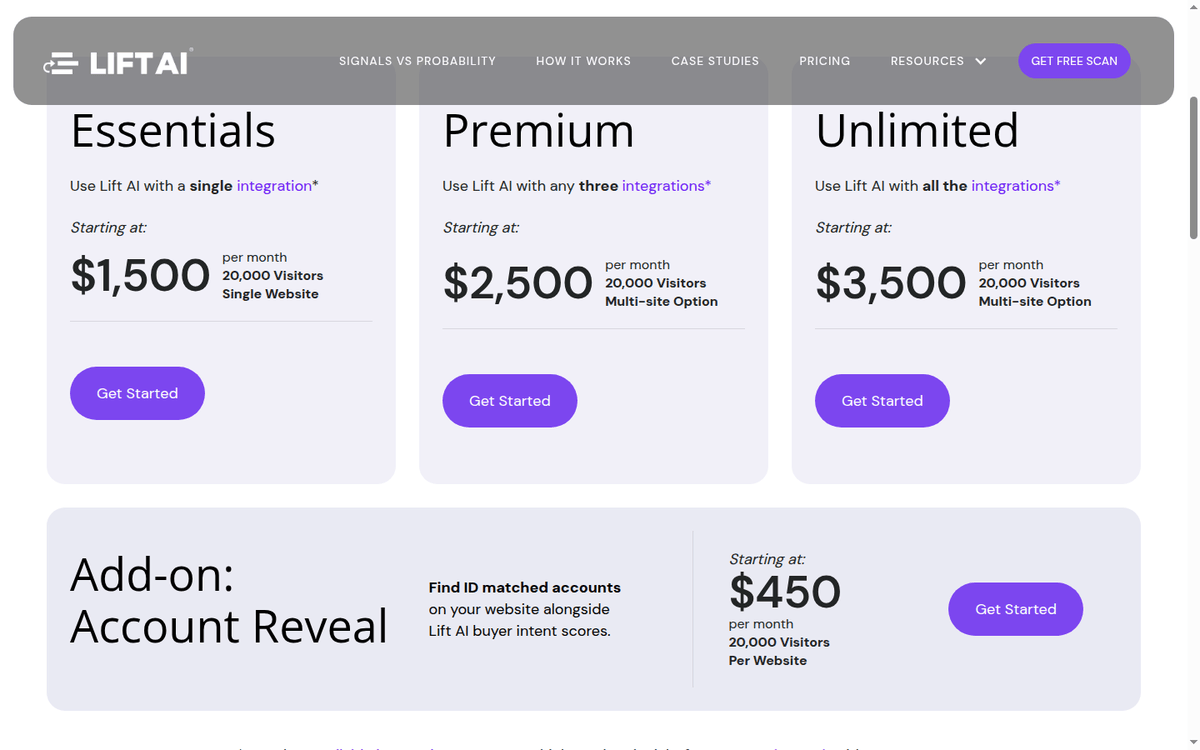
Pricing, the three published tiers
The numbers below are USD, monthly billing, taken from the public pricing page (lift-ai.com/pricing). Lift AI is sales-led for contract terms; these are the published starting prices.
| Tier | Monthly price | Visitors / mo | Integrations | Website |
|---|---|---|---|---|
| Essentials | from $1,500/mo | 20,000 | 1 | Single |
| Premium | from $2,500/mo | 20,000 | Up to 3 | Multi-site option |
| Unlimited | from $3,500/mo | 20,000 | All | Multi-site option |
The pricing page is laid out as a three-card grid with the prices visible. Three mechanics drive the math:
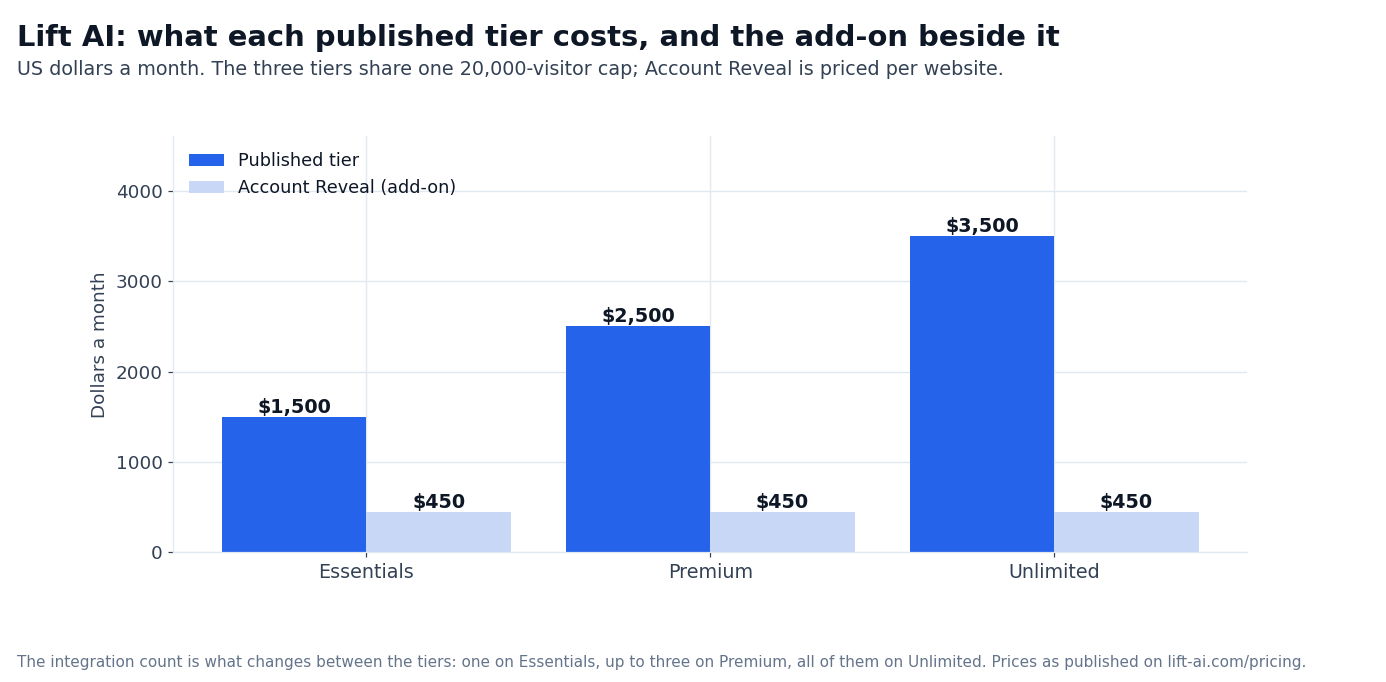
- Integration count scales the tier. Essentials allows one integration; Premium three; Unlimited all. The published integrations cover CRM, marketing automation and analytics destinations — HubSpot, Salesforce, GA4 and Marketo among them — and the pricing page points to the integrations page for the current list.
- The 20,000-visitor cap is uniform. All three base tiers include 20,000 visitors per month. The cap is per tier, not per integration. Overage is not published.
- Multi-site is a Premium-and-above option. Essentials is single-website; Premium and Unlimited add the multi-site option.
The pricing page also leads with a 27× ROI claim anchored to a Truckstop case study. The case-study numbers are vendor-published. We did not independently verify the lift on Truckstop’s pipeline.
The 20,000 visitor cap and what happens above it
Every published tier is capped at 20,000 visitors per month. The pricing page does not document an overage rate or an automatic upgrade trigger. The published cap is uniform across all three base tiers.
For a B2B site with low traffic but high visitor quality — typical for enterprise SaaS — 20,000 visitors per month is workable. For a B2B site in a broader category or with content marketing that pulls top-of-funnel traffic, 20,000 visitors per month is a budget that may not last the full month.
We did not find a published overage rate or a path to extend the cap without moving to the Account Reveal add-on.
The Account Reveal add-on is its own line item, priced at $450/mo per website with its own 20,000-visitor cap. Add-on can be combined with any of the three base tiers; the pricing page presents it as a stackable component.
Three things the pricing page does not document:
- Overage rates above 20,000 visitors per month.
- Whether the cap resets on a calendar-month or rolling-30-day basis.
- How multi-site on Premium and Unlimited aggregates across sites — does the 20,000 cap apply per site or to the account total?
If the contract terms you negotiate do not address overage, the math is “stay under the cap or upgrade to Enterprise.” Both paths require a sales conversation.
How integrations shape the tier choice
The pricing page ties the tier to the integration count, not to a feature list. Lift AI ships with a fixed capability set — real-time scoring, dashboard, alerts — and the integrations determine where the scores land.
The pricing page points to the integrations page (lift-ai.com/integrations) for the current catalog. The published list covers CRM, marketing automation, and analytics:
- CRM — HubSpot, Salesforce.
- Marketing automation — Marketo and others.
- Analytics — Google Analytics 4.
The pricing page does not document the integration count exhaustively. The relevant constraint is the tier’s published limit: Essentials one integration, Premium up to three, Unlimited all available.
For a team that runs on HubSpot and Salesforce in parallel and wants scores landing in both, Essentials at $1,500/mo is not enough. Premium at $2,500/mo covers three integrations, which fits the HubSpot + Salesforce + GA4 stack.
Unlimited at $3,500/mo is the right tier if your stack stretches to marketing automation plus CRM plus analytics.
We did not enumerate the full integration catalog; the integrations page is the source.
The Account Reveal add-on and what it actually adds
Account Reveal is the published add-on for ID-matched accounts. The base Lift AI tiers score anonymous traffic — visitors arrive on your site without identifying themselves, and Lift AI assigns a buyer-intent probability.
Account Reveal layers account-level identity on top: when an IP matches a known company in the data provider’s catalog, Lift AI surfaces the company name alongside the buyer-intent score.
The pricing:
- $450/mo starting price per website
- 20,000 visitors/mo per website (separate cap from the base tier)
The published use case is B2B sales teams that want both the score and the company name on the same screen. Without Account Reveal, the score is the only output; with Account Reveal, the company domain is added.
What is not published:
- The data provider behind the account-matching. The pricing page points to the integrations page but does not name the firmographic source.
- Whether Account Reveal pricing scales with TAM (total addressable market) or is flat per website.
- Whether Account Reveal can be combined with all three base tiers or only specific ones.
For a B2B sales team running an ABM motion, the score + company name pairing is what makes the system actionable for SDRs. For a marketing team that already has its own IP-to-company enrichment — Clearbit Reveal, ZoomInfo, 6sense — the add-on may be redundant.
How Lift AI compares to 6sense, Demandbase, ZoomInfo, and Leadlander
Lift AI sits in the buyer-intent and ABM category. The published positioning is “real-time buyer-intent scoring on anonymous traffic” — closer to predictive analytics than to firmographic enrichment (lift-ai.com/).
| Tool | Primary positioning | Pricing model | Where it fits |
|---|---|---|---|
| Lift AI | Real-time scoring on anonymous traffic | Published tiers from $1,500/mo | B2B sites that want a score before form fill |
| 6sense | Account intent + firmographic enrichment | Sales-led annual contract | Enterprise ABM with multi-channel orchestration |
| Demandbase | ABM platform with advertising and intent | Sales-led annual contract | Enterprises that want ads + intent in one contract |
| ZoomInfo | B2B contact and company data + intent | Sales-led with seat pricing | Sales teams that need direct dials + emails |
| Leadlander | Visitor identification + lead scoring | Sales-led, lower price point | SMBs that want IP-to-company at low cost |
The published Lift AI tiers at $1,500–$3,500/mo place it above point-tool B2B SaaS and well below enterprise ABM platforms. The math works for a mid-market B2B SaaS that wants buyer-intent scoring without committing to a six-figure ABM contract.
For an enterprise ABM motion with multi-channel orchestration, 6sense or Demandbase are the published options. For sales teams that need contact data plus intent, ZoomInfo bundles both. Lift AI’s positioning is narrower: scoring on anonymous traffic, with the integration count as the tier driver.
What we did not verify
The pricing page is the source for every number in this review. Items we did not confirm hands-on:
- The exact overage rate above 20,000 visitors per month. None is published.
- Whether the visitor cap is per site or per account on Premium / Unlimited multi-site deployments.
- The full integration catalog and whether each integration counts toward the tier’s integration cap.
- The firmographic data provider behind Account Reveal.
- The 27× ROI claim anchored to the Truckstop case study.
- Whether the 30-day free trial requires a credit card on file.
What the buyer-intent score actually unlocks for an ABM team
Lift AI scores anonymous traffic in real time. For an ABM team, the practical question is what the score lets you do that you could not do without it. The published positioning on the homepage is “buyer probability scores for GTM teams.” Three workflows are common in this category (lift-ai.com/):
- Prioritized chat routing. When a high-score visitor lands on the site, route the conversation to a senior AE rather than a chatbot. Lift AI publishes an integration path into chat platforms through the integrations page.
- Sales alerting. When a high-score visitor hits a pricing page or a key product page, ping the account owner in Slack or by email. The alert triggers on a score threshold combined with page targeting.
- Account prioritization. When Account Reveal is stacked on top, the score + company name combo is what an SDR works from. Without the account identity, the score is the only signal.
The pricing page does not document how the score is computed or what model is behind it. The published positioning is “machine learning trained on Lift AI customer data,” which is the same general framing most intent-scoring vendors use.
If your team has its own scoring model already, the question is whether Lift AI’s output adds signal beyond what you already have.
For an ABM team that has no buyer-intent scoring today, Lift AI at Essentials ($1,500/mo) is the published entry point. For an ABM team that already has its own model, the lift has to be measured against the cost of the contract — and that measurement is the published 30-day free trial.
Who Lift AI is for
Three profiles fit Lift AI cleanly:
- Mid-market B2B SaaS with one CRM and a single website. Essentials at $1,500/mo is the entry tier for HubSpot-only or Salesforce-only stacks.
- B2B sales teams running on a HubSpot + Salesforce + GA4 stack. Premium at $2,500/mo covers three integrations and adds the multi-site option.
- B2B teams that need both buyer-intent scores and account names. Premium or Unlimited at $2,500–$3,500/mo plus Account Reveal at $450/mo per website is the published stack.
Three profiles should pass:
- Enterprise ABM with multi-channel orchestration. 6sense and Demandbase are the published options for ads + intent; Lift AI does not publish an ads component.
- Sales teams that need direct dials and emails. ZoomInfo bundles contact data with intent; Lift AI scores anonymous traffic but does not publish a contacts or dials feature.
- SMBs that need basic visitor identification at lower cost. Leadlander is the published option at a lower price point.
Is Lift AI worth the price tag? For a mid-market B2B SaaS that wants buyer-intent scoring on one website with a single integration, Essentials at $1,500/mo is a published starting price. The 20,000-visitor cap is the binding constraint for sites with broader top-of-funnel traffic.
The Account Reveal add-on at $450/mo per website is the published path to company-name visibility alongside the score.
FAQ
How much does Lift AI cost?
Three published monthly tiers: Essentials from $1,500, Premium from $2,500, Unlimited from $3,500. Every base tier is capped at 20,000 visitors/mo. Account Reveal is a $450/mo per website add-on with its own 20,000-visitor cap (lift-ai.com/pricing).
What does Lift AI actually do?
Real-time buyer-intent scoring on anonymous traffic to a B2B website. The output is a probability score between 0 and 1. The score can flow into CRM, marketing automation, or analytics destinations via integrations.
Is there a free trial?
Yes. Lift AI publishes a 30-day free trial with self-install instructions on lift-ai.com/trial-faq. The pricing page itself does not mention it — its own FAQ links out to the trial page instead.
What is the visitor cap?
20,000 visitors per month on every base tier. Account Reveal has its own 20,000-visitor cap per website. Overage rates are not published.
What is the difference between Essentials, Premium, and Unlimited?
Integration count and multi-site option. Essentials allows one integration on a single website. Premium allows up to three integrations with the multi-site option. Unlimited allows all available integrations with the multi-site option. Feature parity otherwise.
What is Account Reveal?
An add-on that layers ID-matched company names onto the buyer-intent score. $450/mo per website with its own 20,000-visitor cap. Combinable with any of the three base tiers.
How does Lift AI compare to 6sense and Demandbase?
Lift AI is positioned as real-time scoring on anonymous traffic. 6sense and Demandbase are enterprise ABM platforms with multi-channel orchestration (ads, intent, orchestration) at higher annual contract values. Lift AI’s published tiers ($1,500–$3,500/mo) sit below the ABM platform price band.
Does Lift AI integrate with HubSpot and Salesforce?
Yes. The pricing page points to the integrations page for the current catalog; HubSpot, Salesforce, Marketo, and GA4 are visible across the marketing site.
Is there a public API?
The pricing page does not document a public API. Integrations are described as “available integrations” with a link to the integrations page; the canonical path is through those connectors.
What is the Truckstop 27× ROI?
A vendor-published case study headline on the pricing page. We did not independently verify the methodology or the lift claim.
Sources
- Lift AI pricing: https://www.lift-ai.com/pricing (captured 2026-09)
- Lift AI integrations: https://www.lift-ai.com/integrations (captured 2026-09)
- Lift AI home: https://www.lift-ai.com/ (captured 2026-09)
How we put this together: the three tier prices, the 20,000-visitor cap, the integration counts and the Account Reveal add-on come from lift-ai.com/pricing, quoted as displayed, with the integration catalog read from lift-ai.com/integrations and the 30-day trial terms from lift-ai.com/trial-faq.
We have not run a scoring pilot on a live site, negotiated a contract or tested the Truckstop case study, so anything that depends on your own traffic stays flagged where it appears.
Figures that depend on a real workload, a real target or a real integration are flagged where they appear in the text rather than being estimated.
Disclosure: this article contains affiliate links. If you buy through them we may earn a commission at no extra cost to you. Commission never changes our scoring or the order of a ranking.