
Prospeo sells the record, not the seat — and the whole review turns on whether a credit budget beats a seat-and-unlimited contract.
- What it is — a credit-based contact-data and enrichment platform, with the plan ladder built around monthly credit volume and the CRM and MCP surfaces hanging off it.
- Where it fits — outbound teams and agencies that want verified emails and direct mobiles for cold outreach, with a credit budget instead of a seat-and-unlimited contract.
- Not the right tool — if you need a built-in sequencer, an ABM platform or a sales engagement suite. Outbound execution lives in Outreach, Lemlist, Clay or HubSpot, not here.
The four plans, the credit mechanic and the year-long cost at each tier are read off the vendor’s public pages (prospeo.io/pricing).
Prospeo positions itself as a credit-based B2B contact data provider: one verified business email costs one credit, a direct mobile costs ten, a company record costs one. That single rule is the entire pricing model. Everything else on the published plan ladder (filters, intent topics, AI features, CRM sync, MCP support) hangs off how many credits you buy each month or year.
This review is written for an outbound lead-gen buyer who has already decided that contact data is the missing piece. It is meant to answer three questions: is the platform cheaper than Apollo, are Lusha or Snov.io realistic substitutes at a similar budget, and where does the credit math quietly blow up a campaign.
We walk through the credit mechanic, the four published plans, the year-long cost at each tier, the workflow surface (API, MCP, CRM sync, Chrome extension), and the workloads where the tool is the wrong fit.
Pricing and product facts come from the public prospeo.io pages captured in September 2026. We did not purchase a plan; figures are read off the published pricing table, the /our-data page, and the /alternatives comparison statements.
Who Prospeo is really for
Prospeo is built for buyers who already know what they want to do with a verified email or a direct mobile number: drop it into Outreach or Lemlist, enrich a CRM record, push a list into HubSpot.
The product is a contact database with enrichment, signal filters (hiring trends, technographics, intent), and a public API — not a sequencer and not a deal-pipeline tool.
Three buyer shapes show up on the vendor’s own customer page: solo founders running outbound themselves, outbound agencies running campaigns for multiple clients, and sales teams of 5–50 reps.
The case studies published under prospeo.io/case-studies lean into that mix — Stack Optimize scaling to $1M ARR, Meritt tripling weekly pipeline without adding headcount, GreyScout doubling its sales team. These are not Fortune 500 logos with custom contracts; they are small and mid-market teams.
The data layer behind that pitch is, on the vendor’s own count, 300M+ profiles pulled from 800M+ raw records, with 125M+ mobile numbers. Accuracy is claimed at 98%, mobile connect rate at 30%. Source: prospeo.io/our-data. Those are vendor claims, not third-party measurements; we cover what we did and did not verify separately below.
If you are evaluating Prospeo against a tool like ZoomInfo or Cognism, the pitch is smaller-database-but-cheaper. Weekly refresh on the highest-intent records, roughly 30 days on the rest. The /alternatives page claims the platform is 90% cheaper than competitors, has 2x coverage, and produces 5x fewer bounces.
Those are vendor numbers and should be read as marketing until tested in your own campaign.
How credits actually behave
Every Prospeo plan is governed by the same credit rules. The FAQ on the pricing page lays them out plainly:
- Verified business email: 1 credit.
- Direct mobile number: 10 credits.
- Company record (full firmographic and tech stack): 1 credit.
- People exports: 1 credit per email found (0 if no email is found), with company data and 30+ firmographic data points included.
- Browsing and searching: free. Credits are only consumed when you actually reveal or export a contact.
- Rollover: none. Credits reset at the start of each billing cycle and unused credits expire.
- Add-on: 1,000 additional credits for $10, available on any plan from Account Settings → Billing.
- Cancellation: downgrades and cancellations take effect at the end of the current cycle; upgrades apply immediately and bill pro rata.
The mobile-to-email ratio is the single most important number. Direct mobiles are the highest-margin line item for any B2B database, and Prospeo charges 10x what it charges for an email.
A team that planned for $99/month on Growth and decides halfway through the month to pull mobiles for the top 100 accounts will burn 1,000 credits (10 × 100). That is one-fifth of the Growth monthly allowance in a single push.
Yearly billing behaves differently. All yearly credits are delivered upfront on day one of the subscription and reset only at the annual renewal date. The pricing page gives a worked example: a Yearly Pro plan bought at the start of a billing year grants 180,000 credits immediately (15,000 per month × 12).
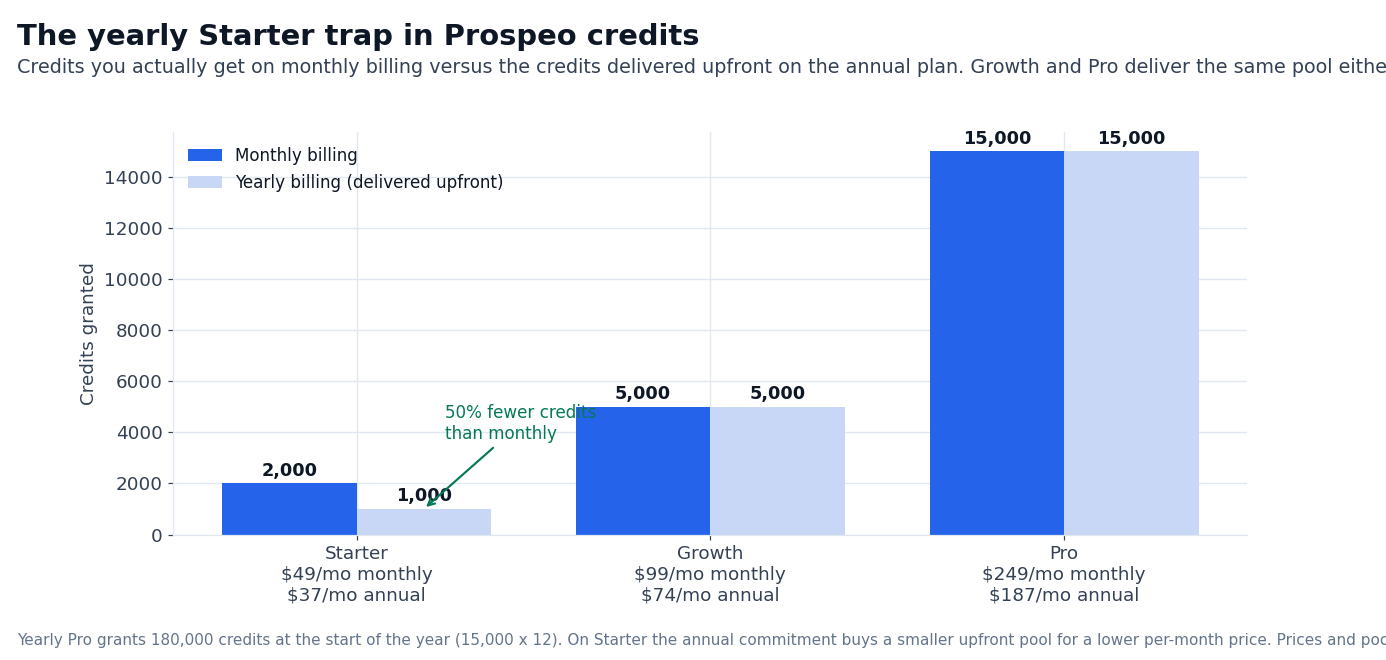
Those credits do not reset until the same date the following year. The annual model rewards teams that front-load a year of prospecting; teams with spiky usage patterns get punished by the lack of rollover on the monthly plans.
A second quirk worth flagging: people exports always include email enrichment by default. You cannot turn that off. If you only want a name and a title and explicitly do not want an email revealed, you still pay 1 credit per export.
Browsing and search previews are free, but the act of pulling a row into your list consumes credits even if you only intended to read the company description.
The price ladder, plan by plan
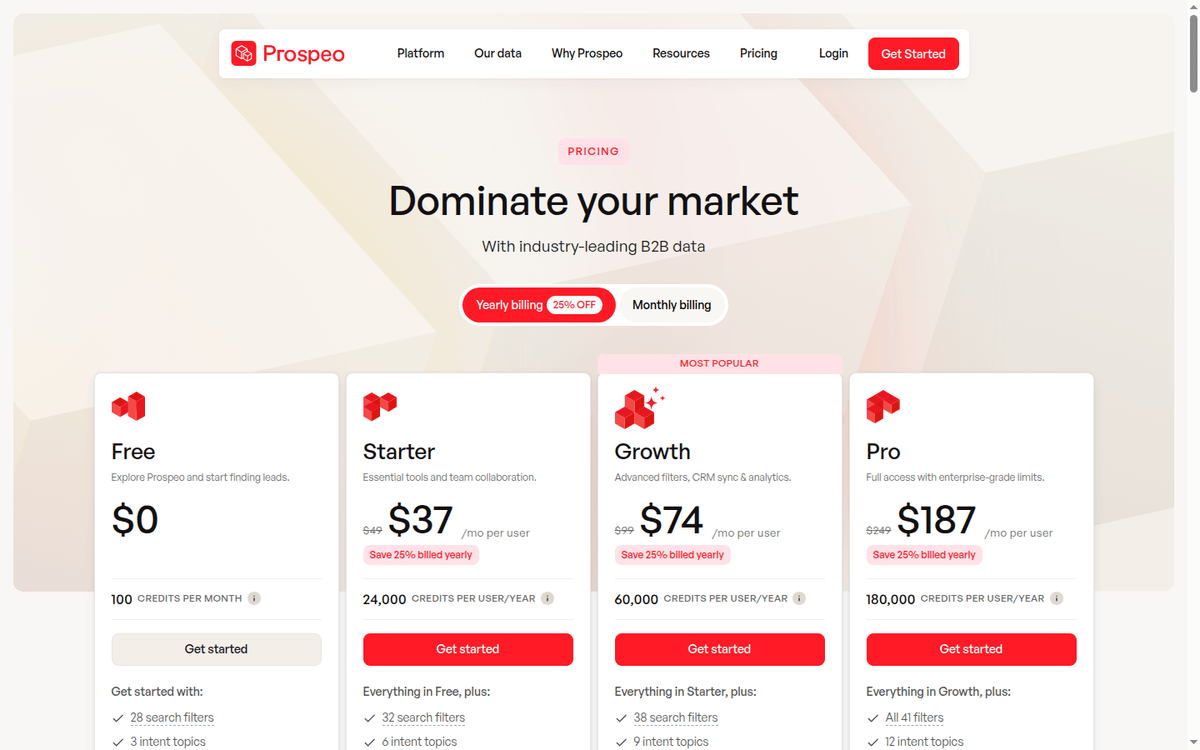
The published ladder has four plans. We pulled the table straight from prospeo.io/pricing in September 2026. The headline price you see on the landing cards is the yearly price; the monthly price sits to the right of each tier.
| Feature | Free | Starter | Growth | Pro |
|---|---|---|---|---|
| Monthly price | $0 | $49 | $99 | $249 |
| Yearly price (per user per month) | — | $37 | $74 | $187 |
| Monthly credits | 100 | 2,000 | 5,000 | 15,000 |
| Yearly credits delivered upfront | — | 1,000 | 5,000 | 15,000 |
| Search filters | 28 | 32 | 38 | All 41 |
| Max intent topics | 3 | 6 | 9 | 12 |
| Max row selection | 25 | 20,000 | 20,000 | 20,000 |
| AI Search | Yes | Yes | Yes | Yes |
| AI Lookalikes | 5 free searches | Unlimited | Unlimited | Unlimited |
| Personas | Yes | Yes | Yes | Yes |
| Chrome Extension | Yes | Yes | Yes | Yes |
| 50+ AI Data Fields | Yes | Yes | Yes | Yes |
| CSV & API Enrichment | — | Yes | Yes | Yes |
| Roles & Permissions | — | Yes | Yes | Yes |
| 2FA | — | Yes | Yes | Yes |
| Search Analytics | — | — | Yes | Yes |
| HubSpot & Salesforce sync | — | — | Yes | Yes |
| CRM Enrichment | — | — | Yes | Yes |
| Job Change Tracking | — | — | Yes | Yes |
| ICP Detection | — | — | Yes | Yes |
| Highest API rate limits | — | — | — | Yes |
| Enrich API rate limit (per min / hour / day) | No access | 5 / 300 / 2,000 | 5 / 300 / 5,000 | 30 / 1,800 / 500,000 |
| Search API rate limit (per min / hour / day) | No access | 1 / 30 / 1,000 | 2 / 60 / 4,000 | 5 / 180 / 250,000 |
Two details to call out:
- Yearly Starter is the trap on credits. The Free plan hands you 100 credits per month, but Starter on monthly billing gives you 2,000 — and Starter on yearly billing gives you only 1,000 delivered upfront. A solo founder who chooses annual Starter for the lower per-month price is signing up for a 50% smaller credit pool than the equivalent monthly plan. The savings ($144/year) come out of your prospecting budget.
- Pro is where the API ceiling opens up. The Enrich API rate limit on Pro (30 per minute, 1,800 per hour, 500,000 per day) is roughly 100x what Starter offers. If you are running enrichment through n8n, Clay, or a custom pipeline, the difference between Starter and Pro is the difference between a slow trickle and a real-time feed.
A yearly budget at each tier
A worked example helps. The numbers below assume a team that does mostly email outreach (1 credit per contact) and pulls a direct mobile on roughly 10% of those contacts (10 credits each). The mobile pull shifts the bill quickly.
| Plan | Yearly cost (one seat) | Yearly credits | Pure-email contacts | Mixed outreach (90% email, 10% mobile) |
|---|---|---|---|---|
| Free | $0 | 1,200 (100/month) | 1,200 | ~1,050 contacts |
| Starter (monthly) | $588 | 24,000 (2,000/month) | 24,000 | ~20,800 contacts |
| Starter (yearly) | $444 | 1,000 | 1,000 | ~870 contacts |
| Growth (monthly) | $1,188 | 60,000 (5,000/month) | 60,000 | ~52,200 contacts |
| Growth (yearly) | $888 | 5,000 | 5,000 | ~4,350 contacts |
| Pro (monthly) | $2,988 | 180,000 (15,000/month) | 180,000 | ~156,500 contacts |
| Pro (yearly) | $2,244 | 180,000 (delivered upfront) | 180,000 | ~156,500 contacts |
Three things to notice in this table.
- Annual plans are deeply front-loaded on email-only workloads. Because emails cost 1 credit and mobiles cost 10, the same yearly credit pack buys dramatically more pure-email contacts than mobile-heavy contacts. A team that needs both should budget for roughly 16 contacts per 25 credits consumed (assuming the 90/10 mix above), not 25 per 25.
- Mobile pulls dominate the bill. On the mixed-outreach column, the effective cost per contact is about 1.9 credits — not 1. That is the headline the published pricing page does not show, and it is the number an outbound lead should budget against.
- Yearly billing is not always cheaper at the credit level. Starter and Growth yearly plans deliver fewer upfront credits than their monthly equivalents. The price-per-month drops, but so does the total outreach volume. Pro is the only tier where yearly and monthly deliver the same 180,000 credits.
The workflow surface: API, MCP, CRM, sequencers
The published /integrations and /api pages name four native connectors plus a public API and an MCP server. The practical effect is that Prospeo is closer to a data layer than a workflow tool: it is meant to sit underneath something else.
- CRM sync. Growth and Pro plans offer native HubSpot and Salesforce sync, including CRM Enrichment, Deduplication, and a CRM Health Scan. Starter and Free plans do not. Anyone whose CRM is the system of record should plan for Growth at minimum.
- Sequencers and CSV. Every paid plan plugs into Clay, Zapier, Outreach, Lemlist, and CSV export. The Free plan also exports CSV, which makes it usable for one-off list pulls even without a paid seat.
- Public API. Every plan exposes a Search API and an Enrich API. Rate limits scale with plan tier (see table above). The API documentation lives at prospeo.io/api-docs; a separate MCP server is documented at prospeo.io/api-docs/mcp, which is a relatively rare offering among B2B data providers and matters for teams wiring the platform into Claude-based or n8n-based agent workflows.
- Chrome extension. Available on every plan, including Free. Useful for pulling a contact from LinkedIn or a company page mid-research without leaving the browser.
- Signal data. Hiring trends, technographics, and intent topics live behind the filter ladder. Intent topics cap at 3 (Free), 6 (Starter), 9 (Growth), and 12 (Pro).
The honest assessment: the integration story is good but not unique. Apollo, Lusha, and Snov.io all offer comparable native CRM sync and Zapier-style glue. The MCP server is a differentiator if you are running LLM-agent workflows — most competitors do not expose one. For everyone else, the integration question is “does it connect to my sequencer,” and the answer is yes.
Prospeo vs Apollo, Lusha, and Snov.io at the same budget
A direct price comparison is harder than it should be, because Apollo does not publish a public starter price (the apollo.io/pricing page hands you a free Starter plan forever, then hides everything else behind a sales conversation). Lusha and Snov.io publish transparent ladders.
The table below puts the published starter tier side by side. All numbers are read from each vendor’s pricing page in September 2026.
| Tool | Entry paid tier | Entry paid price (yearly) | Credits at entry tier | Free plan | Email credit cost |
|---|---|---|---|---|---|
| Prospeo | Starter | $37/mo per user | 1,000/year (yearly) or 2,000/month (monthly) | 100 credits/month | 1 credit |
| Lusha | Starter | $37.45/mo per user | 4,800/year (yearly) | 40 credits/month | 1 credit |
| Snov.io | Starter | $39/mo (annual) | 1,000 credits + 5,000 recipients + 3 warm-ups | Free trial (limits vary) | 1 credit |
| Apollo | Custom (sales) | Not published | Not published | Free Starter plan forever | Not published |
What the table hides:
- Lusha’s Starter delivers more credits than Prospeo’s for almost the same price. 4,800 vs 1,000 on yearly billing. That gap closes if you switch to monthly Starter billing (2,000/month, which is 24,000/year for $588 versus 4,800/year for Lusha at $449), but monthly is more expensive per month and Prospeo’s monthly price erases the Starter-tier discount.
- Snov.io’s Starter bundles warm-up and recipient tracking. That is a different product category — closer to a sales engagement suite than a database — so the 1,000 credits comparison understates what Snov.io is selling at $39.
- Apollo’s free-forever plan is the entry point most teams will actually try first. Apollo does not publish rates or credit costs; pricing requires a sales call. For teams who want a transparent credit economy on a published page, both Prospeo and Lusha are the cleaner comparison.
- Mobile credit cost is the same 5–10 credit range across vendors. Lusha publishes 5 credits per phone number on its pricing page; Prospeo publishes 10. Both are within striking distance of each other; Apollo does not publish this figure.
The honest summary: Prospeo’s pricing is competitive but not the cheapest in any single tier, and it is not the most expensive either. The case for choosing Prospeo over Lusha is the Chrome extension depth and the slightly larger claimed coverage; both vendors now document an MCP server. The case against is Lusha’s higher credit pool at the same entry price.
When the platform is the wrong call
Three buyer shapes that should look elsewhere.
If you want a built-in sequencer. Prospeo ships Clay, Zapier, Outreach, and Lemlist integrations, but no first-party email or call sequencer. Apollo, SalesLoft, and Outreach-as-a-platform all combine data and execution. For a team that wants to consolidate vendors, this platform is a data layer on top of those tools, not a substitute.
If your prospecting is heavy on direct dials. The 10-credit mobile cost is real. A team running 1,000 mobile dials per month on Growth is consuming 10,000 credits — twice the entire monthly allowance. Either budget up to Pro or pick a tool that prices mobiles closer to email. Lusha publishes 5 credits per phone, half Prospeo’s number.
If you need unlimited exports. Prospeo’s credit model is the product, not a limitation. Teams that want flat-rate, unlimited-email prospecting should evaluate Apollo’s unlimited plans or ZoomInfo’s seat contracts. The credit math rewards focused prospecting; it punishes bulk scraping.
There is also a quieter mismatch. Prospeo sells on the claim of “weekly refreshed data” for the highest-intent records and ~30 days for the broader dataset (source: prospeo.io/our-data).
Teams whose compliance or deliverability posture requires 7-day-or-better refresh across the entire database should validate that claim against their own sample, then decide whether an annual Pro contract is worth the risk.
What we did not verify
We did not purchase a Prospeo plan, run a sample campaign, or test the 98% accuracy or 30% mobile connect rate claims. Those numbers are vendor-side and come from prospeo.io/our-data and prospeo.io/.
Independent benchmarks on G2 and other review sites give the platform a 4.8 rating; we did not parse those reviews for verified-buyer filtering.
We did not verify the competitor-comparison claims on prospeo.io/alternatives (90% cheaper, 2x coverage, 5x fewer bounces). Those statements are vendor marketing and should be tested against your own sample of accounts before they enter a buying decision.
We did not test the MCP server end-to-end. The documentation exists at prospeo.io/api-docs/mcp, but no first-party benchmark of its rate limits or feature parity with the REST API is included in this review.
The case-study figures — Meritt $100K → $300K weekly pipeline, Stack Optimize $1M ARR, Snyk response rate from 0.9% to ~3% — are vendor-published and not independently audited. Source: prospeo.io/case-studies. Treat them as illustrations of how customers describe their own results, not as benchmarks for your campaign.
Pricing on the Prospeo page was live as of September 2026. Credits, plan limits, and intent topic caps may shift without notice. Re-check the published pricing page before locking in any annual contract.
A separate MCP server is documented at prospeo.io/api-docs/mcp.
Apollo bundles a built-in sequencer; Prospeo does not.
FAQ
How much does Prospeo cost per verified email?
1 credit. At the Starter yearly price ($37 per user per month, 1,000 credits delivered upfront), that works out to roughly $0.037 per email if you only pull emails and never touch mobiles.
Does Prospeo have a free plan?
Yes. The Free plan gives you 100 credits per month, 28 search filters, 3 intent topics, AI Search, 5 free AI Lookalikes searches, Personas, the Chrome extension, and 50+ AI data fields. No time limit. Source: prospeo.io/pricing.
Do Prospeo credits roll over?
No. Monthly credits reset on renewal; unused credits expire. Yearly credits are delivered upfront on day one of the subscription and reset at the annual renewal. There is no partial rollover between cycles. Source: same.
How much does a Prospeo mobile number cost?
10 credits per direct mobile number. The published pricing page does not distinguish between US and international mobiles; the cost is the same on every plan.
Can I add credits without upgrading my plan?
Yes. From Account Settings → Billing, you can purchase a Credits Add-on starting at 1,000 credits for $10. The credits are added immediately; your credit balance still resets at the next billing cycle. Source: same.
Does Prospeo integrate with HubSpot and Salesforce?
Native sync is available on Growth and Pro plans. Starter and Free plans do not include native CRM sync; they rely on Zapier, Clay, or CSV export. Source: same.
Is there a Prospeo API?
Yes, on every paid plan. Rate limits scale with plan tier — Starter gets 1 search per minute / 30 per hour / 1,000 per day on the Search API; Pro gets 5 per minute / 180 per hour / 250,000 per day. Documentation at prospeo.io/api-docs.
How does Prospeo compare to Apollo?
Apollo does not publish prices on its pricing page — paid plans require a sales call — and offers a free-forever Starter plan that is the actual entry point most teams try first. Prospeo publishes transparent credit pricing and a credit-based model, which makes cost forecasting easier.
How does Prospeo compare to Lusha?
Both publish credit-based pricing. Lusha’s Starter tier ($37.45 per user per month on yearly billing) delivers 4,800 credits per year; Prospeo’s Starter delivers 1,000 credits on yearly billing or 2,000 per month on monthly. Lusha charges 5 credits per mobile; Prospeo charges 10. Both vendors document an MCP server.
Does Prospeo allow canceling mid-cycle?
Downgrades and cancellations take effect at the end of the current billing cycle. Upgrades apply immediately with pro rata billing. Switching between monthly and yearly is instant. Source: prospeo.io/pricing.
Sources
- Prospeo pricing — plans, credit rules, FAQ, comparison claims. Captured September 2026.
- Prospeo homepage — user counts (40,000 users, 15,000+ companies), 4.8 G2 badge, 98% accuracy claim, 280M leads.
- Prospeo /our-data — 300M+ profiles, 800M+ raw, 125M+ mobiles, 5-step verification workflow, 7-day and ~30-day refresh rates.
- Prospeo /alternatives — vendor-published comparison statements (90% cheaper, 2x coverage, 5x fewer bounces).
- Prospeo /case-studies — Meritt, Stack Optimize, GreyScout, Snyk, Founder Led Sales customer stories.
- Prospeo API documentation — Search and Enrich API reference.
- Prospeo MCP documentation — MCP server endpoint and usage.
- Apollo pricing — Apollo credit model, fair-use policy, free-forever Starter plan. Captured September 2026.
- Lusha pricing — Lusha plan ladder, credit costs (1 per email, 5 per phone), yearly vs monthly billing.
- Snov.io pricing — Snov.io Sales Suite tier ladder, recipient-based pricing model.
How we put this together: plan prices on annual and monthly billing, the credit pools, the 1-credit email and 10-credit mobile rates, the add-on price and the API rate limits come from prospeo.io/pricing and the API documentation, quoted as displayed. We have not run a paid Prospeo account.
Figures that depend on a real workload, a real target or a real integration are flagged where they appear in the text rather than being estimated.
Disclosure: this article contains affiliate links. If you buy through them we may earn a commission at no extra cost to you. Commission never changes our scoring or the order of a ranking.