What works
- Voice, script, art, sound in one app
- Quota published on every tier
- Cloning uncapped above Basic
What to watch
- Grid from an archived copy
- No rollover, no overage rate
- Lifetime Plan outside the grid
Two quotas decide a LOVO bill: the hours of voice generation you use and the voices you clone. Everything else on the pricing page is sized around them.
The engine, the clones, the studio
Behind the name sit a hyperrealistic text-to-speech engine, an AI voice cloning product, and an “AI Content Suite” that bundles script generation, AI art and AI sound effects inside the same app. The product name inside LOVO is Genny, and the iOS/web app is built around it.
The home page calls itself “the award-winning AI Voice Generator” and claims 2,000,000+ users (lovo.ai).
Under the hood, the product is a single application, not a suite of separate tools. A Genny project contains the script, voice, music, subtitles and image layers; you can render a finished 1080p video without leaving the editor. Where it parts company with a pure TTS API like ElevenLabs is the editor around the voice.
- Auto Subtitle Generator with minutes budget. LOVO charges the Auto Subtitle feature against a monthly minutes allowance (120/180/300 per month on Basic/Pro/Pro+). Pure TTS vendors do not have this surface at all.
- AI Art Generator and AI Sound Effect generators. Content-generation features inside the same workspace as the voiceover, closer in kind to the AI image and design tools than to a text-to-speech API. ElevenLabs ships sound effects, music and image tools of its own; Murf has limited equivalents.
- Voice Cloning with unlimited quota on Pro and above. Basic is capped at 5 cloned voices; Pro and Pro+ lift that ceiling. ElevenLabs sells a fixed number of Professional Voice Clones per tier; Murf puts Custom Voice Clones behind an Enterprise add-on.
The pricing model is per user, billed monthly or annually. Annual billing cuts the per-month rate roughly in half on Pro and Pro+ during the launch discount window. The most expensive published line item is Pro+ at $149/mo annually; the cheapest paid line is Basic at $24/mo annually.
The tier grid, on one page
All numbers below come from the lovo.ai/pricing page, which was not serving when this review was written. The grid is quoted from the last archived copy of that page, so it is the last published shape of the ladder rather than a live reading.
The grid is in USD. Each card shows the annual-billing rate as the current price with the monthly rate struck through beside it, and the 50% first-year discount is layered on top of the annual price.
| Plan | Monthly (annual billing, full price) | Monthly (annual billing, 50% launch discount) | Voice Generation hours/mo | Voice Clones | Projects | Storage | Auto Subtitle min/mo |
|---|---|---|---|---|---|---|---|
| Basic | $24 | n/a (no discount) | 2 hr | 5 | 10 | 30 GB | 120 min |
| Pro | $48 | $24 (1st year) | 5 hr | Unlimited | 50 | 100 GB | 180 min |
| Pro+ | $149 | $75 (1st year) | 20 hr | Unlimited | Unlimited | 400 GB | 300 min |
| Enterprise | Quote | Quote | Custom | Custom | Custom | Custom | Custom |
The rates are the simple part. What moves the bill is set out in the terms that follow.
The 50% discount is a first-year number, not a permanent rate. The pricing page shows the full rate struck through beside a 50% OFF badge for the first year on annual billing. After renewal, Pro reverts to $48/mo and Pro+ reverts to $149/mo. The Basic tier is not part of the discount.
The Lifetime Plan is paid once and its feature list comes from a deal listing. The $477 tier sits outside the pricing grid the rest of this review is built on. So the published quota (5 hr of voice generation per month) is the number the deal listing carried rather than a term LOVO publishes.
The trial is a Pro trial, and it is not a published tier. LOVO advertises a 14-day trial of Pro with no credit card required. The published paid tiers start at Basic ($24/mo annually) and Pro ($48/mo annually or $24/mo first-year discounted).
Voice generation hours, decoded
LOVO’s central pricing unit is Voice Generation hours per month. Everything else — the clone quota, projects, storage, subtitles — is sized in proportion to it. What the hour converts to in production, and where it runs out, is the part worth pinning down.
One Voice Generation hour is roughly 12,000–15,000 words of synthesized speech. LOVO’s calculator on the pricing page estimates a 10-minute finished video at ~1,200 words of script. At that density, a single hour covers 5+ finished videos.
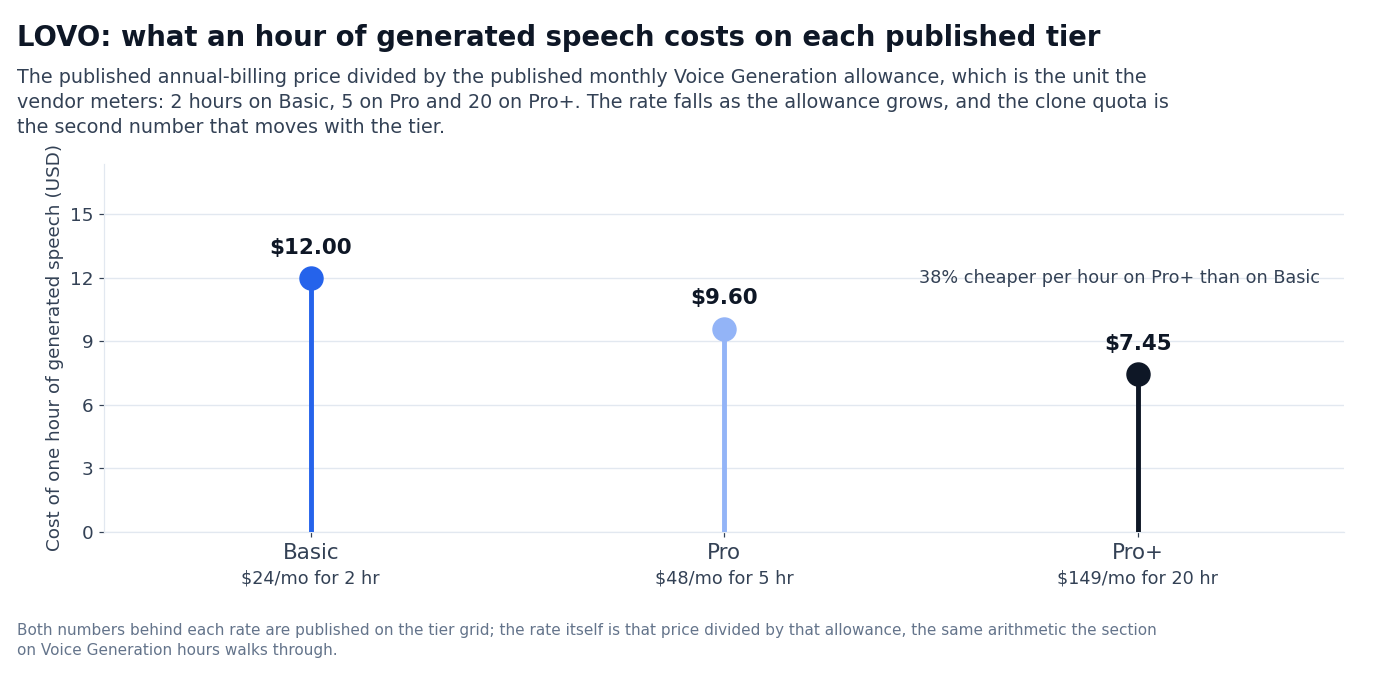
The Basic tier’s 2 hours/month is enough for one short explainer or social ad per week, not a daily content pipeline.
Generation hours do not roll over. The pricing page does not advertise a credit bank. Once the monthly quota runs out, the vendor’s own FAQ answers that you need to upgrade the subscription, and no overage rate is published.
Pro at 5 hours covers a small creator publishing weekly. Pro+ at 20 hours covers a small team producing daily content. Anything heavier is Enterprise by quote.
Generation hours are not the same as Audio Export hours. LOVO caps project length at 1 hour regardless of plan. A single 1-hour render consumes most of a Basic plan’s monthly Voice Generation quota and leaves very little room for revisions or alternative takes.
The honest answer on Voice Generation math: a Pro plan at $48/mo annually (or $24/mo first-year discounted) covers one creator producing roughly one 10-minute video per week with two to three revision rounds. Pro+ at $149/mo annually covers a small team of three to four creators producing daily social content with headroom for takes.
Basic is for evaluation only; the 2-hour ceiling runs out within a day of real production.
Lifetime deal: the one-time trap
LOVO has run a Lifetime Plan promotion at $477 paid once. The math and the caveats matter.
What you get. The deal listings describe:
- 5 hours of Voice Generation per month
- 500+ AI voices in 100+ languages
- unlimited voice cloning
- Auto Subtitles
- AI Script, Images and SFX
- team collaboration and API access
The archived pricing page carries no Lifetime tier at all.
What “lifetime” actually means. The listings do not define the term. In practice, “lifetime” in this kind of promotion means the lifetime of the product or the buyer’s account, whichever the vendor chooses. There is no contractual lifetime warranty.
The $477 price is not in the standing grid. The pricing page this review is built on never listed a Lifetime tier, and no archived campaign page carries it either. The price and the feature list come from third-party deal listings. Buyers should treat the promotion as time-limited and the feature set as fixed by the listing.
For anyone who produces less than 5 hours of voice per month and expects to stay on LOVO for 2+ years, the Lifetime Plan at $477 is cheaper than 12 months of Pro at $48/mo ($576/yr). That math holds only if LOVO’s “lifetime” outlasts the buyer’s patience with the platform.
LOVO’s terms allow a refund only within 24 hours of payment, while the deal listing promised a 30-day money-back guarantee.
Voice cloning math, free vs unlimited
Voice cloning is the second quota that decides real cost. How many voices you actually need is what separates a workable plan from an upgrade.
Basic caps cloning at 5 voices; Pro and above are unlimited. A creator who needs 6+ clones, one per character, language variant or project type, cannot stay on Basic. ElevenLabs sells a fixed number of Professional Voice Clones per tier rather than an unlimited quota, so the comparison is not 1:1.
Cloning puts the consent duty on the account holder. LOVO’s terms require the speaker behind a cloned voice to have given the “licenses, rights, consents, releases, and permissions” for it. The published pages do not describe a consent step inside the cloning flow, so the duty is contractual rather than a gate in the product.
For a creator producing branded audio content with one consistent narrator voice, Basic is enough. For a small studio producing localized audio across multiple regions or characters, Pro or Pro+ is the floor.
What the API actually exposes
LOVO has a developer-facing API, and the pricing page does not sell it as a product line the way ElevenLabs does. What the pricing page and the FAQ each say about access does not quite line up.
The API is priced nowhere on the page. The pricing page publishes no API rate limits, request ceilings or per-request pricing. The only plan card that names the API is the Enterprise one, under “API Support” beside its SLAs.
The vendor’s own FAQ answers that the LOVO API is available to all LOVO users — the two statements sit unreconciled on the same page.
Enterprise includes SLA-grade API support. The Enterprise card on the pricing page lists “API Support” alongside Service Level Agreements and dedicated onboarding. Smaller tiers get self-serve API access with no uptime guarantee.
No published API-only allowance. The pages describe one Voice Generation quota, with no API-only pool and no per-call price beside it.
For developers building TTS into a product, ElevenLabs is the stronger default. LOVO’s API works for batch generation and integration with internal tools, but the published quota and the per-request economics are less transparent than ElevenLabs’ credit-based model, where text to speech costs one credit per character.
How it sits beside ElevenLabs and Murf
LOVO competes in the AI voice market against the tools in the table below. The differentiators that come up most often are how much of the price grid the vendor publishes, the integrated AI Content Suite (script + art + sound), and the Lifetime Plan promotion.
| Tool | Published pricing grid | Voice Generation model | Voice Cloning | AI art + SFX | API | Best-fit signal |
|---|---|---|---|---|---|---|
| LOVO | Yes (USD) | Hours of generation per month | 5 on Basic, unlimited from Pro up | Yes (bundled) | Enterprise card only | Creators who want a one-stop voice + video suite |
| ElevenLabs | Yes (USD) | Credits per month, one credit per character for text to speech | Instant cloning from Starter up, fixed Professional clone slots on Scale and Business | Yes (sound effects, music, image and video) | Yes (all paid tiers) | Developers and product teams embedding TTS |
| Murf AI | Yes (USD) | Hours of voice generation per year | Custom Voice Clones as an Enterprise add-on | Limited | Yes (published per-character API price) | Enterprise narration and e-learning studios |
| Speechelo | Yes (one-time USD) | One-time | No cloning | No | No | One-off small projects, no subscription |
| WellSaid Labs | Yes (USD) | Downloaded minutes per year | Limited | No | Limited | Enterprise brand voice at scale |
| Amazon Polly | Yes (pay-per-character) | Pay-as-you-go | Limited | No | Yes | High-volume AWS-native workloads |
ElevenLabs is the closest competitor for developers, with a published credit-based pricing model and broader language coverage. Murf sells voice generation by the year, keeps custom clones on an Enterprise add-on and wins on enterprise narration workflows with collaboration features.
Speechelo is a one-time alternative for small projects but lacks cloning and API access. WellSaid Labs publishes a grid of its own and sells downloaded minutes, so it belongs in the same comparison rather than behind a sales call.
The three buyers it suits
The fit comes down to how many hours and how many voices land in a month.
- Solo creators producing weekly short-form video. Basic at $24/mo annually covers 2 hours of voice generation and 10 projects per month. That is enough for a small creator publishing weekly 5–10 minute explainers, social ads or shorts. The integrated AI art + SFX suite reduces the need for separate tools.
- Small studios producing daily localized content. Pro at $48/mo annually (or $24/mo first-year) covers 5 hours of voice generation, 50 projects and unlimited voice cloning. That fits a team of two to four creators producing daily content across multiple languages or characters.
- Agencies and SMBs that prefer a fixed monthly bill. Pro+ at $149/mo annually (or $75/mo first-year) covers 20 hours of voice generation, unlimited projects and 400 GB of storage. That is enough for a small agency producing content for multiple clients without per-character billing surprises.
When something else fits better
LOVO is not the right pick in a few clear cases.
- Developers embedding TTS into a product. ElevenLabs’ credit-based model and broader language coverage are the better fit. LOVO’s API has no published rate limits or per-call pricing, and the published quota is hours, not characters — less suitable for high-volume programmatic generation.
- Enterprises requiring SOC 2, HIPAA or a sales-quoted SLA. LOVO’s Enterprise tier is sales-quoted, but the public pricing page does not list compliance certifications. ElevenLabs and WellSaid Labs are stronger defaults for regulated workloads.
- Producers needing more than 20 hours of voice generation per month. Pro+ tops out at 20 hr/mo; everything above is Enterprise by quote. ElevenLabs’ Scale plan and Resemble.ai’s enterprise tier are more transparent for high-volume use.
- Creators who want to own the model weights. LOVO is a SaaS with no self-hosted option. For on-prem TTS, look at Coqui TTS (open source), Piper, or a self-hosted ElevenLabs instance.
Terms that move the number
The small print is where the real cost is decided.
- Annual billing is roughly 50% off monthly billing during the launch discount window. Pro drops from $48/mo (annual) to $24/mo (annual, first-year discounted). Pro+ drops from $149/mo to $75/mo. The discount is layered on top of the annual price, not replacing it. Renewal reverts to the full annual price.
- The Lifetime Plan is $477 paid once and its feature list comes from a deal listing. The listings do not define “lifetime” and do not turn the feature set into a warranty.
- The trial is a Pro trial, not a published tier. LOVO’s home page advertises a 14-day trial of Pro with no credit card required. The trial is not part of the standing price grid.
- Auto Subtitle minutes do not roll over. The published quota (120/180/300 per month) is a monthly allowance that resets; no rollover is advertised.
- Storage and projects cap independently. Pro+ at 400 GB and unlimited projects is a hard cap on each axis, not on total content. A 1-hour render plus 100 GB of source assets consumes storage even if projects stay under the limit.
The call, by buyer type
LOVO publishes its tier grid in USD, bundles AI art and SFX into the same workspace, and has run a Lifetime Plan promotion its own pricing page does not carry. Pro at $48/mo annually (or $24/mo first-year discounted) is the entry point for any solo creator or small studio.
It covers 5 hours of voice generation per month, unlimited voice cloning, 50 projects and 180 minutes of Auto Subtitles. Pro+ at $149/mo annually (or $75/mo first-year) is the right step when monthly generation hits 10+ hours or when multiple creators share a workspace.
It covers 20 hours, unlimited projects, 400 GB of storage and 300 Auto Subtitle minutes for most small-team workloads without sales calls.
The two caveats that matter most are the launch discount (it is a first-year number, not a permanent rate) and the “lifetime” feature lock on the $477 plan. Buyers should price the renewal rate, not the launch rate, when comparing LOVO to ElevenLabs or Murf.
The third caveat is the lack of published compliance certifications on the public pricing grid; SOC 2 and HIPAA buyers should engage Enterprise sales.
For solo creators producing weekly short-form video, small studios producing daily localized content, and agencies that prefer a fixed monthly bill over per-character pricing, LOVO is one of the better-priced AI voice options in 2026.
For developers embedding TTS into products, for enterprises requiring SOC 2 below the custom tier, or for high-volume generation above 20 hours per month, look elsewhere.
Enterprise is sales-quoted, and a one-time Lifetime Plan at $477 has been bundled with periodic promotions (lovo.ai/pricing).
FAQ
How much does LOVO AI cost in 2026?
LOVO has three published paid tiers in USD. Basic is $24/mo annually. Pro is $48/mo annually with a 50% first-year discount that brings it to $24/mo for the first 12 months. Pro+ is $149/mo annually with the same first-year discount that brings it to $75/mo.
What is a LOVO Voice Generation hour?
One Voice Generation hour is the time of synthesized audio you can produce in a month. LOVO’s calculator estimates ~1,200 words of script for a 10-minute video, so a single hour covers roughly 5+ finished videos at that density. Hours do not roll over between months.
Does LOVO have a free plan?
LOVO advertises a 14-day trial of Pro with no credit card required, though no permanent free tier exists. The published paid grid starts at Basic ($24/mo annually), and the trial is not part of it.
What does the LOVO Lifetime Plan include?
The Lifetime Plan at $477 (paid once) lists 5 hours of Voice Generation per month, 500+ AI voices across 100+ languages, unlimited voice cloning, Auto Subtitles, AI Script/Images/SFX, team collaboration and API access. The published quota is the number the deal listing carried, not a contractual warranty.
Is voice cloning included?
Voice cloning is capped at 5 cloned voices on Basic and unlimited on Pro, Pro+, Lifetime and Enterprise. LOVO’s terms put the consent duty on the account holder: the speaker behind a cloned voice must have given the rights and permissions for it.
Does LOVO have an API?
Yes. The pricing page publishes no per-request pricing or request ceilings, and the only plan card that names the API is the Enterprise one, beside its SLAs. The vendor’s FAQ answers that the API is available to all LOVO users.
Does LOVO charge per character like ElevenLabs?
No. LOVO’s central quota is Voice Generation hours per month, not characters. ElevenLabs’ credit-based model is more transparent for high-volume programmatic generation; LOVO’s hours model is easier to reason about for video-length workloads.
Which languages can LOVO generate?
LOVO lists 500+ AI voices across 100+ languages on the pricing page. The published list of supported languages and regional voices is in the voice library inside the app; the pricing page does not enumerate them.
Is LOVO SOC 2 compliant?
The pricing page does not list SOC 2 or HIPAA on Basic, Pro or Pro+. The Enterprise tier is sales-quoted and is the path for compliance reviews and dedicated security reports.
Can LOVO handle invoice billing and procurement?
Yes on Enterprise. Basic, Pro, Pro+ and Lifetime are card-only on the published pricing page; invoice and purchase order handling require Enterprise engagement.
How we put this together: the plan cards and the billing toggle, the FAQ block, the terms and the custom-voice page, all from the last archived copy of lovo.ai (the live site answers HTTP 402, deployment paused), plus the live competitor pricing pages for ElevenLabs, Murf, WellSaid Labs, Speechelo and Amazon Polly, quoted as displayed. We have not run a paid LOVO account.
Figures that depend on a real workload, a real target or a real integration are flagged where they appear in the text rather than being estimated.
Disclosure: this article contains affiliate links. If you buy through them we may earn a commission at no extra cost to you. Commission never changes our scoring or the order of a ranking.